
Large Carpenter Bees in Thailand and Biology of Xylocopa nasalis (Westwood)
Keywords:
Large carpenter bees, Xylocopa nasalis, Biology, ThailandAbstract
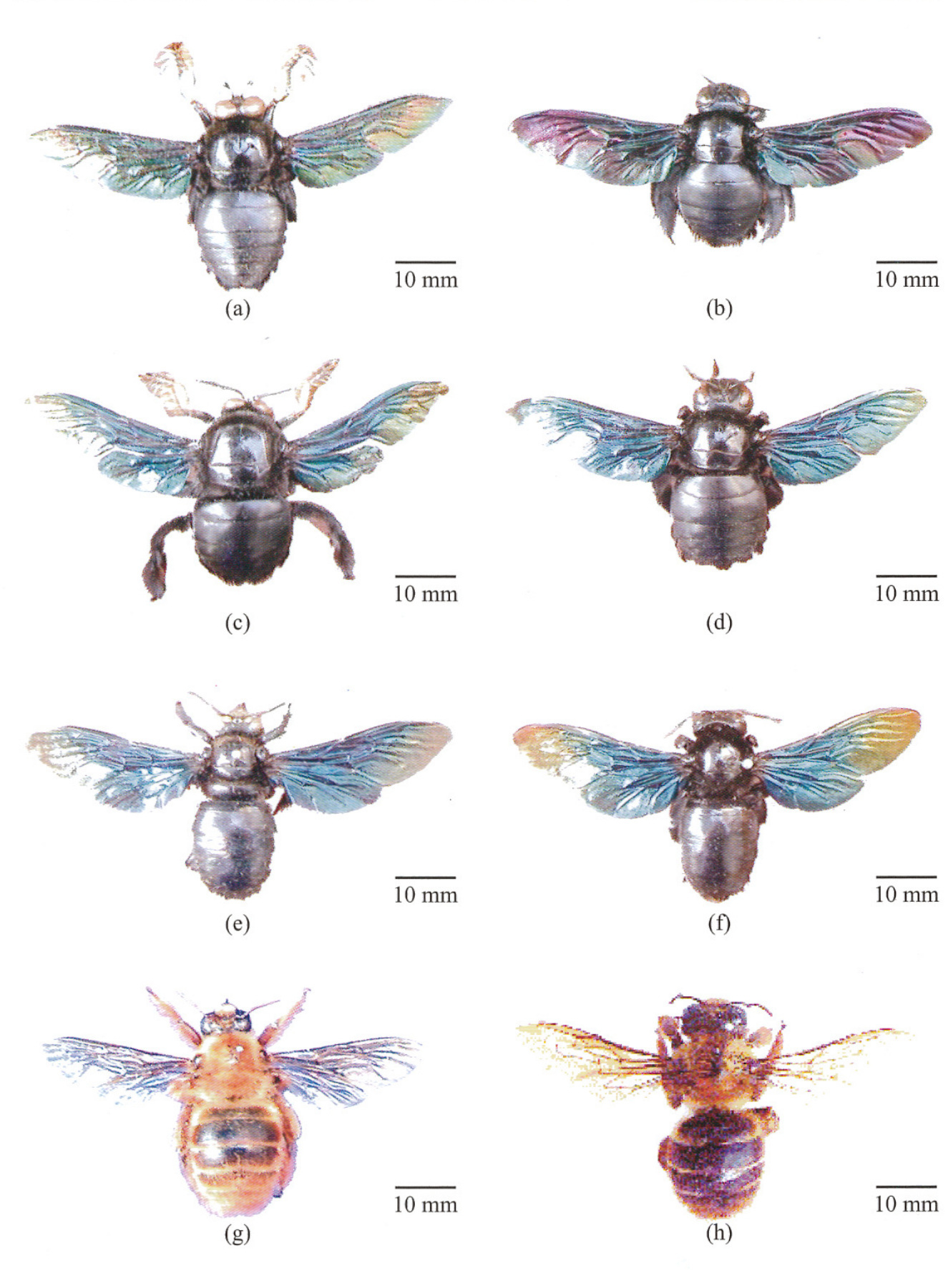
Large carpenter bees from various localities in the Kingdom of Thailand were collected, classified and investigated together with those from local collections. A total of 11 species were identified, namely Xylocopa latipes Drury, X. tenuiscapa Westwood, X. nasalis Westwood, X. tranquebarica Fabricius, X. rufescens Smith, X. caerulea Fabricius, X. abbotti Cockerell, X. aestuans Linnaeus, X. verticalis Lepel, X. collaris Lepel and X. basalis Smith. The complexity of social life of Xylocopa spp. was found in their lifespan. At the outset they lead a solitary life and then enter into subsocial and quasisocial systems respectively. Twenty of the X. nasalis built-in bamboo nests at Kamphaengsaen Campus were investigated. The number of larval and pupal cells were found ranged between 3-15 cells per nest. The intermediate stage which active form may be called “subimago”, was the first time recorded between pupa and adult stage. The sex ratio of male and female per nest was 1:4. The parasite larvae of Opheliimus sp. (Family Eulophidae) and the predator larvae of Cissites maxillosa (Family Meloidae) were also found in the nest. Large carpenter bees spent large amounts of time in the nest guarding against the intrusion of ants Camponotus (Tanaemyrmex) sp. (Family Formicidae). The female carpenter bee would position herself very near the entrance, clinging to the top of the tunnel wall and would block the nest entrance with her abdomen.References
Bingham, C.T. 1897. The Fauna of British India, Hymenoptera. Vol.I: Wasps and Bees. Taylor and Francis, London. 579 p.
Essig, E.O. 1954. College Entomology. The Macmillan Company, New York. 900 p.
Hurd, P.D., Jr. and J.S. Moure. 1960. A new-world subgenera of bamboo-nesting carpenter bees belonging to the genus Xylocopa Latreille. Annals of the Entomol. Soc. of Amer. 53: 809-820.
______ . 1963 a. A Classification of the Large Carpenter Bees (Xylocopinae). Cited by Batra, S.W.T. Bee of India (Apoidea), Their Behavior, Management and A Key to the Genera. 11(3): 289-324.
Kapil, R. P and J.S. Dhaliwal. 1968. Defence of nest by the female of Xylocopa fenestrata Fab. (Xylocopinae, Hymenoptera). Insect Sociaux. 15: 419-422.
Malaipan, S. 1992. Bees and Insect pollinators management. Kasetsart University 227 p.
Michener, C.D. 2000. The Bees of the World. The Johns Hopkins University Press. Maryland. 913 p.
Root, A.I. 1950. The ABC and XYZ of BEE Culture. The A.I. Root Company, Ohio. 696 p.
Downloads
Published
How to Cite
Issue
Section
License
Copyright (c) 2008 National Science Museum

This work is licensed under a Creative Commons Attribution-NonCommercial-NoDerivatives 4.0 International License.


