
First Record of Cladolabes hamatus (Sluiter, 1914) (Echinodermata : Holothuroidea: Dendrochirotida) from the South China Sea.
Keywords:
Holothuroidea, Cladolabes hamatus, South China Sea, Thailand, new recordAbstract
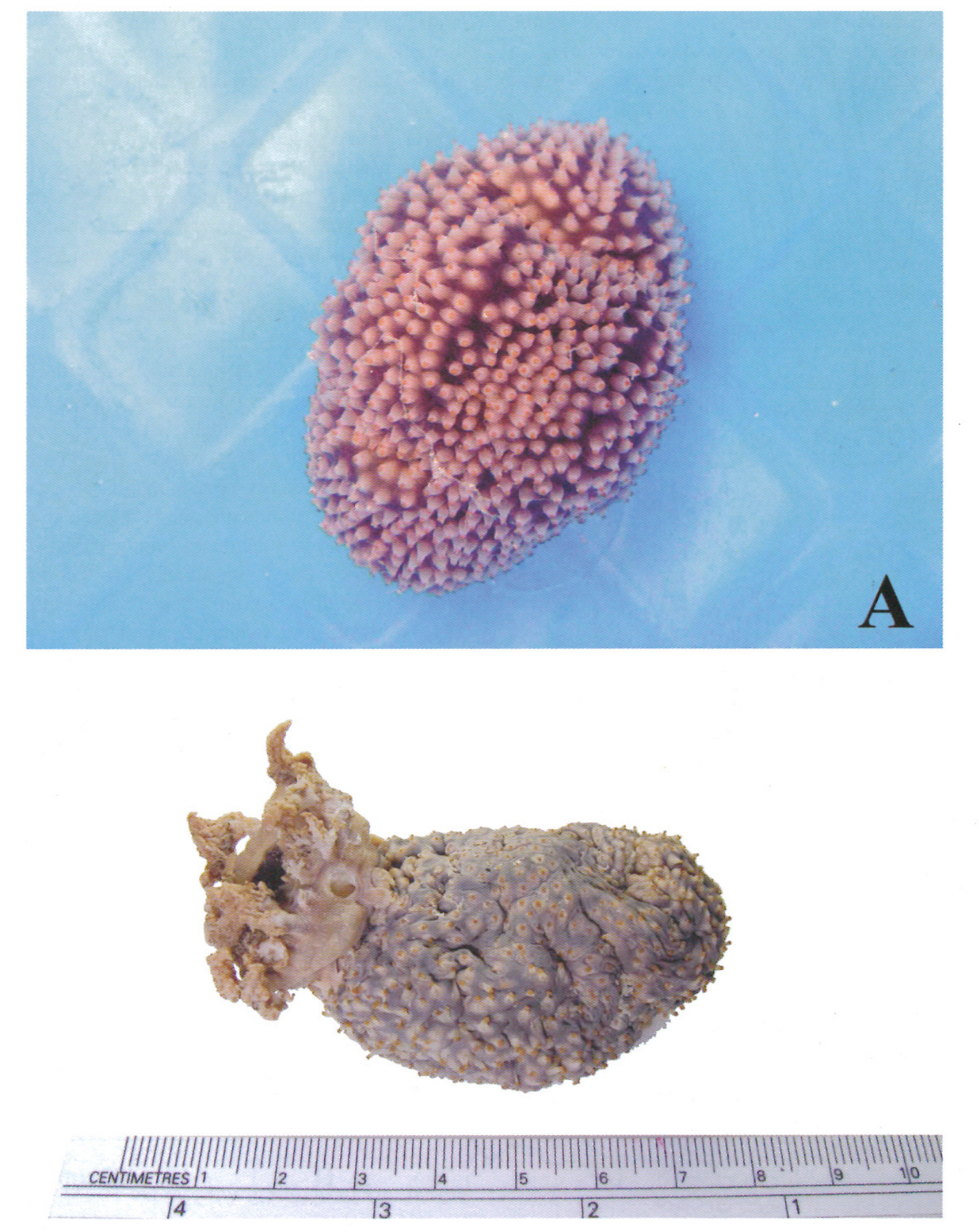
The holothuroid, Cladolabes hamatus (Sluiter, 1914) is here reported for the first time from the South China Sea. Its presence is recorded at Ko Phai, Pattaya, Chon Buri Province, Thailand. This sand-burrowing species has its 20 tentacles positioned in two (15+5) circles and presents tables with rudimentary discs and tall two-pillared spires in the body wall and tentacles. The tables of the dorsal papillae, with an irregular disc and the pillars fused to a curve hook, diagnose the species.References
Brandt, J.F., 1835. Prodromus descriptionis animalium ab H. Mertensio in orbis terrarum circumnavigatione observatorum.1: 1-75, 1 pl. Petropoli.
Cannon, L.R.G. & H. Silver, 1986. Sea Cucumbers of Northern Australia. Brisbane, Queensland Museum, i-viii, 60 p.
Cherbonnier, G., 1950. Une nouvelle holothurie dendrochirote de côtes du Cameroun : Cladodactyla monodi n.sp. Bulletin du Muséum National d’Histoire Naturelle Paris, 2ième série, 22(3) : 375-377.
Cherbonnier, G., 1988. Echinodermes: Holothurides. Faune de Madagascar, 70: 1-292.
Clark, H.L., 1938. Echinoderms from Australia. Memoirs of the Museum of Comparative Zoology 55(VIII): i-viii: 1-596, pls 1-28.
Clark, H.L., 1946. The Echinoderm Fauna of Australia. Publications of the Carnegie Institution of Washington, 566: i-iv, 1-567.
Clark, A.M. & F.W.E. Rowe, 1971. Monograph of Shallow-water Indo-West Pacific Echinoderms. Trustees of the British Museum (Natural History), London. 238 pp., 31 pls.
Deichmann, E., 1944. Urodemas bifurcatum a new Holothurian from South Africa with a revision of the Genus Urodemas Selenka. The Annals and Magazine of Natural History 11 (83): 731-737.
Ekman, S. 1918. Results of Dr. E. Mjöbergs Swedish Scientific Expeditions to Australia 1910-1913. XIX. Holothurioidea. Kungl. Svenska Vetenskapakademiens Handlingar 58 (6): 1-70, 5 pls.
Heding, S.G. & A. Panning, 1954. Phyllophoridae. Eine Bearbeitung der polytentaculaten dendrochiroten Holothurien des Zoologischen Museum in Kopenhagen. Spolia Zoologica Musei Hauniensis, 18 : 1-209.
Lane, D.J.W., L.M. Marsh, D.VandenSpiegel & F.W.E. Rowe, 2000. Echinoderm fauna of the South China Sea: an inventory and analysis of distribution patterns. The Raffles Bulletin of Zoology, Supplement 8: 459-493.
Ludwig, H., 1875. Beiträge zur Kenntniss der Holothurien. Arbeiten aus dem Zoologischen zootom Institut in Würzburg 2(2): 77-120, pls 6, 7.
Massin, C., 1999. Reef-dwelling Holothuroidea (Echinodermata) of the Spermonde Archipelago (South-West Sulavesi, Indonesia). Zoologische Verhandelingen, 329, 144 p.
Panning, A., 1949. Versuch einer Neuordnung der Familie Cucumariidae. Zoologische Jahrbücher, Abteilung für Systematik, Ökologie und Geographie der Tiere, 78: 404-470, 62 figs.
Putchakarn, S. and P. Sonchaeng, 2004. Echinoderm Fauna of Thailand : History and Inventory Reviews. Science Asia 30: 417-428.
Rowe, F.W.E. and Doty, J.E., 1977. The Shallow-Water Holothurians of Guam. Micronesica, 13: 217-250.
Rowe, F.W.E. and J. Gates. 1995. Echinodermata. In wells, A. (ed.) Zoological Catalogueu of Australia. Vol. 33. Melbourne : CSIRO Australia xiii 510 pp.
Satayamas K., 1982. Study on echinoderms in Songkla province. Special problem in biological science, Faculty of Science, Prince of Songkla University. 70 p. (in Thai)
Selenka, E., 1867. Nachtrage zu den beiträgen zur Anatomie und Systematik de Holothurien. Zeitschrift für wissenschaftliche Zoologie, 18: 109-119, pl. 8.
Semper, C., 1868. Reisen im Archipel der Philippinen. Holothurien. 2. Wissenschaftliche Resultate: i-x, 1-288, pls 1-40. Leipzig.
Sluiter, C.P., 1914. Die von Dr. P. N. Kamper während seiner Fahrten mit dem Regierungsdampfer iGieri 1906-1909 im Indischen Archipel gesammelten Holothuien. Contributions Faune Indes néerl, 1(1) : 1-28, 1 pl.
Thandar, A.S., 1989. The sclerodactylid holothurians of southern Africa with the erection of one new subfamily and two new genera. South African Journal of Zoology 24(4): 290-304.
Downloads
Published
How to Cite
Issue
Section
License
Copyright (c) 2008 National Science Museum

This work is licensed under a Creative Commons Attribution-NonCommercial-NoDerivatives 4.0 International License.


