
A Comparison of Vertical Bird Assemblages Between Abandoned Settlement Areas and Primary Dry Evergreen Forests in Western Protected Forest of Thailand
Keywords:
Vertical habitats, birds, diversity, recovery, tropical forestAbstract
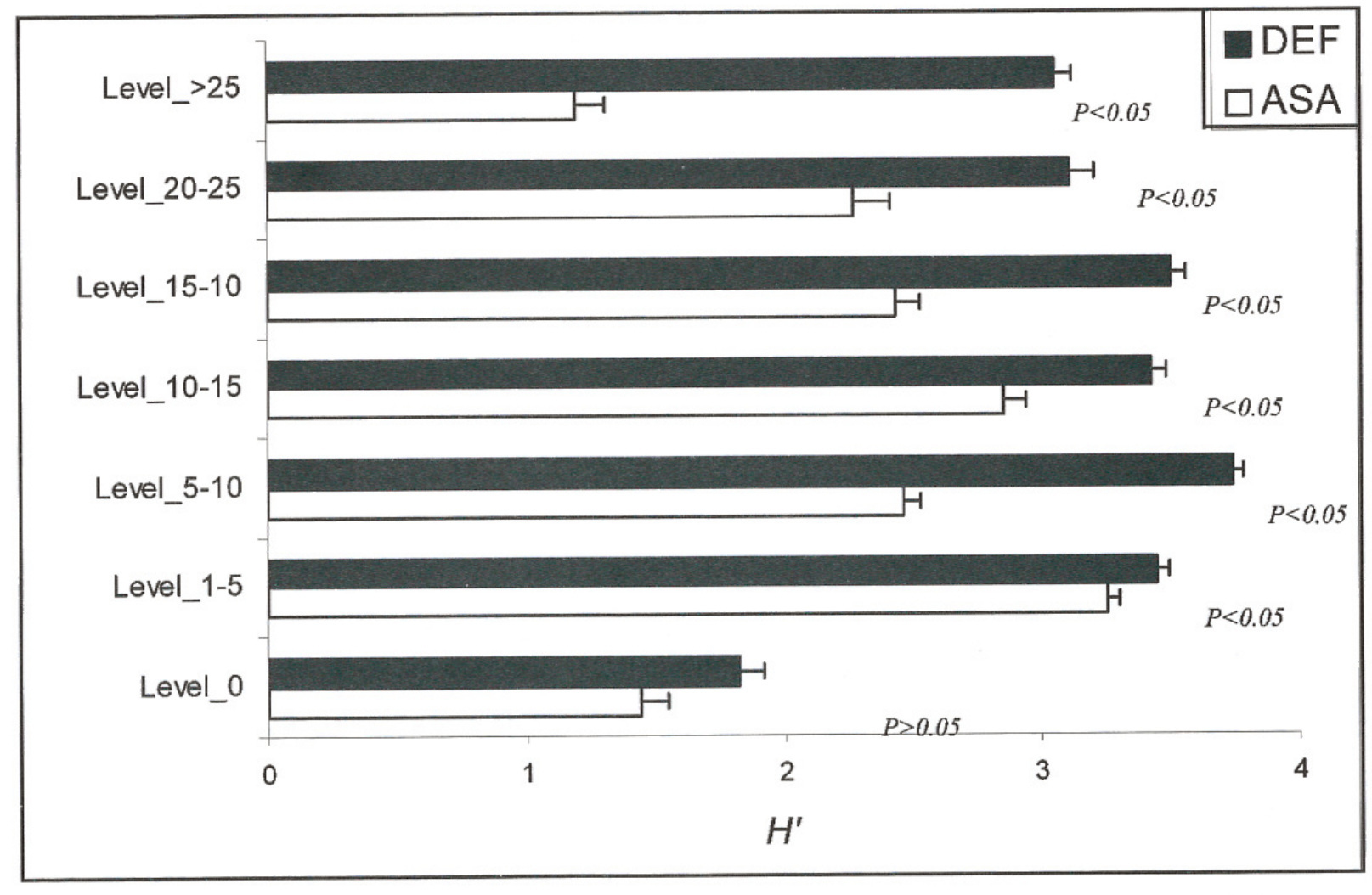
A Vertical stratification of the bird assemblage between abandoned settlement areas (ASA) and dry evergreen forests (DEF) was investigated in the western forest complex of Thailand, Natural World Heritage Site. The aim was to examine species diversity, vertical strata patterns, and niche breath of individual bird species between disturbance and primary forests. A permanent line transect was used for the field survey. Our research presents the results of a first study on vertical stratification of bird assemblages between abandoned settlement areas and primary forests in Thailand. The study revealed 170 bird species. Diversity indices of vertical strata in the ASA tended to be lower than those in the DEF sites. However, the bird community in the DEF and ASA was classified into 3 major groups: ground level group, lower canopy group (1-5 m in the ASA and 1-15 m in the DEF) and upper canopy group (5->25 m in the ASA and 15->25 m in the DEF). Most species were relatively generalized in their behavior and used resources across broad ranges of microhabitats. The study also demonstrated that the ASA appeared to support less species richness than the DEF. The results of this study provide vital information in revealing patterns of assemblage structure and majors factors in the maintenance of species diversity. Further research should concentrate on these species to determine resource use pattern, and investigate the effect of forest fragmentation on their movements. Furthermore, this study demonstrated that bird diversity showed a clear recovery pattern after human resettlement. Recommendations are given to limit human disturbances as much as possible to allow for maximum avian diversity to recover.References
Johns, A. D. 1986. Effect of selective logging on the ecological organization of a Peninsular Malaysian rainforest avifauna. Forktail 1 :65-79
_______. 1989. Recovery of a Peninsular Malaysian rainforest avifauna following selective timber logging : the frist twelve years. Avifauna. Forktail 4 : 89-105
Kays, R. and A. Alliison.2001. Arboreal tropicalforest vertebrates : current knowledge and research trends. Plant Ecology 153 :109-120
Krebs, J. C. 1989. Ecological Metethodology. Harper Collins Publishers,New York.
Ludwig, J. A. and J. F. Reynolds. 1988. Statistical Ecology. John Wiley & Sons, Inc. New York.
Manopawitr, P. 2000. Foraging ecology of insectivorous birds in forests in tropical North Queensland.M.S. Thesis, Jame Cook University.
McCune, B. and M. J. Mefford. 1999. PC-ORD. Multivariate Analysis of Ecological Data Version 4. MjM Software Design, Gleneden.
Ohno, Y. and A. Ishida. 1997. Differences in bird species diversities between a natural mixed forest and a coniferous plantation. J. For. Res. 2 : 153 - 158.
Pattanavibool, A. 1999. Wildlife response to habitat fragmentation and other human influences in tropical montane evergreen forests, Northern Thailand. Ph. D Thesis. University of Victoria.
Pearson , D., L. 1971.Vertival stratification of birds in a tropical dry forest. Condor 73 :45-55.
_______. 1975. The relation of foliage complexity to ecological diversity of the Three amazonian bird communities. Condor 77 :453-466
_______.1977. A pantropical comparison of bird community structure on six lowland forest sites. Condor 79 : 232-244
Pisces Conservation Ltd. 2001. Species diversity and richness II program manual. Pisces Conservation Ltd, Hampshire.
Raman, T.R.S, G. S. Rawat and A. J. T. Johnsingh. 1998. Recovery of tropical rainforest avifauna in relation to vegetation succession following shifting cultivation in Mizoram, north-east India. J. of Appl. Eco. Vol 35(2) : 214-231.
Round, P. D. and W. Y. Brockelman. 1998. Bird community in disturbed lowland forest habitat of Southern Thailand. Nat. Hist. Bull. Siam. Soc. 46 :171 -196.
Schulze, C., H., K. E. Linsenmair and K. Fiedler.2001.Understorey versus canopy:patterns of vertical stratification and diversity among Lepidoptera in a Bornean rain forest. Plant Ecology. 153 : 133-152
Stiles, E. W. 1980. Bird community structure in Alder forests in Washington. Condor 82 :20-30
Walther, B., A. 2002.Vertical stratification and use of vegetation and light habitats by Neotropical forest birds. J. Ornithol. 143 : 64-81
Welford, M. R. 2000 The importance of early successional habitats to rare, restricted-range, and endangered birds in the Ecuadorian Andes. Bir. Conserv. 10 : 351-359.
Whitmore, T. C. 1984. Tropical rain forests of the Far East. Clarendon, Oxford.
Winkler, H. and M. Preleuthner. 2001. Behavior and ecology of birds in tropical rain forest canopies. Plant Ecology 153 : 193-202
Downloads
Published
How to Cite
Issue
Section
License
Copyright (c) 2008 National Science Museum

This work is licensed under a Creative Commons Attribution-NonCommercial-NoDerivatives 4.0 International License.


