
Larvae of the Commercial Tropical Oyster Crassostrea belcheri (Sowerby) are induced to settle by Pheromones from the Adults
Keywords:
tropical oyster, larvae settling, pheromones, Crassostrea belcheriAbstract
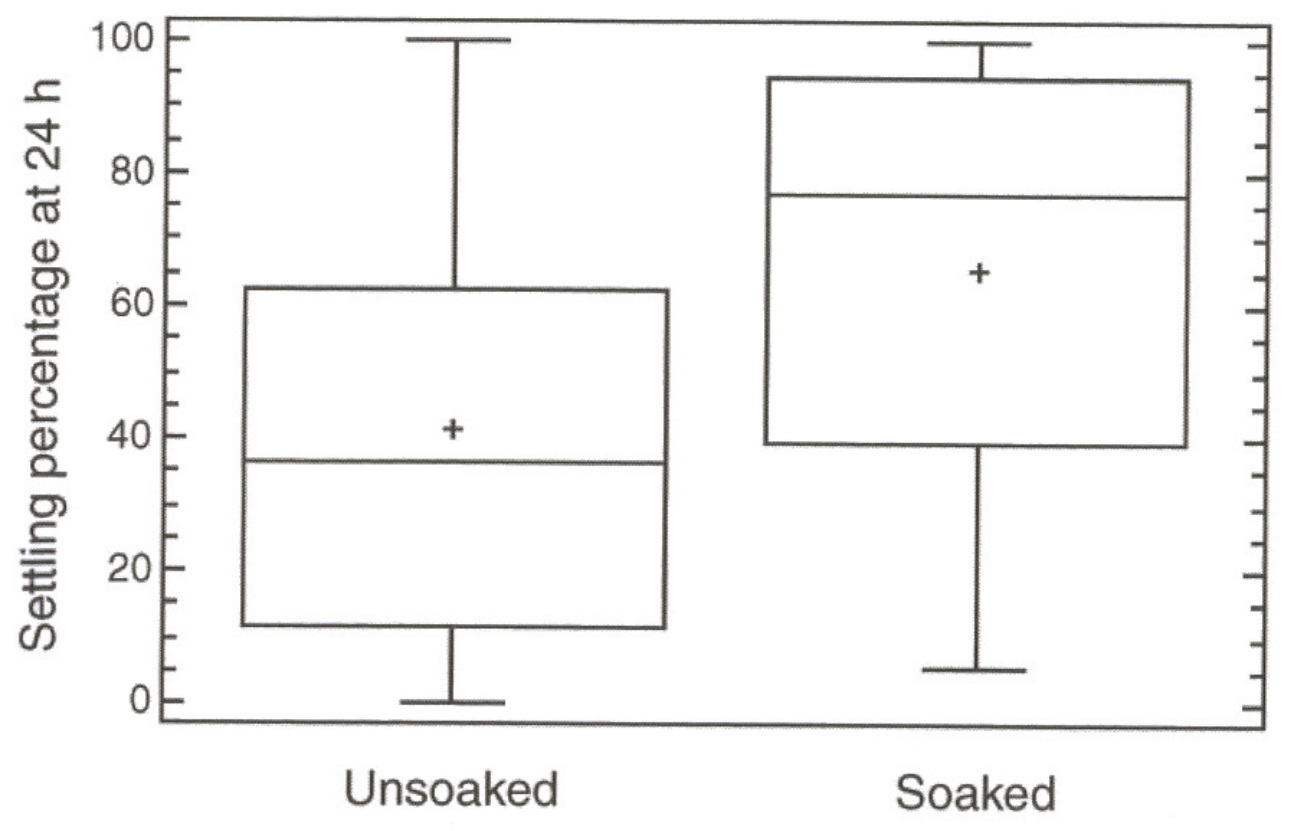
Pediveliger larvae of the commercial tropical oyster Crassostrea belcheri were allowed to settle under different conditions. Two types of seawater were used for the experiments: aged seawater (1 month) and aged seawater conditioned by the presence of adult oysters for 24 hours. Two groups of five different substrates were used, each group soaked in one of the two water types. More larvae settled in conditioned aged seawater than in aged unconditioned seawater and on soaked substrates contrary to unsoaked substrates. The larvae preferred substrates of their own species for settling rather than from other species within the same genus or from a different genus. Settling frequency was increased by the presence of living oysters together with soaked spatfall collectors in commercial aquaculture. The fact that larvae are induced to settle by pheromones released from the adults is an important mechanism that favours the gregariousness of the oysters in nature. Settling behaviour of oyster larvae was observed and the behaviour of the three main stages was described: free swimming searching stage, crawling stage and cementing stage.References
Bayne, B.L. 1969. The gregarious behaviour of the larvae of Ostrea edulis L. at settlement. Journal of the marine biological Association of the United Kingdom. 49: 327-356.
Born, L. 1778. Index rerum naturalium musei Caesarei Vindobonensis. Part I, Testacea. Officina Krausiana, Vienna. 458 pp.
Cole, H.A. and E.W. Knight-Jones, 1939. Some observations and experiments on the settling behaviour of larvae of Ostrea edulis. Journal du Conseil. Conseil Permanent Inter-national pour l’Exploration de la Mer. 14: 86-105.
Cole, H.A. and E.W. Knight-Jones, 1949. The setting behaviour of larvae of the European flat oyster Ostrea edulis L., and its influence on methods of cultivation and spat collection. Fishery Investigations, Series 2. 17(3):1-39.
Cranfield, H.J. 1973. Observation on the behaviour of the pediveliger of Ostrea edulis during attachment and cementing. Marine Biology. 22:203-209.
Crisp, D.J. 1965. Surface chemistry, a factor in the settlement of marine invertebrate larvae. Botanica Gothoburgensia III. Proceedings of the Fifth Marine Biological Symposium, Göteborg, pp. 51-65.
Crisp, D.J. 1967. Chemical factors inducing settlement in Crassostrea virginica (Gmelin). Journal of Animal Ecology. 36:329-336.
Crisp, D.J. 1974. Factors influencing the settlement of marine invertebrate larvae. In: Grant PT and Mackie AM (eds.), Chemoreception in Marine Organisms, Academic Press, London, pp. 177-265.
Hadfield, M.G. 1984. Settlement requirement of molluscan larvae: new data on chemical and genetic roles. Aquaculture. 39: 283-298.
Hidu, H. 1969. Gregarious setting in the American Oyster Crassostrea virginica Gmelin. Chesapeake Science. 10(2): 85-92.
Hidu, H., W.G.Valleau and F.P. Veitch, 1978. Gregarious setting in European and American oysters - response to surface chemistry vs waterbourne pheromones. Proceedings of the National Shellfish Association. 68: 11-16.
Keck, R., D. Maurer, C. Kauer and W.A. Shepard, 1970. Chemical stimulants affecting larval settlement in the American oyster. Proceedings of the National Shellfish Association. 61: 24-28.
Knight-Jones, E.W. 1952. Reproduction of the oysters in the Rivers Crouch and Roach, Essex, during 1947, 1948, and 1949. Fishery Investigations, Series 2. 18:1-48.
Nelson, T.C. 1924. The attachment of oyster larvae. Biological Bulletin. 46(3):143-151.
Prytherch, H.F. 1934. The role of copper in the setting, metamorphosis and distribution of the American oyster, Ostrea virginica. Ecological Mono-graphs. 4:45-107.
Röding, P.F. 1798. Museum Boltenianum sive catalogus cimeliorum e tribus regnia naturae. Vol. 2. V+352 pp., 56 text-fig. George & Cie, Geneva, Basel.
Roughly, T.C. 1933. The life history of the Australian oyster (Ostrea commercialis). Pro-ceedings of the Linnean Society of New South Wales. 58: 279-332.
Sowerby, G.B. 1870-1871. Monograph of the genus Ostrea. In: L.A. Reeve’s Conchologia Iconica. L. Reeve and Co., London. Vol. 18.
Veitch, F.P. and H. Hidu. 1971. Gregarious setting in the American oyster, Crassostrea virginica Gmelin. I. Properties of a partially purified “setting factor”. Chesapeake Science. 12(3): 173-178.
Wong, T.M., S.H. Tan, and T.K. Cheong. 1989. Induced spawning, larval development and early spat growth of the tropical oyster Crassostrea belcheri in the laboratory. Proceedings of the 12th Annual Seminar of the Malaysian Society of Marine Science, pp. 255-260.
Downloads
Published
How to Cite
Issue
Section
License
Copyright (c) 2012 National Science Museum, Thailand

This work is licensed under a Creative Commons Attribution-NonCommercial-NoDerivatives 4.0 International License.


