
Distribution, Diversity, and Abundance Patterns of Intertidal Benthic Molluscs on Rocky Shores (Phuket Island, Thailand)
Keywords:
Phuket Island, Thailand, tropical rocky shore, molluscs, zonation, intertidalAbstract
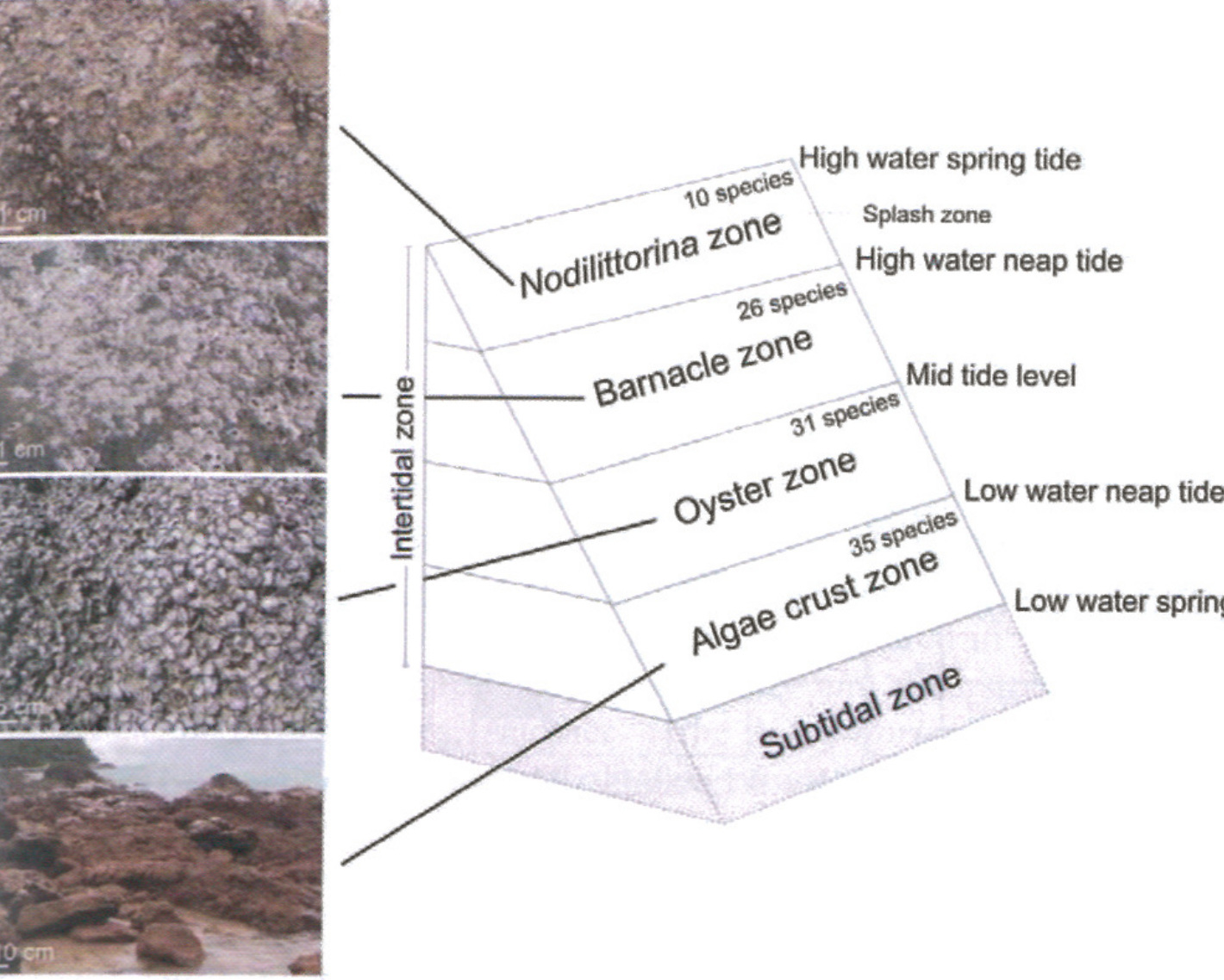
A total of 51 mollusc species were encountered along the south-western coast of Phuket Island (Thailand). The taxa were dominated by gastropods, which are well adapted for the zones recognized on the shore. Multivariate cluster analysis shows that faunal composition and species diversity changes between the four zones recognised and a faunal turnover is found in the middle of the intertidal area, which is the boundary between relative wet and relative dry substrate. Mollusc density, species diversity and functional diversity increases below this boundary due to less stressed environmental conditions, supporting the hypothesis that the functional diversity decreases with increasing stress. In contrast faunal composition and species diversity is similar for all microhabitats. This finding does not support the hypothesis of increased species diversity with increased structural complexity. This shows that there is a different relationship between gastropod diversity and microhabitat diversity compared to other intertidal rocky shore biota.References
Charoenlaph, T. 1982. Preliminary report of a study of current patterns along the west coast of Phuket Island, Thailand. National Research Council of Thailand (NRCT) Publication.
Connor, E.F. and E.D. McCoy. 1979. The statistics and biology of the species- area relationship. American Naturalist. 113: 791–833.
Huston, M. 1979. A general hypothesis of species diver-sity. American Naturalist. 113: 81–101.
Hylleberg, J., A. Nateewathana and B. Chatananthawei. 1985. Temporal changes in the macrobenthos on the west coast of Phuket Island, with emphasis on the effects of offshore tin mining. Phuket Marine Biological Center Research Bulletin. 38: 1–32.
Johnson, M.P., N.J. Frost, M.W.J. Mosley, M.F. Roberts and S.J. Hawkins. 2003. The area-independent effects of habitat complexity on biodiversity vary between regions. Ecology Letters. 6: 126–132.
Kelaher, B.P. 2003. Changes in habitat complexity negatively affect diverse gastropod assemblages in coralline algal turf. Oecologia. 135: 431–441.
Kostylev, V.E., J. Erlandsson, M.Y. Ming, and G.A. Williams. 2005. The relative importance of habitat complexity and surface area in assessing biodiversity: Fractal applica-tion on rocky shores. Ecological Complexity. 2: 272–286.
Levinton, J.S. 2001. Marine biology. Function, Biodiversity, Ecology. Oxford: Oxford University Press, 515 pp.
Limpsaichol, P. 1981. Environmental factors estimated at PMBC. Phuket Marine Biological Center Research Bulletin. 28: 23–26.
Scoffin, T.P., A.W. Tudhope, B.E. Brown, H. Chansang and R.F. Cheeney. 1992. Patterns and possible environmental controls of skeletogenesis of Porites lutea, South Thailand. Coral Reefs. 11: 1–11.
Stephenson, T.A. and A. Stephenson. 1972. Life between tidemarks on rocky shores. San Francisco: W.H. Freeman & Co, 425 pp.
Yesaki, M. and P. Jantarapagdee. 1981. Wind stress and sea temperature changes off the west coast of Thailand. Phuket Marine Biological Center Research Bulletin. 28: 27–41.
Downloads
Published
How to Cite
Issue
Section
License
Copyright (c) 2012 National Science Museum, Thailand

This work is licensed under a Creative Commons Attribution-NonCommercial-NoDerivatives 4.0 International License.


