
Aenictus shilintongae sp. nov. (Hymenoptera: Formicidae: Dorylinae), an Army Ant of the Aenictus laeviceps Species Group from China
Keywords:
Army ants, Aenictus shilintongae, Taxonomy, ChinaAbstract
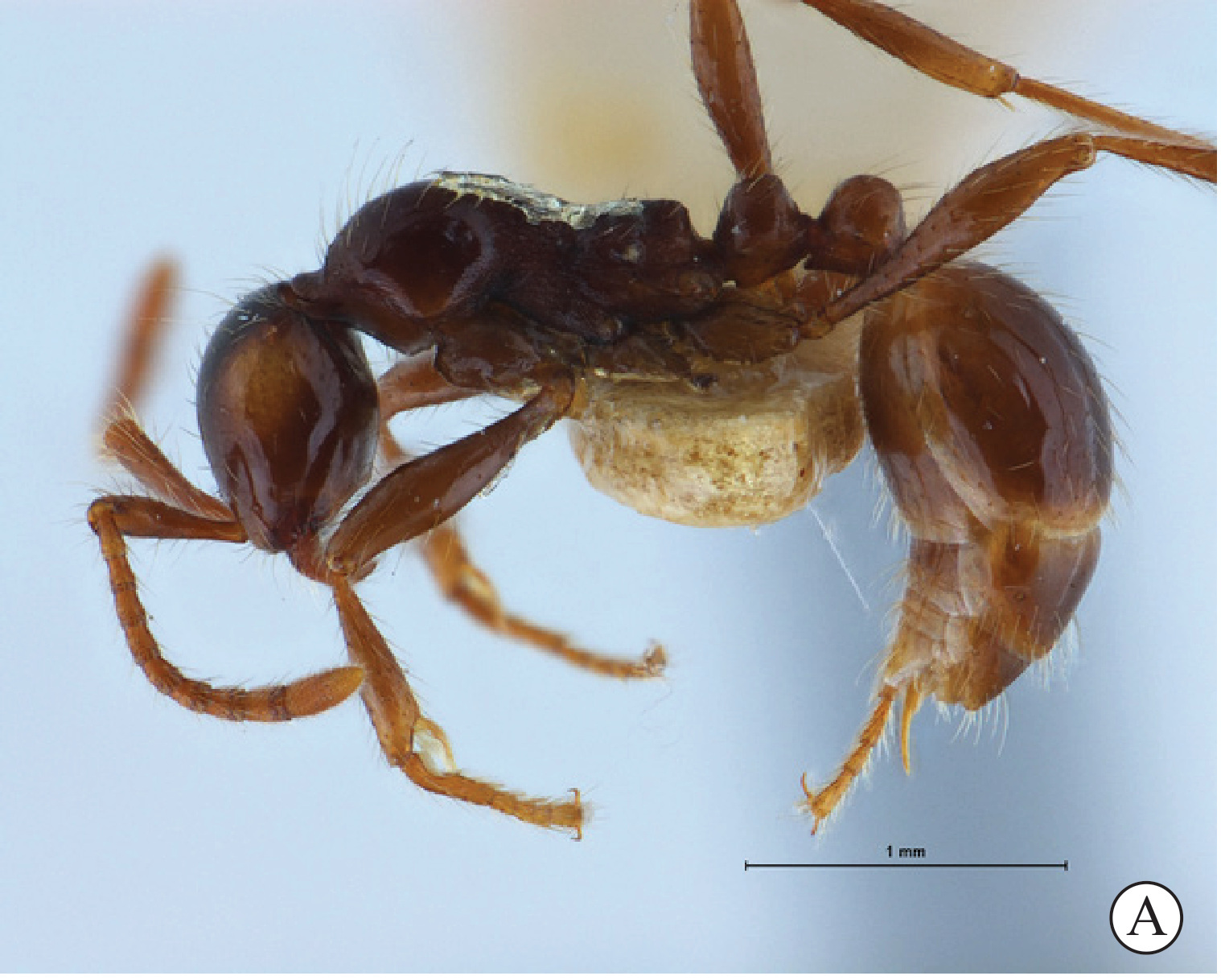
Aenictus shilintongae, a new army ant from Southeast China, is described based on the worker caste. The new species belongs to the A. laeviceps species group and seems to be closely related to A. rotundicollis Jaitrong et Yamane, 2011 and A. sonchaengi Jaitrong et Yamane, 2011, but is easily distinguished from the latter two in having dense pilosity on head and mesosoma. It is named in honor of Her Royal Highness Princess Maha Chakri Sirindhorn of the Kingdom of Thailand after her name in Chinese.References
Aktaç, N., A.G. Radchenko and K. Kiran. 2004. On the taxomony of the West Palaearctic Dorylinae ants (Hymenoptera: Formicidae). Annales Zoologici 54: 361-364.
Antweb, 2016. Genus Aenictus. Downloaded from https://www.antweb.org/taxonomic Page.do?rank=species&country Name= Laos&images=true on 4 July 2016.
Arnol′di, K.V. 1968. Vazhnye dopolneniya k mirmekofaune SSSR i opisanie novykh form. Zoologichesky Zhurnal 47: 1800- 1822.
Bolton, B. 1994. Identification Guide to the Ant Genera of the World. Harvard University Press,Cambridge,Massachusetts, 222 pp.
Bolton, B. 1995. A New General Catalogueof the Ants of the World. Harvard University Press,Cambridge,Massachusetts, 504 pp.
Gotwald, W.H. 1976. Behavioral observations on African army ants of the genus Aenictus (Hymenoptera: Formicidae). Biotropica 8: 59-65.
Gotwald, W.H. 1995. Army Ants: the Biologyof Social Predation. Cornell University Press, New York, 320 pp.
Hölldobler, B. and E.O. Wilson. 1990.The Ants. Harvard University Press, Cambridge, Massachusetts, 733 pp.
Jaitrong, W. and Sk. Yamane. 2011. Synopsis of Aenictus species groups and revision of the A. currax and A. laeviceps groups in the eastern Oriental, Indo-Australian, and Australasian regions (Hymenoptera: Formicidae: Aenictinae). Zootaxa 3128: 1-46.
Jaitrong, W. and Sk. Yamane. 2013. The Aenictus ceylonicus species (Hymenoptera, Formicidae, Aenictinae) from Southeast Asia. Journal of Hymenoptera Research 31: 165-233.
Jaitrong, W., Sk. Yamane and N. Chanthalangsy. 2011. The ant genus Aenictus from Laos, with description of a new species (Hymenoptera: Formicidae: Aenictinae). Journal of Asia-Pacific Entomology 14: 317-322.
Rościszewski, M. and U. Maschwitz. 1994. Prey specialization of army ants of the genus Aenictus in Malaysia. Andrias 13; 179-187.
Schneirla, T.C. and A.Y. Reyes. 1966. Raiding and related bihaviour in two surfaceadaptive species of the Old World doryline ant, Aenictus. Aminal Behaviour 14(1): 132-147.
Shuckard, W.E. 1840. Monograph of the Dorylidae, a family of the Hymenoptera Heterogyna. Annals of Natural History;or Magazine of Zoology, Botany and Geology 5: 258-271.
Terayama, M. and A. Kubota. 1993. The ant army genus Aenictus (Hymenoptera: Formicidae) from Thailand and Veitnam, with description of three new species. Bulletin of the Biogeographical Societyof Japan 48(2) 68-72.
Wilson, E.O. 1964. The true army ants of the Indo-Australian area (Hymenoptera: Formicidae: Dorylinae). Pacific Insects 6(3): 427-483.
Downloads
Published
How to Cite
Issue
Section
License
Copyright (c) 2016 National Science Museum, Thailand

This work is licensed under a Creative Commons Attribution-NonCommercial-NoDerivatives 4.0 International License.


