
Hoya carandangiana, Hoya bicolensis, and Hoya camphorifolia (Apocynaceae) Species Delineation: Insights from Leaf Architecture
Keywords:
Hoya carandangiana, Hoya bicolensis, Hoya camphorifolia, leaf architecture, and taxonomyAbstract
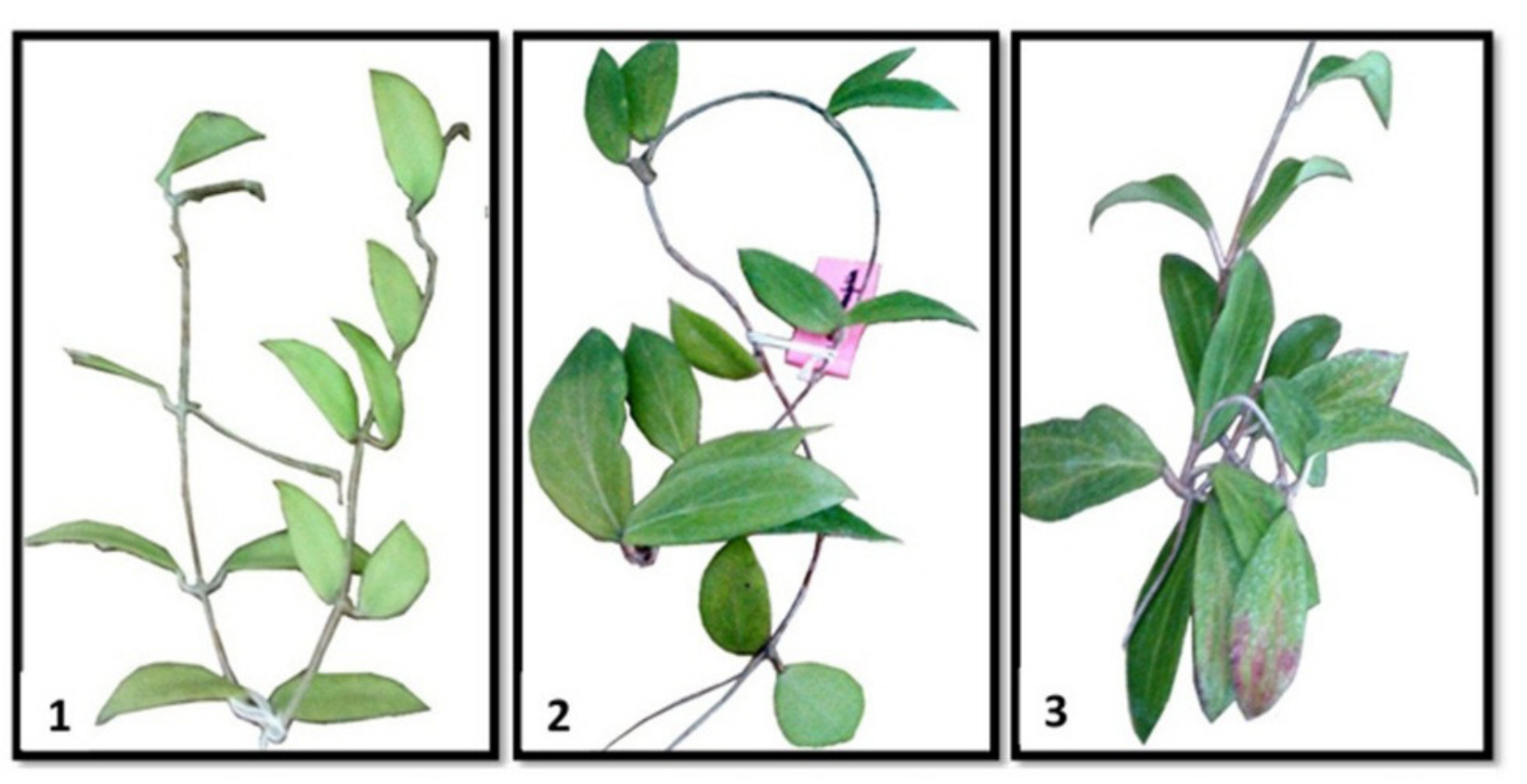
Three species of Hoya; H. carandangiana, H. bicolensis, and H. camphorifolia under the family Apocynaceae, have been studied and re-evaluated using leaf architecture to compare taxonomic markers. The three species seem superficially similar and consequently, controversial. This paper has carefully studied the three species and the results delineate them, proving they are three distinct species. In past decades there have been numerous studies, such as systematic studies and fossil (paleobotanical) studies, which utilized leaf architecture with the aim of resolving certain taxonomic issues. In this present study, leaf architectural characteristics have been utilized to examine the similarities and differences between the three Hoya species. Unifying leaf architectural characters were found, exhibited by the three Hoya species however; characters such as blade shape, blade class, base shape, apex shape, secondary vein category, tertiary vein category and course were found to delineate them. Cluster analysis was also carried out to illustrate relationships between the three Hoya species by using unweighted pair-group average (UPGMA) and single linkage (nearest neighbor). The results showed that Hoya carandangiana, Hoya bicolensis and Hoya camphorifolia are three distinct species, demonstrating that leaf architectural characters have the capacity to serve as good taxonomic markers.References
Alejandro, G.D. and S. Liede. 2003. The Philippine Rubiaceae genera: updated synopsis in INTKEY databases of the DELTA System. Blumea-Biodiversity,Evolution and Biogeography of Plants 48(2): 261-277.
Bailey, K. 1994. Typologies and Taxonomy-Numerical taxonomy and Cluster Analysis. ISBN: 0780803952591.
Banactila, M.C.N. and I.E. Buot. 2004. Leaf architecture of ten Philippine Psychotria species (Rubiaceae). The Philippine Scientist 41: 74-90.
Dilcher, D.L. 1974. Approaches to the identification of angiosperm leaf remains. The Botanical Review 40:1-156. Dilcher, D.L. 1974
Hammer, Ø., D.A.T. Harper and P.D. Ryan. 2016. PAST-Palaeontological statisticsver. 3.11. Downloaded from http://folk. uio.no/ohammer/past/ on 6 March 2016.
Hickey, L.J. 1973. Classification of the architecture of dicotyledonous leaves. American Journal of Botany 60: 17–30.
Hickey, L.J. and D.W. Taylor. 1991. The leaf architecture of Ticodenron and application of foliar characters in discerning its relationships. Annals of the Missouri Botanical Garden 78:105–130.
The International Plant Names Index. 2012. Published on the Internet http://www. ipni.org [accessed 6 March 2016].
Kleijn, D. and R. van Donkelaar. 2001. Notes on the taxonomy and ecology of the genus. Blumea 46(3):457-483.
Kloppenburg, D. 2015. Hoya New. A pdfpublication devoted to the Genus Hoya 4 (4) ISSN 2329-7336.
Kloppenburg, D., M.L.D. Guevarra, J.M. Carandang and F.S. Maranan. 2012. New species of Hoya R. Br. (Apocynaceae) from the Philippines. Journal of Nature Studies 11(1&2): 34-48.
LAWG (Leaf Architecture Working Group). 1999. Manual of leaf architecture andcategorization of dicotyledonous and net–veined monocotyledonous angiosperms. Smithsonian Institution.
Rodda, M. and W.F. Ang. 2012. Hoya caudata Hook. f. (Apocynaceae), a new record for Singapore, and keys to the Hoya species of Singapore. Nature in Singapore 5: 123-128.
Roth–Nebelsick, A., D. Uhl, V. Mosbrugger and H. Kerp. 2001. Evolution and function of leaf venation architecture: a review. Annals of Botany 87(5):553–566.
Salvaña, F.R.P. and I.E. Buot. 2013. Leaf Architectural Study of Hoya coriacea, Hoya halconensis and Hoya buotii Apocynaceae). International Research Journal of Biological Sciences 3(3): 37-44.
Sibson, R. 1973. “SLINK”: an optimally efficient algorithm for the single linkcluster method. The British Computer Journal British Company & Society 16(1): 30-34.
Sokal, R.R. and C. Michener. 1958. A statistical method for evaluating systematic relationships. University of Kansas Science Bulletin 38:1409-1438.
Villareal, A.G.M. and I.E. Buot. 2015. Leaf Architecture of Hoya incrassata Warb. and Hoya cassicaulis Elmer x Kloppenb. (Apocynaceae): Taxonomic identification and Conservation Concerns. International Journal of Ecology and Conservation: 15.
Downloads
Published
How to Cite
Issue
Section
License
Copyright (c) 2017 National Science Museum, Thailand

This work is licensed under a Creative Commons Attribution-NonCommercial-NoDerivatives 4.0 International License.


