
Leaf Architectural Variations among Species and Accessions of Genus Cucumis L.
Abstract
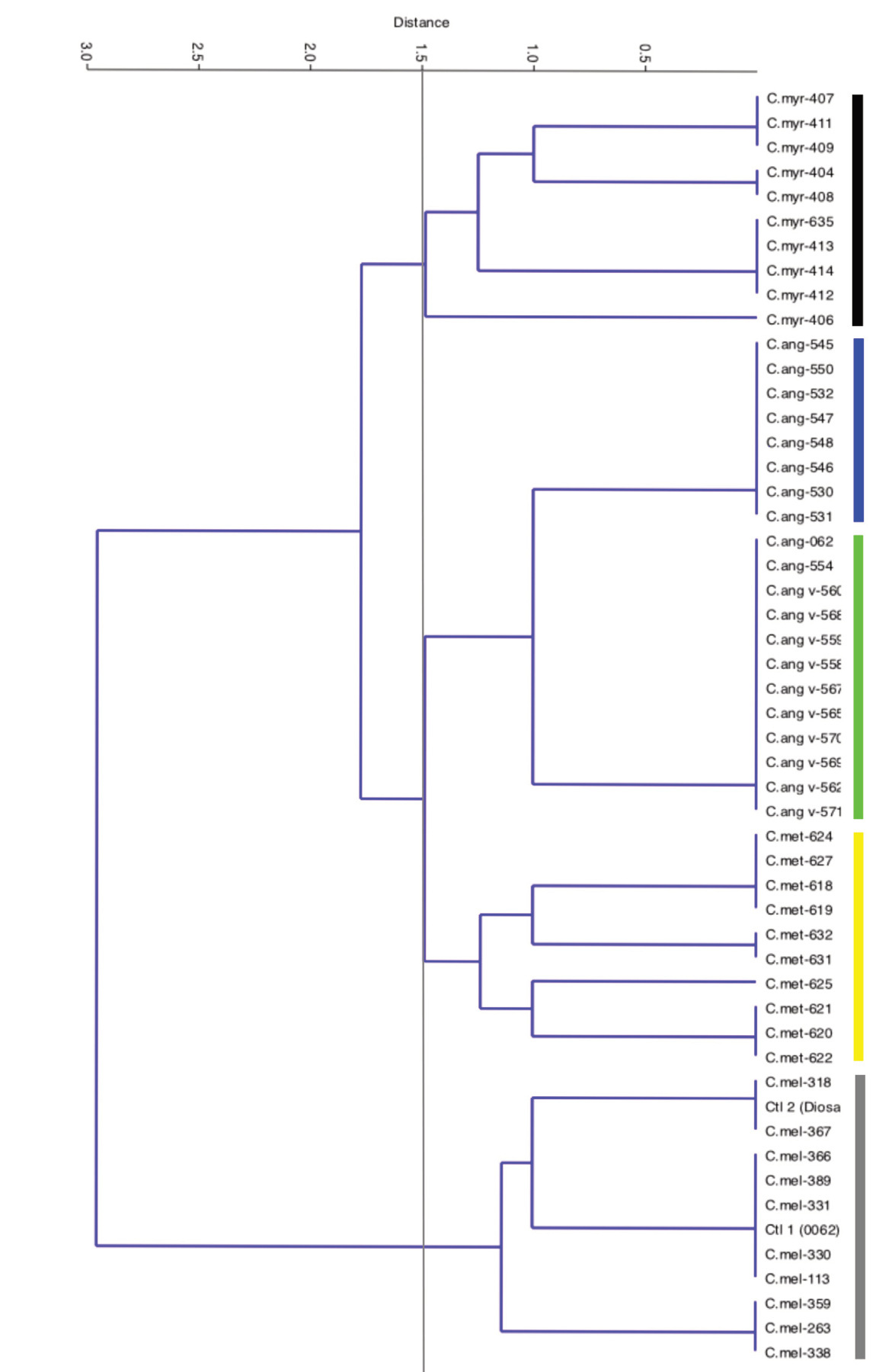
Taxonomic identification of Cucumis species and accessions in the gene bank are challenging among researchers due to morphological similarities when reproductive parts are not available. Variations in leaf architectural characters are commonly used to illustrate relationships among interspecific and intraspecific taxa. In this study, leaf architectural characters were used to determine variations among selected species and accessions of Cucumis. Five species of Cucumis were used, namely: C. melo, C. myriocarpus, C. anguria, C. metuliferus, and C. anguria var. longaculeatus. Ten accessions per species were examined, measured and described. Leaf architectural characterization was based on the established categories of Hickey (1973), LAWG (1999) and Ellis et al. (2009). Leaf architectural characters were subjected to cluster analysis. Similarities among Cucumis species and accessions examined include simple leaf, elliptic with distinct serrations at the margins, actinodromous suprabasal primary vein, craspedodromous secondary vein, regular polygonal reticulate quaternary vein and looped marginal ultimate venation. Results also showed that variations in leaf architecture among Cucumis species and accessions can be observed in secondary vein spacing, laminar shape, blade class, apex angle and primary vein size. These variations were supported with the result of cluster analysis wherein Cucumis species and accessions were successfully delineated based on these characters. Based on the results, leaf architecture is a useful tool in describing, classifying and delineating species and accessions of Cucumis.References
M. G. Ajuru and B.E. Okoli. 2013. The morphological characterization of the melon species in the family Cucurbitaceae Juss., and their utilization in nigeria. International Journal of Modern Botany 3(2): 15−19.
J.B. Baroga and I. E. Buot JR. 2014. Leaf Architecture of ten Species of philippine Terminalia Linn. (Combretaceae). International Research Journal ofBiological Sciences 3(3): 83−88.
Bhat, 1995. Taxonomic implications of leaf architecture in the genus Hibiscus. South African Journal of Botany 61 (4): 209−214.
A. Borazan and M.T. Babac. 2003. Morphometric leaf variation in oaks (Quercus) of Bolu, Turkey. Annales Botanici Fennici 40: 233−242.
Chen, Y. and R.L. Nelson. 2004. Evaluation and classification of leaflet shape and size in wild soybean. Crop Sci. 44: 671−677.
De Wilde, W.J.J.O. and B.E.E. Duyfjes. 2007. The Wild species of Cucumis L. (Cucurbitaceae) in South-East Asia. Adansonia, sér. 3, 29 (2): 239−248.
Ellis, B., D.C. Daly, L.J. Hickey, K.R. Johnson, J.D. Mitchell, P. Wilf and S.L. Wing. 2009. Manual of Leaf Architecture. The New York Botanical Garden Press, Ithaca New York. 188pp.
Hickey, L.J. 1973. Classification of the architecture of dicotyledonous leaves. Am J. Bot. 60: 17−33.
Hill, R.S. 1980. A numerical taxonomic approach to the study of angiosperm leaves. Botanical Gazette 141 (2): 213−229.
Kpadehyea, J.T. and I.E. Buot Jr. 2014. Leaf architecture of two species and nine infraspecific taxa of the Philippine MussaendaLinn.(Rubiaceae):Conservation concerns. International Research Journal
Laraño, A.A. and I.E. Buot Jr. 2010. Leaf architecture of selected species of Malvaceae sensu APG and its taxonomic significance. Philippine Journal ofSystematic Biology 4: 21−54.
Leaf Architecture Working Group (LAWG). 1999. Manual of Leaf ArchitectureMorphologicalDescriptionandCategoriza-tion of Dicotyledonous and Net-veinedMonocotyledonous angiosperms. Washington DC: Smithsonian Institute. 65 pp.
Mantovani, A., T.E. Pereira and M.A.N. Coelho. 2009. Leaf midrib outline as a diagnostic character for taxonomy in Anthurium section Urospadix subsection Flavescenti viridia (Araceae). Hoehnea 36(2): 269−277.
Nandyal, S.S., B.S. Anami, and A. Govardhan 2013. Base and apex angles and margin types-based identification and Classification from medicinal plants’ leaves images. International Journal of Computat-ional Vision and Robotics 3(3): 197.
Nelson, T. and N. Dengler. 1997. Leaf vascular pattern formation. The PlantCell 9: 1121−1135.
Rasool, G., M.J. Jaskani, A. Ullakh, and R. Ahmad. 2016. Genetic variability and phylogenetic relationship of pakistani snapmelon (Cucumismelo var. momord-ica) by using microsatellite markers. Journal of Agricultural Science 8(7): 163−172.
Renner, S.S. and H. Schaefer, 2008. Phylogenetics ofCucumis (Cucurbitaceae) as understood in 2008. Cucurbitaceae 2008, Proceedings of the IXth EUCARPIAmeeting on genetics and breeding ofCucurbitaceae (Pitrat M, ed), INRA,Avignon (France), May 21-24th, 2008 pp. 53−58
Roth-Nebelsick, A., D. Uhl, V. Mosbrugger and H. Kerp. 2001. Evolution and function of leaf venation architecture: A review. Annals of Botany 87(5): 553−566.
Salvaña, F.R.P., W. Sm. Gruezo, and A.S. Hadsall. 2018. Recent taxonomic Notes and new distribution localities of Podocarpus Pers. species in the Philippines. The Journal of BotanicGarden Horticulture 16: 99-120.
Telford, I.R.H., P. Sebastian, J.J. Bruhl, and S.S. Renner. 2011. Cucumis (Cucurbitaceae) in Australia and Eastern Malesia, including newly recognized species and the sister species to C. melo.Systematic Botany 36(2): 376−389. doi/ full/10.1600/036364411X569561
Downloads
Published
How to Cite
Issue
Section
License
Copyright (c) 2019 National Science Museum, Thailand

This work is licensed under a Creative Commons Attribution-NonCommercial-NoDerivatives 4.0 International License.


