
Photoperiod Influenced Flowering and Steviol Glycoside Accumulation of Stevia Under In Vitro And Ex Vitro Condition
Keywords:
flowering, photoperiod, Stevia rebaudiana Bertoni, steviol glycosideAbstract
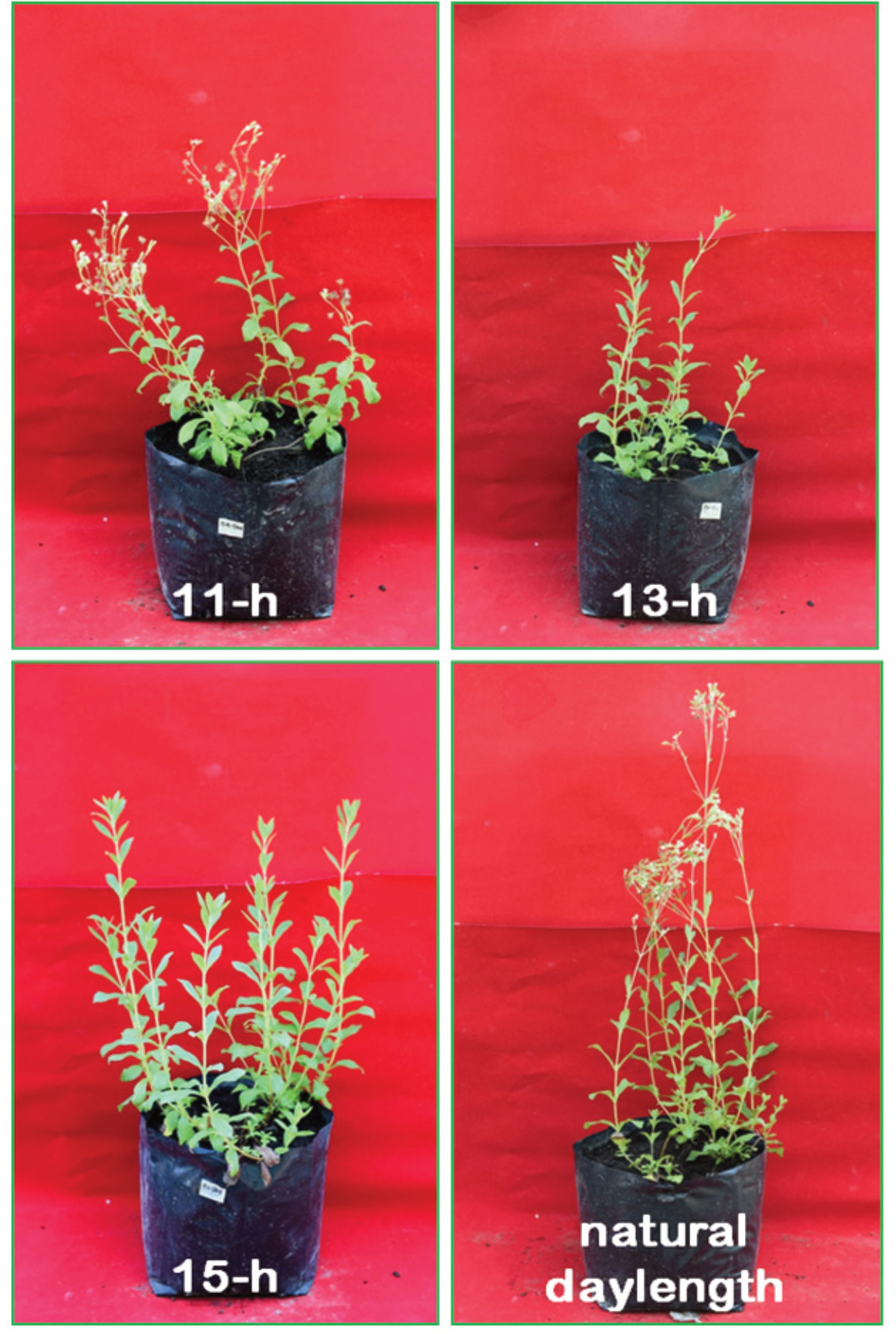
The purposive manipulation of photoperiod condition that could delay or inhibit flowering in stevia (Stevia rebaudiana Bertoni) both under in vitro and ex vitro conditions was investigated. Under in vitro condition, stevia did not flower under either short-day or long-day condition; instead, leaf production was promoted. In contrast, ex vitro grown plants, whether potted or directly planted to the field, flowered under photoperiods shorter than the established critical daylength of 13 h for stevia and were inhibited from flowering at longer photoperiod of 15 h. Flowering was not prevented in stevia obtained from plants that have previously flowered even when exposed to long photoperiods. The steviol glycoside (SG) accumulation was lower in in vitro grown plants than those of plants maintained under ex vitro conditions; the stevioside content ranged from 0.83% − 0.90%, while rebaudioside A amounted to only 0.26% − 0.42%. Under ex vitro conditions, the average leaf stevioside content of tissue culture-derived stevia was 5.64%, while that of the flowers was 3.82%; rebaudioside A was 0.96% and 0.48% in these organs, respectively. The purposeful manipulation of photoperiod may be useful to stevia growing and SG accumulation both under in vitro and ex vitro production systems.References
Bharat P., Y. Virenda, K. Amrita, S. Love and T. Binny. 2013. Stevia (Meethi patti): Prospects As An Emerging Natural Sweetener. IJPCS (1). ISSN: 2277–5005.
Bondarev, N., O. Reshetnyak and A. Nosov. 2003. Effects of nutrient medium composition on development of Steviarebaudiana shoots cultivated in the roller bioreactor and their production of steviol glycosides. Plant Science 165(4): 845–850.
Bondarev, N.I., M.A. Sukhanova, O.V. Reshetnyak and A.M. Nosov. 2003. Steviol glycoside content in different organs of Stevia rebaudiana and its dynamics during ontogeny. BiologiaPlantarum 47: 261–264.
Brandle J.E. and N. Rosa. 1992. Heritability for yield, leaf: stem ratio and stevioside content estimated from a landrace cultivar of Stevia rebaudiana. Can J Plant Sci 72: 1263–1266.
Brusick J. 2008. A critical review of the genetic toxicity of steviol and steviol glycosides. Food Chem Toxicol 46(7): S83–S91.
Ceunen S., and J.M.C. Geuns. 2013. Glucose, sucrose, and steviol glycoside accumulation in Stevia rebaudiana grown under different photoperiods. Biol Plantarum 57(2): 390–394.
Ibrahim I.A., M.I. Nasir, B.R. Mohammed and M.M. El-Zefzafi. 2008. Nutrient factor affecting in vitro cultivation of Stevia rebaudiana (Bert.) Bertoni. SugarTechnology 10: 248–253.
Kang K.H., and E.W. Lee. 1981. Physioecological studies on stevia (Steviarebaudiana Bertoni). Korean J Crops Sci 26: 69–89.
Kinghorn A.D., and D.D. Sojarto. 1985. Current status of stevioside as a sweetening agent for human use. In: Wagner H., Uliana RF. 2001. Analysis of sweet diterpene glycosides from Steviarebaudiana: Improved HPLC method.J Agric Food Chem 49: 4538–4541.
Kudo M. 1974. Stevia rebaudiana (Bert.). Science and Culture 34: 2.
Kurilcik A., S. Dapkuniene, G. Kurilcik, S. Žilinskaite, A. Žukauskas and P. Dichovskis. 2008. Effect of the photoperiod duration on the growth of chrysanthemum plantlets in vitro. Scientific works of the LithuanianInstitute of Hort and Lithuanian UnivAgric. Sodininkyste Ir Daržininkyste 27(2): 39–46.
Metivier J., and A.M. Viana. 1979. The effect of long and short day length upon the growth of whole plants and the level of soluble proteins, sugars, and stevioside in leaves of Stevia rebaudiana Bert.Journal of Experimental Botany 30: 1211– 1222.
Mohede J., and R.T.M. Van Son. 1999. Stevia rebaudiana (Bertoni) Bertoni. In: De Guzman C.C. and J.S Siemonsma, editors. Plant Resources of South-EastAsia No. 13: Spices. Leiden, The Netherlands: Backhuys Publisher. p. 207–211.
Murashige T., and F. Skoog. 1962. A revised medium for rapid growth and bioassays with tobacco tissue cultures. PhysiolPlant 15: 473–497.
Pal P.K., R. Rasad and V. Pathania. 2013. Effect of decapitation and nutrient applications on shoot branching, yield, and accumulation of secondary metabolites in leaves of Stevia rebaudiana Bertoni.J Plant Physiol 170: 1526–1535.
Serfaty M., M. Ibdaha, R. Fischera, D. Chaimovitsha, Y. Sarangab and N. Dudai. 2013. Dynamics of yield components and stevioside production in Stevia rebaudiana grown under different planting times, plant stands and harvest regime. Industrial Crops and Products 50: 731–736.
Thomas B., and D. Vince-Prue. 1997. Photo-periodism in Plants. 2nd ed. Academic Press, London. 428 p.
Valio I.F.M., and R.F. Rocha. 1977. Effect of photoperiod and growth regulator on growth and flowering ofStevia rebaudiana Bertoni. Japan J Crop Sci 46(2): 243–248.
Zaidan L.B.P., S.M.C. Dietrich and G.M. Felippe. 1980. Effect of photoperiod on flowering and stevioside content in plants of Stevia rebaudiana Bertoni. Japan J Crop Sci 49: 569–574.
Zara R.R., S.A.G. Rodriquez and M.L. Cedo. 2014. Efficient in vitro culture protocol for mass propagation of stevia (Stevia rebaudiana Bertoni) in the Philippines. Philipp Agric Scientist 97(4): 340–346.
Downloads
Published
How to Cite
Issue
Section
License
Copyright (c) 2019 National Science Museum, Thailand

This work is licensed under a Creative Commons Attribution-NonCommercial-NoDerivatives 4.0 International License.


