
Floral morphology and Potential Pollinator of Vanilla siamensis Rolfe ex Downie (Orchidaceae: Vanilloideae) in Thailand
Keywords:
vanilla fruit, vanilla flower, insect pollinator, stingless bee, bee speciesAbstract
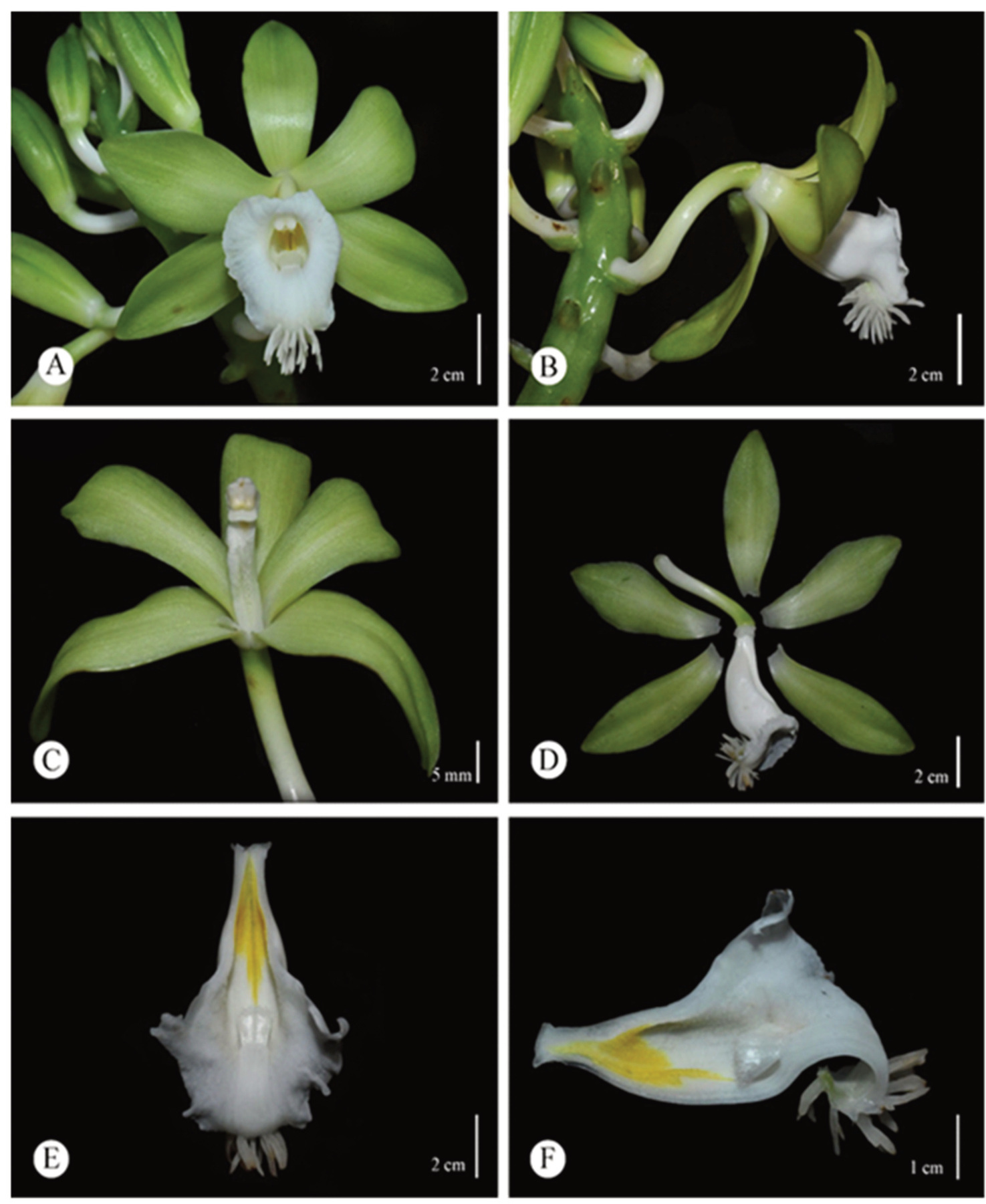
The orchid genus Vanilla has a pantropical distribution. It includes notable species, particularly Vanilla planifolia and V. pompona from the tropical Americas, and the first commercial hybrid V. tahitensis. Both species are used in various industries, including food, pharmaceuticals, cosmetics, tobacco, insect repellent, and traditional crafts. Less known is V. siamensis from Thailand. Here we investigate the flower morphology, fruit set, and natural pollinator of V. siamensis. Flower morphology and pollination experiments indicate that the species is pollinator-limited, thus undergoing pollination via deception. During observations of visiting insects, eight insect groups were collected (Blattodea, Coleoptera, Diptera, Hemiptera, Hymenoptera, Lepidoptera, Mantodea, and Orthoptera), representing twenty-eight insect morpho-species. The most frequent visiting group was the Hymenoptera, which accounted for the largest value of frequency of occurrence with 80% of the total visitations. The main visitor, Thrinchostoma sp. 2 is most likely the pollinator as observed at Khao Soi Dao Wildlife Sanctuary in the eastern region of Thailand. This species was observed entering a flower carrying Vanilla-like pollen before exiting with the pollen having been removed. It is therefore suggested that pollination of V. siamensis is by the Thrinchostoma bees, under natural conditions; however, visitations are infrequent, resulting in pollinator-limitation when compared to hand pollination experiments.References
Ackerman, J.D. 1983. Specificity and mutual dependency of the orchid-euglossine interaction. BiologicalJournal of the Linnean Society 20(3): 301–314.
Ackerman, J.D. 1986. Mechanisms and evolution of food-deceptive pollination systems in orchids. Lindleyana 1: 108–113.
Bory, S., P. Lubinsky, A.M. Risterucci, J.L. Noyer, M. Grisoni, M.F. Duval and P. Besse. 2008. Patterns of introduction and diversification of (Orchidaceae) in Reunion island (Indian ocean). American Journalof Botany 95(7): 805–815.
Cameron, K. 2011. Vanilla Orchids; Natural Historyand Cultivation. Timber Press, Portland & London,
Chase, M.W., K.M. Cameron, J.V. Freudenstein, A.M. Pridgeon, G. Salazar, C. Van den Berg and A. Schuiteman. 2015. An updated classificationof Orchidaceae. Botanical Journal of the LinneanSociety 177(2): 151–174.
Díaz-Bautista, M., G. Francisco-Ambrosio, J. Espinoza- Pérez, H.J. Barrales-Cureño, C. Reyes, B. E. Herrera-Cabrera and M. Soto-Hernándezd. 2018. Morphological and phytochemical data of Vanilla species in Mexico. Data in Brief 20: 1730–1738
Dodson, C.H., R.L. Dressler, H.G. Hills, R.M. Adams and N.H. Williams. 1969. Biologically Active Compounds in Orchid Fragrances. Science 164: 1243–1249.
Dressler, R.L. 1981. The Orchids: Natural HistoryandClassification. Harvard University Press, Cambridge, Massachusetts, United States, 332 pp.
Dressler, R.L. 1993. Phylogeny and Classification ofthe Orchid Family. Dioscorides Press, Portland, Oregon, USA, 314 pp.
Free, J.B. 1970. Effect of flower shapes and nectar guides on the behaviour of foraging honeybees. Behaviour 37: 269–285.
Householder, E., J. Janovec, M. A. Balarezo, J.H. Maceda, J. Wells and R. Valega. 2010. Diversity, natural history, and conservation of Vanilla (Orchidaceae) in Amazonian wetlands of Madre De Dios, Peru. Journal of the Botanical ResearchInstitute of Texas 4(1): 227–243.
Gigant, R., S. Bory, M. Grisoni and P. Besse. 2011. Biodiversity and 831 evolution in the Vanilla Genus. In: Grillo O. and G. Venora (eds). The 832dynamical processes of biodiversity; cases studiesof evolution 833 and spatial distribution. Intech, Rijeka, Croatia, 366 pp.
Jersáková, J., S.D. Johnson and P. Kindlmann. 2006. Mechanisms and evolution of deceptive pollination in orchids. Biological Reviews 81(2): 219–235.
Johnson, S.D. and K.E. Steiner. 1997. Long-tongued fly pollination and evolution of floral spur length in the complex (Orchidaceae). Evolution 51(1): 45–53.
Johnson, S.D., H.P. Linder and K.E. Steiner. 1998. Phylogeny and radiation of pollination systems in Disa (Orchidaceae). American Journal of Botany 85(3): 402–411.
Johnson, S.D. and K.E. Steiner. 2000. Generalization versus specialization in plant pollination systems. Tree 15(4): 140–143.
Johnson, S.D., C.I. Peter, L.A. Nilsson and J. Agren. 2003. Pollination success in a deceptive orchid is enhanced by co-occurring rewarding magnet plants. Ecology 84(11): 2919–2927.
Johnson, S.D. 2010. The pollination niche and its role in... 13 the diversification and maintenance of the southern African flora. Philosophical Transactions of theRoyal Society B 365: 499–516.
Lubinsky, P., M. Van Dam and A. Van Dam. 2006. Pollination of Vanilla and evolution in Orchidaceae. Orchids 75(12): 926–929.
McCravy, K.W. 2018. A Review of sampling and monitoring methods for beneficial arthropods in agroecosystems. Insects 9(4): https://doi. org/10.3390/insects9040170.
Micheneau, C., S.D. Johnson and M.F. Fay. 2009. Orchid pollination: from Darwin to the present day. Botanical Journal of the Linnean Society 161(1): 1–19.
Michener, D.M. 2000. The Bees of the World. Johns Hopkins Univ. Press, Baltimore, 972 pp.
Nilsson LA. 1980. The pollination ecology of Dactylorhiza sambucina (Orchidaceae). BotaniskaNotiser 133: 157–179.
Pansarin, E.R. 2016. Recent advances on evolution of pollination systems and reproductive biology of Vanilloideae (Orchidaceae). Lankesteriana 16(2): 255–267.
Peakall, R. 1994. Interactions between orchids and ants. In: V.I. J. Arditti, (Ed.), Orchid Biology - Reviewsand perspective. John Wiley & Sons, New York, pp 103–134.
Petersson, L. 2015. Pollination biology of the endemic orchid Vanillabosseri in Madagascar. MSc Dissertations, Uppsala University, Sweden, 32 pp.
Proctor, M., P. Yeo and A. Lack. 1996. The naturalhistory of pollination. Timber Press, Portland,Oregon, USA, 487 pp.
Rasmussen, K. 1985. Pollination of pepper: results from two years experiment. Gartner Tidende 101: 830–831.
Roubik, D.W. and J.D. Ackerman. 1987. Long term ecology of euglossine orchid-bees (Apidae: Euglossini) in Panama. Oecologia 73(3): 321–333.
Schiest, F.P. and S.D. Johnson. 2013. Pollinatormediated evolution of floral Signals. Trends inEcology & Evolution 28(5): 307–315.
Soto-Arenas, M.A. and K.M. Cameron. 2003. Vanilla. In: A.M. Pridgeon, P.J. Cribb, M.W. Chase and F.N. Rasmussen (eds.), Genera Orchidacearum:Orchidoideae. Oxford University Press, USA, pp. 321–334.
Soto-Arenas, M.A. and R.L. Dressler. 2010. A revision of the Mexican and central American species of Vanilla Plumier ex. Miller with a characterization of their ITS region of the nulcear ribosomal DNA. Lankesteriana 9: 285–354.
Van Der Pijl, L. and C.H. Dodson. 1966. Orchid Flowers, Their Pollination and Evolution, University of
R.N. Calvo. 2005. Variation in sexual reproduction
Triplehorn, C.A. and N.F. Johnson. 2005. Borror and
Downloads
Published
How to Cite
Issue
Section
License
Copyright (c) 2020 National Science Museum, Thailand

This work is licensed under a Creative Commons Attribution-NonCommercial-NoDerivatives 4.0 International License.


