
Vegetative Growth of Ratooned Sugarcane and Yield of Cowpea (Vigna unguiculata (L.) WALP) with Mykovam Application under Intercropping System
Keywords:
Vigna unguiculata (L.) WALP, sugarcane, intercropping, vesicular-arbuscular mycorrhizaAbstract
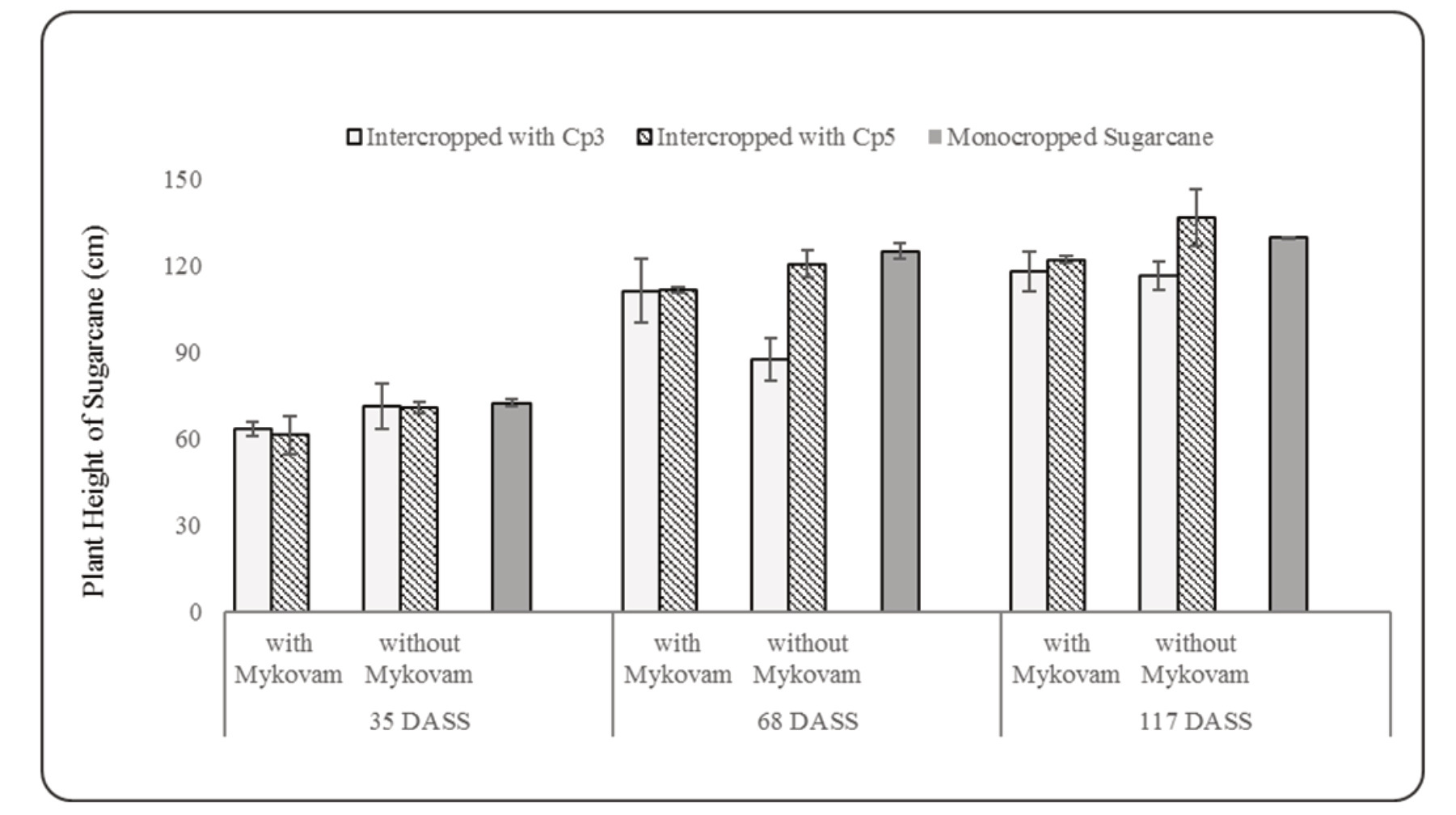
Intercropping and biofertilizer application are sustainable agricultural practices that increase farm productivity by improving the yield performance of components involved in the production system. This on-farm trial determined the effect of intercropping and Mykovam application to the yield of two cowpea varieties and vegetative growth of ratooned sugarcane. Intercropping cowpea to ratooned sugarcane reduced its plant height at the tillering stage, but the effect was not lasting. Moreover, it did not affect the yield predictive parameters of sugarcane. Intercropping Cp5 cowpea variety with ratooned sugarcane did not affect its maturity, yield, and harvest index. On the other hand, intercropped Cp3 cowpea variety matured earlier, had higher yield and harvest index. Mykovam application did not improve yield of cowpea, and land equivalent ratio (LER). Thus, Mykovam application is not necessary to improve the yield of cowpea and reduce the effect of intercropping on ratooned sugarcane. However, it is recommended that a follow-up study should cover the full cropping cycle of sugarcane, intercropping varying crops coupled with production management that minimize competition with sugarcane leading to an increased yield of both crops; cost-benefit analysis at the cropping pattern level is also recommended for a holistic approach.References
Alam, M.H., M.M. Rahman, M.A.R. Sarkar, M.K. Rahman, A.K.M.R Islam, M.A.T. Sohel M.J. Uddin and M.K. Habib. 2015. Productivity of lentilmungbean sequential intercropping in paired row sugarcane. International Journal of SustainableCrop Production 10(1):1–10.
Bareja, B.G. 2014. Environment factors: what and howdo they affect crop growth and yield. Downloaded from https://www.cropsreview.com/environmentalfactors.html on 1 February, 2019.
Bassi, D., M. Menossi and L. Mattiello. 2018. Nitrogen supply influences photosynthesis establishment along the sugarcane leaf. Scientific Reports. 8, article number 2327: 1–13.
Brintha, I. and T.H. Seran. 2009. Effect of paired row planting of raddish (Raphanus sativus L.) intercropped with vegetable amaranths (Amaranthstricolor L.) on yield components in sandy regosol. Journal of Agricultural Sciences 4: 19–28.
Elsheikh, E.A.E, A.H. El Tinay and I.A. Fadul. 2000. Effect of cooking on antinutritional factors and in vitro protein digestibility (IVPD) of faba bean grown under different nutritional regimes. Food Chemistry 68: 211–212.
Hay, R.K.M. 2008. Harvest index: A review of its use in plant breeding and crop physiology. Annals ofApplied Biology 126(1): 197 – 216. DOI: 10.1111/ j.1744–7348. 1995.tb05015.
Hombrebueno, E.M. 1980. A parametric approachto productivity evaluation of soils for sugarcaneproduction in selected fields of commercial farmsin Negros Occidental, Philippines. Unpublished MS Thesis, UPLB.
Mendoza, T.C. 1986. Light interception and total biomass productivity in sugarcane intercropping. Philippine Journal of Crop Science 11(3): 181–187.
Murchie E. and M. Reynolds. 2013. Crop Radiation Capture and Use Efficiency. Springer, NewYork, NY: Sustainable Food Production.
Parsons, M.J. 2003. Successful intercropping of sugarcane. Proceedings: South Africa SugarcaneTechnology Association 2003: 77–98.
Philippine Statistics Authority. 2017. Sugarcaneproduction in Negros Occidental. Downloaded from www.psa.gov.ph on 15 November 2017.
Ramirez, F.L. and M.J. Caballero. 2005. Bacterial biofertilizers. In: Siddiqui ZA, editor. PGPR: biocontrol and biofertilization. The Netherland: Springer; 2005. pp. 143–172.
UPLB Research, Development and Extension. 2017. Mykovam. Downloaded fromhttp:// ovcre.uplb.edu.ph/index.php?option=com_ j o o d b & v i e w = a r t i c l e & i d = 5 3 % 3 A mykovam&Itemid=154 on 10 November 2017.
Zhang, X., G. Huang, X. Bian and Q. Zhao. 2013. Effects of root interaction and nitrogen fertilization on the chlorophyll content, root activity, photosynthetic characteristics of intercropped soybean and microbial quantity in the rhizosphere. Plant Soil EnvironmentJournal. 59(2): 80–88.
Downloads
Published
How to Cite
Issue
Section
License
Copyright (c) 2020 National Science Museum, Thailand

This work is licensed under a Creative Commons Attribution-NonCommercial-NoDerivatives 4.0 International License.


