
Neogene Bovidae from Tha Chang Sandpits, Nakhon Ratchasima, Northeastern Thailand
Keywords:
Bovini, mammal, fossil, Miocene, Khorat, Southeast AsiaAbstract
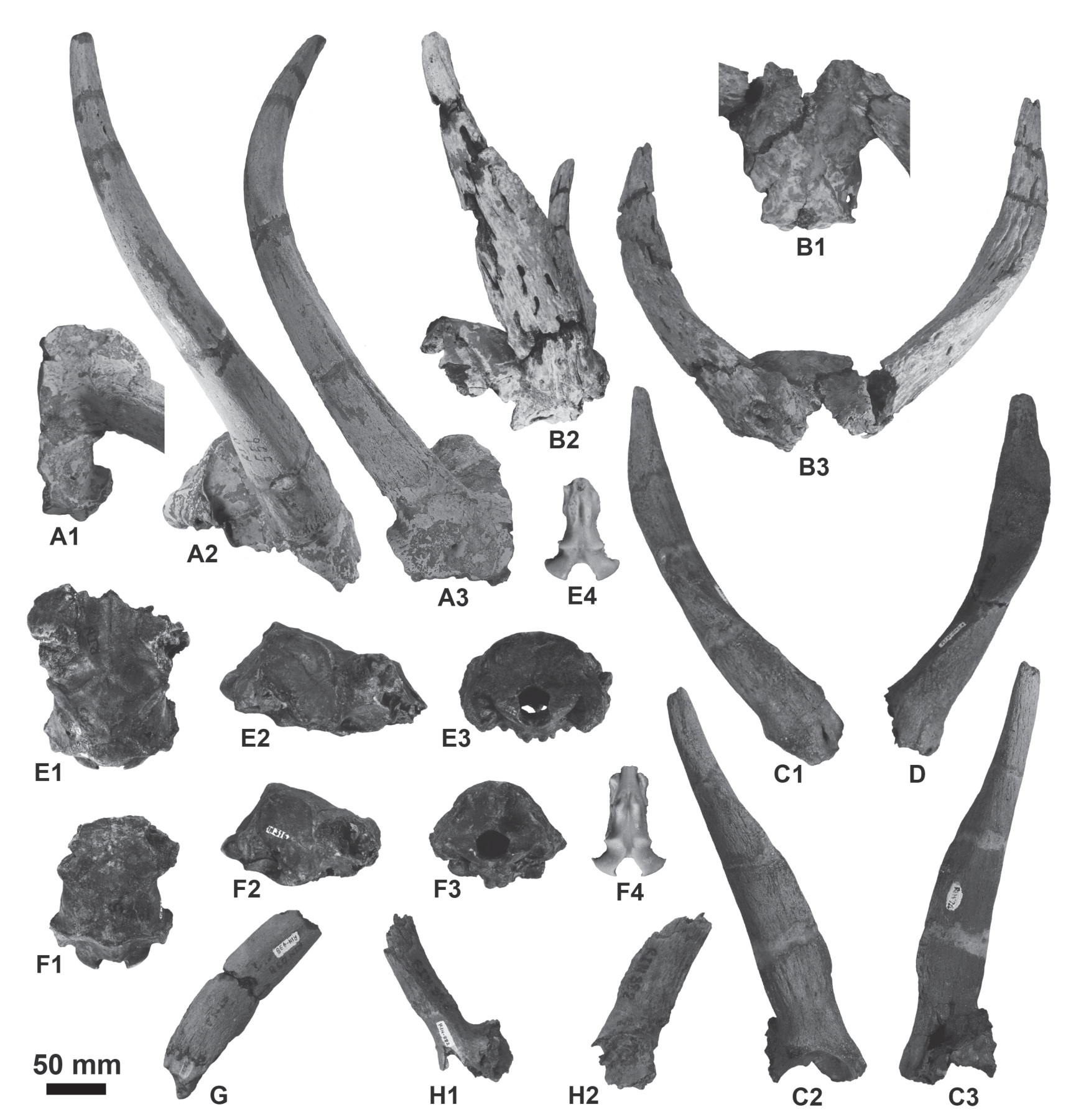
The Neogene bovids (Artiodactyla, Mammalia) from Tha Chang sandpits No. 8 and No. 10, Nakhon Ratchasima, northeastern Thailand were taxonomically examined, with systematic descriptions of ancestral bovins, Selenoportax and Pachyportax species. The fossil assemblage from sandpit No. 8 is composed of one species, S. vexillarius, with many early late Miocene mammals corresponding to the Hipparion datum of South Asia. The fossil assemblage from sandpit No. 10 includes two species, S. falconeri and P. giganteus. The occurrence range of S. falconeri is slightly older than that of P. giganteus in South Asia, but they probably coexisted during the late Miocene in continental Southeast Asia. The finding of Selenoportax and Pachyportax species from Tha Chang sandpits confirms early dispersal of these species between South Asia and Southeast Asia during the late Miocene.References
Akhtar, M. 1995. Pachyportax giganteus, new species (Mammalia: Artiodactyla: Bovidae) from the Dhok Pathan, District Chakwal, Punjab, Pakistan. PakistanJournal of Zoology 27: 337–340.
Barry, J.C., M.E. Morgan, L.J. Flynn, D. Pilbeam, A.K. Behrensmeyer, S.M. Raza, I.A. Khan, C. Badgley, J. Hicks and J. Kelley. 2002. Faunal and environmental change in the late Miocene Siwaliks of northern Pakistan. Paleobiology 28(S2): 1–71.
Bibi, F. 2007. Origin, paleoecology, and paleobiogeography of early Bovini. Palaeogeography,Palaeoclimatology, Palaeoecology 248(1-2): 60–72. Marandat, P. Tafforeau, C. Nemoz and J.-J. Jaeger. 2006. Khoratpithecuspiriyai, a late Miocene hominoid of Thailand. American Journal of PhysicalAnthropology 131(3): 311–323.
Deng, T., R. Hanta and P. Jintasakul. 2013. A new species of Aceratherium (Rhinocerotidae, Perissodactyla) from the late Miocene of Nakhon Ratchasima, Northeastern Thailand. JournalofVertebratePaleontology 33(4): 977–985.
Department of Mineral Resources. 1999. Geological mapof Thailand; ,. Department of Mineral Resources, Thailand.
Duangkrayom, J., S.-Q. Wang, T. Deng and P. Jintasakul. 2017. The first Neogene record of Zygolophodon (Mammalia, Proboscidea) in Thailand: implications for the mammutid evolution and dispersal in Southeast Asia. Journal of Paleontology 91(1): 179–193.
Gentry, A.W. 1974. A new genus and species of Pliocene boselaphine (Bovidae, Mammalia) from South Africa. Annals of the South African Museum 65: 145–188.
Gentry, A.W., N. Solounias and J.C. Barry. 2014. Stability in higher level taxonomy of Miocene bovid faunas of the Siwaliks. Annales ZoologiciFennici 51(1-2): 49–56.
Gray, J.E. 1821. On the natural arrangement of vertebrose animals. The London Medical Repository 15: 296–310.
Haines, P.W, K.T. Howard, J.R. Ali, C.F. Burrett and S. Bunopas. 2004. Flood deposits penecontemporaneous with ~0.8 Ma tektite fall in NE Thailand: impactinduced environmental effects? Earth and PlanetaryScience Letters 225(1-2): 19–28.
Han, D. 1985. The Artiodactyla of Ramapithecus site, Lufeng, Yunnan. Acta Anthropologica Sinica 4(1): 44–54.
Hanta, R., B. Ratanasthien, Y. Kunimatsu, H. Saegusa, H. Nakaya, S. Nagaoka and P. Jintasakul. 2008. A new species of Bothriodontinae, Merycopotamusthachangensis (Cetartiodactyla, Anthracotheriidae) from the late Miocene of Nakhon Ratchasima, Northeastern Thailand. JournalofVertebratePaleontology 28(4): 1182–1188.
Howard, K., P. Haines, C. Burrett, J. Ali and S. Bunopas. 2003. Sedimentology of 0.8 million year old logbearing flood deposits in Northeastern Thailand and mechanisms for pre-flood deforestation. Pp. 49–232 in: B. Ratanasathien, S.L. Rieb and S. Chantrapasert (eds.), 8th International Congress onPacific Neogene Stratigraphy, Chiang Mai. Chiang Mai University, Chiang Mai.
Lydekker, R. 1884. Indian Tertiary and post-Tertiary vertebrata. Rodents and new ruminants from the Siwaliks, and synopsis of Mammalia. Memoirs ofthe Geological Survey of India, PalaeontologiaIndica 10(3): 105–134.
Lydekker, R. 1886. Siwalik Mammalia, supplement I. Palaeontologia Indica 10(1): 1–21.
Nishioka, Y. and C. Vidthayanon. 2018. First occurrence of Duboisia (Bovidae, Artiodactyla, Mammalia) from Thailand. Fossil Record 21: 291–299.
Nishioka, Y., M. Takai, T. Tsubamoto, N. Egi, T. Nishimura, R. Kono, S. Ogino, Thaung-Htike, Zin- Maung-Maung-Thein and C. Vidthayanon. 2019. Bovidae (Mammalia,Artiodactyla) from the Neogene Irrawaddy beds, Myanmar. Palaeontographica A 314(1-3): 11–68.
Nishioka, Y., R. Hanta and P. Jintasakul. 2014. Note on giraffe remains from the Miocene of continental Southeast Asia. Journal of Science and Technology,Mahasarakham University 33(4): 365–377.
Pilgrim, G.E. 1910. Notices of new mammalian genera and species from the Tertiaries of India. Records ofthe Geological Survey of India 40: 63–71.
Pilgrim, G.E. 1937. Siwalik antelopes and oxen in the American Museum of Natural History. Bulletin of theAmerican Museum of Natural History 72: 729–874.
Pilgrim, G.E. 1939. The fossil Bovidae of India. Palaeontologia Indica (New Series) 26: 1–356.
Thasod, Y., P. Jintasakul and B. Ratanasthien. 2011. Proboscidean fossil from the Tha Chang sand pits, Nakhon Ratchasima Province, Thailand. Journal ofScience and Technology, Mahasarakham University 31(1): 33–44.
Downloads
Published
How to Cite
Issue
Section
License
Copyright (c) 2020 National Science Museum, Thailand

This work is licensed under a Creative Commons Attribution-NonCommercial-NoDerivatives 4.0 International License.


