
Bioproduction of alpha-amylase from Bacillus amyloliquefasciens using taro (Colocasia esculenta) as a medium
Keywords:
amylase, Bacillus amyloliquefaciens, Colocasia esculenta, RSMAbstract
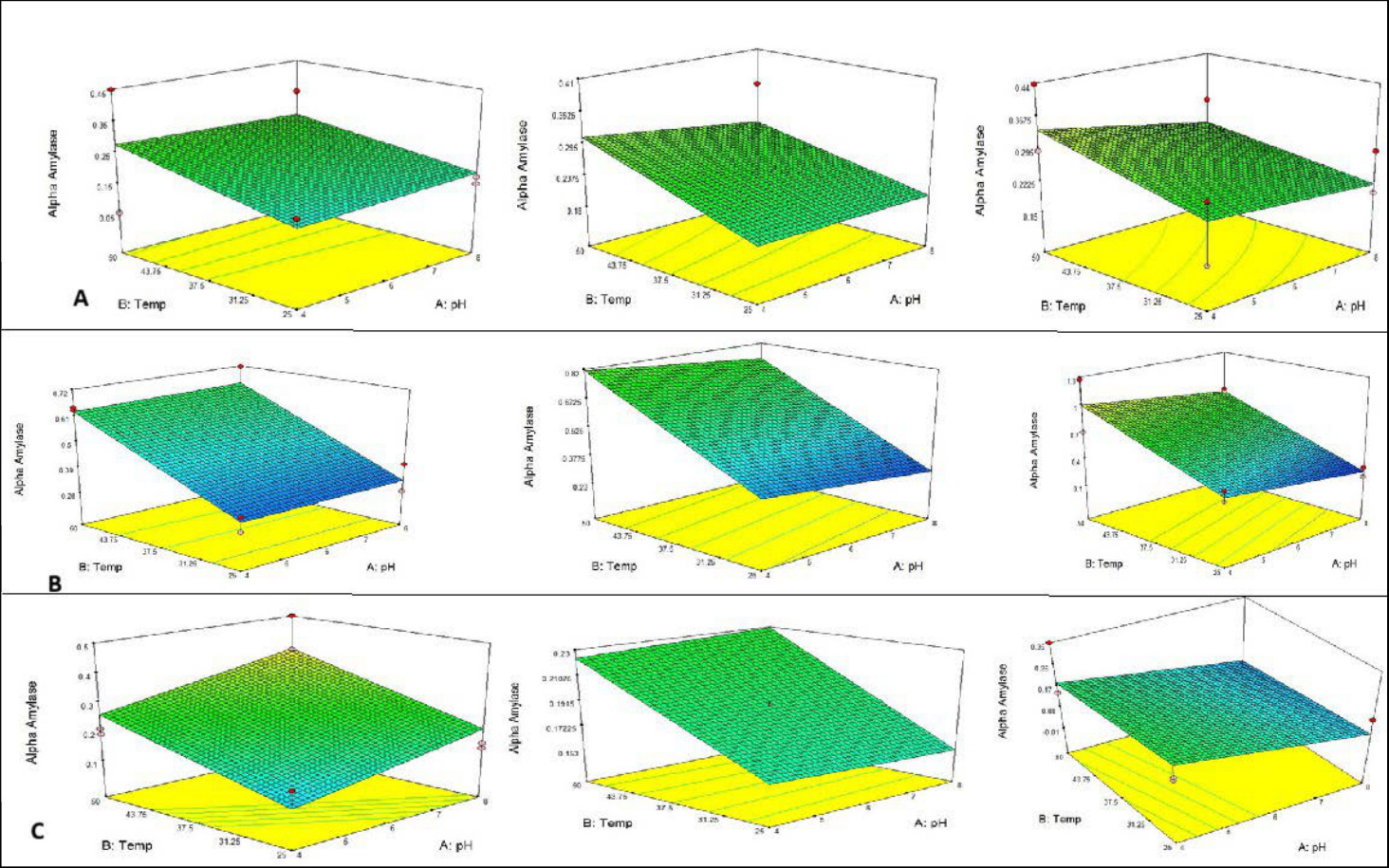
Amylases are among the most important industrial enzymes, with diverse applications ranging from conversion of starch into sugar syrups to the production of cyclodextrins for the pharmaceutical industry. Bacillus amyloliquefaciens NBRC 15535 can be a potential source of amylase production. The use of taro (Calocasia esculenta) as primary starch submerged for α-amylase production and scale up contributes as substrate for industrial enzyme production. Report on taro as fermentation substrate are scarce despite its high starch content and availability in tropical regions like Philippines. This study aimed to optimize alpha-amylase production conditions for large-scale industrial applications. Stat-Ease Design-Expert software was employed to design the bioproduction parameters, specifically pH, temperature, and substrate concentration. For the scale-up process, a two-level factorial design was utilized to determine the optimal fermentation conditions. Based on small-scale experimental results, the optimum conditions were identified as pH 8.0, 50°C, and a 4% substrate concentration. Statistical analysis demonstrated that temperature was the only significant factor influencing α-amylase production (p < 0.0001), while pH, substrate concentration, and their interactions were not significant. Scale-up experiments revealed that conditions favoring biomass accumulation did not necessarily correspond to maximal specific enzyme activity, highlighting the importance of distinguishing cell growth from enzyme production. Time-course analyses indicated thatthe culture remained in theexponential growth phase within 24 h of fermentation, suggesting that the true optimum for α-amylase production was not yet reached under the evaluated conditions. Therefore, extending the incubation period to 48–72 h and exploring broader pH ranges are proposed to capture potential growth-associated or stability-driven increases in enzyme yield. Overall, this study establishes baseline process parameters and demonstrates the feasibility of taro-based media for scalable α-amylase production to meetindustrydemand, while providing aclear framework for future optimization. under the evaluated conditions. Therefore, extending the incubation period to 48–72 h and exploring broader pH ranges are proposed to capture potential growth-associated or stability-driven increases in enzyme yield. Overall, this study establishes baseline process parameters and demonstrates the feasibility of taro-based media for scalable α-amylase production to meet industry demand, while providing a clear framework for future optimization.References
Abate, C.M., N.G.R. Castro, F. Sineriz and D.A.S. Callieri. 1999. Production of amylolytic enzymes by Bacillus amyloliquefaciens in pure culture and in co-culture with Zymomonas mobilis. BiotechnolyLetters 21: 249–252. DOI: 10.1023/A:1005477505683
Almeida, D.E., S.E.K. Mizuta and J.R. Giglio. 1997. Pycnoporus sanguineus: a novel source of α-amylase. Mycological Research 101(2): 188–190.
Anto, H., U. Trivedi and K. Patel. 2005. Alpha amylase production by Bacillus cereus MTCC 1305 using solid-state fermentation. Food Technology and Biotechnology 44(2): 241–245.
Asgher, M., M.J. Asad, S.U. Rahman and R.L. Legge. 2007. A thermostable α-amylase from a moderately thermophilic Bacillus subtilis strain for starch processing. Journal of Food Engineering 79: 950–955. DOI: 10.1016/j.jfoodeng.2005.12.053.
Balkan, B. and F. Ertan. 2005. Production and properties of α‐amylase from Penicillium chrysogenum and its application in starch hydrolysis. Preparative Biochemistry & Biotechnology 35: 169–178. DOI: 10.1081/PB-200054740.
Banargee, R. and B.C. Bhattacharya. 1992. Extracellular alkaline protease of newly isolated Rhizopusoryzae.Biotechnoly Letters 14: 301–304. DOI: 10.1007/BF01022328.
Da Lage, J., E.G.J. Danchin and D. Casane. 2007. Where do animal α-amylases come from? an interkingdom trip. FEBS Letters 581(21): 3927–3935. DOI: 10.1016/j.febslet.2007.07.019
Deo, P., A. Tyagi, M. Taylor, D. Becker and R. Harding. 2009. Improving taro (Colocasia esculenta var.esculenta) production using biotechnological approaches. The South Pacific Journal of Naturaland Applied Sciences 27(1). DOI: 10.1071/SP09002. Brazilian Journal of Microbiology 41: 850–861.
Djekrif-Dakhmouche S., Z. Gheribi-Aoulmi Meraihi and L. Bennamoun. 2006. Application of a statistical design to the optimization of culture medium for a-amylase production by Aspergillusniger ATCC 16404 grown on orange waste powder. Journal of Food Engineering 73 (2): 190–197.
Falade, K. and C. Okafor. 2014. Physical, functional, and pasting properties of flours from corms of two Cocoyam (Colocasia esculenta and Xanthosoma sagittifolium) cultivars. Journal ofFood Science and Technology 52. DOI: 10.1007/s13197-014-1368-9.
Gangadharan, D., K.M. Nampoothiri, S. Sivaramakrishnan and A. Pandey. 2009. Immobilized bacterial α-amylase for effective hydrolysis of raw and soluble starch. Food Research International 42: 436–442.
Gupta, R., P. Gigras, H. Mohapatra, V. K. Goswami and B. Chauhan. 2003. Microbial α-amylases: a biotechnological perspective. Process Biochemistry 38(11): 1599–1616. DOI: 10.1016/S0032- 9592(03)00053-0.
Haq, I., S. Ali, M.M. Javed, U. Hameed, A. Saleem, F. Adnan and M.A. Qadeer. 2010. Production of alpha amylase from a randomly induced mutant strain of Bacillus amyloliquefaciens and its application as a Desizer in textile industry. Pakistan Journal of Botany 42(1): 473–484.
Huang, H., D. Ridway, T. Gu and M. Moo-Young. 2003. A segregated model for heterologous α-amylase production by Bacillus subtilis. Enzyme and Microbrial Technology 32: 407–413. DOI: 10.1016/ S0141-0229(02)00312-5.
Kaur, P. and A. Vyas. 2012. Characterization and optimal production of alkaline α-amylase from Bacillus sp. DLB 9. African Journal of Microbiology Research 6(11): 2674–2681.
Kathiresan K. and S. Manivannan. 2006. Amylase production by Penicillium fellutanum isolated from mangrove rhizosphere soil. African Journal of Biotechnology 5(10): 829–832
Konsoula, Z. and M. Liakopoulou-Kyriakides. 2007. Co-production of a-amylase and b-galactosidase by Bacillus subtilis in complex organic substrates. Bioresource Technology 98: 150–157.
Kumar, C.G. and H. Takagi. 1999. Microbial alkaline protease: from a bioindustrial viewpoint. Biotechnoly Advances 17(7): 561–594. DOI: 10.1016/S0734-9750(99)00027-0.
Kunamneni, A. and S. Singh. 2005. Response surface optimization of enzymatic hydrolysis of maize starch for higher glucose production. Biochemical Engineering Journal 27: 179–190.
Lim, T. K. 2015. Edible Medicinal and Non-Medicinal Plants: Modified Stems, Roots, Bulbs. Springer Verlag, Dordrecht. 95 pp.
Nielsen J.E. and T.V. Borchert. 2000. Protein engineering of bacterial alpha-amylases. Biochim BiophysActa 1543(2): 253–274. DOI: 10.1016/s0167-4838(00)00240-5.
Oboh, G. 2005. Effect of blanching on the antioxidant properties of some tropical green leafy vegetables. Food Science and Technology 38 (5): 513–517 DOI: 10.1016/j.lwt.2004.07.007.
Melasniemi, H. 1987. Characterization of alpha-amylase and pullulanase Activities of Clostridiumthermohydrosulfuricum. Evidence for a novel thermostable amylase. Biochemical Journal 246(1): 193–7. DOI: 10.1042/bj2460193
Moller, K., M.Z. Sharif and L. Olsson. 2004. Production of fungal alpha-amylase by Saccharomyces kluyveri in Glucose-limited cultivations. Journal of Biotechnology 111: 311–318. DOI: 10.1016/j. jbiotec.2004.04.013
Mwamba, N., P. Adebola and M. Pillay. 2016. Genetic diversity analysis in South African taro (Colocasiaesculenta) accessions using molecular tools. International Journal of Genetics and MolecularBiology 8: 18–24. DOI: 10.5897/IJGMB2016.0124
Paquet, V., C. Croux, G. Goma and P. Soucaille. 1991. Purification and characterization of the extracellular alpha-amylase from Clostridium acetobutylicum ATCC 824. Appl Environ Microbiol 57(1): 212–218. DOI: 10.1128/aem.57.1.212-218.1991
Roychoudhury, S., S. Parulekar and W. Weigand. 1988. Cell growth and α-amylase production characteristics of Bacillus amyloliquefaciens. Biotechnology and Bioengineering 33: 197–206. sequence of an intracellular maltotriose-producing alpha-amylase from Streptococcus bovis. Applied and Environmental Microbiology 63(12): 4941–4944. DOI: 10.1128/aem.63.12.4941-
Schallmey M., A. Singh and O.P. Ward. 2004. Developments in the use of Bacillus species for Industrial production. Canadian Journal of Microbiology 50(1): 1–17. DOI: 10.1139/w03-076
Sivaramakrishnan, S., D. Gangadharan, K. Nampoothiri, C. Soccol and A. Pandey. 2007. α-amylase from microbial sources-an overview on recent developments. Food Technology and Biotechnology 44 (2): 173–184
Sindhu, R., G.N. Suprabha and S. Shashidhar. 2009. Optimization of process parameters for the production of α- amylase from Penicillium janthinellum (NCIM 4960) under solid State fermentation. African Journal of Microbiology Research 3(9): 498–503.
Soudy, I.D., P. Delatour and D. Grancher. 2010. Effects of traditional soaking on the nutritional profile of taro flour (Colocasia esculenta L. Schott) produced in chad. Revue de Médicine Véterinaire 1: 37–42.
Sudo, S., T. Ishikawa, K. Sato and T. Oba. 1994. Comparison of acidstable α-amylase production by Aspergillus kawachii in Solid-state and submerged cultures. Journal of Fermentation andBioengineering 77(5): 483–489.
Sundarram, A. and T. Murthy. 2014. A-amylase production and applications: a review. Journal of Applied& Environmental Microbiology 2: 166–175. DOI: 10.12691/jaem-2-4-10
Swain, M.R. and R.C. Ray. 2007. Alpha-amylase production by Bacillus subtilis CM3 in solid state fermentation using cassava fibrous residue. Journal of Basic Microbiology 47: 417–425.
Swamy, M.V. and G. Seenayya. 1996. Thermostable pullulanase and α-amylase activity from Clostridiumthermosulfurogenes SV9: optimization of culture conditions for enzyme production. ProcessBiochemistry 31(2): 157–162. DOI: 10.1016/0032-9592(95)00034-8.
Tanyildizi, M., D. Ozer and M. Elibol. 2005. Optimization of alpha amylase production by Bacillus sp. using response surface methodology. Process Biochemistry 40: 2291–2296. DOI: 10.1016/j. procbio.2004.06.018.
van der Maarel M.J., B. van der Veen, J.C. Uitdehaag, H. Leemhuis, L. Dijkhuizen. 2002. Properties and applications of starch-converting enzymes of the alpha-amylase family. J Biotechnol. 2002 Mar 28;94(2):137-55. DOI: 10.1016/s0168-1656(01)00407-2. PMID: 11796168.
Wanderley, K.J., F.A.G. Torres, L.M.P. Moraes and C.J. Ulhoa. 2004. Biochemical characterization of α-amylase from the yeast Cryptococcus flavus. FEMSMicrobiology Letters 231(2): 165–169. DOI: 10.1016/S0378-1097(03)00955-8.
Xian, L., F. Wang, X. Luo, Y.L. Feng and J. X. Feng. 2015. Purification and characterization of a highly efficient calcium-independent α-amylase from Talaromyces pinophilus. PLoS ONE 10(3): e0121531. DOI: 10.1371/journal.pone.0121531
Downloads
Published
How to Cite
Issue
Section
License
Copyright (c) 2026 The Thailand Natural History Museum Journal

This work is licensed under a Creative Commons Attribution-NonCommercial-NoDerivatives 4.0 International License.


