
Population structure and distribution of Critically Endangered Cycas sancti-lasallei Agoo & Madulid (Cycadaceae) in northern Mindanao, Philippines
Keywords:
aggregated spatial distribution, endemic gymnosperm, population survey, sex ratioAbstract
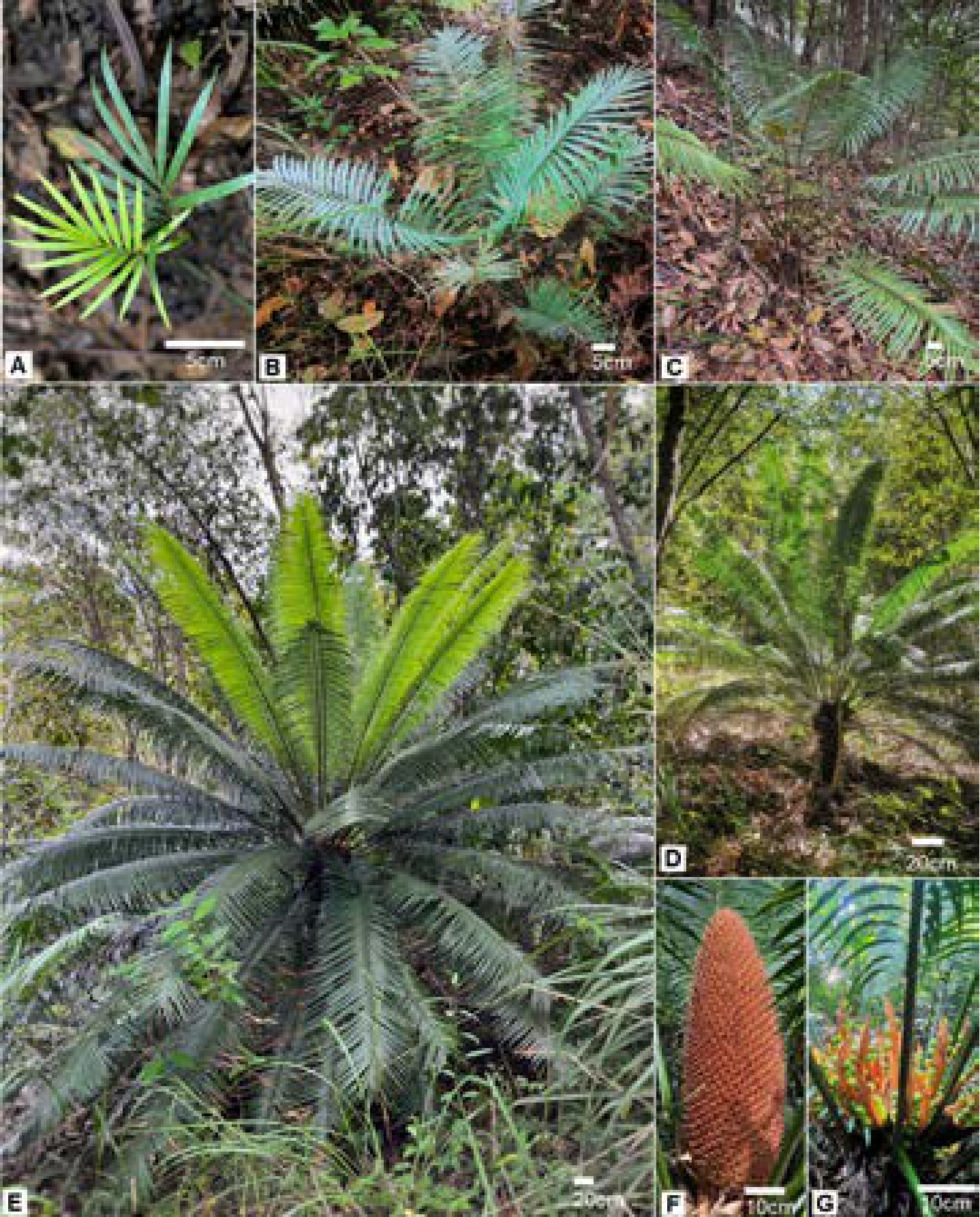
Cycas sancti-lasallei Agoo & Madulid is a Critically Endangered (CR) cycad endemic to Mindanao. Its population structure, sex ratio, and distribution remain poorly understood; therefore, this study aims to provide a more comprehensive characterization of these parameters. Fieldwork was conducted across five plots in Mapawa Nature Park, Barangay Cugman, and one plot in Barangay F.S. Catanico, collectively covering 25,000 ha. Individual locations were mapped using QGIS and GeoCAT. A total of 1,015 individuals were recorded, with the population dominated by juvenile plants with reproductive adults comprised only 4.93% of the total population. This pattern suggests active recruitment but limited progression to reproductive maturity. Reproductive adult density was low (20 plants/ha), with nearly half of these individuals concentrated in a secondary forest site, whereas youngest stage juveniles exhibited the highest density (125.6 plants/ ha). The sex ratio was skewed toward females (0.72:1), which may reflect differences in detectability between sexes during a single survey period rather than a true demographic imbalance. Spatial analysis indicated an aggregated distribution pattern influenced by terrain, soil properties, and vegetation structure. Secondary forests with loamy soils acted as reproductive hubs, supporting nearly half of all coning individuals. In contrast, areas with steep rocky slopes,invasivevegetation,ordensecanopycover supported fewer individuals and showed limited reproductive activity. The skewed stage structure, low abundance of reproductive adults, and spatially constrained distribution suggest potential limitations to the long-term viability of C. sancti-lasallei. These findings highlight the need for targeted conservation strategies and habitat protection.References
Agoo, E.M.G. and A. Lindstrom. 2022. Cycas sancti-lasallei. The IUCN Red List of Threatened Species 2022: e.T66910010A66910021. DOI: 10.2305/IUCN.UK.2022-1.RLTS.T66910010A66910021. en
Agoo, E.M.G. and D.A. Madulid. 2012. Cycas sancti-lasallei (Cycadaceae), a new species from the Philippines. Blumea 57(2): 131–133. in a rare cycad within angiosperm communities. Oecologia 175: 725–735.
Cabral, J.S. and F.M. Schurr. 2010. Estimating demographic models for the range dynamics of plant species. Global Ecology and Biogeography 19(1): 85–97.
Calonje, M., D.W. Stevenson and R. Osborne. 2023. The World List of Cycads. Downloaded from http:// www.cycadlist.org on 15 June 2025.
Castillo-Lara, P., P. Octavio-Aguilar and J.A. De-Nova. 2017. Ceratozamia zaragozae Medellín-Leal (Zamiaceae), an endangered Mexican cycad: new information on population structure and spatial distribution. Brittonia 70(2): 155–165.
Donaldson, J. 2003. Cycads: Status Survey and Conservation Action Plan. IUCN – The World Conservation Union, Gland and Cambridge. ix + 86 pp.
Grobbelaar, N. 1999. Coning frequency, gender ratio, and pollination of Encephalartos transvenosus (Zamiaceae) at the Modjadji Nature Reserve, South Africa, and the germination of this cycad’s seed, pp. 309–318. In: C.J. Chen (ed.), Proceedings of the Fourth International Conference onCycad Biology. Panzhihua.
Hall, J.A. and G.H. Walter. 2013. Seed dispersal of the Australian cycad Macrozamia miquelii (Zamiaceae): are cycads megafauna-dispersed “grove-forming” plants? American Journal ofBotany 100: 1127–1136.
Hoffmann, M., C. Hilton-Taylor, A. Angulo, M. Böhm, T.M. Brooks, S.H.M. Butchart, K.E. Carpenter, J. Chanson, B. Collen, N.A. Cox, W.R.T. Darwall, N.K. Dulvy, L.R. Harrison, V. Katariya, C.M. Pollock, S. Quader, N.I. Richman, A.S.L. Rodrigues, M.F. Tognelli, J.-C. Vié, J.M. Aguiar, D.J. Allen, G.R. Allen and G. Amori. 2010. The impact of conservation on the status of the world’s vertebrates. Science 330: 1503–1509.
Ismail, N.A.N. and F. Metali. 2014. Allelopathic effects of invasive Acacia mangium on germination and growth of local paddy varieties. Journal of Agronomy 13(4): 158–168.
Keppel, G., P.D. Hodgskiss and G.M. Plunkett. 2008. Cycads in the insular south-west Pacific: dispersal or vicariance? Journal of Biogeography 35(6): 1004–1015.
Krebs, C.J. 1972. Ecology: The Experimental Analysis of Distribution and Abundance. Harper and Row, New York. 694 pp.
Lindstrom, A., K. Hill and L. Stanberg. 2008. The genus Cycas (Cycadaceae) in the Philippines. Telopea 12: 119–145.
Marler, T.E. 2010. Cycad mutualist offers more than pollen transport. American Journal of Botany 97(5): 841–845.
Marler, T.E. and U.F. Ferreras. 2017. Current status, threats and conservation needs of the endemic Cycas wadei Merrill. Journal of Biodiversity and Endangered Species 5(3): 1–6.
Matthies, D., I. Bräuer, W. Maibom and T. Tscharntke. 2004. Population size and the risk of extinction: empirical evidence from rare plants. Oikos 105: 481–488.
Octavio-Aguilar, P., J. González-Astorga and A.P. Vovides. 2008. Population dynamics of the Mexican cycad Dioon edule Lindl. (Zamiaceae): life history stages and management impact. BotanicalJournal of the Linnean Society 157(3): 381–391.
Ogwal, J.J. 2017. Population structure of the cycad along River Mpanga, western Uganda. AfricanJournal of Rural Development 2(1): 95–103.
Ornduff, R. 1985. Male-biased sex ratios in the cycad Macrozamia riedlei (Zamiaceae). Bulletin of theTorrey Botanical Club 112(4): 393–397.
Parreno, C.L., I.V. Sanchez, A.A. Vasallo, S.A. Vedra and R.E. Relox. 2020. Diversity and distribution of avifauna in Mapawa Nature Park, Cugman, Cagayan de Oro City, Misamis Oriental. Journalof Biodiversity and Environmental Sciences 17(6): 1–8.
Pelser, P.B., J.F. Barcelona and D.L. Nickrent (eds.). 2011 (onwards). Co’s Digital Flora of thePhilippines. Downloaded from http://www.philippineplants.org on 15 June 2025.
Richardson, D.M. and M. Rejmánek. 2011. Trees and shrubs as invasive alien species: a global review. Diversity and Distributions 17(5): 788–809.
Schneider, D., M. Wink, F. Sporer and P. Lounibos. 2002. Cycads: their evolution, toxins, herbivores and insect pollinators. Naturwissenschaften 89: 281–294. Systematics. Academic Press (Elsevier), Amsterdam.
Stein, G. 2004. The Cycad Pages: 1997 IUCN List of Threatened Plants, Summary for Family Zamiaceae. Downloaded from http://www.plantapalm.com/vce/conservation/zamiaceae.html on 15 June 2025.
Swart, C., R. Rowswell, J. Donaldson and N. Barker. 2019. Population structure and survival of the critically endangered cycad Encephalartos latifrons in South Africa. South African Journal ofBotany 126: 283–290.
Vovides, A.P., R. Guevara, M. Coiro, S. Galicia and C. Iglesias. 2020. Pollen morphology of the Megamexican cycads reveals the potential of morphometrics to identify cycad genera. BotanicalSciences 99(1): 182–197.
Watkinson, A.R. and J.C. Powell. 1997. The life history and population structure of Cycas armstrongii in monsoonal northern Australia. Oecologia 111: 341–349.
Wu, E., D. Li, X. Yang, Y. Zuo, L. Li, P. Zhang and C. Li. 2021. Population structure ofCycas hainanensis and its relationship with forest canopy density. Biodiversity Science 29(11): 1461–1469.
Yang, Y.-Q., L.-L. Yang, J.-B. Lin, J.-R. Xiang, B. Zhou, H. Li, S.-W. Ma, L.-F. Li and S.-Z. Zhang. 2024. Sex ratio and spatial distribution of Cycas panzhihuaensis in Sichuan Panzhihua Cycad National Nature Reserve. Plant Species Biology 39: 1–12.
Downloads
Published
How to Cite
Issue
Section
License
Copyright (c) 2026 The Thailand Natural History Museum Journal

This work is licensed under a Creative Commons Attribution-NonCommercial-NoDerivatives 4.0 International License.


