
Urban PM2.5 Concentration Estimation Based on Remote Sensing and Land Use Regression Model: Evidence from the Bangkok Metropolitan Region
Keywords:
PM2.5, Land Use Regression model, Aerosol Optical Depth (AOD), Himawari-8Abstract
Background and Objectives: Fine particulate matter (PM2.5) pollution has been a persistent environmental issue in Thailand for over two decades. In 2023, Thailand ranked fifth in Southeast Asia among countries experiencing the worst air quality for over 30 consecutive days. Bangkok and its metropolitan area, as the country’s economic, political, social, and cultural hub, have undergone rapid urban expansion, intensifying cumulative pollution and continuously affecting residents’ quality of life. In 2022, only three months recorded good air quality. The highest PM2.5 concentrations occurred during March and April, particularly in roadside areas, where levels began to pose adverse health impacts and showed an increasing trend. However, the limited number of air quality monitoring stations restricts comprehensive surveillance and accurate assessment of PM2.5 concentrations. Aerosol Optical Depth (AOD) data obtained from the Himawari-8 satellite are widely recognized as a valuable alternative for estimating PM2.5 levels in areas without ground-based monitoring due to their broad spatial coverage. Meteorological conditions and urban factors also influence PM2.5 concentrations. Land Use Regression (LUR), extensively applied in previous studies, has demonstrated strong capability in explaining PM2.5 factors. Therefore, this study aims to examine the relationships among PM2.5 concentrations, AOD data, meteorological factors, and urban factors in the Bangkok Metropolitan Region. The LUR model is developed to estimate PM2.5 levels in unmonitored areas and to generate monthly concentration maps covering the entire study area.
Methodology: Data were collected from 73 air quality monitoring stations operated by the Pollution Control Department and the Bangkok Metropolitan Administration to develop a PM2.5 database. Meteorological factors—including wind speed, temperature, relative humidity, and air pressure—were compiled. In addition, Aerosol Optical Depth (AOD) data obtained from Himawari-8 in NetCDF format, with a spatial resolution of 5 × 5 square kilometers, were extracted at station locations. Subsequently, all datasets were organized into daily and monthly records. Urban factors comprised traffic speed, population density, and land use. For spatial analysis, buffer zones with radius of 200, 400, 600, 800, and 1,000 meters were mapped around each station. The buffer distance showing the highest correlation with PM2.5 for each factor was then selected for model development. To investigate factor associations, Pearson’s correlation coefficient at a 0.01 significance level was applied to identify variables significantly associated with PM2.5. These selected predictors were then incorporated into a Land Use Regression (LUR) model using stepwise selection to construct a multiple linear regression equation for estimating PM2.5 concentrations. Model performance was subsequently evaluated using R² and Root Mean Square Error (RMSE), together with 10-fold and leave-one-out cross-validation (LOOCV). Finally, the resulting regression equation was used to produce monthly PM2.5 maps for the study area.
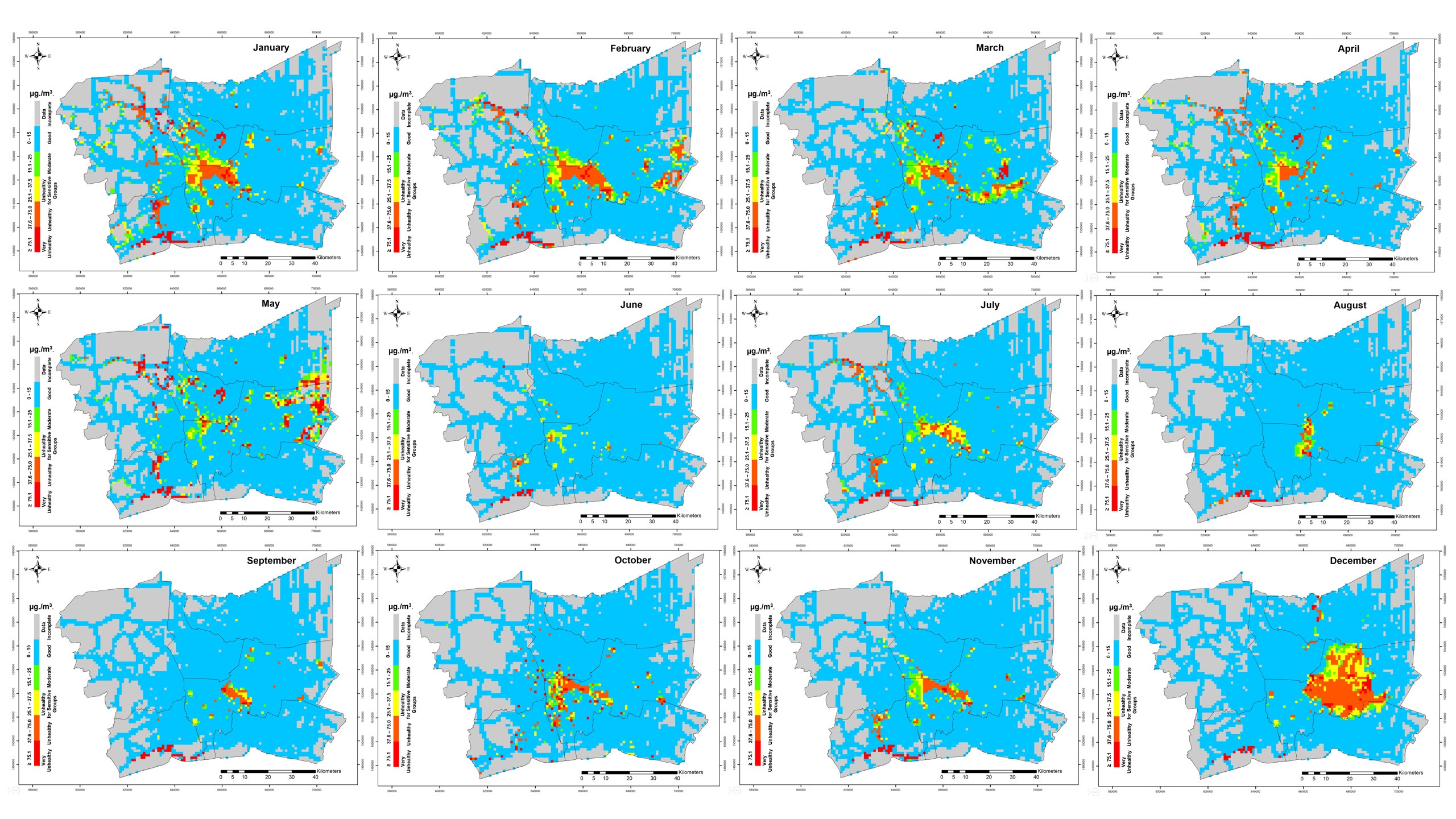
Main Results: The results of PM2.5 concentration estimation in the Bangkok Metropolitan Region area during 2019–2023 reveal pronounced spatial and temporal variability, with peak concentrations consistently occurring in the winter season each year. Analysis of the relationships between PM2.5 and meteorological factors indicates that air pressure and relative humidity were the most influential factors. Relative humidity exhibited a significant negative correlation with PM2.5 concentrations, whereas air pressure showed a significant positive correlation. Regarding urban factors, several land use categories were significantly associated with PM2.5, reflecting the role of human activities in shaping pollution distribution patterns. Traffic speed and population density demonstrated weak negative correlations; Aerosol Optical Depth (AOD) data derived from Himawari-8 showed positive correlations with PM2.5 at all monitoring stations. Although the strength of these correlations was moderate, their temporal consistency highlights the potential of AOD as a surrogate for ground-based monitoring data in areas with limited station coverage. The Land Use Regression (LUR) model yielded an R² value of 0.339 for the combined five-year dataset, with a Root Mean Square Error (RMSE) of 9.971. The highest R² value (0.456) was observed in 2020, demonstrating the model’s capacity to explain PM2.5 variability in a complex urban environment. The model outputs were further applied to develop monthly PM2.5 maps, providing a foundational dataset for area-based air quality management planning.
Conclusions: The research findings indicate that PM2.5 concentrations exhibit pronounced seasonal variability, particularly during the winter period. Correlation analysis revealed that meteorological factors are significant determinants, exerting statistically significant influences on PM2.5 levels. In contrast, urban factors play a comparatively lesser role in explaining pollution variability. Aerosol Optical Depth (AOD) data derived from the Himawari-8 demonstrated consistent correlations with PM2.5 concentrations across all monitoring stations over multiple time periods. The Land Use Regression (LUR) model achieved a moderate level of predictive performance and was capable of generating monthly PM2.5 concentration maps. These outputs can effectively support localized air quality monitoring and management strategies.
References
Anwar, S., Shameer, M., Alawadhi, H., & Hamdan, N. M. (2024). Source apportionment of PM2.5 and PM10 pollutants near an urban roadside site using positive matrix factorization. Environmental Advances, 17. https://doi.org/10.1016/j.envadv.2024.100573
Chalermpong, S., Thaithatkul, P., Anuchitchanchai, O., & Sanghatawatana, P. (2021). Land use regression modeling for fine particulate matters in Bangkok, Thailand, using time-variant predictors: Effects of seasonal factors, open biomass burning, and traffic-related factors. Atmospheric Environment, 246. https://doi.org/10.1016/j.atmosenv.2020.118128
Cheewinsiriwat, P. (2016). Estimation of nitrogen dioxide concentrations in Inner Bangkok using Land Use Regression modeling and GIS. Applied Geomatics, 8(2), 107-116. https://doi.org/10.1007/s12518-016-0170-y
Cheewinsiriwat, P., Duangyiwa, C., Sukitpaneenit, M., & Stettler, M. E. J. (2022). Influence of Land Use and Meteorological Factors on PM2.5 and PM10 Concentrations in Bangkok, Thailand. Sustainability, 14(9). https://doi.org/10.3390/su14095367
Chen, Z., Chen, D., Zhao, C., Kwan, M. P., Cai, J., Zhuang, Y., Zhao, B., Wang, X., Chen, B., Yang, J., Li, R., He, B., Gao, B., Wang, K., & Xu, B. (2020). Influence of meteorological conditions on PM 2.5 concentrations across China: A review of methodology and mechanism. Environ Int, 139, 105558. https://doi.org/10.1016/j.envint.2020.105558
Clougherty, J. E. K. I., M, E. H., Zev, R., Grant, P., E., G. J., Johnson, S., Steven, M., Daniel, K., & Thomas, M. (2013). Intra-urban spatial variability in wintertime street-level concentrations of multiple combustion-related air pollutants: the New York City Community Air Survey (NYCCAS). Journal of exposure science & environmental epidemiology, 23(3), 232 - 240.
GBD 2019 Risk Factors Collaborators. (2020). Global burden of 87 risk factors in 204 countries and territories, 1990–2019: A systematic analysis. The Lancet, 396(10258), 1223–1249.
Gupta, P., Zhan, S., Mishra, V., Aekakkararungroj, A., Markert, A., Paibong, S., & Chishtie, F. (2021). Machine Learning Algorithm for Estimating Surface PM2.5 in Thailand. Aerosol and Air Quality Research, 21(11). https://doi.org/10.4209/aaqr.210105
Lang, Q., Zhao, W., Ma, M., & Wang, W. (2023). A Machine Learning-Based Method for Downscaling All-Sky Downward Surface Shortwave Radiation Over Complex Terrain. IEEE Geoscience and Remote Sensing Letters, 20, 1-5. https://doi.org/10.1109/lgrs.2022.3228262
Liu, Z., Xiao, Q., & Li, R. (2023). Full Coverage Hourly PM (2.5) Concentrations' Estimation Using Himawari-8 and MERRA-2 AODs in China. Int J Environ Res Public Health, 20(2). https://doi.org/10.3390/ijerph20021490
Makhdoomi, A., Sarkhosh, M., & Ziaei, S. (2025). PM2.5 concentration prediction using machine learning algorithms: an approach to virtual monitoring stations. Scientific Reports, 15(1), 8076. https://doi.org/10.1038/s41598-025-92019-3
Mohammadi, F., Teiri, H., Hajizadeh, Y., Abdolahnejad, A., & Ebrahimi, A. (2024). Prediction of atmospheric PM2.5 level by machine learning techniques in Isfahan, Iran. Scientific Reports, 14(1), 2109. https://doi.org/10.1038/s41598-024-52617-z
Mukherjee, A., & Agrawal, M. (2018). Assessment of local and distant sources of urban PM2.5 in middle Indo-Gangetic plain of India using statistical modeling. Atmospheric Research, 213, 275-287. https://doi.org/10.1016/j.atmosres.2018.06.014
Nguyen, G. T. H., La, L. T., Hoang-Cong, H., & Le, A. H. (2024). An exploration of meteorological effects on PM2.5 air quality in several provinces and cities in Vietnam. J Environ Sci (China), 145, 139-151. https://doi.org/10.1016/j.jes.2023.07.020
Pope, C. A., Burnett, R. T., Thun, M. J., Calle, E. E., Krewski, D., Ito, K., & Thurston, G. D., (2002). Lung cancer, cardiopulmonary mortality, and long-term exposure to fine particulate air pollution. New England Journal of Medicine, 343(13), 1132–1138.
Putham, K. W. P. a. N. C. (2020). A Comparison of Methods for Estimating Fine Particulate Matter Concentration from Himawari-8 Satellite Over Northern Thailand [Science and Technology]. RMUTI Journal 14(1), 55-67. (in Thai)
Song, Z., Chen, B., & Huang, J. (2022). Combining Himawari-8 AOD and deep forest model to obtain city-level distribution of PM2.5 in China. Environ Pollut, 297, 118826. https://doi.org/10.1016/j.envpol.2022.118826
Thailand Science Research and Innovation. (2022). Urban culture in the marginal area of Bangkok and periphery. https://researchcafe.org/urban-culture-and-marginalized-area/
Thongthammachart, T. S. A., Hikari Shimadera, Tomohito Matsuo & Akira Kondo, (2022). Land Use Random Forests Model Incorporating WRF/CMAQ for Estimating Daily PM2.5 Concentration in Bangkok, Thailand. EnvironmentAsia, 15(2) 2022 15-22. https://doi.org/10.14456/ea.2022.29
Uttamang, P., Choomanee, P., Phupijit, J., Bualert, S., & Thongyen, T. (2023). Investigation of Secondary Organic Aerosol Formation during O3 and PM2.5 Episodes in Bangkok, Thailand. Atmosphere, 14(6). https://doi.org/10.3390/atmos14060994
Wang, B., Yuan, Q., Yang, Q., Zhu, L., Li, T., & Zhang, L. (2021). Estimate hourly PM2.5 concentrations from Himawari-8 TOA reflectance directly using geo-intelligent long short-term memory network. Environ Pollut, 271, 116327. https://doi.org/10.1016/j.envpol.2020.116327
Wang, W., Mao, F., Du, L., Pan, Z., Gong, W., & Fang, S. (2017). Deriving Hourly PM2.5 Concentrations from Himawari-8 AODs over Beijing–Tianjin–Hebei in China. Remote Sensing, 9(8). https://doi.org/10.3390/rs9080858
Wei, J., Li, Z., Pinker, R. T., Wang, J., Sun, L., Xue, W., Li, R., & Cribb, M. (2021). Himawari-8-derived diurnal variations in ground-level PM2.5 pollution across China using the fast space-time Light Gradient Boosting Machine (LightGBM). Atmos. Chem. Phys., 21(10), 7863-7880. https://doi.org/10.5194/acp-21-7863-2021
Wende Zhu, Q. Z., Kun Cai,a, Lei Wang, & Shenshen Li,. (2018). Estimations of PM2.5 concentrations based on the geographically weighted regression from Himawari-8 AOD
Wu, Y., Du, N., Wang, L., Cai, H., & Zhou, B. (2022). Analysis of the Gridded Influencing Factors of the PM2.5 Concentration in Sichuan Province Based on a Stacked Machine Learning Model. International Journal of Environmental Research, 17(1). https://doi.org/10.1007/s41742-022-00494-7
Yang, X., Zheng, Y., Geng, G., Liu, H., Man, H., Lv, Z., He, K., & de Hoogh, K. (2017). Development of PM2.5 and NO2 models in a LUR framework incorporating satellite remote sensing and air quality model data in Pearl River Delta region, China. Environ Pollut, 226, 143-153. https://doi.org/10.1016/j.envpol.2017.03.079
Zang, Z., You, W., Ye, H., Liang, Y., Li, Y., Wang, D., Hu, Y., & Yan, P. (2022). 3DVAR Aerosol Data Assimilation and Evaluation Using Surface PM2.5, Himawari-8 AOD and CALIPSO Profile Observations in the North China. Remote Sensing, 14(16). https://doi.org/10.3390/rs14164009
Zhang, H., Wei, Z., Henderson, B. H., Anenberg, S. C., O'Dell, K., & Kondragunta, S. (2022). Nowcasting Applications of Geostationary Satellite Hourly Surface PM2.5 Data. Weather Forecast, 37(12), 2313-2329. https://doi.org/10.1175/waf-d-22-0114.1
Zou, B., Luo, Y., Wan, N., Zheng, Z., Sternberg, T., & Liao, Y. (2015). Performance comparison of LUR and OK in PM2.5 concentration mapping: a multidimensional perspective. Sci Rep, 5, 8698. https://doi.org/10.1038/srep08698
Downloads
Published
How to Cite
Issue
Section
License
Copyright (c) 2026 Faculty of Science, Burapha University

This work is licensed under a Creative Commons Attribution-NonCommercial-NoDerivatives 4.0 International License.
Burapha Science Journal is licensed under a Creative Commons Attribution-NonCommercial-NoDerivatives 4.0 International (CC BY-NC-ND 4.0) licence, unless otherwise stated. Please read our Policies page for more information