
Peer Review Process
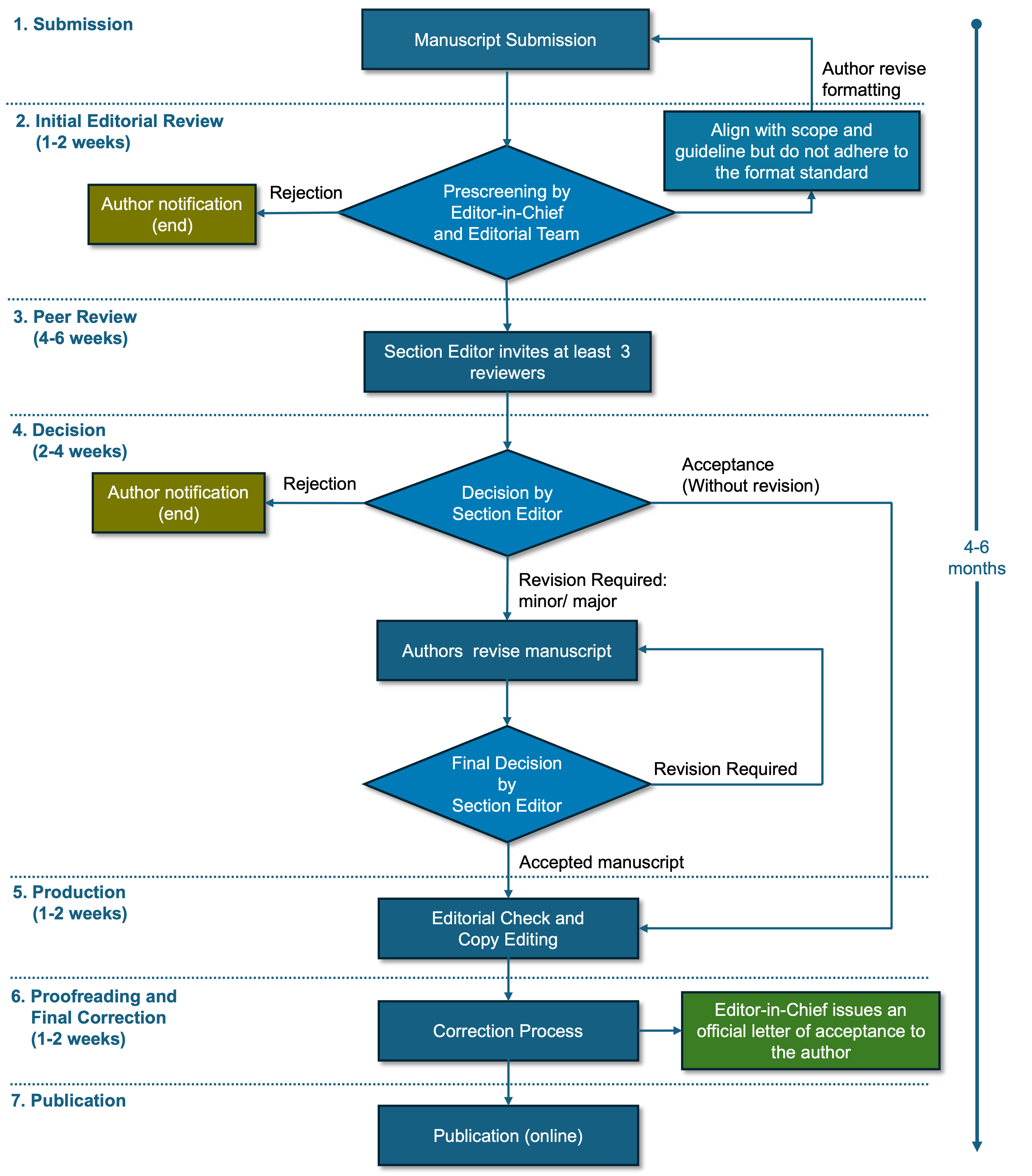
Peer Review Process of Burapha Science Journal
1. Manuscript Submission
Corresponding or submitting author submits their manuscript file through the journal’s online system (ThaiJo system). It is mandatory to include all required components—including figures, tables, and supplementary data—and strictly adhere to the Author Guidelines.
2. Initial Editorial Review (1–2 Weeks)
The Editor-in-Chief screens the submitted manuscript to verify that it aligns with the journal’s scope and guidelines. Submissions failing to meet these criteria are declined without further review. The manuscript is also evaluated for formatting compliance. If a manuscript is suitable for the journal but does not adhere to the formatting rules, it will be returned to the authors for necessary adjustments. Once all initial standards are met, the manuscript is assigned to a Section Editor specializing in the relevant field of study to oversee the peer review process.
3. Peer Review (4–8 Weeks)
Burapha Science Journal utilizes a single-blind peer review system. Upon receiving a manuscript, the assigned Section Editor invites a minimum of three independent expert reviewers who are unaffiliated with the authors' institutions. Reviewers are given up to 4 weeks to complete their assessment. To prevent publication delays, the Section Editor may invite additianl reviewers if the initial reviewer fail to respond. The reviewers are expected to deliver a rigorous, impartial critique of the manuscript's scientific merit. If any of the invited reviewers provides only brief comments, such as suggestions for improving the figures or identifying typos, without giving any feedback on the scientific content of the manuscript; in that case, the section editor will invite additional reviewers to ensure a comprehensive and fair review.
4. Decision (2–6 Weeks)
After receiving all reviewer feedback, the Section Editor evaluates the manuscript alongside the reviewer’s reports to make an initial decision wether to accept, reject, or require revisions. If the reviewer’s recommendations differ significantly, the Section Editor may invite an additional reviewer to resolve the discrepancy before reaching a decision. The Section Editor will then communicate the decision, along with the reviewer's relevant comments, to the authors via the online system. Details of each decision are as follows:
Acceptance (Without revision): The manuscript is accepted as submitted. Once the authors are informed of the decision, the manuscript proceeds directly to the production step.
Rejection: The manuscript is declined for publication. Once the authors are notified, the review process formally concludes.
Revisions Required (Major or Minor revision): For manuscripts requiring revision, authors are given up to 4 weeks to submit their updated work. The authors must address all reviewer feedback, clearly highlight changes within the text, and provide a point-by-point response explaining any disagreements. Upon resubmission, the Section Editor will verify that all comments have been adequately addressed. If any feedback is overlooked, the manuscript will be returned to the authors for completion. If necessary, the revised manuscript may undergo a second round of peer review, which adds approximately 4 weeks to the timeline.
If the authors fail to submit a revised version of their manuscript within 4 weeks after receiving reviewer feedback, the section editor will send two follow-up emails via the online system. The first reminder will be sent after the revision due date has passed, and the authors may request an extension. If the authors do not respond to the section editor's first reminder within two weeks, the editor will send a second reminder. If the authors are still unreachable within two weeks after the second reminder is sent, the section editor may consider terminating the review process and decline the submission.
Accepted manuscript: After completing peer review process, authors will be informed of their manuscript's acceptance for publication by the Section Editor. This process ensures that all submitted manuscripts meet the highest standards of ethical conduct and scientific integrity.
5. Production: Editorial Check and Copy Editing (2–3 Weeks)
Once Burapha Science Journal accepts the manuscript, the production process will begin. The editorial team performs a stylistic and technical review to ensure typographical accuracy and reference formatting. This stage includes professional copy editing and the refinement of all artwork, tables, and supplementary files.
6. Proofreading and Final Correction (1-2 Weeks)
Authors receive the final galley proof for a final check. All requested corrections must be implemented and returned promptly to maintain the publication schedule. Following the final correction process, the Editor-in-Chief will issue an official letter of acceptance to the authors via the online system.
7. Publication
The article is officially published online. The total duration from initial submission to final publication is approximately 4–6 months.