Probiotic Application in Dietary Supplements for 𝘼𝙥𝙞𝙨 𝙢𝙚𝙡𝙡𝙞𝙛𝙚𝙧𝙖
Keywords:
𝘈𝘱𝘪𝘴 𝘮𝘦𝘭𝘭𝘪𝘧𝘦𝘳𝘢, probiotics, lactic acid bacteria, dietary supplements, bee immunityAbstract
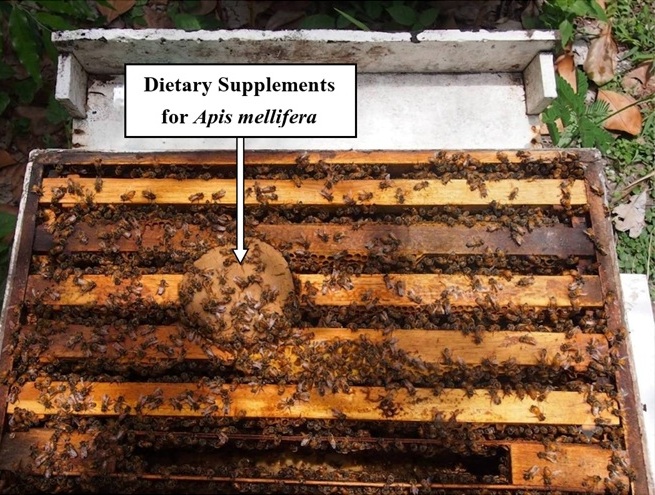
Background and Objectives: Currently, the honey bee (Apis mellifera) industry, including Thailand’s, is experiencing a critical decline known as Colony Collapse Disorder (CCD), which poses an immediate threat to global ecosystems and food security. The primary causes of this crisis stem from combined threats, including fluctuating climate change, pesticide contamination in the environment, and the outbreak of American Foulbrood (AFB) caused by Paenibacillus larvae. These factors result in stress for the bees and a loss of balance in the gut microbiota (gut dysbiosis), which weakens the natural immune system. Although the use of supplementary diets is a primary approach to sustain bee populations during periods of natural pollen scarcity, general supplements lack essential biological components. Therefore, this academic article aims to analyze and present guidelines for the use of probiotics mixed into supplementary diets as a biological innovation to mitigate the impacts of such crises and sustainably enhance the well-being of honey bees in Thailand.
Methodology: The study was conducted by collecting, analyzing, and synthesizing knowledge from experimental research reports and academic documents on the application of probiotics in honey bees. The focus was specifically on autochthonous probiotic strains in Thailand, such as Lactobacillus, Bacillus, and Priestia, which possess outstanding properties in enduring hot and humid climates. The study also covers management methods for supplementary diets, both in the form of mixing in pollen substitute and dissolving in sugar syrup for spray application. Furthermore, key biological indicators were evaluated, including survival rates, changes in body weight, and the quality of reproductive cells in drones, under the specific tropical environmental conditions of Thailand.
Key findings: Traditional supplementary diets lacking probiotics result in an imbalance of the core microbiota in the bee gut, causing bees to lose their biological barriers for disease prevention. However, when autochthonous probiotic strains are added to the supplements, it was found that these microorganisms effectively perform the functions of natural microbiota through the mechanism of competitive exclusion to compete for attachment space on the intestinal wall and produce antimicrobial substances in the bacteriocin group, as well as organic acids that inhibit P. larvae. In terms of physiology, bees receiving probiotic supplements showed an average weight increase of 10-15% and a longer average lifespan compared to the group receiving only supplementary diets. This is because probiotics assist in the digestion of complex nutrients and stimulate signaling through insulin-like peptides. Additionally, significant results were found in drones, where probiotics helped promote spermatogenesis, increasing the concentration and strength of sperm, which is an important factor for reproductive success. At the molecular level, probiotics also help stimulate the expression of immune genes to secrete antimicrobial peptides (AMPs), such as apidaecin and defensin, to protect against environmental threats.
Implications: The development of bee supplements mixed with autochthonous probiotics is a high-potential strategy for addressing the shortage of natural food plants, as local microorganisms adapt well to hot and humid climates. This approach helps beekeepers reduce costs from the loss of bee populations during the off-season of floral blooms and helps elevate honey standards to be antibiotic-free, aligning with export requirements. Furthermore, it serves as a model for producing high-quality supplementary diets that mimic the characteristics of natural food to maintain the strength of the beehive in performing pollination for economic crops and preserving the balance of the ecosystem.
Conclusions: The application of probiotics in supplementary diets for honey bees is an innovation that closes the gap between supplements and natural food. These microorganisms not only function as immunostimulants and pathogen inhibitors but also help improve the metabolism and reproductive systems of bees to a level of integrity comparable to receiving natural food, resulting in healthier beehives that can effectively resist diseases and fluctuating environmental conditions.
References
Alberoni, D., Baffoni, L., Gaggìa, F., Ryan, P. M., Murphy, K., Ross, R. P., Stanton, C., & Di Gioia, D. (2018). Impact of beneficial bacteria supplementation on the gut microbiota, colony development and productivity of Apis mellifera L. Beneficial Microbes, 9(2), 269-278. https://doi.org/10.3920/BM2017.0061
Aurell, D., Bruckner, S., Wilson, M., Steinhauer, N., & Williams, G. R. (2024). A national survey of managed honey bee colony losses in the USA: Results from the Bee Informed Partnership for 2020–21 and 2021–22. Journal of Apicultural Research, 63(1), 1–14. https://doi.org/10.1080/00218839.2023.2264601
Baer, B., Heazlewood, J. L., Taylor, N. L., Eubel, H., & Millar, A. H. (2009). The seminal fluid proteome of the honeybee Apis mellifera. Proteomics, 9(8), 2085-2097. https://doi.org/10.1002/pmic.200800708
Borges, D., Guzman-Novoa, E., & Goodwin, P. H. (2021). Effects of prebiotics and probiotics on honey bees (Apis mellifera) infected with the microsporidian parasite Nosema ceranae. Microorganisms, 9(3), 481. https://doi.org/10.3390/microorganisms9030481
Brodschneider, R., & Crailsheim, K. (2010). Nutrition and health in honey bees. Apidologie, 41(3), 278–294. https://doi.org/10.1051/apido/2010012
Chantawannakul, P., De Guzman, L., Li, J., & Williams, G.R. (2016). Parasites, pathogens, and pests of honeybees in Asia. Apidologie, 47(3), 301-324. https://doi.org/10.1007/s13592-015-0407-5
Ding, N., Zhang, X., Zhang, X. D., Jing, J., Liu, S. S., Mu, Y. P., Peng, L. L., Yan, Y. J., Xiao, G. M., Bi, X. Y., Chen, H., Li, F. H., Yao, B., & Zhao, A. Z. (2020). Impairment of spermatogenesis and sperm motility by the high-fat diet-induced dysbiosis of gut microbes. Gut, 69(9), 1608-1619. https://doi.org/10.1136/gutjnl-2019-319127
Disayathanoowat, T., Li, H., Supapimon, N., Suwannarach, N., Lumyong, S., Chantawannakul, P.,& Guo, J. (2020). Different dynamics of bacterial and fungal communities in hive-stored bee bread and their possible roles: a case study from two commercial honey bees in China. Microorganisms, 8(2), 264. https://doi.org/10.3390/microorganisms8020264
Disayathanoowat, T., Yoshiyama, M., Kimura, K., & Chantawannakul, P. (2012a) Isolation and characterization of bacteria from the midgut of the Asian honey bee (Apis cerana indica). Journal of Apicultural Research, 51(4), 312-319, http://dx.doi.org/10.3896/IBRA.1.51.4.04
Disayathanoowat, T., Young, J. P. W., Helgason, T., & Chantawannakul, P. (2012b). T-RFLP analysis of bacterial communities in the midguts of Apis mellifera and Apis cerana honey bees in Thailand. FEMS Microbiology Ecology, 79(2), 273–281. https://doi.org/10.1111/j.1574-6941.2011.01216.x
Elenany, Y.E., & Hassan, A.A.M. (2023). Beneficial effect of honeybee-specific lactic acid bacteria on health and activity of Apis mellifera L. colonies. Bulletin of the National Research Centre, 47(1), https://doi.org/10.1186/s42269-023-00997-z
Ellegaard, K. M., & Engel, P. (2019). Genomic diversity landscape of the honey bee gut microbiota. Nature Communications, 10(1), 446. https://doi.org/10.1038/s41467-019-08303-0
Engel, P., Kwong, W. K., & Moran, N. A. (2013). Frischella perrara gen. nov., sp. nov., a gammaproteobacterium isolated from the gut of honeybees, Apis mellifera. International Journal of Systematic and Evolutionary Microbiology, 63(10), 3646–3651. https://doi.org/10.1099/ijs.0.049569-0
Gallai, N., Salles, J. M., Settele, J., & Vaissière, B. E. (2009). Economic valuation of the vulnerability of world agriculture confronted with pollinator decline. Ecological Economics, 68(3), 810–821. https://doi.org/10.1016/j.ecolecon.2008.06.014
Goli Mehdi Abadi, M. E., Hosseini-Safa, A., Habibi, S., Dehghan, M., Forouzani-Moghaddam, M. J., & Oshaghi, M. (2023). Isolation and characterization of the lactobacillus strain from honey and its probiotic properties. Iranian Journal of Microbiology, 15(3), 439–447. https://doi.org/10.18502/ijm.v15i3.12905
Goulson, D., Nicholls, E., Botías, C., & Rotheray, E. L. (2015). Bee declines driven by combined stress from parasites, pesticides, and lack of flowers. Science, 347(6229), Article 1255957. https://doi.org/10.1126/science.1255957
Kešnerová, L., Mars, R. A. T., Ellegaard, K. M., Troilo, M., Sauer, U., & Engel, P. (2017). Disentangling metabolic functions of bacteria in the honey bee gut. PLoS Biol, 15(12), e2003467. https://doi.org/10.1371/journal.pbio.2003467
Killam, S. M., Daisley, B. A., Kleiber, M. L., Lacika, J. F., & Thompson, G. J. (2024). A case for microbial therapeutics to bolster colony health and performance of honey bees. Frontiers in Bee Science, 2(1422265). https://doi.org/10.3389/frbee.2024.1422265
Kwong, W. K., & Moran, N. A. (2016). Gut microbial communities of social bees. Nature Reviews Microbiology, 14(10), 623–635. https://www.nature.com/articles/nrmicro.2016.43
Le Conte, Y., & Navajas, M. (2008). Climate change: impact on honey bee populations and diseases. Revue Scientifique et Technique (International Office of Epizootics), 27(2), 499–510. https://doi.org/10.20506/rst.27.2.1819
Motta, E. V. S., & Moran, N. A. (2024). The honeybee microbiota and its impact on health and disease. Nature Reviews Microbiology, 22(3), 122–137. https://doi.org/10.1038/s41579-023-00990-3
Pettis, J. S., Rice, N., Joselow, K., vanEngelsdorp, D., & Chaimanee, V. (2016). Colony failure linked to low sperm viability in honey bee (Apis mellifera) queens and an exploration of potential causative factors. PLoS ONE, 11(5), e0155833. https://doi.org/10.1371/journal.pone.0155833
Powell, J. E., Martinson, V. G., Urban-Mead, K., & Moran, N. A. (2014). Routes of acquisition of the gut microbiota of the honey bee Apis mellifera. Applied and Environmental Microbiology, 80(23), 7378-7387. https://doi.org/10.1128/AEM.01861-14
Prihadi, J. C., Hengky, A., Alvianto, S., Putranata, H., Putra, P. A., & Telium, H. D. (2026). Probiotic supplementation improved sperm parameters in idiopathic infertility male: a systematic review and meta-analysis. Urologia Colombiana. 35(1), 39-48. https://doi.org/10.24875/RUC.25000029
Raymann, K., & Moran, N. A. (2018). The role of the gut microbiome in health and disease of adult honey bees workers. Current Opinion in Insect Science, 26, 97–104. https://doi.org/10.1016/j.cois.2018.02.012
Sanchez-Rodriguez, A., Idrovo, I. I. D., Villafranca, R., Latorre, N., Rielo, J. A., Laburu, A., Nieto-Román, S., Heredia, D., González, R., García-Cañas, V., Laxalde, D., Simó, C., Vieites, D. R., & Roldan, E. R. S. (2025). Effect of probiotics on sperm quality in the adult mouse. Probiotics and antimicrobial proteins, 17(6), 4480–4490. https://doi.org/10.1007/s12602-024-10388-z
Suenami, S., Koto, A., & Miyazaki, R. (2023). Basic structures of gut bacterial communities in eusocial insects. Insects, 14(5), 444. https://doi.org/10.3390/insects14050444
Tarpy, D. R., Keller, J. J., Caren, J. R., & Delaney, D. A. (2012). Assessing the mating health of commercial honey bee queens. Journal of Economic Entomology, 105(1), 20-25. https://doi.org/10.1603/EC11276
Thacharoen, C., Chuankid, W., Inkaewwong, T., Petchdee, P., Sompowloy, T., & Pisithkul, T. (2023). Biological properties and potential probiotic bacteria isolated from honey collected in Chiang Mai, Thailand. Agriculture and Natural Resources, 57(3), 429–440. https://li01.tci-thaijo.org/index.php/anres/article/view/260142
Tlak Gajger, I., & Mutinelli, F. (2024). Impact of environmental factors and management practices on bee health. Insects, 15(12), 996 https://doi.org/10.3390/insects15120996
Vasquez, A., Forsgren, E., Fries, I., Paxton, R. J., Flaberg, E., Schedwin, L., & Olofsson, T. C. (2012). Symbionts as major modulators of insect health: Lactic acid bacteria and honeybees. PLoS ONE, 7(3), Article e33188. https://doi.org/10.1371/journal.pone.0033188
Wongsiri, S., & Deowanish, S. (2012). Biology of Bees (3rd ed.). Bangkok: Chulalongkorn University Press. (in Thai)
Yooboriboon, S., Chuenchan, W., & Sumpaoloi, T. (2021a). Effect of supplementary diet mixed with probiotics on colony population of Apis mellifera Linnaeus, 1758. Burapha Science Journal, 26(3), 1796-1813. (in Thai)
Yooboriboon, S., Chuenchan, W., Sumpaoloi, T., & Pawara, T. (2021b). Effect of supplementary diets mixed with probiotics on sperms production of Apis mellifera. Journal of Science Ladkrabang, 30(1), 44–54. (in Thai)
Yooboriboon, S., Chuenchan, W., & Sumpaoloi, T. (2023). Effect of dietary supplement mixed with probiotics on body weight and age of honeybee (Apis mellifera). Journal of Science Ladkrabang, 32(1), 106–119. (in Thai)
Zheng, H., Perreau, J. J., Powell, E. J., Han, B., Zhang, Z., Kwong, W. K., Tringe, S. G., & Moran, N. A. (2019). Division of labor in honey bee gut microbiota for plant polysaccharide digestion. Proceeding of the National Academy of Sciences, 116(51), 25909–25916. https://doi.org/10.1073/pnas.1916224116
Zheng, H., Powell, J. E., Steele, M. I., Dietrich, C., & Moran, N. A. (2017). Honeybee gut microbiota promotes host weight gain via bacterial metabolism and hormonal signaling. Proceeding of the National Academy of Scienc
Downloads
Published
How to Cite
Issue
Section
License
Copyright (c) 2026 Faculty of Science, Burapha University

This work is licensed under a Creative Commons Attribution-NonCommercial-NoDerivatives 4.0 International License.
Burapha Science Journal is licensed under a Creative Commons Attribution-NonCommercial-NoDerivatives 4.0 International (CC BY-NC-ND 4.0) licence, unless otherwise stated. Please read our Policies page for more information