
From Detection to Interpretation: Generating Human-Readable Cabbage Disease Reports Using YOLOv8s and LLaMA 3.1-13B-Instruct
Keywords:
cabbage disease detection, LLaMA 3.1-13B-Instruct, precision agriculture, structured-to-text generation, YOLOv8sAbstract
Background and Objectives: Recent advances in deep learning have significantly improved plant disease detection, particularly through convolutional neural networks (CNNs) and YOLO-based object detection architectures. In precision agriculture, these approaches have demonstrated strong capabilities for identifying and localizing disease symptoms with high accuracy. However, most existing systems primarily produce technical outputs such as bounding boxes, class labels, and confidence scores, which are difficult for non-expert agricultural users to interpret and utilize for practical decision-making. Consequently, a gap remains between detection performance and real-world usability. Farmers and agricultural practitioners often require contextual explanations, severity interpretation, and actionable recommendations rather than raw detection outputs. At the same time, recent developments in large language models (LLMs) have shown strong potential for transforming structured information into coherent and human-readable narratives. Nevertheless, the integration of object detection and language generation for agricultural disease reporting remains largely unexplored. To address this limitation, this study proposes an end-to-end detection-to-interpretation framework that integrates YOLOv8s and LLaMA 3.1-13B-Instruct to automatically transform cabbage disease detection outputs into human-readable and actionable agricultural reports. The framework aims to bridge the gap between visual disease detection and user-centered interpretation, thereby improving the interpretability, accessibility, and practical usability of artificial intelligence (AI) systems in precision agriculture.
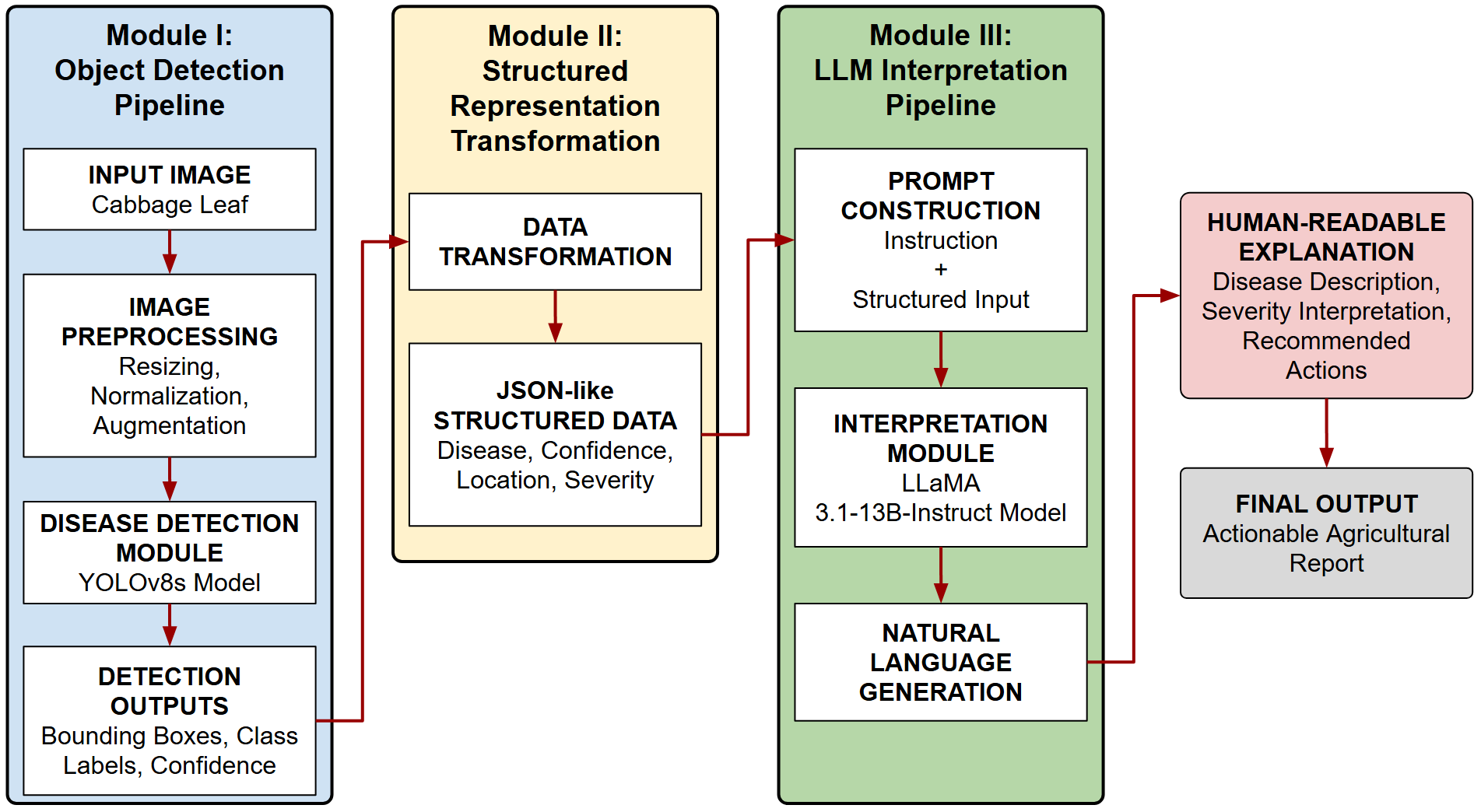
Methodology: The proposed framework consists of three main components: disease detection, structured representation transformation, and natural language generation (NLG). A publicly available cabbage disease dataset containing Black Rot, Downy Mildew, and Healthy classes was adapted for object detection through manual annotation and expert validation. The final dataset comprised 1,500 images and was divided into training, validation, and testing subsets using a 70:15:15 ratio. YOLOv8s was employed as the disease detection model due to its favorable balance between detection accuracy and computational efficiency. The model was trained using resized images of 640 × 640 pixels with data augmentation techniques including rotation, scaling, flipping, and brightness adjustment. Detection outputs consisting of bounding boxes, disease labels, and confidence scores were subsequently transformed into a structured representation containing disease type, confidence level, spatial location, and estimated severity. This intermediate representation served as a semantic bridge between computer vision outputs and language generation. LLaMA 3.1-13B-Instruct was then used to generate natural language explanations through prompt-based structured-to-text generation. Few-shot prompting, controlled decoding parameters, and post-processing mechanisms were applied to improve consistency and readability. The framework was evaluated through multiple perspectives, including object detection metrics, text generation metrics, baseline comparisons, ablation analysis, and qualitative expert assessment.
Main Results: Experimental results demonstrate that the proposed framework achieves strong performance across both detection and interpretation tasks. The YOLOv8s detection module achieved a precision of 0.85, recall of 0.83, and mAP@0.5 of 0.87, indicating reliable disease localization and classification performance. Compared with the Faster R-CNN baseline, which achieved an mAP@0.5 of 0.81, YOLOv8s provided superior detection accuracy while maintaining computational efficiency suitable for real-time agricultural deployment. Class-level analysis showed that Black Rot achieved the highest detection performance with an mAP@0.5 of 0.89, while Downy Mildew achieved 0.85 due to the more subtle visual characteristics of its symptoms. For the language generation component, the generated explanations achieved a BLEU score of 0.48, ROUGE-L of 0.61, METEOR of 0.54, and BERTScore of 0.89, demonstrating strong semantic alignment with expert-written references. Baseline comparisons further revealed that the proposed framework outperformed both template-based reporting and a lightweight LLaMA 3.2-3B-Instruct model across all evaluation metrics. Ablation analysis confirmed the importance of the structured representation and prompt engineering components. Removing the structured representation reduced BERTScore from 0.89 to 0.83, while removing few-shot prompting reduced BLEU from 0.48 to 0.42 and resulted in more generic and repetitive outputs. Qualitative evaluation involving three agricultural experts demonstrated that 88% of the generated explanations were rated as accurate, clear, and actionable. Furthermore, the evaluation achieved strong inter-rater agreement with a Cohen’s Kappa coefficient of κ = 0.81, indicating high reliability and consistency among expert assessments.
Conclusions: The proposed YOLOv8s–LLaMA 3.1-13B-Instruct framework effectively bridges visual disease detection and agricultural interpretation by transforming technical detection outputs into understandable, context-aware, and actionable disease reports. The results demonstrate that integrating object detection with LLMs can significantly improve the interpretability and practical value of AI-based plant disease diagnosis systems. Beyond achieving strong detection accuracy and semantic generation quality, the framework supports user-centered decision-making by providing explanations that are accessible to non-expert agricultural users. The study contributes a novel detection-to-interpretation pipeline, an expert-validated cabbage disease detection dataset, and a structured representation mechanism that connects computer vision and NLG. Nevertheless, the framework currently relies on heuristic-based severity estimation and is limited to a small number of disease categories under constrained environmental conditions. Future research should focus on incorporating lesion segmentation, vision transformer-based architectures, multimodal environmental information, domain-specific language model adaptation, and large-scale field validation to improve robustness, scalability, and applicability in real-world precision agriculture environments.
References
Agrawal, N. K., & Sharma, A. K. (2021). Detection of diseases in plants using convolutional neural networks. In Proc. 10th Int. Conf. SMART (pp. 215-217). IEEE. https://doi.org/10.1109/SMART52563.2021.9676299
Aleinzi, M. (2025). Enhancing precision agriculture with YOLOv8: a deep learning approach to potato disease identification. Int. J. Adv. Comput. Sci. Appl., 16(4), 1156-1166. https://dx.doi.org/10.14569/IJACSA.2025.01604110
Ayawli, B. B. K., Kopri, G., Dawson, J. K., Bediako-Kyeremeh, B., Buabeng, S. A., Deveh, D., Ayawli, E. I. B., Badu, E., & Lamusah, D. (2025). Image dataset of Cabbage Crop diseases. Mendeley Data, V1. https://data.mendeley.com/datasets/sjmgzhwrxv/1
Balasubramanian, J. B., Adams, D., Roxanis, L., Gonzalez, A. B. d., Coulson, P., Almeida, J. S., & García-Closas, M. (2025). Leveraging large language models for structured information extraction from pathology reports. J. Pathol. Inform., 1(1), 100521, 1-28. https://doi.org/10.1016/j.jpi.2025.100521
Barbedo, J. G. A. (2019). Plant disease identification from individual lesions and spots using deep learning. Biosyst. Eng., 180(4), 96-107. https://doi.org/10.1016/j.biosystemseng.2019.02.002
Berhe, T. S., Gebreab, S., Musamih, A., AlKhader, W., Salah, K., Ellahham, S., & Jayaraman, R. (2026). Few-shot prompting strategies for improving large language model-based cardiovascular disease risk prediction. Array, 30(2026), 100819, 1-17. https://doi.org/10.1016/j.array.2026.100819
Citarella, A. A., Barbella, M., Ciobanu, M. G., Marco, F. D., Biasi, L. D., & Tortora, G. (2025). Assessing the effectiveness of ROUGE as unbiased metric in extractive vs. abstractive summarization techniques. J. Comput. Sci., 87(1), 102571, 1-17. https://doi.org/10.1016/j.jocs.2025.102571
Ebron, J. G., Apuada, G. R. B., Parra, D. L. R., & Virtucio, J. P. F. T. (2024). Classification of leafy diseases of brassica rapa (Chinese cabbage) using selected parameters in an uncontrolled environment via image processing. Chem. Eng. Trans., 113(1), 451-456. https://doi.org/10.3303/CET24113076
Gan, B., Pu, G., Xing, W., Wang, L., & Liang, S. (2025). Enhanced YOLOv8 with lightweight and efficient detection head for detecting rice leaf diseases. Sci. Rep., 15(1), 22179, 1-13. https://doi.org/10.1038/s41598-025-06843-8
Gao, X., Wang, G., Qi, J., Wang, Q., Xiang, M., Song, K., & Zhou, Z. (2024). Improved YOLOv7 for sustainable agriculture significantly improves precision rate for Chinese cabbage (brassica pekinensis rupr.) seedling belt (CCSB) detection. Sustainability, 16(11), 4759, 1-20. https://doi.org/10.3390/su16114759
Girmaw, D. W., Salau, A. O., Mamo, B. S., & Molla, T. L. (2024). A novel deep learning model for cabbage leaf disease detection and classification. Discover Appl. Sci., 6(1), 521, 1-20. https://doi.org/10.1007/s42452-024-06233-1
Gupta, A., Rastogi, A., Malhotra, H., & Rangarajan, K. (2024). Comparative evaluation of large language models for translating radiology reports into Hindi. Indian J. Radiol. Imaging, 35(1),88-96. https://doi.org/10.1055/s-0044-1789618
Haris, M., Tripathi, A., Pandey, S. S., Tiwari, H., & Ansari, A. A. (2025). A deep learning-based model for plant disease detection. J. Neonatal Surg., 14(5s), 913-925. https://doi.org/10.52783/jns.v14.3655
Hou, S., Pang, Y., Wang, J., Hou, J., & Wang, B. (2025). RS-YOLO: A highly accurate real-time detection model for small-target pest. Smart Agric. Technol., 12(1), 101212, 1-13. https://doi.org/10.1016/j.atech.2025.101212
Jeong, G-S., & Park, J-H. (2025). Early-stage cabbage monitoring using UAV multispectral imagery and a modified faster R-CNN: enhanced object delineation with ExG-based dissolve. Korean J. Remote Sens., 41(1), 73-86. https://doi.org/10.7780/kjrs.2025.41.1.7
Jiang, P., Qi, A., Zhong, J., Luo, Y., Hu, W., Shi, Y., & Liu, T. (2024). Field cabbage detection and positioning system based on improved YOLOv8n. Plant Methods, 20(1), 96, 1-15. https://doi.org/10.1186/s13007-024-01226-y
Joshi, K., Kumar, S., Kumar, V., Nandal, R., Kumar, Y., Tuteja, N., Gill, R., & Gill, S. S. (2025). AgriCure: A web application based layered augmentation-enhanced YOLOv8 for disease and nutrient deficiency detection in bitter gourd leaves. Curr. Plant Biol., 43(1), 100517, 1-14. https://doi.org/10.1016/j.cpb.2025.100517
Kheir, A. M. S., Koubaa, A., Kolluru, V., Mungara, S., & Feike, T. (2025). Smart plant disease diagnosis using multiple deep learning and web application integration. J. Agric. Food Res., 21(1), 101948, 1-13. https://doi.org/10.1016/j.jafr.2025.101948
Li, D., Gupta, K., Bhaduri, M., Sathiadoss, P., Bhatnagar, S., & Chong, J. (2025a). Comparative diagnostic accuracy of GPT-4o and LLaMA 3-70b: Proprietary vs. open-source large language models in radiology. Clin. Imaging, 118(1), 110382, 1-15. https://doi.org/10.1016/j.clinimag.2024.110382
Li, K., Song, Y., Zhu, X., & Zhang, L. (2025b). A severity estimation method for lightweight cucumber leaf disease based on DM-BiSeNet. Inf. Process. Agric., 12(1), 68-79. https://doi.org/10.1016/j.inpa.2024.03.003
Li, J., Li, J., Zhao, X., Su, X., & Wu, W. (2023). Lightweight detection networks for tea bud on complex agricultural environment via improved YOLOv4. Comput. Electron. Agric., 211(1), 107955. https://doi.org/10.1016/j.compag.2023.107955
Lin, K-H., Kao, T-H., Wang, L-C., Kuo, C-T., Chen, P. C-H., Chu, Y-C., & Yeh, Y-C. (2025). Benchmarking large language models GPT-4o, llama 3.1, and qwen 2.5 for cancer genetic variant classification. npj Precis. Oncol., 9(1), 141, 1-10. https://doi.org/10.1038/s41698-025-00935-4
Liu, M., Yang, B., Wang, X., Xu, X., Ding, W., He, P., & Zhou, W. (2025). Co-benefits of a customized nutrient management approach tailored to smallholder farming for cabbage (Brassica oleracea L.). Eur. J. Agron., 163(127453), 1-20. https://doi.org/10.1016/j.eja.2024.127453
Lyu, Y., Kuswidiyanto, L. W., Wang, P., Noh, H-H., Jung, H-Y., & Han, X. (2025). One-dimensional convolutional neural network for automated kimchi cabbage downy mildew detection using aerial hyperspectral images. Remote Sens., 17(9), 1626, 1-23. https://doi.org/10.3390/rs17091626
Ma, H., Kong, C., Deng, S., Zhao, T., Ji, J., Wang, Y., Zhang, Y., Zhuang, M., Yang, L., Lebedeva, M., Taranov, V., Artemyeva, A. M., Hu, Z., Yu, J., Fang, Z., & Lv, H. (2025). Resistance screening of cabbage to black rot and inheritance pattern analysis. Sci. Hortic., 345(1), 114129, 1-7. https://doi.org/10.1016/j.scienta.2025.114129
Magalhães, S. A., Castro, L., Moreira, G., Santos, F. N. d., Cunha, M., Dias, J., & Moreira, A. P. (2021). Evaluating the single-shot multibox detector and YOLO deep learning models for the detection of tomatoes in a greenhouse. Sensors, 21(10), 3569, 1-24. https://doi.org/10.3390/s21103569
Mahyoub, M., Wang, Y., & Khasawneh, M. T. (2025). GPT-4o in radiology: in-context learning based automatic generation of radiology impressions. Nat. Lang. Process. J., 11(1), 100145, 1-10. https://doi.org/10.1016/j.nlp.2025.100145
Onan, A., & Alhumyani, H. (2024). Knowledge-enhanced transformer graph summarization (KETGS): integrating entity and discourse relations for advanced extractive text summarization. Mathematics, 12(23), 3638, 1-25. https://doi.org/10.3390/math12233638
Orchi, H., Sadik, M., Khaldoun, M., & Sabir, E. (2023). Real-time detection of crop leaf diseases using enhanced YOLOv8 algorithm. In Proc. Int. Wireless Commun. Mobile Comput. (pp. 1690-1696). IEEE. https://doi.org/10.1109/IWCMC58020.2023.10182573
Oro, E., Granata, F. M., & Ruffolo, M. (2025). A Comprehensive Evaluation of Embedding Models and LLMs for IR and QA Across English and Italian. Big Data Cogn. Comput., 9(5), 141, 1-41. https://doi.org/10.3390/bdcc9050141
Qu, J., Li, G., Li, Y., Zhang, X., Yan, X., & Jin, H. (2025). SPW-YOLOv8: a high-precision and efficient deep learning model for rice leaf disease detection. Meas. Sci. Technol., 36(9), 095701, 1-10. https://doi.org/10.1088/1361-6501/ae01c4
Rahman, K. N., Banik, S. C., Islam, R., & Fahim, A. A. (2025). A real time monitoring system for accurate plant leaves disease detection using deep learning. Crop Des., 4(1), 100092, 1-16. https://doi.org/10.1016/j.cropd.2024.100092
Reya, S. S., Malek, M. D. A., & Debnath, A. (2022). Deep learning approaches for cabbage disease classification. In Proc. Int. Conf. Recent Progr. Sci. Eng. Technol. (pp. 1-5). IEEE. https://doi.org/10.1109/ICRPSET57982.2022.10188553
Rezaei, M., Diepeveen, D., Laga, H., & Sohel, F. (2026). Automatic pixel-level annotation for plant disease severity estimation. Comput. Electron. Agric., 241(2026), 111316, 1-17. https://doi.org/10.1016/j.compag.2025.111316
Sambana, B., Nnadi, H. S., Wajid, M. A., Fidelia, N. O., Camacho-Zuñiga, C., Ajuzie, H. D., & Onyema, E. M. (2025). An efficient plant disease detection using transfer learning approach. Sci. Rep., 15(1), 19082, 1-15. https://doi.org/10.1038/s41598-025-02271-w
Sharma, R., Kukreja, V., & Bordoloi, D. (2023). Deep learning meets agriculture: a faster RCNN based approach to pepper leaf blight disease detection and multi-classification. In Proc. 4th Int. Conf. Emerg. Technol. (pp. 1-5). IEEE. https://doi.org/10.1109/INCET57972.2023.10170692
Shen, Y., Yang, Z., Khan, Z., Liu, H., Chen, W., & Duan, S. (2025). Optimization of improved YOLOv8 for precision tomato leaf disease detection in sustainable agriculture. Sensors, 25(5), 1398, 1-23. https://doi.org/10.3390/s25051398
Sorour, S. E., & Almusallam, N. (2025). L3D-RAG: leveraging LLaMA 3.1 and DeepSeek with retrieval-augmented generation (RAG) for advanced reddit community analysis. Alexandria Eng. J., 131(1), 125-152. https://doi.org/10.1016/j.aej.2025.09.070
Sun, H., Liu, T., Wang, J., Zhai, D., & Yu, J. (2024). Evaluation of two deep learning-based approaches for detecting weeds growing in cabbage. Pest Manag. Sci., 80(6), 2817-2826. https://doi.org/10.1002/ps.7990
Syahidi, A. A., & Kiyokawa, K. (2025). Automatic text generation in Banjar language using GPT-4 for low-resource language preservation. In Proc. 7th Symp. Comput. Informatics (pp. 238-243). IEEE. https://doi.org/10.1109/ISCI65687.2025.11167521
Syahidi, A. A., Kiyokawa, K., & Nuchitprasitchai, S. (2025). A fine-tuned GPT-4-based question answering system for e-government services using a custom-built dataset. In Proc. 7th Symp. Comput. Informatics (pp. 232-237). IEEE. https://doi.org/10.1109/ISCI65687.2025.11166787
Szechyńska-Hebda, M., Hołownicki, R., Doruchowski, G., Sas, K., Puławska, J., Jarecka-Boncela, A., Ptaszek, M., & Włodarek, A. (2025). Application of hyperspectral imaging for early detection of pathogen-induced stress in cabbage as case study. Agronomy, 15(7), 1516, 1-30. https://doi.org/10.3390/agronomy15071516
Tang, G., Yousuf, O., & Jin, Z. (2024). Improving BERTScore for Machine Translation Evaluation Through Contrastive Learning. IEEE Access, 12(1), 77739, 1-11. https://doi.org/10.1109/ACCESS.2024.3406993
Vega-Álvarez, C., Francisco, M., & Soengas, P. (2021). Black rot disease decreases young brassica oleracea plants’ biomass but has no effect in adult plants. Agronomy, 11(3), 569, 1-12. https://doi.org/10.3390/agronomy11030569
Wang, S., Ma, S., Wang, Y., Yang, X., Jiao, C., Yang, C., Wang, X., Wang, X., Xiang, W., & Zhao, J. (2026). Fungal diversity, pathogenicity, and fungicide sensitivity in leaf diseases of Chinese cabbage from Heilongjiang Province, China. Physiol. Mol. Plant Pathol., 141(1), 102991, 1-14. https://doi.org/10.1016/j.pmpp.2025.102991
Wang, X., & Song, J. (2021). ICIoU: improved loss based on complete intersection over union for bounding box regression. IEEE Access, 9(1), 105686, 1-10. https://doi.org/10.1109/ACCESS.2021.3100414
Zahid, I. A., Joudar, S. S., Albahri, A. S., Albahri, O. S., Alamoodi, A. H., Santamaría, J., & Alzubaidi, L. (2024). Unmasking large language models by means of OpenAI GPT-4 and Google AI: A deep instruction-based analysis. Intell. Syst. Appl., 23(1), 200431, 1-18. https://doi.org/10.1016/j.iswa.2024.200431
Zhang, Y., Lin, S., Xiong, Y., Li, N., Zhong, L., Ding, L., & Hu, Q. (2025). Fine-tuning large language models for interdisciplinary environmental challenges. Environ. Sci. Ecotechnol., 27(1), 100608, 1-11. https://doi.org/10.1016/j.ese.2025.100608
Downloads
Published
How to Cite
Issue
Section
License
Copyright (c) 2026 Faculty of Science, Burapha University

This work is licensed under a Creative Commons Attribution-NonCommercial-NoDerivatives 4.0 International License.
Burapha Science Journal is licensed under a Creative Commons Attribution-NonCommercial-NoDerivatives 4.0 International (CC BY-NC-ND 4.0) licence, unless otherwise stated. Please read our Policies page for more information