
Assessing Evapotranspiration and Water Use Efficiency of Cassava Using Landsat-8 and SEBS: A Case Study of the Thai Tapioca Development Institute, Thailand
Keywords:
water use efficiency, evapotranspiration, SEBS, landsat 8, GPPAbstract
Background and Objectives: Water use efficiency (WUE) is a critical determinant of sustainable agricultural water management, quantifying the relationship between crop productivity and water consumption through evapotranspiration (ET). ET governs the exchange of water and energy among the soil, vegetation, and atmosphere, making its accurate estimation essential for optimizing irrigation strategies and managing water resources at both field and regional scales. Remote sensing has emerged as a viable approach for spatially and temporally monitoring ET; however, satellite-derived spectral measurements cannot directly quantify ET and must be integrated with surface energy balance models. This study applied the Surface Energy Balance System (SEBS) model to estimate ET in cassava (Manihot esculenta Crantz) cultivation at the Thai Tapioca Development Institute, Tambon Huai Bong, Dan Khun Thot District, Nakhon Ratchasima Province, Thailand, and to assess satellite-based WUE using the GPP/ET approach, while acknowledging the conceptual distinction from field agronomic WUE.
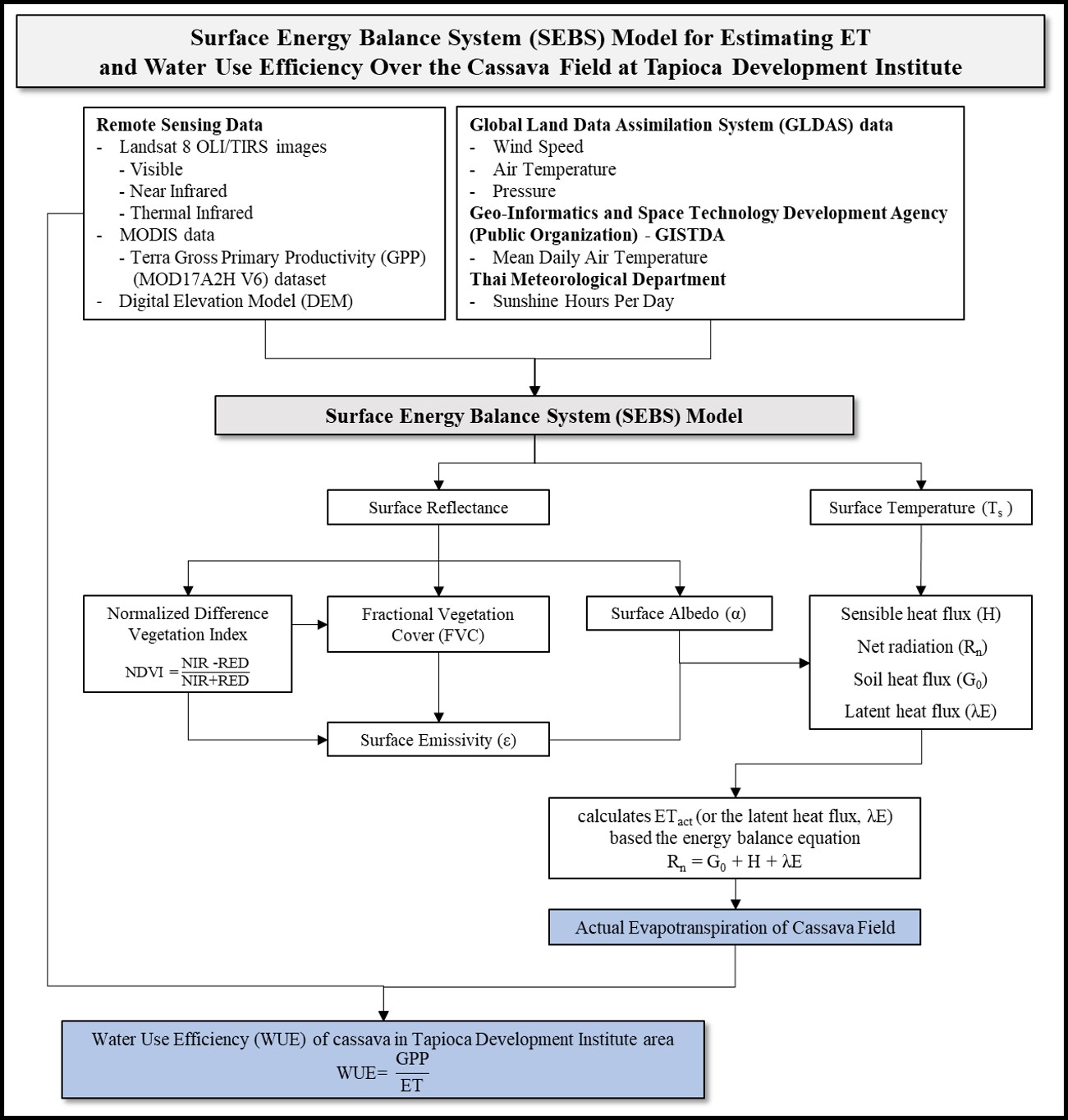
Methodology: The SEBS model was implemented using three primary input datasets: (1) satellite-derived land surface parameters including surface albedo (derived via the Liang (2001) algorithm), land surface temperature, NDVI, and fractional vegetation cover extracted from Landsat 8 OLI/TIRS imagery (path 129, row 49, Collection 2 Level 2), supplemented by Gross Primary Productivity (GPP) from MODIS (MOD17A2H V6, 500 m, 8-day composite) and DEM data; (2) meteorological variables including air pressure, air temperature, relative humidity, and wind speed sourced from GLDAS (Noah model, 0.25 degree, 3-hourly); and (3) downward solar and longwave radiation fluxes. A total of 48 Landsat 8 scenes acquired between 2018 and 2021 were processed using ENVI 5.3 and ILWIS 3.8.5. Monthly ET was derived as a residual of the surface energy balance, with instantaneous fluxes scaled to daily totals using the evaporative fraction approach. MODIS GPP data (500 m) were resampled to 30 m using bilinear interpolation to harmonize spatial resolution with Landsat 8 ET, and 8-day GPP composites were temporally matched to the nearest Landsat 8 overpass date. SEBS-estimated ET was validated against in-situ measurements from the GISTDA weather station; field ET was derived from station-recorded net radiation and meteorological variables via the surface energy balance equation. Satellite-based WUE was calculated as GPP/ET (Yu et al., 2008), with cloud screening applied using QA band thresholds (cloud cover < 20%). In-field agronomic WUE was independently calculated as cassava yield/ET using published yield data (Malipan & Sittinam, 2011) for reference comparison.
Main Results: SEBS-derived monthly ET ranged from 0 to 4.891 mm day-1, while field-measured ET ranged from 0.032 to 2.035 mm day-1. The minimum RMSE of 0.37 mm day-1 and MAE of 0.31 mm day-1 in 2020; the 0 mm minimum ET values reflect cloud-masked months (July 2018 and October 2020, with >80% cloud cover) rather than true hydrological conditions. Satellite-based WUE (GPP/ET) ranged from 0.0035 to 0.2834 kg C m-3, while independently computed field agronomic WUE (yield/ET) ranged from 0.3325 to 22.083 kg m-3. The large difference between these two metrics is expected and ecologically meaningful: satellite GPP represents total carbon fixed by photosynthesis, while agronomic yield represents only the harvested starchy root fraction, which constitutes approximately 30-40% of total biomass with further losses due to autotrophic respiration. A direct comparison of these two WUE frameworks is therefore not valid.
Conclusions: The SEBS model, when integrated with multi-source remote sensing datasets, provides a reliable framework for estimating ET in tropical cassava systems. The pronounced difference between satellite-based WUE (GPP/ET) and agronomic WUE (yield/ET) reflects fundamental conceptual differences between these metrics rather than model error alone. Future research should incorporate cloud-penetrating sensors, cassava harvest index data for GPP-to-yield conversion, and field biomass measurements to enable direct agronomic WUE validation and to support sustainable irrigation management in monsoon-dominated environments.
References
Alexandratos, N., & J. Bruinsma. (2012). World agriculture towards 2030/2050: the 2012 revision. (ESA Working paper No. 12-03). Rome: FAO.
Allen, R., Irmak, A., Trezza, R., Hendrickx, J. M. H., Bastiaanssen, W., & Kjaersgaard, J. (2011). Satellite-based ET estimation in agriculture using SEBAL and METRIC. Hydrological Processes, 25(26), 4011-4027. https://doi.org/10.1002/hyp.8408
Bastiaanssen, W.G.M. (1998). Remote sensing in water resources management: the state of the art. Colombo: International Water Management Institute.
Bastiaanssen, W.G.M., E.J.M. Noordman, H. Pelgrum, G. Davids, B.P. Thoreson, & R.G. Allen. (2005). SEBAL Model with Remotely Sensed Data to Improve Water-Resources Management under Actual Field Conditions. Journal of Irrigation and Drainage Engineering, 131, 85-93. https://doi.org/10.1061/(ASCE)0733-9437(2005)131:1(85)
Bidlake, W.R., W.M. Woodham, & M.A. Lopez. (1996). Evapotranspiration from areas of native vegetation in west-central Florida. In Water Supply Paper (- ed.).
Briggs, L.J., & H.L. Shantz. (1915). Water Requirement of Plants. Botanical Gazette, 59, 282 - 285.
Cai, W., S. Ullah, L. Yan, & Y. Lin. (2021). Remote Sensing of Ecosystem Water Use Efficiency: A Review of Direct and Indirect Estimation Methods. Remote Sensing, 13(12), 2393.
Edwards, W.R.N. (1986). Precision weighing lysimetry for trees, using a simplified tared-balance design. Tree Physiology, 1(2), 127-144. https://doi.org/10.1093/treephys/1.2.127.
El-Sharkawy, M.A. (2004). Cassava biology and physiology. Plant Molecular Biology, 56(4), 481-501. https://doi.org/10.1007/s11103-005-2270-7
Food and Agriculture Organization of the United Nations (FAO). (2012). The state of food and agriculture 2012: Investing in agriculture for a better future. FAO.
Gowda, P.H., J.L. Chávez, T.A. Howell, T.H. Marek, & L.L. New. (2008). Surface Energy Balance Based Evapotranspiration Mapping in the Texas High Plains. Sensors, 8(8), 5186-5201.
Green, D.S., & K.J. Byrne. (2004). Defining, measuring, and applying ecosystem productivity. Proceedings of the Annual Conference of the British Ecological Society.
Hatfield, J.L., & C. Dold. (2019). Water-Use Efficiency: Advances and Challenges in a Changing Climate. Frontiers in Plant Science, 10. https://doi.org/10.3389/fpls.2019.00103.
He, P., R. Bi, L. Xu, Z. Liu, F. Yang, W. Wang, Z. Cui, & J. Wang. (2023). Evapotranspiration of Winter Wheat in the Semi-Arid Southeastern Loess Plateau Based on Multi-Source Satellite Data. Remote Sensing, 15(8), 2095.
Leuning, R., & J. Moncrieff. (1990). Eddy-covariance CO2 flux measurements using open- and closed-path CO2 analysers: Corrections for analyser water vapour sensitivity and damping of fluctuations in air sampling tubes. Boundary-Layer Meteorology, 53(1), 63-76. https://doi.org/10.1007/BF00122463.
Liang, S. (2001). Narrowband to Broadband Conversions of Land Surface Albedo I Algorithms. Remote Sensing of Environment, 76, 213-238. https://doi.org/10.1016/S0034-4257(00)00205-4.
Malipan, A., & T. Sittinam. (2011). Effect of Havesting Times after Stem Cutting on Yield and Starch of 4 Cassava (Manihot esculenta Crantz) Cilitivars in Red-Brown Clayed Loam Soil in Lopburi Province. Thai Agricultureal Research, 29, 131-146.
Mohammadian, M., R. Arfania, & H. Sahour. (2017). Evaluation of SEBS Algorithm for Estimation of Daily Evapotranspiration Using Landsat-8 Dataset in a Semi-Arid Region of Central Iran. Open Journal of Geology, 7, 335-347. https://doi.org/10.4236/ojg.2017.73023.
Office of Agricultural Economics. (2020). Cultivated area, Harvested area, Productivity and Productivity of Cassava in 2020. https://www.oae.go.th/
Office of the National Water Resources. (2019). The 20-Year Master Plan on Water Resources Management B.E.2561-2580 (2018-2037).
Rahmi, K., & P. Danoedoro. (2015). Estimation of Actual Evapotranspiration Using Surface Energy Balance Approach and Landsat-8 Thermal/ Multispectral Images of Semarang Area, Central Java.
Sahnoun, F., H. Abderrahmane, M. Kaddour, K. Abdelkader, B. Mohamed, & T.A.H.d. Castro. (2021). Application of SEBAL and Ts/VI Trapezoid Models for Estimating Actual Evapotranspiration in the Algerian Semi-Arid Environment to Improve Agricultural Water Management. Revista Brasileira de Meteorologia. https://doi.org/10.1590/0102-77863610020.
Sekertekin, A., & S. Bonafoni. (2020). Land Surface Temperature Retrieval from Landsat 5, 7, and 8 over Rural Areas: Assessment of Different Retrieval Algorithms and Emissivity Models and Toolbox Implementation. Remote Sensing, 12(2), 294.
Shoko, C., O. Mutanga, & T. Dube. (2015). Determining the spatial variability of evapotranspiration in the region using MODIS-based SEBS. Geocarto International, 31(10), 1114-1132.
Sinclair, T.R., C.B. Tanner, & J.M. Bennett. (1984). Water-Use Efficiency in Crop Production. BioScience, 34(1), 36-40. https://doi.org/10.2307/1309424.
Somtua, N., T. Hong-in, & N. Wongsupaluk. (2017). The Study Analysis Water usage and the Monthly Effective Rainfall of Cassava crop at Irrigation Water Management Research Station3 Nakhonratchasima (R.I. Department, Trans.). In.
Sriroth, K., C. Rojanaridpiched, V. Vichukit, P. Suriyaphan, & C.G. Oates. (2000). Present situation and future potential of cassava in Thailand. Paper presented at the Abstracts of the 6th Regional Cassava Workshop.
Su, Z. (2002). The Surface Energy Balance System (SEBS) for estimation of turbulent heat fluxes. Hydrology and Earth System Sciences, 6, 85-99. https://doi.org/10.5194/hess-6-85-2002
Thenkabail, P.S. (2015). Remote Sensing of Water Resources, Disasters, and Urban Studies (P.S. Thenkabail Ed. illustrated ed.): CRC Press.
The World Bank. (2011). Thailand Environment Monitor. In Integrated Water Resources Management: A Way Forward.
Todd, R.W., S.R. Evett, & T.A. Howell. (2000). The Bowen ratio-energy balance method for estimating latent heat flux of irrigated alfalfa evaluated in a semi-arid, advective environment. Agricultural and Forest Meteorology, 103(4), 335-348. https://doi.org/10.1016/S0168-1923(00)00139-8.
Wanniarachchi, S. & R. Sarukkalige. (2022). A Review on Evapotranspiration Estimation in Agricultural Water Management: Past, Present, and Future. Hydrology, 9(7), 123.
Waters, R., R. Allen, M. Tasumi, R. Trezza, & W. Bastiaanssen. (2002). SEBAL Surface Energy Balance Algorithms for Land Advanced Training and Users Manual.
Yu, G., X. Song, Q. Wang, Y. Liu, D. Guan, J. Yan, X. Sun, L. Zhang, & X. Wen. (2008). Water‐use efficiency of forest ecosystems in eastern China and its relations to climatic variables. New Phytologist, 177(4), 927-937.
Downloads
Published
How to Cite
Issue
Section
License
Copyright (c) 2026 Faculty of Science, Burapha University

This work is licensed under a Creative Commons Attribution-NonCommercial-NoDerivatives 4.0 International License.
Burapha Science Journal is licensed under a Creative Commons Attribution-NonCommercial-NoDerivatives 4.0 International (CC BY-NC-ND 4.0) licence, unless otherwise stated. Please read our Policies page for more information