
Potential of Chachoengsao Aromatic Coconut Water as a Value-Added Ingredient in Yogurt Products
Keywords:
aromatic coconut water, coconut water-incorporated yogurt, sensory acceptance, storage stabilityAbstract
Background and Objectives: Yogurt is a nutrient-dense dairy product produced by fermenting milk with lactic acid bacteria, providing essential nutrients and functional benefits, such as improving digestion for individuals with mild lactose intolerance. Recent innovations in the dairy industry have focused on blending plant-based ingredients to enhance nutritional value and attract health-conscious consumers. Aromatic coconut (Cocos nucifera L.) is an economic crop of Chachoengsao Province, featuring uniquely sweet and flavorful coconut water due to its cultivation in a distinctive three-water agricultural area, comprising freshwater, saltwater, and brackish water, which is rich in natural nutrients. However, studies on the fermentation dynamics and sensory acceptance of cow's milk blended with aromatic coconut water remain limited. This research aimed to study the production of yogurt blended with different proportions of aromatic coconut water, and to evaluate the physicochemical properties alongside sensory characteristics and overall acceptance by panelists, as well as to assess product quality stability during storage.
Methodology: Yogurt was prepared using UHT milk, cornstarch, and commercial yogurt starter. Aromatic coconuts from plantations in Chachoengsao Province were used, with the coconut water pasteurized at 63 °C for 30 minutes and allowed to cool. Six yogurt formulations were developed by varying the proportion of aromatic coconut water: a control formula (no coconut water added) and experimental formulas containing 20, 40, 60, 80, and 100 ml of aromatic coconut water per 100 ml of UHT milk, respectively. All mixtures were pasteurized, inoculated with the starter culture, and incubated at 43 °C for 6 hours. Physicochemical changes during fermentation were monitored by collecting samples every 1 hour to determine pH, total soluble solids, and titratable acidity expressed as a percentage of lactic acid via titration with sodium hydroxide solution, concurrently with visual observation of curd formation. After storage at 4 °C for 24 hours, sensory evaluation was conducted with 30 untrained panelists using a 9-point hedonic scale to evaluate appearance, color, odor, taste, and overall liking. Statistical differences among the formulations were analyzed using One-way ANOVA and Duncan's multiple range test (p < 0.05). The optimal formulation was subsequently evaluated for physicochemical and microbiological quality throughout a 21-day storage period.
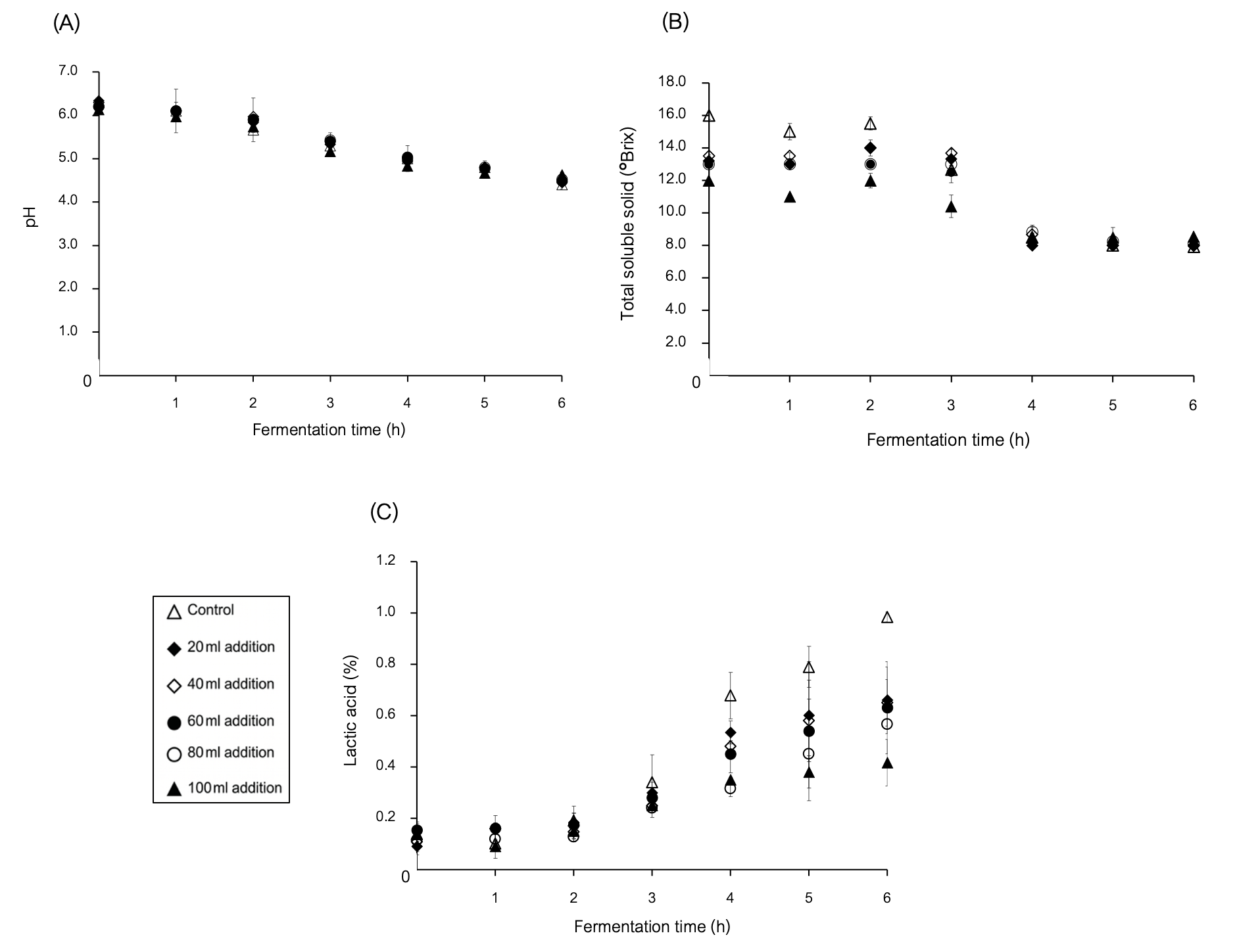
Main Results: Aromatic coconut water yogurt took approximately 3-4 hours to form curds, depending on the coconut water concentration. The control formula and the 20 ml coconut water formula formed curds after 3 hours, whereas the 40 to 100 ml formulas required 4 hours. Throughout the 6-hour fermentation process, the pH of all samples showed a decreasing trend, with final values ranging from 4.40±0.06 to 4.63±0.06. Meanwhile, total soluble solids decreased in all formulas to a range of 7.93±0.15 to 8.54±0.03 °Brix, indicating sugar utilization by lactic acid bacteria. Conversely, lactic acid content was highest in the control formula (0.98±0.02%) and lowest in the 100 ml aromatic coconut water formula (0.42±0.09%), which was a result of the substrate dilution effect. Sensory evaluation results showed no significant differences (p>0.05) in appearance, color, and odor among the formulas. However, significant differences (p<0.05) were observed in taste and overall liking scores, with the 100 ml aromatic coconut water formula receiving the highest taste score (5.60±1.98) and overall liking score (5.60±2.03) at a slightly like level. When this formulation was tested for stability during storage at 4 °C for 21 days, post-acidification successfully reduced the pH to safe standard levels (). Furthermore, it continuously maintained lactic acid bacteria viability above 7.0 log CFU/g, with yeast and mold counts remaining below the detection limit.
Conclusions: The incorporation of aromatic coconut water as an ingredient in yogurt production significantly influenced the fermentation process and product characteristics. Although using higher proportions of coconut water slightly delayed curd formation and decreased lactic acid concentration due to the dilution effect, continuous acid production during storage helped the product maintain a pH within safety standards. Moreover, the addition of 100 ml of aromatic coconut water elevated the overall acceptance by panelists to the highest level, primarily driven by the reduced sourness. The product also remained stable and safe throughout its shelf life. These findings confirm the potential of using aromatic coconut water as an ingredient to develop and add value to alternative yogurt products.
References
Agricultural Research Development Agency. (2024). Thai agricultural innovation: Enhancing the quality of local aromatic coconut. Bangkok: Agricultural Research Development Agency. (in Thai)
Ajibola, O. O., Lihan, S., Hussaini, A., Hipolito, C.N., Octavio, C.Z., Sarbini, S.R., & Mohamad, S.A.S. (2021). Cell viability, physicochemical and sensory characteristics of probiotic coconut juice during cold storage. Journal of Sustainability Science and Management, 16(8), 1-13.
Arkan, N.D., Setyawardani, T., & Rahardjo, A.H.D. (2022). Physicochemical and functional properties of yoghurt made of cow milk, colostrum, and milk-colostrum combination. Food Research, 6(1), 188-195.
Association of Official Analytical Chemists. (2002). Official method of analysis (16th ed.). Washington DC.
Belewu, M.A., Belewu, K.Y., & Bamidele, R.A. (2010). Cyper-coconut yoghurt; preparation, compositional and organoleptic qualities. African Journal of Food Science and Technology, 1(1), 010-012.
Chen, C., Zhao, S., Hao, G., Yu, H., Tian, H., & Zhao, G. (2017). Role of lactic acid bacteria on the yogurt flavour: A review. International Journal of Food Properties, 20(S1), S316-S330.
Codex Alimentarius. (2003). Codex standard for fermented milks (CXS 243-2003). Food and Agriculture Organization of the United Nations (FAO) and World Health Organization (WHO).
Donkor, N.O., Henriksson, A., Vasiljevic, T., & Shah, N. (2006). Effect of acidification on the activity of probiotics in yoghurt during cold storage. International Dairy Journal, 16(10), 1181-1189.
Gangwar, A.S., Bhardwaj, A., & Sharma, V. (2018). Fermentation of tender coconut water by probiotic bacteria Bacillus coagulans. International Journal of Food Studies, 7(1), 100-110.
Khalifa, M., Elgasim, A., Zaghloul, A., & Maufouz, M. (2011). Application of inulin and mucilage as stabilizers in yoghurt production. American Journal of Food Technology, 6(1), 31-39.
Ledenbach, L. H., & Marshall, R. T. (2009). Microbiological spoilage of dairy products. In W. H. Sperber & M. P. Doyle (Eds.), Compendium of the microbiological spoilage of foods and beverages (pp. 41-67). Springer, New York, NY.
Naikhon, N., Sripiromrak, A., Udomsaksakul, N., & Olanratmanee, P. (2024). Community-based project learning model to promote 21st century learning skills for applied biology students Ratjabhat Rajanagarindra university. Journal of Education Burapha University, 35(1), 71-85. (in Thai)
Naveena, C. P. ,& Maheswari, S. U. (2022). Antioxidant activity of yoghurt incorporated with tender coconut water and tender coconut meat. International Journal of Creative Research Thoughts, 10(10), 578-585.
Naz, H., Raza, N., Murtaza, S., Naz, A., & Farooq, U. (2023). Development and quality evaluation of non-dairy yogurts. Journal of Nutritional and Food Sciences, 4(1), 06-12.
Ndife, J., Idoko, F., & Garba, R. (2014). Production and quality assessment of functional yoghurt enriched with coconut. International Journal of Nutrition and Food Sciences, 3(6), 545-550.
Pachekrepapol, U., Kokhuenkhan, Y., & Ongsawat, J. (2021). Formation of yogurt-like product from coconut milk and evaluation of physicochemical, rheological, and sensory properties. International Journal of Gastronomy and Food Science, 25, 1-7.
Pandiyan, C., Malarkannan, S. P., & Geewarghese, P. I. (2011). Utilization of coconut water for the preparation of yoghurt. Journal of Indian Veterinary Association Kerata, 9(2), 43-46.
Priya, S. R., & Ramaswamy, L. (2016). Preparation and quality assessment of yoghurt prepared from dairy milk and coconut (Cocos nucifera, L) Milk. Cord, 32(1), 15-24.
Sanful, R. E. (2009). Promotion of coconut in the production of yoghurt. African Journal of Agriculture and Food Security, 3(5), 147-149.
Swarnalatha, G., Sudharani, K., & Rajgopat, K. (2021). Optimization and textural properties of set yoghurt prepared with hydrocolloids, milk and tender coconut water. Biological Forum-An International Journal, 13(3), 71-75.
Vedamuthu, E.R. (2006). Starter cultures for yogurt and fermented milks. In: R.C. Chandan (Eds.), Manufacturing yogurt and fermented milks (pp. 89-115). Oxford, UK: Blackwell publishing.
Yang, T., Wu, K., Wang, F., Liang, X., Liu, Q., Li, G., & Li, Q. (2014). Effect of exopolysaccharides from lactic acid bacteria on the texture and microstructure of buffalo yoghurt. International Dairy Journal, 34(2), 252-256.
Downloads
Published
How to Cite
Issue
Section
License
Copyright (c) 2026 Faculty of Science, Burapha University

This work is licensed under a Creative Commons Attribution-NonCommercial-NoDerivatives 4.0 International License.
Burapha Science Journal is licensed under a Creative Commons Attribution-NonCommercial-NoDerivatives 4.0 International (CC BY-NC-ND 4.0) licence, unless otherwise stated. Please read our Policies page for more information