Food Plants Utilized by the Stingless Bee 𝙃𝙚𝙩𝙚𝙧𝙤𝙩𝙧𝙞𝙜𝙤𝙣𝙖 𝙞𝙩𝙖𝙢𝙖 (Cockerell, 1918) in Narathiwat Province, Thailand
Keywords:
stingless bee, pollen analysis, forage plants, acetolysis method, Narathiwat ProvinceAbstract
Background and Objectives: Information on floral resources and pollen use by stingless bees in the southern border provinces of Thailand remains limited, although Heterotrigona itama (Cockerell, 1918) is one of the most economically important stingless bee species and plays a significant role in pollination within tropical ecosystems. This study aimed to investigate the diversity of floral resources and differences in floral resource utilization by
H. itama in a stingless bee farm located in Tanyong Limo Subdistrict, Ra-ngae District, and a community enterprise of stingless bee keepers located in Waeng Subdistrict, Waeng District, Narathiwat Province, Thailand. In addition, the relationships between floral resource utilization and environmental characteristics of each study area were examined to provide baseline information for stingless bee management and floral resource conservation in the southern border provinces of Thailand.
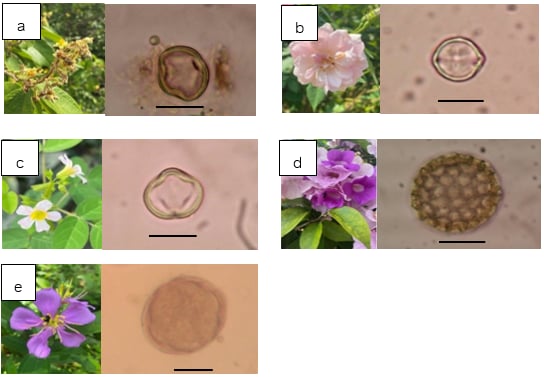
Methodology: Floral resource surveys were conducted within a radius of 1,000 m surrounding the stingless bee farms in Tanyong Limo Subdistrict, Ra-ngae District, and Waeng Subdistrict, Waeng District, Narathiwat Province. Flowering plant samples and pollen samples collected from pollen pots of stingless bees were obtained over a one-year period. Pollen samples were prepared using the acetolysis method and examined under a light microscope for morphological identification and comparison with pollen collected from flowering plants in the study areas. The frequency of plant occurrence and the proportion of pollen types found in stingless bee pollen pots were subsequently analyzed.
Main Results: This study aimed to investigate the diversity of floral resources and the patterns of floral resource utilization by the stingless bee H. itama in two study sites in Narathiwat Province, southern Thailand. At the stingless bee farm in Tanyong Limo Subdistrict, a total of 34 flowering plant species belonging to 28 families were recorded, with the family Myrtaceae being the most dominant. In contrast, the community-based stingless bee farm in Waeng Subdistrict contained 35 flowering plant species representing 26 families, with Asteraceae as the dominant family. Based on the frequency of pollen occurrence over a one-year sampling period, Acacia mangium Willd. was the most frequently utilized floral resource at the Tanyong Limo site, occurring in pollen pots for five months, followed by Solanum torvum Sw., which was recorded for four months. At the Waeng site, Microcos tomentosa Sm. was the most frequently detected pollen source, occurring for five months, whereas Carica papaya L. and A. mangium were each recorded for two months. Analysis of the relative pollen abundance revealed that A. mangium constituted the highest proportion of pollen collected from colonies at Tanyong Limo (33.86%), followed by Pandanus odorifer (Forssk.) Kuntze and Croton hirtus L'Hér. In contrast, pollen of M. tomentosa accounted for the highest relative abundance (26.60%) at the Waeng site, followed by A. mangium and Rosa chinensis Jacq. The Shannon–Wiener diversity index (H′) was 2.76 for Tanyong Limo and 2.85 for Waeng, indicating that the Waeng site supported slightly greater floral resource diversity. Meanwhile, the Jaccard similarity index between the two study sites was 0.25, suggesting a relatively low similarity in floral resource composition. These findings indicate that H. itama exhibits selective foraging behavior by preferentially utilizing particular flowering plant species and demonstrates the ability to adapt its foraging strategy according to differences in vegetation composition and local environmental conditions at each study site.
Conclusions: Heterotrigona itama exhibited spatial and temporal variation in floral resource utilization associated with flowering phenology. The species preferentially utilized pollen from particular plant species, which may be related to plant abundance, floral characteristics, and pollen suitability for the physiological requirements of stingless bees. The findings provide fundamental information for floral resource management to support commercial stingless bee cultivation, conservation of floral resources, and the development of sustainable stingless bee farming systems in the southern border provinces of Thailand.
References
Anutrakunchai, S., Thongkamngam, T., Puramongkon, P., & Charoensuk, K. (2025). Stingless bees collecting pollen in durian orchards, Khao Khitchakut District, Chanthaburi Province. International Journal of Agricultural Technology, 21(2), 421–432.
Balderas, M. B. (2016, June 1–3). Pollen spectrum and phenology of stingless bee (Tetragonula biroi Friese) plants [Conference paper]. In Proceedings of the 3rd International Conference on Agriculture and Forestry, Vol. 2, 2016, pp. 116-126. Manila, Philippines.
Basari, N., Ramli, S. N., & Mohd Khairi, N. A. S. (2018). Food reward and distance influence the foraging pattern of stingless bee, Heterotrigona itama. Insects, 9, 138.
Benedick, S. (2019, August). House yard beekeeping with stingless bee (Heterotrigona itama) [Symposium presentation]. National Stingless Bee Symposium, Institut Perkayuan Malaysia (IIPM), Malaysia. http://www.iipm.com.my/wp-content/uploads/2019/08/SIMPOSIUM-1-ORAL-1.pdf
Boonkerd, S., & Khomkham, A. (2006). Khrongkan suksa anukromwithan chanrong nai phak tai khong prathet Thai [Project on taxonomic study of stingless bees in Southern Thailand] (Research report). Faculty of Science, Ramkhamhaeng University. (in Thai)
Chelong, I. (2021). Foraging plant and palynological analysis of stingless bee potpollen in Pattani, Thailand. Journal of Physics: Conference Series, 1835, 012108.
Chelong, I., & Abd Razak, S. B. (2021). Pollen resources partitioning of stingless bee species (Tetrigona apicalis (Smith)) (Hymenoptera: Apidae) from the Saiburi, Pattani, Thailand. Annals of the Romanian Society for Cell Biology, 25(4), 1115–1120.
Dejtisakdi, W., Areelop, W., Masuthon, S., Santisuk, T., Wongsiri, S., & Juntawong, N. (2005). Melliferous plants for the stingless bees (Trigona collina Smith) in deciduous forest of Queen Sirikit Botanic Garden, Mae Rim, Chiang Mai Province. In Proceedings of the 43rd Kasetsart University Academic Conference: Plant Science Section (pp. 280–287). Bangkok. (in Thai)
Engel, M. S., Rasmussen, C., Ayala, R., & de Oliveira, F. F. (2023). Stingless bee classification and biology (Hymenoptera, Apidae): A review, with an updated key to genera and subgenera. ZooKeys, 1172, 239–312.
Fahimee, J., Badrulisham, A. S., Zulidzham, M. S., Reward, N. F., Muzammil, N., Jajuli, R., Md-Zain, B. M., & Yaakop, S. (2021). Metabarcoding in diet assessment of Heterotrigona itama based on trnL marker towards domestication program. Insects, 12(3), 205.
Hanapai, S. N. S. M., Basari, N., & Razak, S. B. A. (2023). Pollen calendar of six stingless bee species at Taman Peranian Sekayu, Terengganu. Malaysian Journal of Microscopy, 19(1), 1–17.
Harris, C., Balfour, N. J., & Ratnieks, F. L. W. (2024). Seasonal variation in the general availability of floral resources for pollinators in northwest Europe: A review of the data. Biological Conservation, 298, 110774.
Heard, T. A. (1999). The role of stingless bees in crop pollination. Annual Review of Entomology, 44, 183–206.
Inuthai, J. (2023). Flowering and fruiting phenology of herbs, climbers, shrubs, and trees in the deciduous dipterocarp forest of Northern Thailand. Journal of Ecology and Environment, 47(1), 12.
Kajobe, R., & Echazarreta, C. M. (2005). Temporal resource partitioning and climatological influences on colony flight and foraging of stingless bees (Apidae; Meliponini) in Ugandan tropical forests. African Journal of Ecology, 43, 267–275.
Lamsa-ard, J. (1990). Khrongkan suksa anukromwithan lae khwam lak lai khong chanrong nai prathet Thai [Taxonomy and diversity of stingless bees in Thailand] (Research report). Faculty of Science and Technology, Suratthani Rajabhat University. (in Thai)
Martins, A. E., Camargo, M. G. G., & Morellato, L. P. C. (2021). Flowering phenology and the influence of seasonality in flower conspicuousness for bees. Frontiers in Plant Science, 11, 594538.
Martins, A. C., Proença, C. E. B., Vasconcelos, T. N. C., Aguiar, A. J. C., Farinasso, H. C., de Lima, A. T. F., Faria, J. E. Q., Norrana, K., Costa, M. B. R., Carvalho, M. M., Dias, R. L., Bustamante, M. M. C., Carvalho, F. A., & Keller, A. (2023). Contrasting patterns of foraging behavior in neotropical stingless bees using pollen and honey metabarcoding. Scientific Reports, 13(1), 14474. https://doi.org/10.1038/s41598-023-41304-0
Masrianih, Dhafir, F. & Trianto M. (2022). Pollen collected by stingless bees Tetragonula laeviceps (Smith, 1857) (Hymenoptera: Apidae: Meliponini) from Central Sulawesi. Jurnal Biologi Tropis, 22(3), 851–856.
Mitek, M., Moton, M., Kula-Maximenko, M., Sidor, E., Zaguta, G., & Dzugan, M. (2023). Chemical composition and bioactivity of laboratory-fermented bee pollen in comparison with natural bee bread. Biomolecules, 13(7), 1025
Mohammad, S. M., Mahmud-Ab-Rashid, N.-K., & Zawawi, N. (2021). Stingless bee-collected pollen (Bee Bread): Chemical and microbiology properties and health benefits. Molecules, 26(4), 957. https://doi.org/10.3390/molecules26040957
Nakkuntod, M. (2014). Comparative morphology of pollen grains in hardy and tropical water-lilies. Journal of Science, 12(2), 60–73. (in Thai)
Phangnga Provincial Agricultural Office. (2020). Stingless bees: Tiny yet ultimate pollinators. https://www.opsmoac.go.th (in Thai)
Saiboon, S. (1996). Biology and ecology of the stingless bee [Hypotrigona and Trigona (Hymenoptera: Apidae)] [Unpublished doctoral dissertation]. Faculty of Agriculture, Prince of Songkla University.
Shannon, C.E. (1949). Mathematical theory of communication. Bell System Technical Journal, 27, 379-423.
Smitinand, T. (2014). Thai plant names (Revised ed. 2014). Office of the Forest Herbarium, Department of National Parks, Wildlife and Plant Conservation.
Stewart, A. B., Sritongchuay, T., & Bumrungsri, S. (2020). Local and landscape compositions influence stingless bee species richness in tropical agricultural landscapes. Diversity, 12(12), 482.
The Forest Herbarium (BKF). (n.d.). BKF Online Herbarium Database. Department of National Parks, Wildlife and Plant Conservation. https://dnp.go.th
Downloads
Published
How to Cite
Issue
Section
License
Copyright (c) 2026 Faculty of Science, Burapha University

This work is licensed under a Creative Commons Attribution-NonCommercial-NoDerivatives 4.0 International License.
Burapha Science Journal is licensed under a Creative Commons Attribution-NonCommercial-NoDerivatives 4.0 International (CC BY-NC-ND 4.0) licence, unless otherwise stated. Please read our Policies page for more information