
Effect of Zirconium Content on the Structural and Mechanical Properties of Ti–Zr Alloy Thin Films Deposited by DC Magnetron Co-Sputtering
Keywords:
Ti-Zr alloy, thin film, DC magnetron co-sputtering, hardnessAbstract
Background and Objectives: Titanium has attracted considerable attention for a range of applications because of its excellent mechanical properties, high corrosion resistance, and biocompatibility, leading to its widespread use in fields such as the aerospace industry, decorative coatings, and biomedical materials. Adding zirconium to titanium can improve the material properties of titanium-based alloys. In this research, titanium-zirconium alloy thin films with varying zirconium content were prepared using the DC magnetron co-sputtering method with titanium and zirconium metal targets. The effect of zirconium content on the crystal structure, morphology, and hardness of the titanium-zirconium alloy thin films was studied.
Methodology: Titanium–zirconium alloy thin films were deposited on silicon substrates using a DC magnetron co-sputtering system with titanium and zirconium metal targets as the sputtering targets. Before deposition, the vacuum chamber was evacuated to a base pressure of 5.0×10⁻⁵ mbar using a diffusion pump in combination with a rotary pump. Subsequently, ultra-high purity argon gas (99.999%) was used as the sputtering gas and introduced into the vacuum chamber at a constant flow rate of 4.0 sccm to obtain a working pressure of 5.0×10⁻³ mbar during the deposition process. The deposition time was kept constant at 20 min for all conditions, and the zirconium content in the thin films was controlled by adjusting the electrical current supplied to the titanium and zirconium cathode targets. The crystal structure of the deposited thin films was analyzed using an X-ray diffractometer. The surface morphology and cross-sectional morphology of the deposited thin films were examined using field-emission scanning electron microscopy. The elemental composition of the deposited thin films was analyzed using energy-dispersive X-ray spectroscopy, and the hardness of the deposited films was measured using the nanoindentation technique.
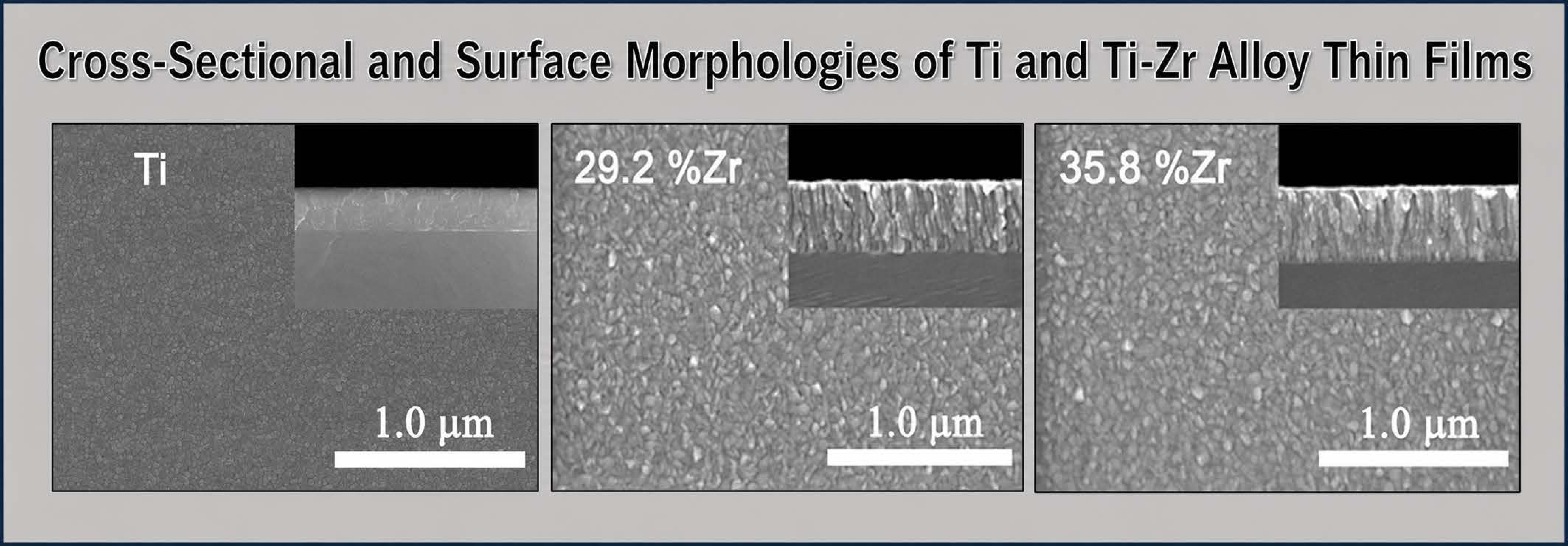
Main Results: The elemental composition analysis of the titanium–zirconium alloy thin films deposited on silicon substrates, performed using energy-dispersive X-ray spectroscopy, showed that the zirconium content in the thin films increased with increasing electrical current supplied to the zirconium target and decreasing electrical current supplied to the titanium target. The X-ray diffraction analysis revealed that all thin films with zirconium contents in the range of 0–35.8 at.% exhibited a hexagonal close-packed structure, and no X-ray diffraction peaks corresponding to other compounds were observed. This indicates the formation of a substitutional solid solution between titanium and zirconium. As the zirconium content increased, the X-ray diffraction peaks shifted toward lower diffraction angles, indicating an expansion of the crystal structure. This expansion resulted from the substitution of larger zirconium atoms into the titanium crystal lattice, leading to an increase in interatomic spacing. Consequently, the lattice parameters increased, with the a-lattice parameter increasing from 0.296 to 0.314 nm and the c-lattice parameter increasing from 0.470 to 0.485 nm. Meanwhile, the c/a ratio showed a decreasing trend, indicating anisotropic lattice distortion. In terms of microstructure, the crystallite size increased from 2.6 to 12.7 nm as the zirconium content increased from 0–35.8 at.%, along with the development of a pronounced preferred orientation along the (002) plane. Field-emission scanning electron microscopy analysis revealed that the grain size tended to increase with increasing zirconium content. In addition, the average film thicknesses were approximately 220, 350, and 380 nm for the thin films containing 0, 29.2, and 35.8 at.% zirconium, respectively. The thin films containing 29.2 and 35.8 at.% zirconium exhibited dense columnar structures. Furthermore, the hardness of the thin films increased with increasing zirconium content, reaching a maximum value of approximately 7.7 GPa at a zirconium content of 35.8 at.%. However, the increase in hardness occurred despite the increase in grain size, which does not follow the Hall–Petch relationship. This behavior can be explained by the combined effects of solid-solution strengthening and anisotropic lattice distortion.
Conclusions: The titanium–zirconium alloy thin films with increasing zirconium content up to 35.8 at.% exhibited an expansion of the crystal lattice and anisotropic lattice distortion within the hexagonal close-packed structure. Grain growth was also observed, and the thin films showed a pronounced preferred orientation along the (002) plane. The increase in film hardness can be explained by solid-solution strengthening caused by the substitution of zirconium atoms into the titanium crystal lattice.
References
Akimoto, T., Ueno, T., Tsutsumi, Y., Doi, H., Hanawa, T., & Wakabayashi, N. (2018). Evaluation of corrosion resistance of implant‐use Ti‐Zr binary alloys with a range of compositions. Journal of Biomedical Materials Research Part B: Applied Biomaterials, 106(1), 73-79.
Chawla, V., Jayaganthan, R., Chawla, A. K., & Chandra, R. (2008). Morphological study of magnetron sputtered Ti thin films on silicon substrate. Materials Chemistry and Physics, 111(2-3), 414-418.
Dearnley, P. A., Dahm, K. L., & Çimenoǧlu, H. (2004). The corrosion–wear behavior of thermally oxidised CP-Ti and Ti–6Al–4V. Wear, 256(5), 469-479.
Geetha, M., Singh, A. K., Asokamani, R., & Gogia, A. K. (2009). Ti based biomaterials, the ultimate choice for orthopaedic implants–A review. Progress in Materials Science, 54(3), 397-425.
Grandin, H. M., Berner, S., & Dard, M. (2012). A review of titanium zirconium (TiZr) alloys for use in endosseous dental implants. Materials, 5(8), 1348-1360.
Kwon, J. H., Kim, D. Y., & Hwang, N. M. (2020). Generation of charged Ti nanoparticles and their deposition behavior with a substrate bias during RF magnetron sputtering. Coatings, 10(5), 443.
Liu, X., Chen, S., Tsoi, J. K., & Matinlinna, J. P. (2017). Binary titanium alloys as dental implant materials –A review. Regenerative Biomaterials, 4(5), 315-323.
Naik, S. N., & Walley, S. M. (2020). The Hall–Petch and inverse Hall–Petch relations and the hardness of nanocrystalline metals. Journal of Materials Science, 55(7), 2661-2681.
Rodríguez-Hernández, M. G., Jiménez, O., Alvarado-Hernández, F., Flores, M., Andrade, E., Canto, C. E., Ávila, C., & Espinoza-Beltrán, F. (2015). The effect of C content on the mechanical properties of Ti–Zr coatings. Journal of the Mechanical Behavior of Biomedical Materials, 49, 269-276.
Rong-hong, Z., Meng-lin, L., Xiu, F., Pu, Z., & Meng, H. (2013). Study of application of titanium on surface of decorative jewelry. Journal of Gems & Gemmology, 15(3), 75-80.
Rukkun, J., Wongpisan, W., Waree, K., & Aiempanakit, K. (2021). Influence of nitrogen flow rate on properties of TiAlN thin film prepared by reactive DC magnetron sputtering. Burapha Science Journal, 26(3), 1575-1590. (in Thai)
Wei, B., Liang, H., Zhang, D., Qi, Z., Shen, H., & Wang, Z. (2018). Magnetron sputtered TiN thin films toward enhanced performance supercapacitor electrodes. Materials for Renewable and Sustainable Energy, 7(2), 11.
Williams, J. C., & Boyer, R. R. (2020). Opportunities and issues in the application of titanium alloys for aerospace components. Metals, 10(6), 705.
Witit-anun, N., Khambun, A., Alaksanasuwan, S., & Buranawong, A. (2020). Effect of sputtering current on the structure of titanium nitride thin film deposited by reactive DC magnetron sputtering. Burapha Science Journal, 25, 387-399. (in Thai)
Yu, Z. H., Cao, S., Yang, R., & Hu, Q. M. (2025). Enhanced solid solution hardening by off-center substitutional solute atoms in α-Ti. Materials & Design, 251, 113709.
Zhang, H., Zhang, X., Zhao, X., Tang, Y., & Zuo, Y. (2018). Preparation of Ti–Zr-based conversion coating on 5052 aluminum alloy, and its corrosion resistance and antifouling performance. Coatings, 8(11), 397
Downloads
Published
How to Cite
Issue
Section
License
Copyright (c) 2026 Faculty of Science, Burapha University

This work is licensed under a Creative Commons Attribution-NonCommercial-NoDerivatives 4.0 International License.
Burapha Science Journal is licensed under a Creative Commons Attribution-NonCommercial-NoDerivatives 4.0 International (CC BY-NC-ND 4.0) licence, unless otherwise stated. Please read our Policies page for more information