
Diversity and Spatial Distribution Patterns of Phytoplankton in the Area Around Samui Island, Surat Thani Province, Thailand
Keywords:
phytoplankton, diversity, spatial distribution, Samui Island, coastal ecosystemAbstract
Background and Objectives: Phytoplankton are essential primary producers in marine ecosystems and reliable indicators of water quality and environmental conditions. The coastal waters around Samui Island, Surat Thani Province, are ecologically, economically, and tourism-important areas that have experienced increasing pressures from tourism, coastal development, and human activities. These pressures may influence the structure, composition, and spatial distribution of phytoplankton communities. In addition, the coastal areas around Samui Island are characterized by diverse land and sea uses, including tourism areas, local communities, piers, and marine activities, resulting in different coastal environmental conditions among areas. However, baseline information on phytoplankton species composition, diversity, and spatial distribution around Samui Island remains limited, particularly data comparing different coastal zones around the island. This study aimed to investigate phytoplankton diversity, species composition, and spatial distribution patterns to support coastal ecosystem assessment, water quality monitoring, and sustainable coastal resource management.
Methodology: This study was conducted in the coastal waters around Samui Island, Surat Thani Province, Thailand. Seawater samples were collected from five coastal areas, including Mae Nam, Bang Rak, Chaweng, Hua Thanon–Lamai, and Nathon beaches, at distances of 300 and 500 m from the shoreline, resulting in 10 sampling stations. Samples were preserved with Lugol's iodine solution and analyzed using the Utermöhl sedimentation method. Phytoplankton species were identified and counted under an inverted microscope. Phytoplankton density
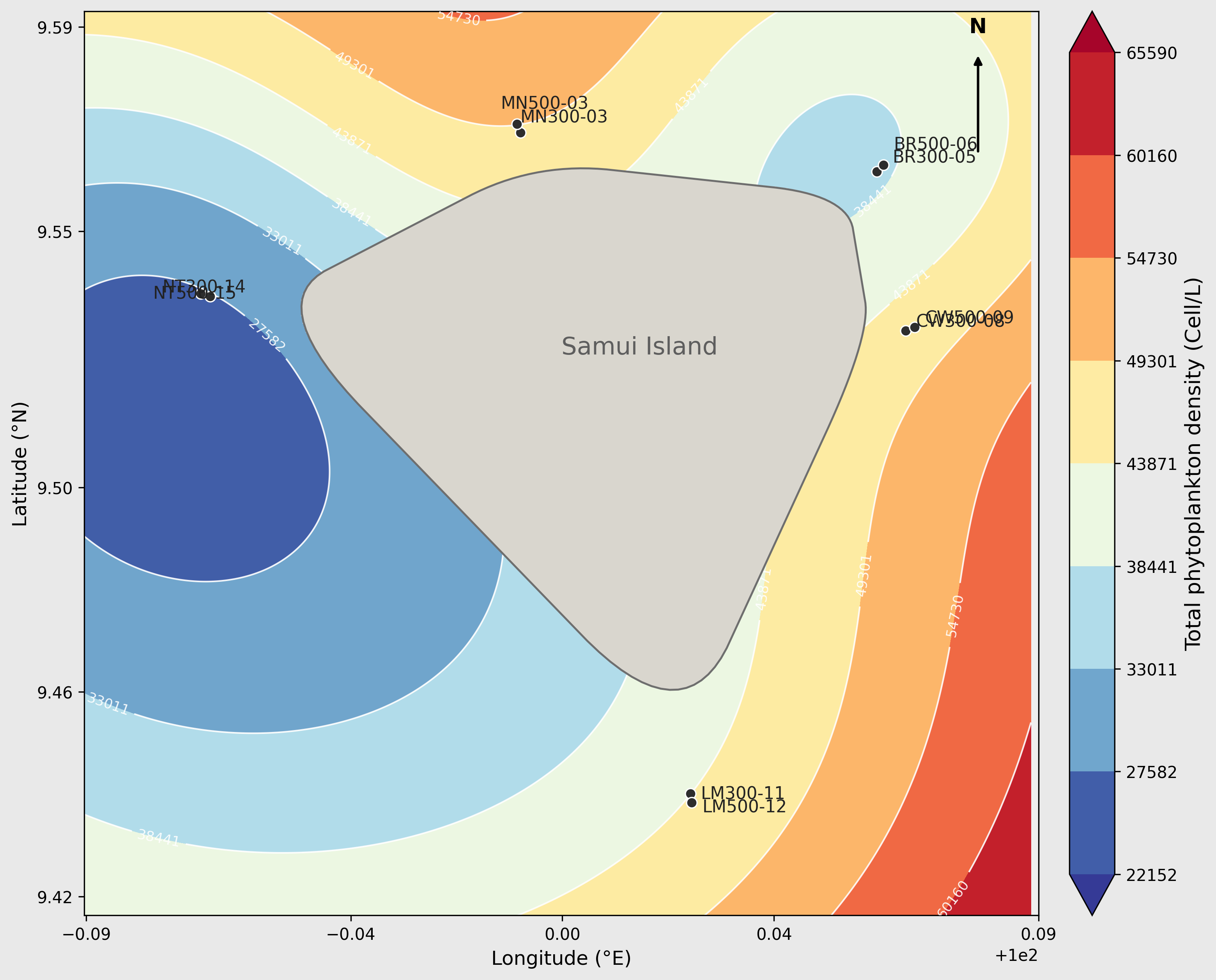
(cells L⁻¹), species composition, and diversity indices were determined. Species richness, Shannon–Wiener diversity index, Pielou’s evenness index, and Simpson dominance index were used to evaluate phytoplankton community structure. Geographic coordinates and total phytoplankton density at each station were used for spatial analysis. Spatial distribution patterns were analyzed using QGIS with spatial interpolation and presented as contour maps to illustrate variations in phytoplankton density around Samui Island.
Main Results: Phytoplankton communities around Samui Island showed relatively high species diversity and comprised several taxonomic groups. Diatoms were the dominant group, with Thalassiosirophyceae accounting for an average of 20.6 species per station (32.09%), followed by Bacillariophyceae with 15.2 species (23.34%) and Dinophyceae with 10.5 species (16.54%). Species richness ranged from 55 to 78 species, while the Shannon–Wiener diversity index (H′), Pielou's evenness index (J′), and Simpson dominance index (D) ranged from
1.936–2.165, 0.468–0.513 and 0.229–0.239, respectively. No single species showed a clearly dominant proportion. The moderate to relatively high values of the diversity and evenness indices, together with the low Simpson dominance values, indicated a well-balanced phytoplankton community structure without clear species dominance. Phytoplankton density varied among sampling stations, ranging from 22,152 to 65,590 cells L⁻¹. Higher densities were observed at Chaweng and Hua Thanon–Lamai beaches, whereas lower densities occurred at Nathon Beach. Spatial interpolation further demonstrated a distinct east–west gradient, with higher phytoplankton abundance along the eastern and southeastern coasts than the western coast of Samui Island. Among the sampling stations, MN 500 recorded the highest phytoplankton density and species richness, while BR 500 had the highest Shannon–Wiener diversity and Pielou's evenness indices. These findings indicate considerable spatial variability in phytoplankton community characteristics among different coastal environments around the island.
Conclusions: The coastal waters around Samui Island support relatively high phytoplankton diversity, with diatoms as the dominant taxonomic group. Phytoplankton density showed clear spatial variation, with higher densities along the eastern and southeastern coasts than the western coast. The diversity and evenness indices suggest that the phytoplankton community remained relatively balanced, with no single species showing clear dominance. Areas with high phytoplankton density should be continuously monitored together with water quality and nutrient data. Such monitoring would help assess potential ecological changes, eutrophication risk, and future phytoplankton blooms. These findings provide baseline information for long-term marine ecosystem monitoring and sustainable coastal resource management on Samui Island.
References
Al-Mur, B. A. (2025). Environmental assessment using phytoplankton diversity, nutrients, chlorophyll-a, and trophic status along southern coast of Jeddah, Red Sea. Journal of Marine Science and Engineering, 13(1), Article 29. https://doi.org/10.3390/jmse13010029
Cloern, J. E. (2001). Our evolving conceptual model of the coastal eutrophication problem. Marine Ecology Progress Series, 210, 223–253. https://doi.org/10.3354/meps210223
Edler, L., & Elbrächter, M. (2010). The Utermöhl method for quantitative phytoplankton analysis. In B. Karlson, C. Cusack, & E. Bresnan (Eds.), Microscopic and molecular methods for quantitative phytoplankton analysis (IOC Manuals and Guides No. 55). UNESCO.
Holland, M. M., Artigas, L. F., Atkinson, A., Best, M., Bresnan, E., Devlin, M., Eerkes-Medrano, D., Johansen, M., Johns, D. G., Machairopoulou, M., Pitois, S., Scott, J., Schilder, J., Stern, R., Tait, K., Whyte, C., Widdicombe, C., & McQuatters-Gollop, A. (2025). Mind the gap: The need to integrate novel plankton methods alongside ongoing long-term monitoring. Ocean & Coastal Management, 262, Article 107542. https://doi.org/10.1016/j.ocecoaman.2025.107542
Howarth, R. W., Chan, F., Conley, D. J., Garnier, J., Doney, S. C., Marino, R., & Billen, G. (2011). Coupled biogeochemical cycles: Eutrophication and hypoxia in temperate estuaries and coastal marine ecosystems. Frontiers in Ecology and the Environment, 9(1), 18–26. https://doi.org/10.1890/100008
Israngkura, A. (2022). Marine resource recovery in Southern Thailand during COVID-19 and policy recommendations. Marine Policy, 137, 104972. https://doi.org/10.1016/j.marpol.2022.104972
Li, J., Gao, M., Liu, B., Fan, Y., Wei, J., Zhang, Y., Li, F., Zhang, N., & Hu, Z. (2025). Seasonal dynamics of phytoplankton community structure and environmental drivers in the coastal waters of the Leizhou Peninsula, China. Diversity, 17(12), 867. https://doi.org/10.3390/d17120867
Ma, M., Li, J., Lu, A., Zhu, P., & Yin, X. (2024). Effects of phytoplankton diversity on resource use efficiency in a eutrophic urban river of Northern China. Frontiers in Environmental Science, 12, 1389220. https://doi.org/10.3389/fenvs.2024.1389220
Pierella Karlusich, J. J., Bowler, C., & Vardi, A. (2025). Global ecological importance of diatoms in marine ecosystems. Nature Communications, 16, 58027. https://doi.org/10.1038/s41467-025-58027-7
Retnaningdyah, C., Hakim, L., Arisoesilaningsih, E., Sumani, S., Setiahadi, R., & Mukhtasor. (2025). Phytoplankton diversity as a health indicator of coastal ecosystems in Prigi Bay, Trenggalek District, East Java, Indonesia. Biodiversitas, 26(5), 2198–2209. https://doi.org/10.13057/biodiv/d260518
Santos, M., Amorim, A., Brotas, V., Cruz, J. P. C., Palma, C., Borges, C., Favareto, L. R., Veloso, V., Dâmaso-Rodrigues, M. L., Chainho, P., Félix, P. M., & Brito, A. C. (2022). Spatio-temporal dynamics of phytoplankton community in a well-mixed temperate estuary (Sado Estuary, Portugal). Scientific Reports, 12, 16423. https://doi.org/10.1038/s41598-022-20792-6
Sathish Kumar, P., Dharani, G., Santhanakumar, J., Jha, D. K., Pandey, V., Venkatnarayanan, S., Jebakumar, J. P. P., Muthukumar, C., & James, R. A. (2023). Assessment of phytoplankton diversity, distribution, and environmental variables along the southeast coast of India. Frontiers in Marine Science, 10, 1215627.https://doi.org/10.3389/fmars.2023.1215627
U.S. Environmental Protection Agency. (2021). Standard operating procedure for phytoplankton sample collection and preservation field procedures (LG400, Version 10). U.S. EPA
Downloads
Published
How to Cite
Issue
Section
License
Copyright (c) 2026 Faculty of Science, Burapha University

This work is licensed under a Creative Commons Attribution-NonCommercial-NoDerivatives 4.0 International License.
Burapha Science Journal is licensed under a Creative Commons Attribution-NonCommercial-NoDerivatives 4.0 International (CC BY-NC-ND 4.0) licence, unless otherwise stated. Please read our Policies page for more information