
An Improved Differential Evolution Algorithm for Solving Systems of Nonlinear Equations
Keywords:
systems of nonlinear equations, global optimization, differential evolution algorithmAbstract
Background and Objectives: Systems of nonlinear equations are considered extremely important optimization problems in the computational field. They frequently appear and play a crucial role in many different practical fields, such as applied science, engineering, and economic modeling. Generally, these problems are characterized by their high nonlinearity and the presence of numerous local minima. Because of these challenging characteristics, traditional derivative-based methods often struggle to solve these problems. Specifically, they easily get stuck in local minima and depend heavily on initial values to function correctly. To overcome these limitations, researchers apply differential evolution (DE), which is widely recognized as a powerful global optimization method. However, the basic DE algorithm still faces certain critical challenges. It often suffers from slow convergence speed, premature convergence, or complete search stagnation in highly complex problems. These issues mainly result from the use of inappropriate control parameters and ineffective mutation strategies during the search process. Therefore, this research proposes an improved differential evolution algorithm, named DECM. The main objective is to successfully solve six complex real-world systems of nonlinear equations with higher accuracy and a faster convergence speed compared to existing techniques.
Methodology: To achieve these goals, this research improves the standard differential evolution (DE) algorithm in two main parts. The first part focuses on setting appropriate control parameters that are randomly generated within appropriate ranges. These parameter settings help the system maintain a balance between population diversity and convergence speed. The second part applies a fitness-sorted mutation strategy. This process sorts randomly selected vectors based on their objective function values in ascending order. After sorting, it forces the vector with the best fitness to serve as the base vector. This approach effectively guides the search direction toward the most promising regions. To evaluate its actual performance, the DECM algorithm is tested on five real-world nonlinear systems of equations. These problems include Neurophysiology, Robot kinematics, Economics modeling, Chemical equilibrium, Combustion, and Automotive steering. The experiments use two stopping criteria based on existing literature: Value-To-Reach (VTR) and the maximum number of function evaluations (Max nf). Finally, the results of DECM are directly compared with DE59-50, DE59-100, DE-R, and PSO-based methods.
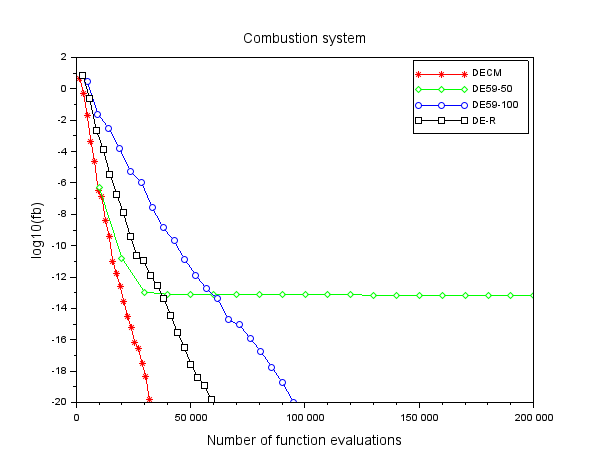
Main Results: Under the VTR criterion, the proposed DECM algorithm achieves a perfect 100% success rate across all five problems. Furthermore, it requires a lower mean of function evaluations (Mean nf) than the compared methods in most cases. For example, in Problem 5, DECM uses an average of only 34009.80 evaluations to find a solution. This number is significantly lower than the other methods, whereas DE59-50 completely fails to solve this problem. Additionally, DECM produces lower standard deviations than the comparative methods in almost all scenarios. The experimental results indicate that the proposed algorithm achieves rapid convergence and maintains stability in finding the solution. Under the Max nf criterion, DECM consistently yields lower average best objective function values than all compared methods, demonstrating significant improvements in Problem 1. However, Problem 3 presents an exception. In this problem, DECM successfully finds the same minimum value as the compared methods, but its average value remains higher. The experimental results under this criterion demonstrate that the DECM method provides accurate and stable solutions across all test problems, except for Problem 3, where the proposed method occasionally fails to avoid converging to local minima during some experimental runs.
Conclusions: In summary, this research successfully presents an improved differential evolution algorithm called DECM for solving real-world systems of nonlinear equations. The proposed algorithm combines appropriate control parameters with a fitness-sorted mutation strategy. These implemented strategies effectively balance global exploration and local exploitation. The proposed algorithm has a relatively simple structure, facilitating straightforward implementation. At the same time, it provides high accuracy and fast convergence directly to the global optimum. However, as the performance evaluation is limited to a set of six test problems, the proposed algorithm is considered a promising tool for solving complex systems of nonlinear equations within similar contexts. Future research should expand the testing to include problems in other domains or higher-dimensional systems to further validate the generalization capability of the algorithm.
References
Karr, C. L., Weck, B., & Freeman, L. M. (1998). Solutions to systems of nonlinear equations via a genetic algorithm. Engineering Applications of Artificial Intelligence, 11(3), 369-375.
Luo, Y. Z., Tang, G. J., & Zhou, L. N. (2008). Hybrid approach for solving systems of nonlinear equations using chaos optimization and quasi-Newton method. Applied Soft Computing, 8(2), 1068-1073.
Mangla, C., Ahmad, M., & Uddin, M. (2021). Optimization of complex nonlinear systems using genetic algorithm. International Journal of Information Technology, 13(5), 1913-1925.
Ouyang, A., Zhou, Y., & Luo, Q. (2009, August). Hybrid particle swarm optimization algorithm for solving systems of nonlinear equations. In 2009 IEEE International Conference on Granular Computing (pp. 460-465). IEEE.
Pourjafari, E., & Mojallali, H. (2012). Solving nonlinear equations systems with a new approach based on invasive weed optimization algorithm and clustering. Swarm and Evolutionary Computation, 4, 33-43.
Raja, M. A. Z., Zameer, A., Kiani, A. K., Shehzad, A., & Khan, M. A. R. (2018). Nature-inspired computational intelligence integration with Nelder–Mead method to solve nonlinear benchmark models. Neural Computing and Applications, 29(4), 1169-1193.
Ren, H., Wu, L., Bi, W., & Argyros, I. K. (2013). Solving nonlinear equations system via an efficient genetic algorithm with symmetric and harmonious individuals. Applied Mathematics and Computation, 219(23), 10967-10973.
Storn, R., & Price, K. (1995). Differential evolution-a simple efficient adaptive scheme for global optimization. Tech. Rep. TR-95-012, International Computer Science Institute, Berkeley, Calif, USA.
Wetweerapong, J., & Puphasuk, P. (2020). An improved differential evolution algorithm with a restart technique to solve systems of nonlinear equations. An International Journal of Optimization and Control, 10(1), 118-136.
Zhang, X., Wan, Q., & Fan, Y. (2019). Applying modified cuckoo search algorithm for solving systems of nonlinear equations. Neural Computing and Applications, 31(2), 553-576.
Downloads
Published
How to Cite
Issue
Section
License
Copyright (c) 2026 Faculty of Science, Burapha University

This work is licensed under a Creative Commons Attribution-NonCommercial-NoDerivatives 4.0 International License.
Burapha Science Journal is licensed under a Creative Commons Attribution-NonCommercial-NoDerivatives 4.0 International (CC BY-NC-ND 4.0) licence, unless otherwise stated. Please read our Policies page for more information