
Identity-Preserving Sketch-to-Photo Synthesis for Forensic Face Retrieval Using Discriminator Regularization
Keywords:
forensic face retrieval, sketch-to-photo synthesis, CycleGANAbstract
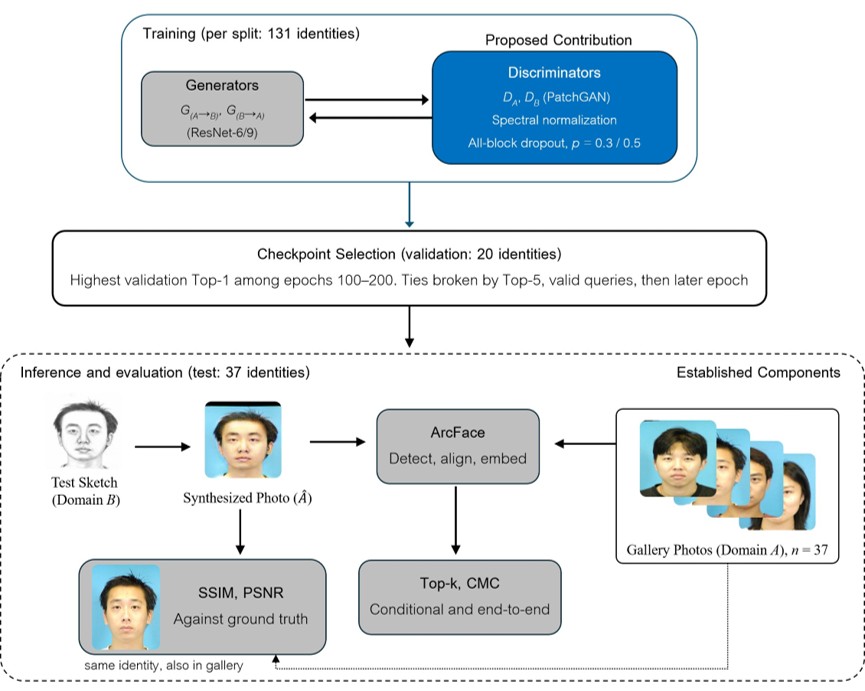
Background and Objectives: Forensic investigations often begin with a hand-drawn sketch, and the practical question is not whether it can be turned into a plausible face but whether that face retrieves the right person from a gallery of photographs. CycleGAN has become the standard route because it trains without paired supervision. Evaluation of such models, however, leans on reconstruction measures such as SSIM and PSNR, which reward smooth, photograph-like output; whether a face scoring well on them also carries the identity information a recognizer depends on is rarely tested. A second gap concerns the discriminator, where regularization is treated as a matter of optimization stability and its effect on identity-discriminative structure is left unexamined. Our objective was to determine whether regularizing the CycleGAN discriminator with all-block dropout, on top of spectral normalization, improves identity-preserving retrieval, whether generator depth or dropout rate contributes independently, and whether pixel-level fidelity can serve as a proxy for retrieval when a model is selected for forensic use.
Methodology: Experiments used the CUHK student subset of CUFS, 188 sketch–photo identity pairs at 128 × 128 resolution, partitioned under fixed seeds into five identity-disjoint splits of 131 training, 20 validation, and 37 test identities. Six configurations were trained on every split, giving thirty runs: two spectral-normalization-only baselines with ResNet-6 and ResNet-9 generators, and four configurations adding all-block discriminator dropout at rates of 0.3 and 0.5 for each depth. Both baselines are previously published spectral-normalized architectures, retrained here so that all configurations share identical partitions, checkpoints, and criteria. Training ran 200 epochs with the standard CycleGAN objective, with cycle and identity loss weights held fixed so that discriminator regularization was the only variable. Evaluation ran in two stages that never share data: checkpoints saved every twenty epochs from epoch 100 were scored on the validation gallery, the best validation Top-1 was selected with ties resolved by a rule fixed in advance, and that checkpoint was evaluated once on the held-out test identities. Synthesized photographs were embedded with a fixed InsightFace ArcFace recognizer, ranked by cosine similarity, and scored as Top-1, Top-5, and Top-10 accuracy alongside SSIM and PSNR. Retrieval is reported under two denominators: a conditional figure over identities whose query and gallery counterpart were both embedded, and an end-to-end figure over all 37 test identities counting a query as incorrect whenever any pipeline stage fails. Paired Wilcoxon signed-rank tests across the five splits are descriptive, since five paired observations floor the attainable p-value at 0.0625 and the test sets overlap.
Main Results: Every configuration carrying all-block dropout outperformed both baselines on conditional Top-1, on all five splits without exception; end-to-end, the same holds in thirty-nine of the forty configuration–split comparisons, with one tie and no reversal. Holding depth fixed, dropout raised mean conditional Top-1 by 14.6 percentage points at ResNet-9, from 80.14% to 94.74%, and by 8.0 points at ResNet-6, from 83.17% to 91.16%, both at the minimum attainable p-value of 0.0625; end-to-end the gaps are 13.0 and 6.5 points. Neither depth nor rate produced a comparable effect: the baselines differed by roughly three points, and no depth or rate comparison held a consistent direction across splits, pointing to the presence of regularization rather than its strength or generator size as the operative factor. The synthesis measures inverted this ordering. The ResNet-9 baseline achieved the highest SSIM, 0.6930, and the highest PSNR, 18.23 dB, while returning the lowest Top-1 of the six. Across all thirty method–split combinations, mean SSIM and Top-1 were negatively correlated (Pearson r = −0.55, p = 0.002), and at the level of individual images the two were effectively unrelated. Training curves are consistent with discriminator overfitting in the unregularized baselines, which the dropout runs avoid.
Conclusions: Crossing generator depth with discriminator dropout, all-block dropout in the discriminator consistently improves identity-preserving retrieval in sketch-to-photo synthesis, and the benefit comes from the presence of the regularization rather than a particular rate or depth. The more consequential finding is that pixel fidelity did not predict retrieval and can point the opposite way: the configuration reconstructing most faithfully retrieves worst, so a model chosen on SSIM or PSNR would be among the weakest search tools here. For forensic systems, where the deliverable is a correct ranked identity rather than a faithful portrait, synthesis models should be selected and stopped on retrieval measured against a held-out gallery. Results come from a single small, clean dataset with five splits, and confirmation on larger, noisier forensic-like data remains necessary.
References
Chugh, T., Singh, M., Nagpal, S., Singh, R., & Vatsa, M. (2017). Transfer learning based evolutionary algorithm for composite face sketch recognition. In Proceedings of the IEEE Conference on Computer Vision and Pattern Recognition Workshops (CVPRW) (pp. 1117–1125).
Deng, J., Guo, J., Xue, N., & Zafeiriou, S. (2019). ArcFace: Additive Angular Margin Loss for Deep Face Recognition. In Proceedings of the IEEE/CVF Conference on Computer Vision and Pattern Recognition (CVPR), 4690–4699.
Du, K., Wang, C., Cao, L., Guo, Y., & Sun, W. (2024). A modality separation approach for facial sketch synthesis. IET Image Processing, 18, 4127–4140. https://doi.org/10.1049/ipr2.13238
Fang, Y., Hu, J., & Deng, W. (2020). Identity-aware CycleGAN for face photo-sketch synthesis and recognition. Pattern Recognition, 102, 107249. https://doi.org/10.1016/j.patcog.2020.107249
Guo, Y., Cao, L., Chen, C., Du, K., & Fu, C. (2020). Domain alignment embedding network for sketch face recognition. IEEE Access, 9, 872–882. https://doi.org/10.1109/ACCESS.2020.3047108
Huang, Z., Tang, F., Zhang, Y., Cao, J., Li, C., Tang, S., Li, J., & Lee, T.-Y. (2024). Identity-preserving face swapping via dual surrogate generative models. ACM Transactions on Graphics, 43(5), Article 161, 1–19. https://doi.org/10.1145/3676165
Mahfoud, S., Daamouche, A., Bengherabi, M., & Hadid, A. (2022). Hand-drawn face sketch recognition using rank-level fusion of image quality assessment metrics. Bulletin of the Polish Academy of Sciences: Technical Sciences, 70(6), e143554. https://doi.org/10.24425/bpasts.2022.143554
Mahfoud, S., Bengherabi, M., Daamouche, A., Boutellaa, E., & Hadid, A. (2024). High-quality synthesized face sketch using generative reference prior. Bulletin of the Polish Academy of Sciences: Technical Sciences, 72(4), Article 150109.
Phisutthangkoon, N., Anchuen, P., Luangwilai, T., & Daungklang, P. (2026). Face photo and sketch synthesis using CycleGAN: The role of residual blocks and spectral normalization. International Scientific Journal of Engineering and Technology, 10(1), 84–95.
Que, Y., Xiong, L., Wan, W., Xia, X., & Liu, Z. (2024). Denoising Diffusion Probabilistic Model for Face Sketch-to-Photo Synthesis. IEEE Transactions on Circuits and Systems for Video Technology, 34(10),10424–10436. https://doi.org/10.1109/TCSVT.2024.3409184
Srivastava, N., Hinton, G., Krizhevsky, A., Sutskever, I., & Salakhutdinov, R. (2014). Dropout: A simple way to prevent neural networks from overfitting. Journal of Machine Learning Research, 15(1), 1929–1958.
Tang, D., Jiang, X., Wang, K., Guo, W., Zhang, J., Lin, Y., & Pu, H. (2024). Toward identity preserving in face sketch-photo synthesis using a hybrid CNN-Mamba framework. Scientific Reports, 14, 22495. https://doi.org/10.1038/s41598-024-72066-y
Tang, D., Jiang, X., Zhang, Y., Dai, Y., & Lin, Y. (2025). Ipdm: identity preserving diffusion model for face sketch and photo synthesis. Machine Vision and Applications, 36, Article 34. https://doi.org/10.1007/s00138-024-01658-5
Tang, X., & Wang, X. (2003). Face sketch synthesis and recognition. In Proceedings of the Ninth IEEE International Conference on Computer Vision (ICCV 2003) (Vol. 2, pp. 687–694).
Wan, W., Yang, Y., & Lee, H. J. (2021). Generative adversarial learning for detail-preserving face sketch synthesis. Neurocomputing, 438, 107–121. https://doi.org/10.1016/j.neucom.2021.01.050
Wang, N., Zhu, M., Li, J., Song, B., & Li, Z. (2017). Data-driven vs. model-driven: Fast face sketch synthesis. Neurocomputing, 257, 214–221. https://doi.org/10.1016/j.neucom.2016.07.071
Wang, Z., Bovik, A. C., Sheikh, H. R., & Simoncelli, E. P. (2004). Image quality assessment: From error visibility to structural similarity. IEEE Transactions on Image Processing, 13(4), 600–612.
Downloads
Published
How to Cite
Issue
Section
License
Copyright (c) 2026 Faculty of Science, Burapha University

This work is licensed under a Creative Commons Attribution-NonCommercial-NoDerivatives 4.0 International License.
Burapha Science Journal is licensed under a Creative Commons Attribution-NonCommercial-NoDerivatives 4.0 International (CC BY-NC-ND 4.0) licence, unless otherwise stated. Please read our Policies page for more information