
Evaluation of Quantile Delta Mapping for Bias Correction of CMIP6 Daily Rainfall Using Independent Temporal Holdout in Prachuap Khiri Khan Province
Keywords:
bias correction, Quantile Delta Mapping, CMIP6, independent temporal holdout, daily rainfallAbstract
Background and Objectives: Rainfall simulations from global climate models participating in the Coupled Model Intercomparison Project Phase 6 (CMIP6) are widely used to investigate climate change and assess its potential impacts at regional and local scales. However, model-simulated rainfall often exhibits systematic differences from observations and therefore requires bias correction before application in climate-impact analyses. Quantile Delta Mapping (QDM) is one of the widely used methods for correcting such biases. Nevertheless, evaluating a bias-correction method over the same period used to estimate the correction relationship primarily reflects calibration-period performance and provides limited evidence of how the correction performs when applied to an independent period. Moreover, improved distributional agreement does not necessarily imply improved temporal correspondence between simulated and observed rainfall. This study therefore evaluated QDM for bias correction of CMIP6 daily rainfall using an independent temporal validation period. Performance was assessed separately in terms of systematic bias, distributional agreement, time-paired error, and temporal correspondence. The study also compared annual-pooled fitting and calendar-month fitting to determine whether the fitting strategy affected performance.
Methodology: Daily rainfall observations from 12 stations in Prachuap Khiri Khan Province, Thailand, were analysed together with historical simulations from five CMIP6 models for 1981–2014. The period 1981–2000 was used to estimate the QDM calibration parameters, whereas 2001–2014 was reserved as an independent validation period. Observations from the validation period were not used for recalibration, allowing the correction to be evaluated outside the period used to derive its parameters. Two fitting strategies were compared: annual-pooled fitting, which estimated a single correction relationship using data pooled across the year, and calendar-month fitting, which estimated separate correction relationships for each month. The corrected rainfall series were evaluated using complementary metrics assessing error magnitude, distributional agreement, and temporal correspondence. Distributional agreement was assessed using the Kolmogorov–Smirnov statistic and the Perkins skill score. Time-paired performance was assessed using monthly root mean squared error (RMSE), and changes in RMSE were further examined by decomposing mean squared error into components associated with the annual cycle, seasonal anomalies, and temporal correspondence.
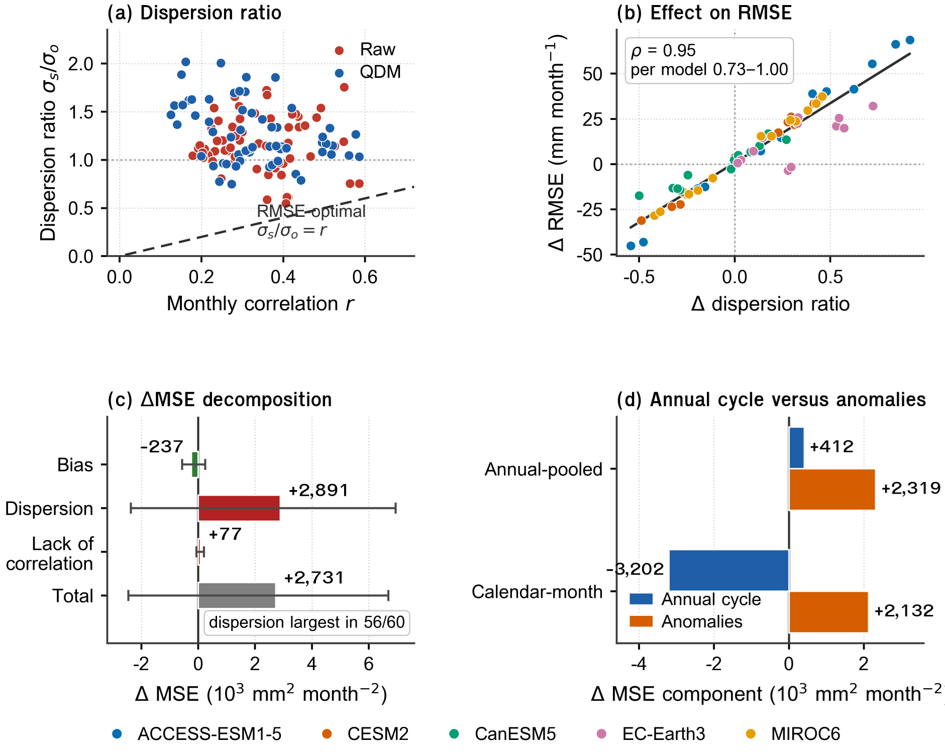
Main Results: Both fitting approaches improved the distributional agreement of CMIP6-simulated rainfall during the independent validation period, with comparable overall performance. The Kolmogorov–Smirnov statistic decreased from 0.201 before correction to 0.102 after calendar-month fitting and 0.105 after annual-pooled fitting. The Perkins skill score increased from 0.776 to 0.861 with calendar-month fitting and 0.859 with annual-pooled fitting. However, their effects on time-paired error differed markedly. Calendar-month fitting reduced monthly RMSE from 116.2 to 109.3 mm month⁻¹, with significant improvement in 14 of the 60 station–model combinations. In contrast, annual-pooled fitting increased monthly RMSE to 124.7 mm month⁻¹, with significant deterioration in 31 of the 60 station–model combinations. Decomposition of mean squared error showed that approximately 95% of the difference in RMSE change between the two fitting approaches was attributable to their effects on the annual-cycle component. Neither approach materially improved the seasonal-anomaly component or the correlation of monthly anomalies. Thus, the lower RMSE obtained with calendar-month fitting primarily reflected closer agreement between the corrected and observed seasonal cycles rather than improved temporal correspondence in rainfall variability.
Conclusions: When evaluated over an independent period not used to estimate the QDM correction relationship, QDM improved selected distributional properties of CMIP6-simulated daily rainfall. In this dataset, calendar-month fitting additionally improved the representation of the observed seasonal cycle and yielded lower monthly RMSE than annual-pooled fitting. However, the correction did not materially improve the measures of temporal correspondence evaluated in this study. Therefore, reductions in RMSE should be interpreted in relation to the underlying components of error rather than regarded as direct evidence of improved temporal correspondence. The findings indicate that bias-correction performance should be evaluated across multiple dimensions, including distributional agreement, seasonal-cycle representation, time-paired error, and temporal correspondence. Performance metrics should therefore be selected according to the intended application and the properties that the corrected rainfall data need to represent.
References
Arif Rafhida, S., Nurdiati, S., Budiarti, R., & Khoirun Najib, M. (2025). Bias correction of CMIP6 rainfall projection for the Lake Toba region, Indonesia, using quantile delta mapping with monthly distribution fitting. Vietnam Journal of Earth Sciences. https://doi.org/10.15625/2615-9783/23833
Benjamini, Y., & Yekutieli, D. (2001). The control of the false discovery rate in multiple testing under dependency. The Annals of Statistics, 29(4), 1165-1188. https://doi.org/10.1214/aos/1013699998
Cannon, A. J., Sobie, S. R., & Murdock, T. Q. (2015). Bias correction of GCM precipitation by quantile mapping: How well do methods preserve changes in quantiles and extremes?. Journal of Climate, 28, 6938-6959. https://doi.org/10.1175/JCLI-D-14-00754.1
Danabasoglu, G., Lamarque, J.-F., Bacmeister, J., Bailey, D. A., DuVivier, A. K., Edwards, J., & Strand, W. G. (2020). The Community Earth System Model version 2 (CESM2). Journal of Advances in Modeling Earth Systems, 12(2), e2019MS001916. https://doi.org/10.1029/2019MS001916
Döscher, R., Acosta, M., Alessandri, A., Anthoni, P., Arsouze, T., Bergman, T., & Zhang, Q. (2022). The EC-Earth3 Earth system model for the Coupled Model Intercomparison Project 6. Geoscientific Model Development, 15(7), 2973-3020. https://doi.org/10.5194/gmd-15-2973-2022
Ehret, U., Zehe, E., Wulfmeyer, V., Warrach-Sagi, K., & Liebert, J. (2012). HESS Opinions: Should we apply bias correction to global and regional climate model data? Hydrology and Earth System Sciences, 16, 3391-3404. https://doi.org/10.5194/hess-16-3391-2012
Ge, F., Zhu, S., Luo, H., Zhi, X., & Wang, H. (2021). Future changes in precipitation extremes over Southeast Asia: insights from CMIP6 multi-model ensemble. Environmental Research Letters, 16(2), 024013. https://doi.org/10.1088/1748-9326/abd7ad
Gudmundsson, L., Bremnes, J. B., Haugen, J. E., & Engen-Skaugen, T. (2012). Technical note: Downscaling RCM precipitation to the station scale using statistical transformations - a comparison of methods. Hydrology and Earth System Sciences, 16, 3383-3390. https://doi.org/10.5194/hess-16-3383-2012
Gupta, H. V., Kling, H., Yilmaz, K. K., & Martinez, G. F. (2009). Decomposition of the mean squared error and NSE performance criteria: Implications for improving hydrological modelling. Journal of Hydrology, 377, 80-91. https://doi.org/10.1016/j.jhydrol.2009.08.003
Humphries, U. W., Waqas, M., Hlaing, P. T., Dechpichai, P., & Wangwongchai, A. (2024). Assessment of CMIP6 GCMs for selecting a suitable climate model for precipitation projections in Southern Thailand. Results in Engineering, 23, 102417. https://doi.org/10.1016/j.rineng.2024.102417
IPCC. (2021). Climate Change 2021: The Physical Science Basis. Contribution of Working Group I to the Sixth Assessment Report of the Intergovernmental Panel on Climate Change. Cambridge University Press. https://doi.org/10.1017/9781009157896
Kuinkel, D., Promchote, P., Upreti, K. R., Wang, S.-Y. S., Dahal, N., & Pokharel, B. (2024). Projected changes in precipitation extremes in Southern Thailand using CMIP6 models. Theoretical and Applied Climatology, 155, 8703-8716. https://doi.org/10.1007/s00704-024-05150-y
Maraun, D. (2016). Bias correcting climate change simulations - a critical review. Current Climate Change Reports, 2, 211-220. https://doi.org/10.1007/s40641-016-0050-x
Maraun, D., Shepherd, T. G., Widmann, M., Zappa, G., Walton, D., Gutiérrez, J. M., Hagemann, S., Richter, I., Soares, P. M. M., Hall, A., & Mearns, L. O. (2017). Towards process-informed bias correction of climate change simulations. Nature Climate Change, 7, 764-773. https://doi.org/10.1038/nclimate3418
Maraun, D., & Widmann, M. (2018). Cross-validation of bias-corrected climate simulations is misleading. Hydrology and Earth System Sciences, 22, 4867-4873. https://doi.org/10.5194/hess-22-4867-2018
Murphy, A. H. (1988). Skill scores based on the mean square error and their relationships to the correlation coefficient. Monthly Weather Review, 116, 2417-2424. https://doi.org/10.1175/1520-0493(1988)116<2417:SSBOTM>2.0.CO;2
Pettitt, A. N. (1979). A non-parametric approach to the change-point problem. Journal of the Royal Statistical Society: Series C, 28(2), 126-135. https://doi.org/10.2307/2346729
Perkins, S. E., Pitman, A. J., Holbrook, N. J., & McAneney, J. (2007). Evaluation of the AR4 climate models' simulated daily maximum temperature, minimum temperature, and precipitation over Australia using probability density functions. Journal of Climate, 20, 4356-4376. https://doi.org/10.1175/JCLI4253.1
Supharatid, S., Nafung, J., & Aribarg, T. (2022). Projected changes in temperature and precipitation over mainland Southeast Asia by CMIP6 models. Journal of Water and Climate Change, 13(1), 337-356. https://doi.org/10.2166/wcc.2021.015
Swart, N. C., Cole, J. N. S., Kharin, V. V., Lazare, M., Scinocca, J. F., Gillett, N. P., & Winter, B. (2019). The Canadian Earth System Model version 5 (CanESM5.0.3). Geoscientific Model Development, 12(11), 4823-4873. https://doi.org/10.5194/gmd-12-4823-2019
Tatebe, H., Ogura, T., Nitta, T., Komuro, Y., Ogochi, K., Takemura, T., & Watanabe, M. (2019). Description and basic evaluation of simulated mean state, internal variability, and climate sensitivity in MIROC6. Geoscientific Model Development, 12(7), 2727-2765. https://doi.org/10.5194/gmd-12-2727-2019
Teutschbein, C., & Seibert, J. (2012). Bias correction of regional climate model simulations for hydrological climate-change impact studies: Review and evaluation of different methods. Journal of Hydrology, 456-457, 12-29. https://doi.org/10.1016/j.jhydrol.2012.05.052
Tong, Y., Gao, X., Han, Z., Xu, Y., Xu, Y., & Giorgi, F. (2021). Bias correction of temperature and precipitation over China for RCM simulations using the QM and QDM methods. Climate Dynamics, 57(5-6), 1425-1443. https://doi.org/10.1007/s00382-020-05447-4
Ziehn, T., Chamberlain, M. A., Law, R. M., Lenton, A., Bodman, R. W., Dix, M., & Srbinovsky, J. (2020). The Australian Earth System Model: ACCESS-ESM1.5. Journal of Southern Hemisphere Earth Systems Science, 70(1), 193-214. https://doi.org/10.1071/ES19035
Downloads
Published
How to Cite
Issue
Section
License
Copyright (c) 2026 Faculty of Science, Burapha University

This work is licensed under a Creative Commons Attribution-NonCommercial-NoDerivatives 4.0 International License.
Burapha Science Journal is licensed under a Creative Commons Attribution-NonCommercial-NoDerivatives 4.0 International (CC BY-NC-ND 4.0) licence, unless otherwise stated. Please read our Policies page for more information