
Effect of Pickling Methods on Physical and Chemical Quality, Phytochemicals and Antioxidant Activity of 𝘾𝙧𝙖𝙩𝙚𝙫𝙖 𝙢𝙖𝙜𝙣𝙖 (Lour.) DC. and 𝙈𝙖𝙣𝙜𝙞𝙛𝙚𝙧𝙖 𝙞𝙣𝙙𝙞𝙘𝙖 𝘓. Var.
Keywords:
𝘊𝘳𝘢𝘵𝘦𝘷𝘢 𝘮𝘢𝘨𝘯𝘢 (Lour.) DC., 𝘔𝘢𝘯𝘨𝘪𝘧𝘦𝘳𝘢 𝘪𝘯𝘥𝘪𝘤𝘢 𝘓. Var., pickling, antioxidations, total phenolic compoundsAbstract
Background and Objectives: Crateva magna (Lour.) DC. and Mangifera indica L. Var. are native to Thailand that are often pickled to extend their shelf life and enhance the flavor of food products. The purpose of this research was to study the physical and chemical quality, phytochemical content and antioxidant activity of Pickled Crateva magna (Lour.) DC. and Mangifera indica L. Var.
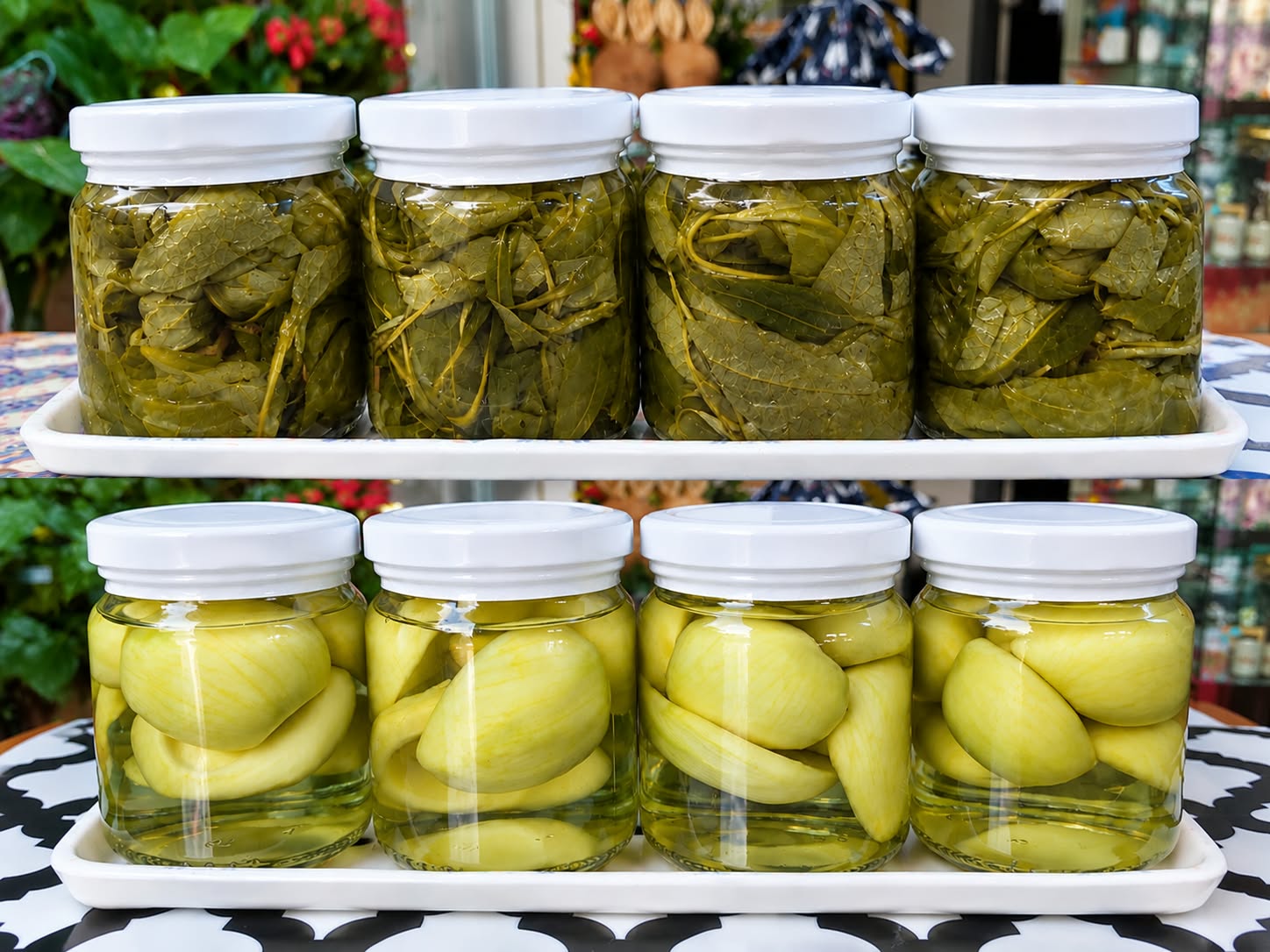
Methodology: This research investigated the laboratory production of pickled Crateva magna (Lour.) DC. leaves and pickled Mangifera indica L. Var. pulp by comparing different raw material preparations prior to pickling: sun-dried Crateva magna (Lour.) DC. leaves (DP-CM) versus non-sun-dried leaves (P-CM), and Mangifera indica L. Var. soaked in a dilute calcium hydroxide solution (SP-MI) versus unsoaked Mangifera indica L. Var. (P-MI). These were compared against fresh Crateva magna (Lour.) DC. leaves (F-CM), fresh Mangifera indica L. Var. (F-MI), and commercially available pickled Crateva magna (Lour.) DC. leaves (M-CM) and pickled Mangifera indica L. Var. (M-MI). Subsequently, the products were analyzed for their physicochemical qualities (color, pH, acidity, moisture content, water activity, ash content, chlorophyll, and vitamin C and phytochemical content (total phenolic compounds and total tannins), as well as evaluating the antioxidant activity using the DPPH assay. Compare the differences in means using Duncan’s New Multiple Range Test (DMRT) at a 95% confidence level and analyze the relationship between antioxidant activity and total phenolic content using the Pearson correlation test.
Main Results: The results demonstrated that the method of raw material preparation prior to pickling affected the quality of pickled Crateva magna (Lour.) DC. and Mangifera indica L. Var. differently. Crateva magna (Lour.) DC. subjected to sun-drying prior to pickling (DP-CM) exhibited a lower overall color change than that without sun-drying (P-CM), while Mangifera indica L. Var. soaked in a dilute calcium hydroxide solution prior to pickling (SP-MI) exhibited a lower overall color change than that without soaking in the solution (P-MI). For Crateva magna (Lour.) DC., pickling resulted in a decrease in pH and an increase in acidity, while total chlorophyll and vitamin C contents decreased compared with fresh Crateva magna (Lour.) DC.. In addition, pickling affected the phytochemical contents and antioxidant activity. The sun-dried Crateva magna (Lour.) DC. prior to pickling (DP-CM) showed the highest total phenolic content, at 423.12±1.99 mg gallic acid/100 g extract, and a total tannin content of 22.39±1.81 mg tannic acid/100 g extract. Its DPPH radical-scavenging activity was 66.69±0.74%, with an IC50 value of 4.76±0.36 mg/mL. For Mangifera indica L. Var., pickling resulted in an increase in pH, whereas acidity and vitamin C content decreased compared with fresh Mangifera indica. Ash and total chlorophyll contents varied depending on the raw material preparation method prior to pickling. The SP-MI treatment showed a total phenolic content of 107.50±0.56 mg gallic acid/100 g extract, a total tannin content of 4.63±0.19 mg tannic acid/100 g extract, and antioxidant activity of 75.23±0.92%. Furthermore, correlation analysis revealed a positive correlation between total phenolic content and total tannin content in both Crateva magna (Lour.) DC. and Mangifera indica L. Var. with correlation coefficients of 0.979 and 0.885, respectively. DPPH radical-scavenging activity was also positively correlated with total phenolic content and total tannin content in both types of samples.
Conclusions: Pickling Crateva magna (Lour.) DC. leaves using the sun-drying pretreatment method (DP-KN) and pickling Mangifera indica L. Var. using the calcium hydroxide solution soaking pretreatment method (SP-MI) yielded products with the highest antioxidant activity, total phenolic content, and total tannin content. Pickled Crateva magna (Lour.) DC. leaves using DP-KN method exhibited 66.69% antioxidant activity and a total phenolic content of 423.12 mg GAE/100 g extract, whereas pickled Mangifera indica L. Var. using SP-MI showed 75.23% antioxidant activity and a total phenolic content of 107.50 mg GAE/100 g extract. Therefore, these methods were selected as suitable for producing pickled Crateva magna (Lour.) DC. leaves and pickled Mangifera indica L. Var.
References
Adebo, O. A., Njobeh, P. B., & Kayitesi, E. (2018). Fermentation by Lactobacillus fermentum strains (singly and in combination) enhances the properties of ting from two whole grain sorghum types. Journal of Cereal Science, 82, 49-56.
Antasionasti, I., Datu, O. S., Lestari, U. S., Abdullah, S. S., & Jayanto, I. (2021). Correlation Analysis of Antioxidant Activities with Tannin, Total Flavonoid, and Total Phenolic Contents of Nutmeg (Myristica fragrans Houtt) Fruit Precipitated by Egg white. Borneo Journal of Pharmacy, 4(4), 301-310.
AOAC. (2000). Official Methods of Analysis of the Association of Official Analytical Chemists 925.19 Moisture in Tea, 17th Ed., Association of Official Analytical Chemists, Washington DC.
Arnon, D.I. (1949). Copper Enzymes in Isolated Chloroplasts, Polyphenoxidase in Beta Vulgaris. Plant Physiology, 24(1), 1-15.
Chanchula, P. (2019). Research and Development Nutritive Quality Improvement Value of Oil Palm Frond by Urea and Calcium Hydroxide Treatments as Goat Feeds. Songkhla: Prince of Songkla University. (in Thai)
Charoenphun, N., & Puttha, R. (2018). Effects of Methods on Delay Browning of Ready-to-eat Fresh Pre-cut Jerusalem Artichokes. Thai Science and Technology Journal, 28(3), 466-479. (in Thai)
Chincinska, I..A. (2021). Leaf infiltration in plant science: old method, new possibilities, Plant Methods, 17(1), 1-21.
Faheem, I. P., Gopalakrishna, B., Mohsina, F. P., & Priya, S. (2021). Antioxidant activity of leaves and bark extracts of Crataeva magna plant. World Journal of Biology Pharmacy and Health Sciences, 5(1), 1-8.
Harbaum, B., Hubbermann, E. M., Zhu, Z., & Schwarz, K. (2008). Impact of Fermentation on Phenolic Compounds in Leaves of Pak Choi (Brassica campestris L. ssp. chinensisvar.communis) and Chinese Leaf Mustard (Brassica juncea Coss). Journal of Agricultural and Food Chemistry, 56(1), 148–157.
Hatano, T., Kagawa, H., Yasuhara, T., & Okuda, T. (1988). Two new flavonoids and other constituents in licorice root: their relative astringency and radical scavenging effects. Chemical and Pharmaceutical Bulletin, 36(6), 2090-2097.
Kampfenkel, K., Vanmontagu, M., & Inze’, D. (1995).Extraction and determination of ascorbate and dehydroascorbate from plant tissue. Analytical Biochemistry, 225(1), 165-167.
Maicaurkaew, S., Apirattananusorn, S., Lueamsaisuk, C., Junlakan, W., & Sribuathong, S. (2025). Effect of Fermentation on Physical and Chemical Characteristics, Bioactive Compounds, and Antioxidant Activity in Bitter Bean and Bamboo Shoot. Recent Science and Technology, 17(3), 263-787. (in Thai)
Matthayom, W., Nochai, K., KoKaew, K., Pisapak, K., & Robmuang, D. (2020). Investigation of antioxidant capacity and antioxidant activity of Ma-huad (Lepisanthes rubiginosa (Roxb.) Leenh.) juice. RMUTSB Academic Journal, 8(2), 187-198. (in Thai)
Moyano, M. J., Heredia, F. J., & Meléndez-martínez, A. J. (2010). The Color of Olive Oils : The Pigments and Their Likely Health Benefits and Visual and Instrumental Methods of Analysis. Compr Rev Food Sci Food Saf, 9(3), 278-291.
Munmoh, S., Nilsamranchit, S., & Tatiang, S. (2021). Relationship of phenolic, flavonoid contents and antioxidant during phenological variation in leaves of two Diospyros species. Khon Kaen Agriculture Journal, 49(2), 323-333. (in Thai)
Namchot, J., Phasuk, S., & Thakonpakdee, P. (2013). Efficiency of Feronia limonia Swingle branch crude extract as antioxidant. RMUTP Research Journal Special Issue. The 5th Rajamangala University of Technology National Conference. 251-260. (in Thai)
Pitikornpuangpetch, C., Saiduang, P., & Kongkaew, P. (2017). A Study of the Diversity of Local Fermented Foods and Food Security within the Taibru Ethnic Lower Khong Riverside Community in Thailand. Humanities and Social Sciences Journal, Ubon Ratchathani Rajabhat University, 8(2), 235-257. (in Thai)
Rattanapanon, N. (2014). Food Chemistry. Bangkok: Odeon Store. (in Thai)
Rungsardthong, V. (2016). Fruit and Vegetable Processing Technology. Bangkok: King Mongkut's University of Technology North Bangkok. (in Thai)
Saharan, P., Sadh, P. K., & Duhan, J. S. (2017). Comparative assessment of effect of fermentation on phenolics, flavonoids and free radical scavenging activity of commonly used cereals. Biocatalysis and Agricultural Biotechnology, 12, 236-240.
Sa-nguanpuag, K., Wongs-Aree, C., Buanong, M., & Techavuthiporn, C. (2012). Bioactive Contents and Antioxidant Capacities of Green Mango Fruits (Mangifera indica) in Thailand: Research reports.(pp. 1-83). Bangkok: Thailand Science Research and Innovation. (in Thai)
Silalai, N., Sirilert, T., Pornprapai, S., & Joemkrajae, K. (2019). Effect of Calcium Salt Solution and Sous Vide Technique on the Characteristics of Ready-to-Eat Carrot during Storage. In The Proceedings of The 7th Academic Science and Technology Conference 2019. (pp. 178-189). Thailand: Pathumthani. (in Thai)
Songchan, K. (2021). Reducing quality loss of fruits and vegetables. Bangkok: Department of Agriculture. (in Thai)
Sunetra, R., (2018). Food Science and Nutrition. New Delhi: Oxford University Press.
Teotia, M. S., Manan, J. K., & Saxena, A. K. (1987). Green Mango processing A Review. Indian Food Packer, 41(6), 75-86.
Tisadondilok, S., & Rattanasing, A. (2019). Antioxidant activities and total phenolic contents of crude ethanolic extract from matat (dillenia indica). VRU Research and Development Journal Science and Technology, 14(3), 104-116. (in Thai)
Yuenyongputtakal, W. (2013). Factors Influencing on Dewatering by Osmotic Dehydration of Fruits and Vegetables. Burapha Science Journal, 18(1), 226-233. (in Thai)
Zhao, Y. S., Eweys, A. S., Zhang, J. Y., Zhu, Y., Bai, J., Darwesh, O. M., Zhang, H. B., & Xiao, X. (2021). Fermentation affects the antioxidant activity of plant-based food material through the release and production of bioactive components. Antioxidants, 10, 1-15.
Downloads
Published
How to Cite
Issue
Section
License
Copyright (c) 2026 Faculty of Science, Burapha University

This work is licensed under a Creative Commons Attribution-NonCommercial-NoDerivatives 4.0 International License.
Burapha Science Journal is licensed under a Creative Commons Attribution-NonCommercial-NoDerivatives 4.0 International (CC BY-NC-ND 4.0) licence, unless otherwise stated. Please read our Policies page for more information