
𝘼𝘾𝙀 Genetic Polymorphism and Body Composition Characteristics in Collegiate Runners
Keywords:
Angiotensin-converting enzyme (𝘈𝘊𝘌) , I/D polymorphism, body composition, collegiate runners, cross-sectional studyAbstract
Background and Objectives: Contemporary sports science recognized that sports performance is determined by a complex interaction among environmental conditions, training status, and genetic factors. Among the genetic markers that have received considerable attention, the Angiotensin-converting enzyme (ACE) gene is one of the most extensively studied genetic markers in sports. It plays a crucial role in the renin-angiotensin system, which regulates cardiovascular homeostasis. The ACE Insertion/Deletion (I/D) polymorphism arises from the presence (Insertion, I) or absence (Deletion, D) of a 287-base pair sequence within intron 16 on chromosome 17, and this variation can influence ACE enzyme activity in the body. Previous studies have demonstrated an association between the ACE I/D polymorphism and athletic physical performance; the I allele tended to correlate with endurance-oriented traits and muscle fatigue resistance, whereas the D allele was frequently associated with power, strength, and muscle hypertrophy. However, most studies of ACE genotypes have focused on elite athletes or non-Thai populations, leaving the genetic profile of Thai collegiate runners unexplored. Accordingly, this study aimed to examine the genotype distribution of the ACE gene in regularly trained university runners and to explore its relationship with body composition.
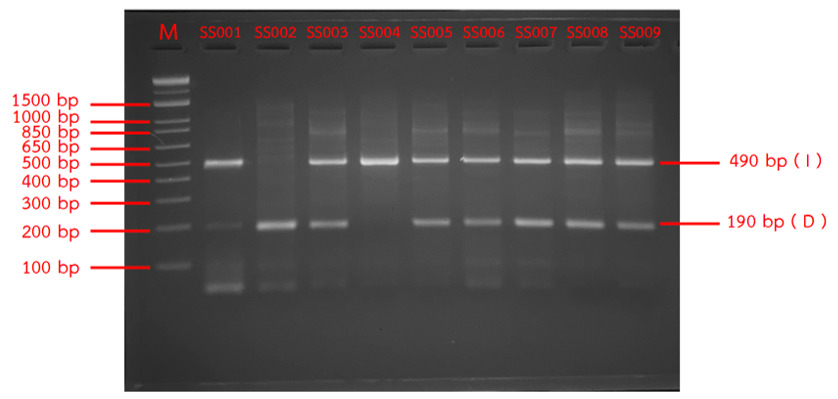
Methodology: This study used a cross-sectional design and involved 24 runners from Burapha University, consisting of 18 males and 6 females, with a mean age of 20.17 ± 1.24 years. All participants were regularly trained university runners. Body composition was assessed using bioelectrical impedance analysis to obtain body mass index (BMI), percent body fat, and skeletal muscle mass. DNA samples were collected from buccal epithelial cells using buccal swabs and subsequently extracted using a DNA extraction kit. The ACE I/D genotype was analyzed via polymerase chain reaction (PCR) utilizing gene-specific primers. The resulting PCR products were separated by agarose gel electrophoresis to visualize genotype patterns. To confirm the accuracy of genotype identification, nucleotide sequencing was performed. Genotype frequencies were tested for Hardy–Weinberg equilibrium (HWE), and the associations between ACE genotype and body composition variables were analyzed using non-parametric statistical techniques appropriate for small sample sizes, with the Kruskal–Wallis H test at a significance level of 0.05. Descriptive statistics were reported as mean ± standard deviation, while genotype distribution was expressed as frequency and percentage.
Results: The results revealed that the ACE genotype distribution in Thai collegiate runners deviated from the Hardy-Weinberg equilibrium. The heterozygous ID genotype was observed most frequently, accounting for 75.0% of the sample, while both homozygous II and DD genotypes were found in equal proportions of 12.5% each. Statistical analysis revealed no significant differences in BMI, body fat percentage, or skeletal muscle mass among the genotype groups (p > 0.05). However, the descriptive results showed a consistent trend. The II genotype group exhibited the highest mean values for BMI, percent body fat, and skeletal muscle mass, followed by the DD group, and then the ID group. These findings suggest that while no significant association was detected in this relatively small sample, genotype-related tendencies may still exist and warrant further investigation in larger populations.
Conclusions: In conclusion, Thai collegiate runners showed an unusually high frequency of the ACE ID genotype. This specific genotype may represent a genetic profile that confers advantages in training adaptations, competition, or overall athletic performance at the university level. Although no statistically significant associations between ACE genotype and body composition were detected, the II genotype group showed a tendency toward greater BMI, adiposity, and skeletal muscle mass. These findings highlight the importance of conducting population-specific genetic studies among Thai athletes, as such information may contribute to a better understanding of sport-related genetic variation. In the future, larger and more diverse samples will be necessary to clarify the biological and performance-related roles of the ACE I/D polymorphism. Ultimately, this line of research may support the development of personalized training and conditioning programs to individual genetic profiles, thereby enhancing athletic preparation and performance optimization.
References
Arcaro, G., Solini, A., Monauni, T., Cretti, A., Brunato, B., Lechi, A., Fellin, R., Caputo, M., Cocco, C., Bonora, E., Muggeo, M., & Bonadonna, R. C. (2001). ACE genotype and endothelium-dependent vasodilation of conduit arteries and forearm microcirculation in humans. Arteriosclerosis, Thrombosis, and Vascular Biology, 21(8), 1313–1319. https://doi.org/10.1161/HQ0801.093508.
Carter, C.S., Onder, G., Kritchevsky, S.B., & Pahor, M. (2005). Angiotensin-converting enzyme inhibition intervention in elderly persons: effects on body composition and physical performance. The Journals of Gerontology. Series A, Biological Sciences and Medical Sciences, 60(11),1437-46. https://doi.org/10.1093/gerona/60.11.1437. PMID: 16339331.
Cieszczyk, P., Krupecki, K., Maciejewska, A., & Sawczuk, M. (2009). The angiotensin converting enzyme gene I/D polymorphism in Polish rowers. International Journal of Sports Medicine, 30(8), 624-7. https://doi.org/10.1055/s-0029-1202825. Epub 2009 May 19. PMID: 19455482.
Charbonneau, D.E., Hanson, E.D., Ludlow, A.T., Delmonico, M.J., Hurley, B.F., & Roth, S.M. (2008). ACE genotype and the muscle hypertrophic and strength responses to strength training. Medicine and Science in Sports and Exercise, 40(4), 677-683. https://doi.org/10.1249/MSS.0b013e318161eab9. PMID: 18317377; PMCID: PMC2984550.
Chai, W., Wang, W., Liu, J., Barrett, E.J., Carey, R.M., Cao, W., & Liu, Z. (2010).Angiotensin II type 1 and type 2 receptors regulate basal skeletal muscle microvascular volume and glucose use. Hypertension, 55(2),523-30. https://doi.org/10.1161/HYPERTENSIONAHA.109.145409. Epub 2009 Dec 7. PMID: 19996061; PMCID: PMC2818814.
Gordon, S.E., Davis, B.S., Carlson, C.J., & Booth, F.W. (2001). ANG II is required for optimal overload-induced skeletal muscle hypertrophy. American Journal of Physiology-Endocrinology and Metabolism, 280(1), E150-9. https://doi.org/10.1152/ajpendo.2001.280.1.E150. PMID: 11120669.
Hernández, D., De La Rosa, A., Barragán, A., Barrios, Y., Salido, E., Torres, A., Martín, B., Laynez, I., Duque, A., De Vera, A. & Lorenzo, V. (2003). The ACE/DD genotype is associated with the extent of exercise-induced left ventricular growth in endurance athletes. Journal of the American College of Cardiology, 42(3), 527-532. https://doi.org/10.1016/s0735-1097(03)00642-9. PMID: 12906984.
Kalupahana, N.S., & Moustaid-Moussa, N. (2012). The adipose tissue renin-angiotensin system and metabolic disorders: a review of molecular mechanisms. Critical Reviews in Biochemistry and Molecular Biology, 47(4), 379-90. https://doi.org/10.3109/10409238.2012.694843. PMID: 22720713.
Liang, X., Sun, J., Guan, H. Zhu, Q., & Yao, W. (2022). Angiotensin II inhibits adipogenic differentiation and promotes mature adipocyte browning through the corepressor CtBP1. Biomedicines, 10, 3131. https://doi.org/10.3390/biomedicines10123131.
McBride, T.A. (2006). AT1 receptors are necessary for eccentric training-induced hypertrophy and strength gains in rat skeletal muscle. Experimental Physiology, 91(2), 413-21. https://doi.org/10.1113/expphysiol.2005.032490. Epub 2005 Nov 29. PMID: 16317083.
Melake, A., & Berhane, N. (2023). Angiotensin-converting enzyme gene insertion/deletion polymorphism and risk of ischemic stroke complication among patients with hypertension in the Ethiopian population. Frontiers in Neurology, 22,14:1093993. https://doi.org/10.3389/fneur.2023.1223173. PMID: 37034069; PMCID: PMC10073506.
Nouryazdan, N., Adibhesami, G., Birjandi, M., Heydari, R., Yalameha, B., & Shahsavari, G. (2019). Study of angiotensin-converting enzyme insertion/deletion polymorphism, enzyme activity and oxidized low density lipoprotein in Western Iranians with atherosclerosis: a case-control study. BMC Cardiovascular Disorders, 19(1), 1–9. https://doi.org/10.1186/S12872-019-1158-4.
Samahito, S., Phataropas, W., Ruangthai, R., Sriyapai, A., & Theanthong, A. (2004). Physical fitness standards for Thai people and a computer-based analysis program (Version 1.0): Research project code KIP 69.41. Kasetsart University, Kasetsart University Research and Development Institute. (in Thai)
Takayama, S., Inoue, K., Ogura, Y., Hoshino, S., Sugaya, T., Ohata, K., Kotake, H., Ichikawa, D., Watanabe, M., Kimura, K., Shibagaki, Y., & Kamijo-Ikemori, A. (2023). Angiotensin II type 1a receptor deficiency alleviates muscle atrophy after denervation. Scientific Reports, 13(1), 519. https://doi.org/10.1038/s41598-023-27737-7. PMID: 36627369; PMCID: PMC9832142.
Varillas-Delgado, D., Del Coso, J., Gutiérrez-Hellín, J., Aguilar-Navarro, M., Muñoz, A., Maestro, A., & Morencos, E. (2022). Genetics and sports performance: the present and future in the identification of talent for sports based on DNA testing. European Journal of Applied Physiology., 122(8), 1811-1830. https://doi.org/10.1007/s00421-022-04945-z. Epub 2022 Apr 16. PMID: 35428907; PMCID: PMC9012664.
Vavak, M., Cihova, I., Reichwalderova, K., Vegh, D., Dolezajova, L.,& Slaninova, M. (2025). Changes in vertical jump parameters after training unit in relation to ACE, ACTN3, PPARA, HIF1A, and AMPD1 gene polymorphisms in volleyball and basketball players. Genes, 16(3), 250. https://doi.org/10.3390/genes16030250. PMID: 40149402; PMCID: PMC11942027.
Vladeanu, M.-C., Bojan, I. B., Bojan, A., Iliescu, D., Badescu, M. C., Badulescu, O. V., Badescu, M., Georgescu, C. A., & Ciocoiu, M. (2020). Angiotensin-converting enzyme gene D-allele and the severity of coronary artery disease. Experimental and Therapeutic Medicine, 20(4), 3407–3411. https://doi.org/10.3892/ETM.2020.8978
Westerkamp, C.M., & Gordon, S.E. (2005). Angiotensin-converting enzyme inhibition attenuates myonuclear addition in overloaded slow-twitch skeletal muscle. American Journal of Physiology. Regulatory, Integrative and Comparative Physiology, 289(4), R1223-31. https://doi.org/10.1152/ajpregu.00730.2004. Epub 2005 Jun 16. PMID: 15961527.
Woods, D.R., Humphries, S.E., & Montgomery, H.E. (2000). The ACE I/D polymorphism and human physical performance. Trends in Endocrinology and Metabolism : TEM; 11(10),416-20. https://doi.org/10.1016/s1043-2760(00)00310-6. PMID: 11091119.
Yabumoto, C., Akazawa, H.,& Yamamoto, R. (2015). Angiotensin II receptor blockade promotes repair of skeletal muscle through down-regulation of aging-promoting C1q expression. Scientific Reports, 5, 14453 https://doi.org/10.1038/srep14453.
Zhang, B., Tanaka, H., Shono, N., Miura, S., Kiyonaga, A.,& Shindo, M. (2003). The I allele of the angiotensin-converting enzyme gene is associated with an increased percentage of slow-twitch type I fibers in human skeletal muscle. Clinical Genetics, 63(2), 139–144. https://doi.org/10.1034/j.1399-0004.2003.00029.x. PMID: 12630962.
Downloads
Published
How to Cite
Issue
Section
License
Copyright (c) 2026 Faculty of Science, Burapha University

This work is licensed under a Creative Commons Attribution-NonCommercial-NoDerivatives 4.0 International License.
Burapha Science Journal is licensed under a Creative Commons Attribution-NonCommercial-NoDerivatives 4.0 International (CC BY-NC-ND 4.0) licence, unless otherwise stated. Please read our Policies page for more information