
A Suitable Forecasting Model for Export Value of Small and Medium Enterprises in Thailand
Keywords:
SMEs, Holt’s Exponential Smoothing, Winter’s Exponential Smoothing, Box-JenkinsAbstract
Background and Objectives: Small and Medium Enterprises (SMEs) constitute an important driving force of Thailand’s economy, playing a vital role in employment generation, income distribution, national economic development, and enhancing the country’s competitiveness. Over the past several years, the export value of Thailand’s SMEs has faced severe volatility driven by both domestic and international factors, including the global economic slowdown, foreign exchange rate fluctuations, trade wars, and the impacts of the Coronavirus Disease 2019 (COVID-19) pandemic. Consequently, these factors have led to high uncertainty in SME export values, directly impacting the financial stability and long-term sustainable growth of Thai SME entrepreneurs. Accurate forecasting data supports production planning, resource management, marketing strategy development, and the formulation of policies to support small and medium enterprises (SMEs) in alignment with changing economic conditions.Therefore, the researcher was interested in conducting a study titled “ A Suitable Forecasting Model for Export Value of Small and Medium Enterprises in Thailand.” The objective of this study was to determine the most suitable forecasting model for predicting the export value of Small and Medium Enterprises (SMEs) in Thailand by comparing forecasting techniques: Holt’s exponential smoothing method, Winter’s exponential smoothing method, and the Box-Jenkins method. The resulting forecasts were intended to provide reliable information for production planning and export management for SMEs, enabling them to align their business operations with changing trends in international trade.
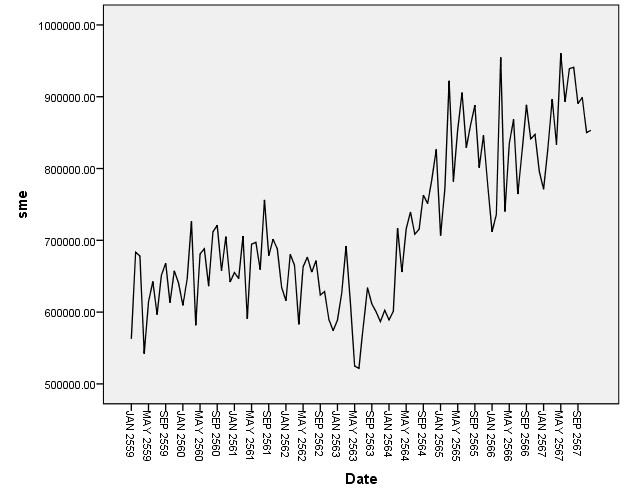
Methodology: The data used in this study consisted of the monthly export value of Small and Medium Enterprises (SMEs) in Thailand, measured in millions of Baht, covering the period from January 2016 to December 2025 (120 months). The dataset was divided into two subsets. The first subset, comprising 108 months of data from January 2016 to December 2024, served as the training dataset to construct forecasting models using time series analysis techniques, specifically Holt’s exponential smoothing method, Winter’s exponential smoothing method, and the Box-Jenkins method. The second subset, consisting of 12 months of data from January 2025 to December 2025, was used as the testing dataset to compare the forecasting accuracy of the methods. The evaluation was based on the lowest Root Mean Square Error (RMSE) and Mean Absolute Percentage Error (MAPE) criteria.
Main Results: In this study on the export value of Small and Medium Enterprises (SMEs) in Thailand, the first dataset from January 2016 to December 2024 was used to construct forecasting models. The results were as follows: 1. Holt’s exponential smoothing method, the optimal smoothing parameters were = 0.301 and
= 0.000047 2. Winter’s additive exponential smoothing, the optimal smoothing parameters were
= 0.409 ,
= 0.0000021 and
= 0.000015 3. Winter’s multiplicative exponential smoothing, the optimal smoothing parameters were
= 0.395 ,
= 0.001 and
= 0.217 4. For the Box-Jenkins method, the most suitable model was identified as SARIMA(2,1,0)(0,1,1)12 . The second dataset, spanning from January 2025 to December 2025 was used to compare the accuracy of the forecasting methods. The evaluation results were as follows: 1. Holt’s exponential smoothing method yielded an RMSE of 58,634.33 and a MAPE of 4.52% 2. Winter’s additive exponential smoothing yielded an RMSE of 49,628.21 and a MAPE of 4.33% 3. Winter’s multiplicative exponential smoothing yielded an RMSE of 51,212.36 and a MAPE of 4.43% and 4. the Box-Jenkins method with the SARIMA(2,1,0)(0,1,1)12 model yielded an RMSE of 44,696.63 and a MAPE of 3.90%. Therefore, the Box-Jenkins method provide the highest forecasting accuracy among the methods considered.
Conclusions: This study constructed and compared forecasting models for the export value of Small and Medium Enterprises (SMEs) in Thailand using time series analysis techniques, specifically Holt’s exponential smoothing method, Winter’s exponential smoothing method, and the Box-Jenkins method. Based on the lowest Root Mean Square Error (RMSE) and Mean Absolute Percentage Error (MAPE) criteria, the results indicated that the Box-Jenkins method with the SARIMA(2,1,0)(0,1,1)12 model provided the highest accuracy, yielding the lowest forecasting errors.
References
Ali, M. P., Sadia, A. Z., & Khanam, M. (2025). ARIMA vs. ETS for RMG export forecasting of Bangladesh: A comparative study on model accuracy. Dhaka University Journal of Science, 73(2), 101-105
Ausavapipit, J., & Jayathavaj, V. (2024). Forecasting the Number of Asthma and Bronchitis Cases using the Box and Jenkins Method. Thai Journal of Public Health and Health Sciences:TJPHS, 7(3), 64 – 76. (in Thai)
Box, G. E. P., Jenkins, G. M., Reinsel, G. C., & Ljung, G. M. (2015). Time Series Analysis: Forecasting and Control (5th ed.). Wiley.
Detthamrong, U. & Chansanam, W. (2018). Time Series Forecasting Stock Closing Prices of Listed Company Using ARIMA Model. Journal of Business, Economics and Communications, 13(2), 57 – 72. (in Thai)
Evania, C. D. & Siregar, B. (2024). Comparison of Holt Winter's and SARIMA Methods on the Data of the Number of Foreign Tourist Visits in Bali Province. Journal of Mathematics, Computations and Statistics, 7(2), 350–359.
Hasibuan, L. H., Musthofa, S., Putri, D.M., and Jannah, M. (2023). Comparison of Seasonal Time Series Forecasting Using SARIMA and Holt Winter's Exponential Smoothing (Case Study: West Sumatra Export Data). BAREKENG: Jurnal Ilmu Matematika dan Terapan, 17(3), 1773–1784.
Hyndman, R. J., & Athanasopoulos, G. (2021). Forecasting : Principles and Practice (3rd ed.). OTexts.
Ketaeam, S. (2005). Forecasting Techniques (2nd ed.). Songkhla: Thaksin University.
LH Bank Business Research. (2026). SME Export and Import in 2025. https://www.lhbank.co.th/getattachment/6c5c0041-6c19-46b3-b890-d2c2e65f41c6/economic-analysis-SME-Industry-Outlook-2026-SME-Export-Import-2568
Mingkwan, Y. (2022). A comparison of Forecasting Models for Electricity Consumption of Uttaradit Rajabhat University. Academic Journal of Science and Applied Science, 6(11), 11 – 24 . (in Thai)
Office of Small and Medium Enterprises Promotion. (2026). Export Value of Small and Medium Enterprises (SMEs) in Thailand. https://gdcatalog.go.th/dataset/gdpublish-msme-export
Ramlan, M.N., Rahman, N.H.A., Ismail, M.T. and Razak, F.A. (2021). Lockdown 2.0 in Malaysia: Evaluating Forecast Performance of Goods Export with Box-Jenkins Methodology and ARIMA Model. Journal of Economics, Finance and Accounting Studies, 3(4), 92–102.
Riansut, W. (2019). Forecasting the export quantity of squid and products. UTK Research Journal, 13(2), 131–143. (in Thai)
Rueangrit, P., Jatuporn, C., Suvanvihok, V., & Wanaset, A. (2020). Forecasting Domestic Durian and Export Durian Prices of Thailand. Maejo Business Review, 2(2), 19 – 31. (in Thai)
Tunkaew, T., Minsan, P.,Nontapa, C., & Minsan, W. (2023). A Suitable Forecasting Model for Exchange Rates of the Top 10 Foreign Currencies Most Preferred by Thai Tourists Compared to the Thai Baht. Thai Science and Technology Journal, 31(3), 1 – 21. (in Thai)
Downloads
Published
How to Cite
Issue
Section
License
Copyright (c) 2026 Faculty of Science, Burapha University

This work is licensed under a Creative Commons Attribution-NonCommercial-NoDerivatives 4.0 International License.
Burapha Science Journal is licensed under a Creative Commons Attribution-NonCommercial-NoDerivatives 4.0 International (CC BY-NC-ND 4.0) licence, unless otherwise stated. Please read our Policies page for more information