
New Physical Parameters Data and Evoluation of a Binary Star System EX Canis Minoris
Keywords:
EX Canis minoris, new orbital period, physical parameters, third bodyAbstract
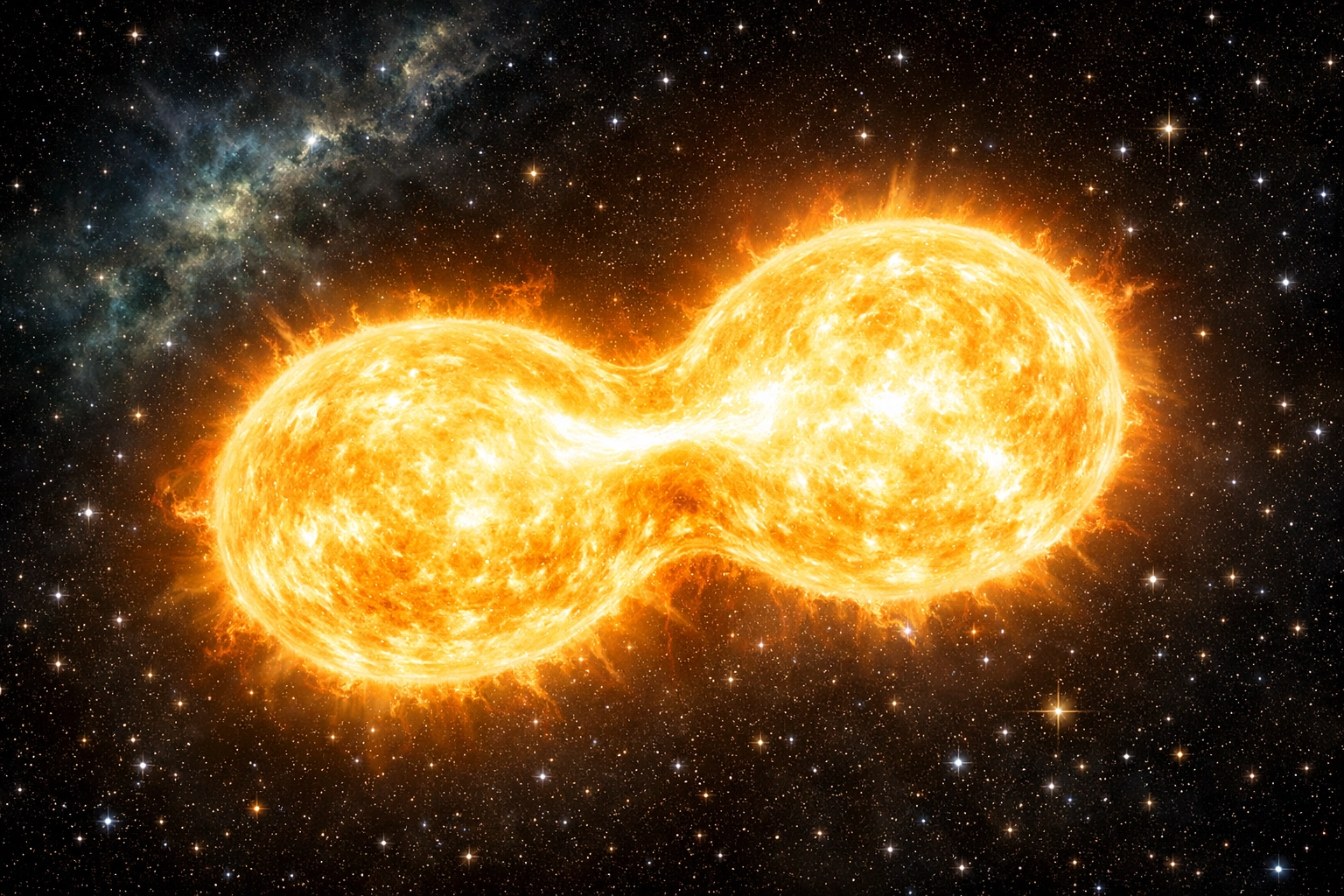
Background and Objectives: The study of binary star systems is a major focus for astronomers in order to understand the evolution of galaxies. Binary star systems are considered key to unlocking the mysteries of stellar evolution because they provide crucial physical data such as mass, radius, and luminosity (Kallrath and Milone, 2009).In particular, the eclipsing binary system of the W Ursae Majoris (W UMa) type, which is a contact binary system where the two stars orbit very close together and share an outer atmosphere (common envelope), the EX Canis Minoris binary system is a fascinating example of this type because it has a short orbital period and exhibits complex physical behavior. Past observations have shown that the binary system EX Canis Minoris exhibits significant orbital period variation. Analysis using the Observed Minus Calculated (O-C) diagram suggests mass transfer between the stars or the possibility of a third body in the system (Kreiner et al., 2001). Furthermore, a study by Samec and Hube (1991) indicated that the binary system EX Kenis Minoris exhibits physical characteristics consistent with models of low-mass ratio touch binary systems. A significant challenge in studying this binary system is the optical asymmetry phenomenon, or the O'Connell effect, which is assumed to be caused by magnetic activity on the star's surface resulting in star spots. High-level data analysis therefore requires accurate processing software such as PHOEBE, which is an advanced version of the Wilson and Devinney algorithm, to create models that are as close to reality as possible (Prša and Zwitter, 2005; Wilson and Devinney, 1971). In the context of research in Thailand, Siramas Komolchinda (2008) studied the evolution and changes in the orbital period of the binary star system EX Canis Minoris. The system was found to undergo changes consistent with the theory of angular momentum loss through stellar winds (magnetic braking). However, this research aims to analyze the physical characteristics and anticipate evolutionary trends of this binary star system.
Methodology: Researchers observed the binary star system EX Canis Minoris at the 7th Cycle Royal Birthday Anniversary Observatory in Nakhon Ratchasima using a 0.7-meter diameter Planewave reflecting telescope, model CDK700, in conjunction with a Proline PL16803 CCD photometry camera. The observations were filtered through blue, yellow, and red wavelength filters according to the UBV standard. The obtained photographic data underwent image reduction to eliminate noise and camera defects. The photographs were then measured using differential photometry with MaxIm DL Pro6 software. The resulting values were then converted from Julian days (JD) to zero Julian days (HJD) to correct for the effects of the Earth's orbit around the Sun. Next, an optical graph was constructed from observations to identify the periods of lowest light. This data, combined with Bob Nelson's historical data, was used to calculate a new equation for the efmeris linear equation. An O-C diagram was analyzed to study changes in the orbital period. The calculated data was then used to analyze the optimal parameters using PHOEBE software to analyze the physical properties of the binary star system.
Main Results: The results revealed that the novel linear equation of ephemeris for the binary star system EX Canis Minoris is HJD = 2453759.635 (±0.00178) + 0.28684 (±8.97951 x 10⁻⁸)E, with an orbital period of 0.28684 days and an orbital period increase rate of 8.83345 x 10⁻¹⁸ seconds per year, or 7.99602 x 10⁻¹¹ days per orbit. This is consistent with the characteristics of an upward-facing parabolic graph in the O-C diagram. Furthermore, the O-C residual diagram tends to exhibit a sine wave pattern, with a period change having an angular velocity in radians per cycle and a semi-amplitude of 0.00152 days. This can be used to determine the light-time, indicating the possible existence of a third object, whose distance can be calculated to be 0.26335 AU from the center of mass of the binary system. This sine wave phenomenon is caused by low-mass companion objects, such as planets or brown dwarfs, orbiting the parent star, resulting in a time shift of eclipses across the object's orbital period. Phoebe's physical analysis shows effective temperatures of the primary and secondary stars at 6000 K and 6300 K, respectively, an orbital inclination of 89.0 degrees, and a mass ratio of 1.83.
Conclusions: In conclusion, the EX Canis Minoris binary system is a over contact binary system with an increasing orbital period, which is inconsistent with the general evolutionary theories of binary systems and may be due to internal system factors such as hot spots or gravitational influence from a third body.
References
Barlow, B. N., Dunlap, B. H., Clemens, J. C., Reichart, D. E., Ivarsen, K. M., LaCluyze, A. P., Haislip, J. B., &Nysewander, M. C. (2011). Fortnightly fluctuations in the O−C diagram of CS 1246. Monthly Notices of the Royal Astronomical Society, 414(4), 3434-3441.
Benacquista, M. (2013). An Introduction to the Evolution of Single and Binary Stars. U.S.A: Springer Science+Business Media New York.
Brown , A. G. A., Vallenari, A., Prusti, T., Bruijne, J. H. J., Babusiaux, C., Biermann, M., Creevey, O. L., Evans, D. W., Eyer, L., Hutton, A., Jansen, F., Jordi, C., Klioner, S. A., Lammers, U., Lindegren, L., Luri, X., Mignard, F., Panem, C., Pourbaix, P., Randich, S., Sartoretti, P., & Zwitter, T. (2021). Gaia Early Data Release 3. Summary of the contents and survey properties. Astronomy and Astrophysics Journal, special issue, 649(A1), 1-20.
Carroll, B., & Ostlie, D. (2007). An Introduction to Modern Astrophysics. 2nd Edition, San Francisco:Addison-Wesley.
Conroy, K. E., Kochoska, A., Heyim, B., Pablo, H., Latham, D. W., & Prša, A. (2020). Physics of Eclipsing Binaries. II. Toward the Complete Model. The Astrophysical Journal Supplement Series, 250(2), 34.
Eker, Z., Soydugan, F., Bilir, S., Bakış, V., & Erdem, A. (2021). Main-sequence effective temperature scale, magnitudes, and colors of early-type stars. Monthly Notices of the Royal Astronomical Society, 506(1), 1186–1208. https://doi.org/10.1093/mnras/stab1714
Erdem, A., Serkan dogru, S., Volkan Bakis, & Demircan, O. (2007). Orbital period variations of four Algol-type eclipsing binaries. Astronomische Nachrichten, 328(6), 543-554.
Heinze, A.N., Tonry, J. L., Denneau, L., Flewelling, H., Stalder, B., Rest, A., Smith, K. W., Smartt S. J., & Weiland, H. (2018). A first catalog of variable stars measured by the Asteroid Terrestrial-impact Last Alert System (ATLAS). The Astronomical Journal, 156(5), 1-49.
Hurley, J. R., Tout, C. A., & Pols, O. R. (2002). Evolution of binary stars and the effect of tides on binary populations. Monthly Notices of the Royal Astronomical Society, 329(4), 897-928.
Kallrath, J., & Milone, E. F. (2009). Eclipsing Binary Stars: Modeling and Analysis (2nd ed.). Springer-Verlag.
Komolchinda, S. (2008). Orbital Period Changes and Evolution of Binary Systems: A.K. Canis Minoris. [Unpublished Master's Thesis]. Chiang Mai University. (in Thai).
Kreiner, J. M., Kim, C.-H., & Nha, I.-S. (2001). An Atlas of O-C Diagrams of Eclipsing Binary Stars. Wydawnictwo Naukowe Akademii Pedagogicznej.
Latkovic/, O., Ceki, A., & Lazarevic/, S. (2021). A Catalog of Overcontact Binary Stars. The Astrophysical Journal Supplement Series, 254(1), 10. https://doi.org/10.3847/1538-4365/abe420
Nagudnok, K., & Rangsungnoen, T. (2024). Orbital Period Change and Light Curve Analysis of a Binary System V410 Aurigae. YRU Journal of Science and Technology, 8(2), 9-18. (in Thai)
Pecaut, M. J., & Mamajek, E. E. (2013). Intrinsic Colors, Temperatures, and Bolometric Corrections of Pre-main-sequence Stars. The Astrophysical Journal Supplement Series, 208(1), 9. https://doi.org/10.1088/0067-0049/208/1/9
Prša, A., & Zwitter, T. (2005). A Computational Framework for the Spectrophotometric Modeling of Eclipsing Binary Stars. The Astrophysical Journal, 628(1), 426–438. https://doi.org/10.1086/430591
Qian, S.-B., Zhu, L. Y., Liu, L., Zhang,X. D., Shi, X. D., He, J. J., & Zhang, J. (2020). Contact binaries at different evolutionary stages. Research in Astronomy and Astrophysics, 20(10), 163-1-20.
Rangsungnoen, T. (2015). Third body and Evolution of a Binary System FZ Orionis. KKU Science Journal, 43(2), 333-345. (in Thai)
Rangsungnoen, T. (2013). Physical Structure of W Uma Binary System LO Andromeda. KKU Science Journal, 41(1), 203-212. (in Thai)
Rattanamala, R. , Kerdprang, T., Longsanthia, P., & Wutsang, S.. (2024). PU Virginis The New Light Curves of a Binary Star System PU Virginis. Burapha Science Journal, 29(1), 266–273. https://li05.tci-thaijo.org/index.php/buuscij/article/view/428 (in Thai)
Rovithis-Livaniou, H. (2020). Study of Eclipsing Binaries: Light Curves & O-C Diagrams Interpretation. Galaxies, 8(4), 78.
Samec, R. G., & Hube, D. P. (1991). The first synthesized light curves of the short-period contact binary, EX Canis Minoris. The Astronomical Journal, 102, 1171–1178. https://doi.org/10.1086/115939
Skelton, P.L., & Smits, D.P. (2009). Modelling of W UMa-type variable stars. South African. Journal of Science. 105(2), 120–126.
Wilson, R. E., & Devinney, E. J. (1971). Realization of Accurate Close-Binary Light Curves: Application to MR Cygni. The Astrophysical Journal, 166, 605. https://doi.org/10.1086/150986
Yang, Y.-G. ,& Qian, S.-B. (2004). A CCD Photometric Study of the W Uma-Type Binary System EZ Hydrae. Publications of the Astronomical Society of the Pacific, 116(823), 826–832.
Zacharias, N., Finch, C. T., Girard, T. M., Henden, A., Bartlett, J. L., Monet, D. G., & Zacharias, M. I.. (2013). THE FOURTH US NAVAL OBSERVATORY CCD ASTROGRAPH CATALOG (UCAC4). The Astrophysical journal, 145(2), 1-14.
Zervas, K., Christopoulou, P. E., & Papageorgiou, A.. (2024). Investigating period variability mechanisms in eclipsing binary stars through eclipsing time variation analysis: a case study of TZ Bootis. The Astrophysical Journal, 961(97), 1-12.
Downloads
Published
How to Cite
Issue
Section
License
Copyright (c) 2026 Faculty of Science, Burapha University

This work is licensed under a Creative Commons Attribution-NonCommercial-NoDerivatives 4.0 International License.
Burapha Science Journal is licensed under a Creative Commons Attribution-NonCommercial-NoDerivatives 4.0 International (CC BY-NC-ND 4.0) licence, unless otherwise stated. Please read our Policies page for more information