
An Improvement Technique in in vitro Propagation of 𝙑𝙖𝙣𝙙𝙖 𝙘𝙪𝙧𝙫𝙞𝙛𝙤𝙡𝙞𝙖, a Rare Orchid Species
Keywords:
𝘝𝘢𝘯𝘥𝘢 𝘤𝘶𝘳𝘷𝘪𝘧𝘰𝘭𝘪𝘢, auxin, cytokinin, chitosan, plant tissue cultureAbstract
Background and Objectives: Thailand is widely recognized as a globally significant epicenter of biological resources and a biodiversity hotspot. This ecological prominence is attributed to its strategic geographical location at the confluence of three major phytogeographical regions: the Indo-Chinese, Indo-Malayan, and Indo-Burmese regions. Such a unique positioning facilitates a remarkable richness in natural resources, with the Orchidaceae family representing one of the most ecologically and economically significant groups. Among these, Vanda curvifolia (Lindl.) L.M. Gardiner, an epiphytic orchid known for its striking floral characteristics, is currently facing a precarious survival status. It is classified as a rare species in Thailand, with scientific reports indicating a rapid and alarming decline in wild populations. The primary drivers of this decline include the intensifying effects of climate change, extensive habitat encroachment due to land development, and the persistent pressure of illegal poaching for the horticultural trade. Given the slow natural regeneration rate of this species, establishing a method for mass propagation within a short timeframe is imperative for its survival. This study was therefore designed to systematically evaluate several critical factors affecting the in vitro propagation of V. curvifolia seedlings. The research objectives focused on: 1) evaluating the efficiency of different basal media formulations; 2) investigating the physiological effects of plant growth regulators within the auxin and cytokinin groups; and 3) examining the growth-stimulating potential of chitosan on seedling proliferation. As there is currently a total absence of prior comprehensive reports regarding these specific developmental factors for V. curvifolia, this research provides a critical scientific foundation for the genetic conservation and sustainable management of this rare orchid species.
Methodology: The experimental plant materials consisted of V. curvifolia seedlings previously obtained through asymbiotic seed germination under sterile in vitro conditions. The research was divided into four distinct experimental phases to ensure a comprehensive analysis of growth factors. Experiment 1 focused on the influence of basal media; four distinct formulations VW, ½VW, MS, and ½MS were compared to identify the optimal nutrient base for vegetative growth. Experiment 2utilized the superior basal medium identified in the first phase, supplementing it with various auxins, namely NAA, IAA, and IBA. These were tested at concentrations of 0, 0.1, 0.5, 1.0, and 2.0 mg/L to determine their efficacy in inducing organogenesis. Experiment 3 followed a similar concentration gradient (0–2.0 mg/L) but focused on the cytokinin group, including BA, Kinetin, and TDZ, to evaluate shoot multiplication. Finally, Experiment 4 investigated the biostimulatory effects of chitosan. Chitosan was added to the optimal basal medium at concentrations ranging from 0 to 100 mg/L (at 10 mg/L intervals) to pinpoint the most effective concentration for enhancing seedling quality and quantity. All experiments were conducted under controlled environmental conditions with regular monitoring of growth parameters.
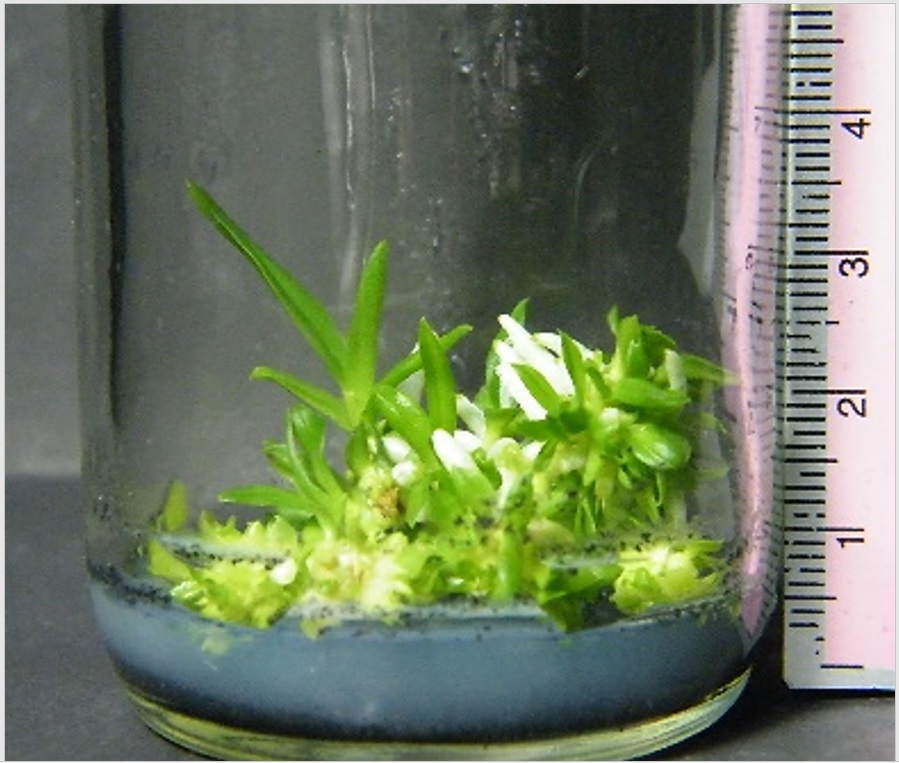
Main Results: Following a rigorous 12-week culture period, the data revealed significant variations across treatments. In the initial assessment of basal media, the VW medium emerged as the most effective formulation. It induced the highest shoot formation rate at 13.33%, with an average of 1.23 shoots per explant. This result was statistically significant (p≤0.05) when compared to the MS and ½MS formulations, which showed lower performance. Furthermore, seedlings cultured on VW medium exhibited superior vegetative development, characterized by the highest average number of leaves (4.46 leaves per explant) and the greatest average seedling height (0.94 cm). Regarding the application of exogenous hormones, the results from Experiment 2 indicated that auxin supplementation significantly influenced developmental pathways. Specifically, VW medium supplemented with 0.5 mg/L IAA yielded the most favorable outcomes, inducing a 40% shoot formation rate and an average of 1.70 shoots per explant. This treatment also stimulated the highest callus formation rate (20%) and the highest protocorm-like body (PLB) formation (25%), with an average of 2.45 protocorms per explant, showing clear statistical superiority over NAA and IBA treatments. In the cytokinin trials (Experiment 3), BA proved to be the most effective cytokinin; the addition of 0.5 mg/L BA resulted in a 35% shoot formation rate and a maximum average of 5.35 leaves per explant. One of the most notable findings of this study was the impact of chitosan (Experiment 4). The addition of 100 mg/L chitosan to the VW medium significantly outperformed other concentrations, resulting in a 35% shoot formation rate. More importantly, it produced the highest average number of shoots at 3.50 per explant and the most robust root system, with an average of 4.95 roots per explant. It also maintained a high rate of protocorm proliferation (2.10 per explant). These results suggest that chitosan acts as a powerful growth enhancer for V. curvifolia, providing a viable alternative or supplement to traditional plant growth regulators.
Conclusions: This research successfully established a highly efficient propagation protocol for V. curvifolia using VW medium supplemented with 100 mg/L chitosan. This method enables the rapid production of high-quality seedlings in large quantities. This protocol serves as a vital tool for ex-situ conservation, facilitating plant production for forest restoration or sustainable commercial trade, which can ultimately reduce the illegal poaching of V. curvifolia from the wild and promote the sustainable conservation of orchid biodiversity.
References
Aktar, S., Nasiruddin, K. M., & Huq, H. (2007). In vitro root formation in Dendrobium orchid plantlets with IBA. Journal of Agriculture & Rural Development, 5, 48-51.
Arditti, J. ,& Harison, C.R. (1977). Vitamin requirements and metabolism in orchid. In Orchid Biology: Reviews and Perspectives I, (pp. 159-175). Edited by Joseph Arditti. Ithaca: Cornell University Press, 1977.
Arditti, J., & Ernst, R. (2008). Micropropagation of orchids. (2nd ep). Singapore: COS Printers Pte Ltd.
Bhadra, S. K., & Hossain, M. M. (2003). In vitro germination and micropropagation of Geodorum densiflorum (Lam.) Schltr., an endangered orchid species. Plant Tissue Culture, 13, 165-171.
Borasee, B. , & Theanhom, A. A. (2014). In vitro seed germination and seedling development of Rhynchostylis coelestis. Khon Kaen Agriculture Journal, 42(3), 524-528. (in Thai)
Boonkerd, N., Chandrkrachang, S., & Stevens, W. F. (1996). Effect of chitin on nodulation and N2 fixation rhizobia-soybean symbiosis, chitin and chitosan. Proceedings of the Asia Pacific Symposium, Bangkok. (pp.183- 187.)
Chamchumroon, V., Suphuntee, N., Tetsana, N., Poopath. , & Tanikkool, S. (2017). Threatened Plants in Thailand. Bangkok: Omega Printing Co., Ltd.
Chuengpanya, R., Muangkroot, A., Jenjittikul, T., Thammasiri, K., Umpunjun, P., Viboonjun, U. , & Chuenboonngarm, N. (2022). In vitro propagation and genetic fidelity assessment of Hedychium longicornutum Griff. ex Baker, a vulnerable zingiberaceous plant of Thailand. Current Applied Science and Technology, 22(6), 1-21.
Chunraspan, S. (2003). Plant Tissue Culture. Department of Biology, Faculty of Science, Udon Thani Rajabhat University. (in Thai)
Coello, C. Y., Miceli, C. L., Dendooven, L., & Gutierrez, F. A. (2010). Plant growth regulators optimization for in vitro cultivation of the orchid Guarianthe skinneri (Bateman) Dressier & W.E. Higgins. Gayana botanica, 67(1),19-26.
Das, M. C., Kumaria, S., & Tandon, P. (2008). In vitro propagation and conservation of Dendrobium lituiflorum Lindl. through protocorm-like bodies. Journal of Plant Biochemistry and Biotechnology, 17, 177-180.
Dasri, K., Munglue, P., Rattana, K., & Sangchanjiradet, S. (2006). The effect of IAA produced by Bacillus pumilus on growth of orchid under micropropagation. Khon Kaen Agricultural Journal, 44(1), 832-837.
Duncan, D. B. (1955). Multiple range and multiple F test. Biometrics, 11, 1-42.
Dzung, N. A. (2005). Application of chitin, chitosan and their derivatives for agriculture in Vietnam. Journal of Chitin Chitosan, 10(3), 109–113.
Faengmuang, W., & Kongbangkerd, A. (2012). Effect of plant growth regulators on growth and development of Dendrobium lamellatum Lindl. in vitro. In Proceedings of the 1st Phayao Research Confarence. (pp.96-102.). Thailand: Phayao. (in Thai).
Fay, M.F., Andriamahefarivo, L., Bachman, S.P., Brown, M.J.M., Calevo, J., Campbell, T., Charitonidou, M., Dixon, K.W., Droissart, V., Forest, F., Hinsley, A.E., Kumar, P., Le Breton, T., Rajaovelona, L.R., Ramandimbisoa, B. Rankou, H., Schuiteman, A., Sharma, J., Simo-Droissart, M., Smidt, E.C., Stévart, T., Svahnström, V.J., Verlynde, S., & Zimmer, H.C. (2025). How threatened are orchids? A review of the state of play and identification of gaps and priorities. Biodiversity and Conservation, 34, 5075–5115.
Gupta, A. (2016). Asymbiotic seed germination in orchids: role of organic additives. International Advanced Research Journal in Science, 3(5), 143-147.
Heikrujam, J., Kishor, R., & Mazumder, P. B. (2017). In vitro propagation of the endemic orchid Ascocentrum ampullaceum (Roxb.) var. auranticum pradhan. International Journal for Science and Advance Research in Technology, 3, 462-467.
Hirano, S. (1999). Chitin and chitosan as novel biotechnological materials. Polym International ,48, 732-734.
Hossain, M. M., Sharma, M, Teixeira da Silva, J. A., & Pathak, P. (2010). Seed germination and tissue culture of Cymbidium giganteum Wall. ex Lindl. Scientia Horticulturae, 23, 479–487.
Hutchinson, J. F., Beardsel, D. V. l., & Comb, J. A. M. (1985). Propagation by tissue culture introduction. In Horticulture of Australian Plants. (pp. 38-52). Western Australian. Dept. Agriculture: South Perth, W.A.
Ieamkheng, S., & Noosawat, S. (2012). Effect of chitosan on in vitro growth and development of Dendrobium moschatum. In The 9th National Kasetsart University Kamphaeng Saen Conference. (pp. 2206-2212).(in Thai)
Indhamusika, S. , & Watthana, S. (2013). Plant of Thailand Orchid 3. Chiang Mai: The Botanical Garden Organization. Ministry of Natural Resources and Environment. (in Thai).
Islam, S. S., & Bhattacharjee, B. (2015). Plant regeneration through somatic embryogenesis from leaf and root explants of Rhynchostylis retusa (L.) Blume. Applied Biological Research, 17, 158-165.
Jandee, A., Bundithya, W., & Potapohn, N. (2021). In vitro seed culture of Dendrobium peguanum Lindl. Journal of Agriculture, 37(2), 149-157.
Janarthanam, B., & Seshadri, S. (2008). Plantlet regeneration from leaf derived callus of Vanilla planifolia Andr. In Vitro Cellular and Developmental Biology – Plant, 44, 84–89.
Kalawong, S., Yimyong, P., Rittirat, S., Suwanno, S., & Siangsuepchart, A. (2020). Effects of culture media, sucrose and chitosan concentrations on Dendrobium palpebrae Lindl. Micropropagation.Khon Kaen Agriculture Journal, 48(2), 395-404. (in Thai)
Khatun, M. M., Khatun, H., & Khanam, D. (2010). In vitro root formation and plantlet development in Dendrobium Orchid. Bangladesh Journal of Agricultural Research, 35(2), 257-265.
Krotsan, J., Soonthornkalump, S.,& Kaewubon, P. (2019). Asymbiotic seed germination and protocorm Development enhancing by chitosan treatment in Coelogyne brunnea Lindl. (Orchidaceae). Khon Kaen Agriculture Journal, 47(1), 141-150. (in Thai)
Malerba, M., & Cerana, R. (2016). Chitosan effects on plant systems. International Journal of Molecular Sciences, 17, 1-15.
Maneerattanarungroj, C., Laywisadkul, S., & Kongbangkerd, A. (2011). Tissue culture of Bulbophyllum affine Lindl. NU Science Journal, 7(2), 45-59. (in Thai)
Mongkolsawat, W. , & Punjansing, T. (2016). In vitro propagation of Liparis regnieri. Journal of Research and Development Buriram Rajabhat University, 11, 118-123. (in Thai)
Murashige, T. , & Skoog, F. (1962). A revised medium for rapid growth and bioassays with tobacco tissue cultures.Physiologia Plantarum, 15(3), 473-497.
Nakamura, T., Nakayama, N., Yamamoto, R., Shimamura, S., Kim, Y., Hiraga, S., Ohyama, T., Komatsu, S., & Shimada, S. (2010). Nitrogen utilization in the supernodulating soybean variety “Sakukei 4” and its parental varieties, “Enrei” and “Tamahomare”. Plant Production Science, 13(2), 123-131.
Nanakorn, W., & Watthana, S. (2008). Queen Sirikit Botanic Garden (Thai Native Orchids 1). Chiang Mai: Wanida Press. (in Thai).
Nasib, A., Ali, K., & Khan, S. (2008). An optimized and improved method for the in vitro propagation of kiwifruit (Actinidia deliciosa) using coconut water. Pakistan Journal of Botany, 4(1), 2355-2360.
Neumann, K.H., Kumar, A.. & Imani, J. (2009). Plant Cell and Tissue Culture - A Tool in Biotechnology Basics and Application. Springer-Verlag. Berlin Heidelberg, 16(2), 1377-1378.
Novak, S. D., Luna, L. J., & Gamage, R. N. (2014). Role of auxin in orchid development. Plant Signaling & Behavior, 9(10), e972277-1 - e972277-8.
Obsuwan, K., & Sawangsri, K. (2010). The effect of chitosan on growth of Dendrobium Queen Pink in tissue culture. Agricultural Sciences Journal, 41(3), 477-480. (in Thai)
Pornpienpakdee, P., Pichyangkura, R., Chadchawan, S., & Limanavech, P. (2005). Chitosan effects on Dendrobium “Eiskul” protocorm-like body production. Congress on Science and Technology of Thailand at Suranaree University of Technology, 31, 18-20. (in Thai)
POWO (2025) Plants of the World Online. Facilitated by the Royal Botanic Gardens, Kew. https://powo.science.kew.org/
Prasertsongskun, S. (2009). Plant tissue culture and plant breeding. (2nd ed.). Bangkok: Forepace publishing house. (in Thai).
Prasertsongskun, S., & Chaipakdee, W. (2011). Effect of chitosan on growth and development of Phalaenopsis cornucervi (Breda) Blume & Rchb.f. Khon Kaen University Science Journal, 39(1), 113-119.
Putalun, W. (2014). Tissue culture technology for medicinal plants: from basics to pharmaceutical applications. Khon Kaen: Khon Kaen pimpattana CO., LTD. (in Thai).
Razdan, M.K. (2002). Introduction to plant tissue culture. (2nd ed.) USA: Science Publishers.
Rahman, M.S., Hasan, M.F., Das, R., Hossain, M.S., & Rahman, M. (2009). In vitro micropropagation of orchid (Vanda tessellata L.) from shoot tip explant. Journal of Biological Sciences, 17, 139-144.
Ritti, W., Chourykaew, B., Phrombangyuan, P., & Thaksin, S. (2016). Effect of chitosan on growth and Development of in vitro seedling of Panisea uniflora(Lindl.) Lindl. Songklanakarin Journal of Plant Science, 3(4), 8-13. (in Thai)
Ritti, W., Chourykaew, B., & Sreenamkhum, O. (2018). Effect of chitosan on growth of in vitro seedling culture of Dendrobium lindleyi Steud. Burapha Science Journal, 23(2), 669-681. (in Thai)
Roy, A. R., Sajeev, S., Pattanayak, A., & Deka, B. C. (2012). TDZ induced micropropagation in Cymbidium giganteum Wall. Ex Lindl. and assessment of genetic variation in the regenerated plants. Plant Growth Regulation, 68, 435-445.
Santarunai. N. (2016). Effect of medium on growth of orchid (Dendrobium friedericksianum Rchb.f.) in vitro. Master of Science Thesis. Burapha University. (in Thai)
Sawhney,R. K., Tiburcio, A. F., Altabella, T., & Galston, A. W. (2003). Polyamines in plants: An overview. Journal of Cell and Molecular Biology, 2, 1-12.
Senavongse, R., Saensouk, P., & Saensouk, S. (2014). In vitro tissue culture of Dendrobium kontumense Gagnep. Khon Kaen University Research Journal, 19(3), 399-413. (in Thai)
Shreetiet, R., Kong, F., & Khanam, D. (2013). In vitro propagation of orchid, Dendrobium densiflorum Lindl. through mature seed culture. South African Journal of Botany, 112, 521-526.
Silayoi, B. (2015). Banana (4th ed.). Bangkok: Kasetsart University Press. (in Thai)
Sitthisatchatham, S. (2007). Wild Orchid of Thailand (4th ed). Bangkok: Bann Lae Suan.
Sitthisatchatham, S. (2015). Orchid (1st ed). Bangkok: Sarakadee Press.
Sitthisatchatham, S. , & Triphet, P. (2009). Wild Orchid of Thailand 2. Bangkok: Bann Lae Suan.
Stewart, S. L., & Kane, M. E. (2006). Asymbiotic seed germination and in vitro seedling development of Habenaria macroceratitis (Orchidaceae), a rare Florida terrestrial orchid. Plant Cell, Tissue and Organ Culture, 86, 147–158.
Street, H. E. (1977). Plant tissue and cell culture (2nd ed). California: University of California Press.
Subthira, T., Suntaranond, S., & Bunnag, S. (2013). Effects of Plant Growth Regulator on in vitro culture of Dendrobium aphyllum (Roxb.) Fischer. Khon Kaen University Research Journal (Graduate Student), 13(1), 1-13. (in Thai)
Sunpapao, A. ,& Pornsuriya, C. (2014). Effects of chitosan treatments on para rubber leaf fall disease caused by Phytophthora palmivora Butler - a laboratory study. Songklanakarin Journal of Science and Technology, 36(5), 507-521. (in Thai)
Supinrach, S., & Supinrach, I. (2014a). Effects of IBA and NAA on Rooting for the Orchid Plantlet Rhynchostylis gigantea (Lindl.) Ridl. ‘Cartoon’. Thai Science and Technology Journal, 22(4), 507-514. (in Thai)
Supinrach, S., & Supinrach, I. (2014b). Effects of BA and NAA on In Vitro Growth of Dendrobium lindleyi Steud.Seedlings. Burapha Science Journal, 19(2), 84-92. (in Thai)
Taji, A. M., & Williams, R. R. (1996). Tissue culture of Australian plants. Australia: University of New England Press.
Tantasawat, P., & Waranyuwut, A. (2008). Plant tissue culture laboratory manual. Bangkok: Agentech CO., LTD. (in Thai)
Tao, J., Yu, L., Kong, F., & Zhao, D. (2011). Effects of plant growth regulators on in vitro propagation of Cymbidium faberi Rolfe. African Journal of Biotechnology, 10(69), 15639-15646.
Techapinyawat, S. (2011). Plant physiology. Bangkok: Chamchuree products Co., Ltd. (in Thai)
Thaitong, O. (2003). Orchid of Thailand (4th ed.). Bangkok: Amarin Printing & Publishing Public Company Limited. (in Thai)
Tikendra, L., Singh, A.R., Vendrame, W.A., & Nongdam, P. (2025). In vitro propagation of endangered Vanda coerulea Griff. ex Lindl.: asymbiotic seed germination, genetic homogeneity assessment, and micro-morpho-anatomical analysis for effective conservation. Agronom, 15, 1-28.
Thammasiri, K. (2016). Thai Orchid Genetic Resources and Their Improvement. Horticulturae, 2(9), 1-13.
Trigiano, R. N. ,& Gray, D. J. (2004). Plant development and biotechnology. USA: CRC Press LLC.
Utami, E. S. W., Hariyanto, S., & Manuhara Y. S. W. (2017). In vitro propagation of the endangered medicinal orchid, Dendrobium lasianthera J.J.Sm through mature seed culture. Asian Pacific Journal of Tropical Biomedicine, 7(5), 406 - 410.
Vacin, E., & Went, F. (1949). Some pH changes in nutrient solutions. In: C.L. Withner (ed.). The Orchids Survey. New York: Ronald Press. 589-599.
Downloads
Published
How to Cite
Issue
Section
License
Copyright (c) 2026 Faculty of Science, Burapha University

This work is licensed under a Creative Commons Attribution-NonCommercial-NoDerivatives 4.0 International License.
Burapha Science Journal is licensed under a Creative Commons Attribution-NonCommercial-NoDerivatives 4.0 International (CC BY-NC-ND 4.0) licence, unless otherwise stated. Please read our Policies page for more information