A Study on the Production of 2-Cell Stage Embryos in C57BL/6Mlac Mice with Adult Age
Keywords:
mice , 2-cell stage embryos , 𝘪𝘯 𝘷𝘪𝘵𝘳𝘰 fertilization, vitrification, embryo transferAbstract
Background and Objectives : The embryo bank unit was established in the National Laboratory Animal Center, Mahidol University, Thailand. The primary role of the embryo bank unit is to preserve various mouse strains. The assisted reproductive technologies for the embryo bank unit included superovulation, in vitro fertilization, in vivo embryo production, vitrification and thawing, in vitro culture, embryo transfer, and cesarean section. In the embryo bank unit, female mice aged 8-10 weeks were used for in vivo embryo production of 2-cell stage embryos, while older mice were terminated from the colony. To optimize animal use, we focus on producing 2-cell stage embryos from adult C57BL/6Mlac female mice through in vitro embryo production, followed by vitrification, thawing, in vitro culture, and embryo transfer. This study aims to determine the percentage of superovulation (% superovulation), the percentage of in vitro fertilization (% in vitro fertilization), the percentage of surviving 2-cell stage embryos after vitrification and thawing (% survival), the percentage of development to blastocysts after in vitro culture (% development), and the percentage of newborn after the embryo transfer (% newborn).
Methodology : C57BL/6Mlac mice were bred in the embryo bank unit. Mice were maintained under routine husbandry procedures in the animal room with strict hygienic conventional, controlled temperature at 22±3ºC, 30-70% humidity, regulated light conditions, a standard mouse diet, and 5-7 ppm choline reverse osmosis water. Mice were kept in plastic cages and stainless-steel lids. The sterile bedding used consisted of corn cobs and dried water hyacinth. Eleven 17-week-old C57BL/6Mlac female mice were used for oocyte production following the routine superovulation protocol. C57BL/6Mlac female mice were induced to superovulation through an intraperitoneal (IP) injection of 10 IU pregnant mare serum gonadotropin (PMSG) at 2:00-3:00 PM, followed by an IP injection of 10 IU human chorionic gonadotropin (hCG) 48 hours later. Nineteen to twenty-one hours after the hCG injection, female mice were euthanized by cervical dislocation. Oviducts were removed and placed in M2 medium. Cumulus oocyte complexes (COCs) were released from the ampulla under a stereomicroscope. COCs of one female mouse were kept in EmbryoMax® Human Tubal Fluid (HTF) medium covered with mineral oil in a CO2 incubator (37ºC, 5%CO2, 95%humidity). Two 12-week-old C57BL/6Mlac male mice were used for fresh sperm collection. A 5 µl of sperm solution was transferred into a COCs drop by micropipette. The sperm and COCs were incubated in a CO2 incubator overnight. The next morning, the 2-cell stage embryos with normal morphology were counted to determine the % in vitro fertilization. The 2-cell stage embryos were collected and pretreated with a Holding medium (Bovine serum albumin, M2 medium) for 3 minutes and frozen by the vitrification method using a 35EG solution (35% v/v ethylene glycol, Bovine serum albumin, Polyvinylpyrrolidone, Trehalose dehydrate, M2 medium) in a 0.25 ml straw tube at room temperature. The 0.25 ml straw tube was placed over liquid nitrogen for 3 minutes, plunged into liquid nitrogen directly, and stored in a liquid nitrogen tank for 6 months. These straw tubes were taken out of the liquid nitrogen tank, warmed at room temperature for 20 seconds, and then warmed at 37ºC water for 20 seconds. The 2-cell stage embryos were found under a stereomicroscope and thawed using a 0.3 M Trehalose, a 0.15 M Trehalose, a 0.075 M Trehalose, and a Holding medium. The surviving 2-cell stage embryos were counted to determine the % survival and then divided into two groups for quality testing through in vitro culture and embryo transfer.
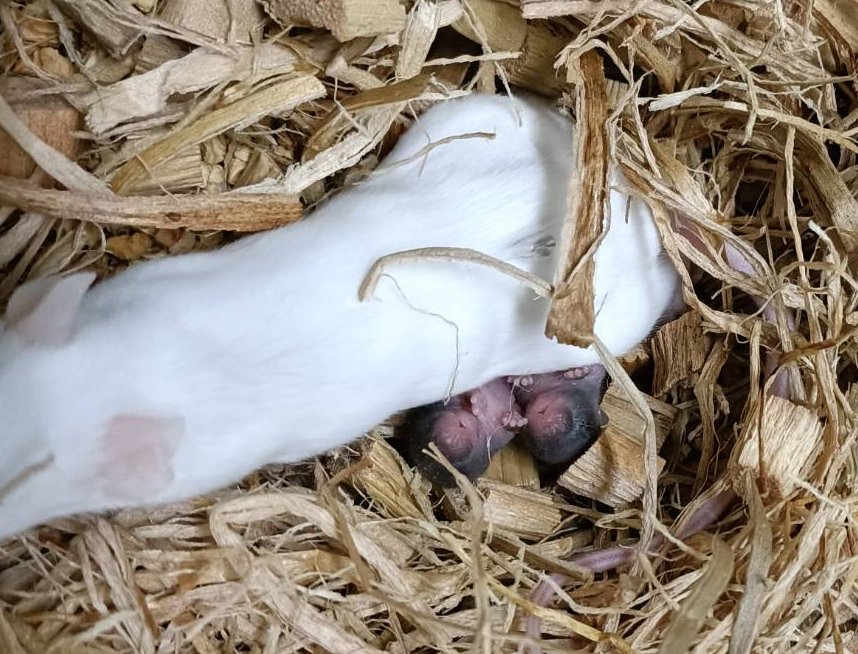
Main Results : Nine 17-week-old C57BL/6Mlac female mice responded to the 10 IU PMSG/hCG superovulation, with the % superovulation was 81.8 (9/11 females). After superovulation and overnight in vitro fertilization, the number of 2-cell stage embryos was 130, the number of oocytes was 38, and the number of abnormal oocytes was 137. The % in vitro fertilization was 42.6 (130/305). The 2-cell stage embryos were kept in a liquid nitrogen tank for 6 months. After thawing, 110 of 2-cell stage embryos were observed under a stereomicroscope, 23 embryos were dead. A total of 87 2-cell stage embryos remained alive after thawing, the % survival was 66.9 (87/130). In Group 1, 29 out of 47 embryos developed into blastocysts, the % development was 61.7 (29/47). In Group 2, 40 embryos were used for embryo transfer into 4 recipients. On the day of birth, the number of newborns was 2, 2, and 2 in the 1st, 2nd, and 4th recipients, respectively, the 3rd recipient gave birth but consumed all the newborns. The % newborn was 15.0 (6/40) after embryo transfer. At 4 weeks old, 2 male and 4 female immature C57BL/6Mlac mice were counted at weaning.
Conclusions : Adult C57BL/6Mlac female mice can be used to produce the 2-cell stage embryos by in vitro embryo production consisting of the 10 IU PMSG/hCG superovulation and the in vitro fertilization. The 2-cell stage embryos are resistant to vitrification and suitable for use in the embryo bank unit. Although the % in vitro fertilization and the % newborn were low, there are sufficient numbers of newborns to establish a new colony. Additionally, it promotes the use of laboratory animals for maximum benefit at the National Laboratory Animal Center.
References
Byers, S. L., Suzan, J., & Rob, A. T. (2006). Performance of ten inbred mouse strains following assisted reproductive technologies (ARTs). Theriogenology, 65(9), 1716-1726.
Golkar-Narenji, A., Hamid, G., Hussein, E., Zeinab, B., & Aliasghar, A. (2012). Superovulation, in vitro fertilization (IVF) and in vitro development (IVD) protocols for inbred BALB/cJ mice in comparison with outbred NMRI mice. Reprod Med Biol, 11(4), 185-192.
Hasegawa, A., Keiji, M., Hiroki, I., Yoshihiro, N., Tamao, E., Gen, W., & Atsuo, O. (2016). High-yield superovulation in adult mice by anti-inhibin serum treatment combined with estrous cycle synchronization. Biology of Reproduction, 94(1), 21, 1-8. https://doi.org/10.1095/biolreprod.115.134023
Kohaya, N., Fujiwara, K., Ito, J., & Kashiwazaki, N. (2013). Generation of live offspring from vitrified mouse oocytes of C57BL/6J strain. PLoS One, 8(3), e58063, https://doi.org/10.1371/journal.pone.0058063
Lamas, S., Franquinho, F., Morgado, M., Mesquita, J., Gartner, F., & Amorim I. (2020). C57BL/6J and B6129F1 embryo transfer: unilateral and bilateral transfer, embryo number and recipient female background control for the optimization of embryo survival and litter size. Animals, 10(8), 1424, https://doi.org/10.3390/ani10081424
Liu, L., Lauryl, M. J. N., Napoleon, L., & Colin, M. K. (2009). Sperm freezing and in vitro fertilization in three substrains of C57BL/6 mice. American Association for Laboratory Animal Science, 48(1), 39-43.
Luo, C., Juliana, Z., Earnessa, E., Shana, P., Wenli, D., & Jan, P. T. (2011). Superovulation strategies for 6 commonly used Mouse strains. Journal of the American Association for Laboratory Animal Science, 50(4), 471-478.
Mochida, K., Hasegawa, A., Li, M. W., Fray, M. D., Kito, S., Vallelunga, J. M., Lloyd, K., Yoshiki, A., Obata, Y., & Ogura, A. (2013). High osmolality vitrification: a new method for the simple and temperature-permissive cryopreservation of mouse embryos. PLoS One, 8(1), e49316, https://doi.org/10.1371/journal.pone.0049316
Nakagata, N., & Takeo, T. (2019). Basic mouse reproductive techniques developed and modified at the center for animal resources and development (CARD), Kumamoto University. Experimental Animals, 68(4), 391-395.
Pornwiroon, S., Kunathikom, S., Makemaharn, O., & Huanaraj, R. (2006). Vitrification of mouse oocyte using open pulled straws compared with needles. Journal of the Medical Association of Thailand, 89(12), 2015-2020.
Qiu, J., Hasegawa, A., Mochida, K., Ogura, A., Koshimoto, C., Matsukawa, K., & Edashige, K. (2021). Equilibrium vitrification of mouse embryos using low concentrations of cryoprotectants. Cryobiology, 98, 127-133.
Sa-ardrit, M., Faisaikarm, T., Boonkusol, D., Pratip Na Talang, N., Chantip, S., Chariyahpongpun, P., Svasti, S.,& Kengkoom, K. (2006). Embryo cryopreservation and transfer of Thalassemia Transgenic mouse. In Proceedings of 49rd Kasetsart University Annual Conference: Science. (pp. 258-264). Bangkok: Kasetsart University. (in Thai)
Song, S., Yuguo, Y., Yao, R., Xin, G., XueQiao, J., Ting, Z., Menmin, Z., Fei, Mi., & Yong, C. (2015). The impact of hormone dosage, mice strains and age on superovulation. Journal of simulation, 3(6), 50-52.
Sztein, J. M., Jane, S. F., & Larry, E. M. (2000). In vitro fertilization with cryopreserved inbred mouse sperm. Biology of Reproduction, 63(6), 1774-1780.
Takeo, T., Ayumi, M., & Naomi, N. (2019). Ovulation of juvenile, mature, and aged female C57BL/6 mice following coadministration of inhibin antiserum and equine chorionic gonadotropin. Theriogenology, 135, 1-6. https://doi.org/10.1016/j.theriogenology.2019.05.028
Taft, Robert. (2017). In vitro fertilization in mice. Cold Spring Harb Protoc. https://doi.org/10.1101/pdb.prot094508
Velazquez, M. A., Bhavwanti, S., Stephanie, J. S., Judith, J. E., Clive, O., & Tom, P. F. (2018). Insulin and branched-chain amino acid depletion during mouse preimplantation embryo culture programmes body weight gain and raised blood pressure during early postnatal life. BBA-Molecular Basis of Disease, 1864(2), 590-600.
Yun, W. B., Kim, H. R., Kim., J. E., Choi, J. Y., Lee, M. R., Park, J. J., Song, B. R., Jung, Y. S., Song, H. K., Cho, J. Y., Kim, K. S., & Hwang, D. Y. (2017). Comparative study of fertilization rates of C57BL/6NKorl and C57BL/6N mice obtained from two other sources. Laboratory Animal Research, 33(2), 179-186.
Zhao, X., Huang, J. X., Zhang, H., Gong, X., Dong, J., Ren, H. L., & Liu, Z. (2021). A comparison study of superovulation strategies for C57BL/6J and B6D2FI mice in CRISPR-Cas9 mediated genome editing. Reproduction, Fertility and Development, 33(13-14), 772-781.
Downloads
Published
How to Cite
Issue
Section
License
Copyright (c) 2025 Faculty of Science, Burapha University

This work is licensed under a Creative Commons Attribution-NonCommercial-NoDerivatives 4.0 International License.
Burapha Science Journal is licensed under a Creative Commons Attribution-NonCommercial-NoDerivatives 4.0 International (CC BY-NC-ND 4.0) licence, unless otherwise stated. Please read our Policies page for more information