
Light Treatment Extended Shelf-Life and Postharvest Quality of Chinese Kale (𝘽𝙧𝙖𝙨𝙨𝙞𝙘𝙖 𝙤𝙡𝙚𝙧𝙖𝙘𝙚𝙖 var. 𝙖𝙡𝙗𝙤𝙜𝙡𝙖𝙗𝙧𝙖)
Keywords:
postharvest, shelf-life , Chinese kale , light emission , senescenceAbstract
Background and Objectives : Chinese kale (Brassica oleracea var. alboglabra) is a leafy vegetable in the Brassicaceae family. It contains phytochemicals such as glucosinolates, vitamin C, polyphenols, carotenoids, and anthocyanins. Chinese kale has a short shelf life of about three days, resulting in a rapid decline in postharvest quality, such as color alteration and chlorophyll degradation. The deterioration leads to income loss, waste, and the production of poor-quality products for consumers. Effective strategies to reduce postharvest losses are, therefore, essential. Light treatment has been developed and shown to be effective in prolonging postharvest quality in vegetables, including broccoli, spinach, and basil. The effectiveness of light treatment depends on the light source, intensity, and quality, as well as the type of treatment (continuous or pulsed). Several internal and external factors influence the efficiency of light treatment, including the genotypes and cultivation conditions, which can range from open fields to greenhouses and plant factories. Within the highly regulated environment of a plant factory, vegetables may exhibit differing physiological and textural characteristics. The aim of this study was to determine the effectiveness of white, red and blue light treatment in prolonging key postharvest quality characteristics of Chinese kale, including chlorophyll content, color, and firmness, cultivated specifically under plant factory conditions.
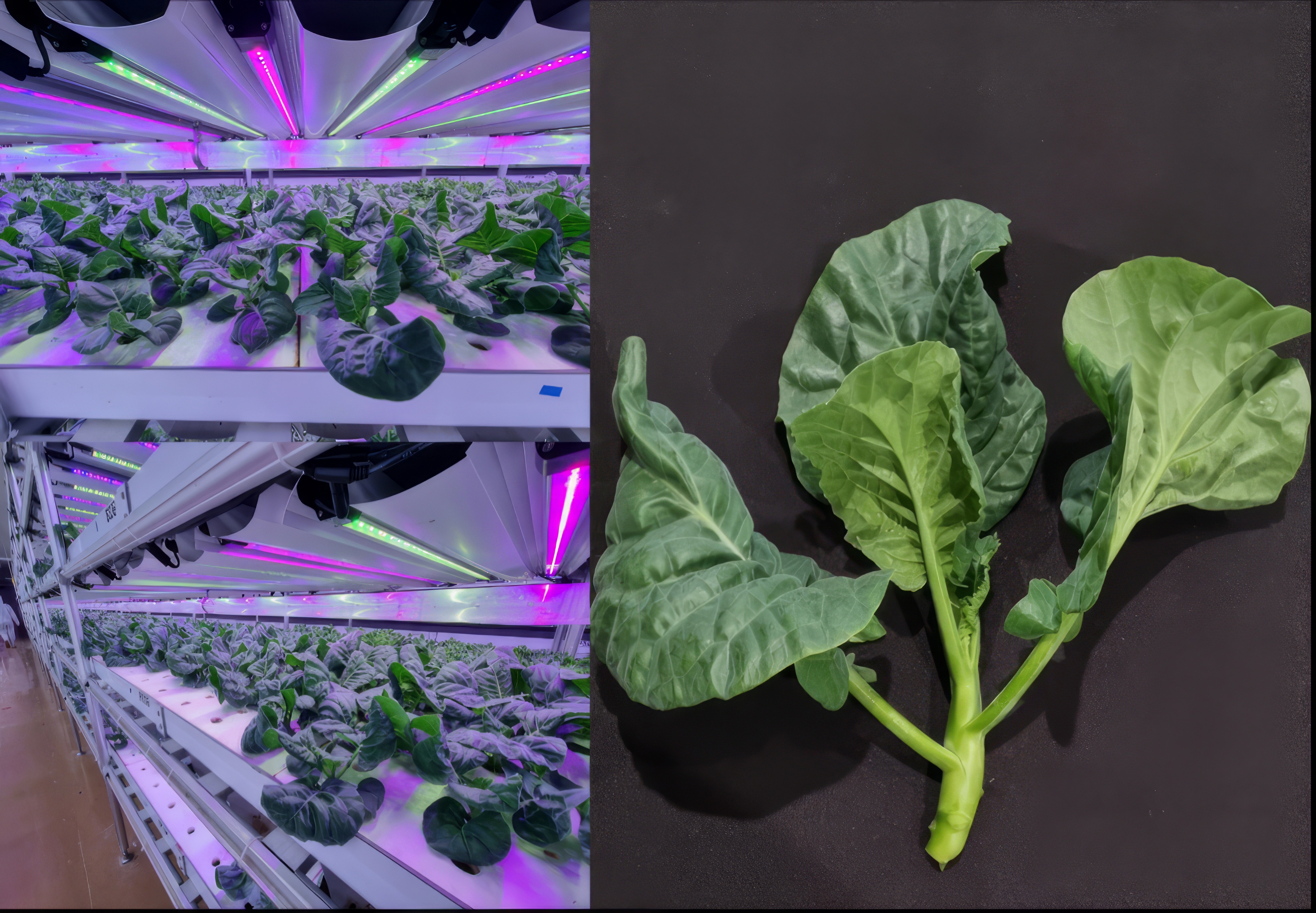
Methodology : Chinese kale cv. Inthanon F1 plants were cultivated in a deep flow technique (DFT) hydroponic system. The plants were grown under white LED light at 100 µmol m-2s-1 PPFD, following a 16-hour light/8-hour dark cycle. After 28 days of growth, the plants that consisting of 5 true leaves were harvested for light treatment. Three Chinese kale plants were packed into Active PakTM bags which facilitate gas and moisture transfer creating equilibrium modified atmospheric packaging. The experiments were conducted in nine replications and the bags were placed horizontally in a plexiglass box measuring 55 cm x 55 cm x 54 cm. Inside the box, LED panels emitted red light (660 ± 10 nm), blue light (460 ± 10 nm), or white light (400–780 nm) at intensities of 20, 50, and 100 µmol m-2s-1 PPFD for 180 min. After the light treatment, the Chinese kale plants were kept in the dark at 20 °C for 14 days. The 2nd, 3rd and 4th leaves from the top from each plant were taken on days 0, 3, 7, 10, and 14 days of storage and used immediately for measurement. Their firmness, chlorophyll index and colour measurement were measured in the middle portion of the leaves, avoiding the veins. Firmness was assessed using a DS/DF Series Digital Force Gauge. Lower values indicated a less rigid leaf texture with a crisper feel, while higher values suggested a tougher texture. The chlorophyll index was measured with a Portable Chlorophyll Meter CM-B and the results were expressed as SPAD values. Color measurements were conducted using a Professional Digital Electronic Colorimeter WR-18. Senescence symptoms including yellowing and microbial infection were also measured. The effects of light type and intensity on postharvest quality were analysed using R software. Density plots were created using the ggplot2 package. All statistical analyses were conducted at a significance threshold of α = 0.05. The data were analysed using one-way analysis of variance (ANOVA) followed by Tukey's multiple comparison tests.
Main Results : The effects of white, red, and blue light at 20, 50, and 100 µmol m-2s-1 PPFD on Chinese kale under plant factory conditions were investigated. Red light at 20 µmol m-2s-1 PPFD (R20) and white light at 50 µmol m-2s-1 PPFD (W50) maintained chlorophyll content and firmness with less variability compared to untreated kale. Blue light at 20 µmol m-2s-1 PPFD (B20) maintained firmness better than blue light at higher intensities, with no significant differences in other parameters. Based on these results, R20, B20, and W50 were selected and combined with equilibrium modified atmospheric packaging during cold storage. During storage, light treatment strongly maintained chlorophyll content. By day 7, untreated kale exhibited a significant decrease in chlorophyll, while light-treated kale particularly W50 and R20 better preserved chlorophyll than B20. This trend continued through day 10. On day 14, only W50- and R20-treated kale retained measurable chlorophyll, whereas B20 and untreated kale showed severe senescence and were unmeasurable. B20-treated kale showed no senescence symptoms until day 7, while R20- and W50-treated kale remained symptom-free until day 10. By day 14, only 4% of W50-treated kale and 7% of R20-treated kale showed microbial infection, with 11% and 30% showing yellowing, respectively. Based on cost-effectiveness, white light treatment can be applied at the commercial scale to improve long-term storage of Chinese kale and other leafy vegetables.
Conclusions : Red and white light emissions at 20 and 50 µmol m-2s-1 PPFD, combined with equilibrium modified atmospheric packaging, extended the shelf life of Chinese kale to 14 days and drastically reduced microbial infection. From a cost-effectiveness perspective, white light treatment is suitable for commercial-scale application to enhance long-term storage of Chinese kale and other leafy vegetables.
References
Allende, A., McEvoy, J. L., Luo, Y., Artes, F., & Wang, C. Y. (2006). Effectiveness of two-sided UV-C treatments in inhibiting natural microflora and extending the shelf-life of minimally processed ‘Red Oak Leaf’ lettuce. Food microbiology, 23(3), 241-249.
Banfield, J. (1999). Rweb: Web-based Statistical Analysis. Journal of Statistical Software, 4, 1-15.
Bantis, F., Smirnakou, S., Ouzounis, T., Koukounaras, A., Ntagkas, N., & Radoglou, K. (2018). Current status and recent achievements in the field of horticulture with the use of light-emitting diodes (LEDs). Scientia Horticulturae, 235, 437-451.
Bárcena, A., Martínez, G., & Costa, L. (2025). The Use of Visible LEDs as Technology to Delay Postharvest Senescence of Vegetables: A Review. Plant Molecular Biology Reporter, 43(1), 1-12.
Bjorkman, M., Klingen, I., Birch, A. N. E., Bones, A. M., Bruce, T. J. A., Johansen, T. J., & Meadow, R. (2011). Phytochemicals of Brassicaceae in plant protection and human health Influences of climate, environment and agronomic practice. Phytochemistry, 72(7), 538-556.
Büchert, A. M., Gomez Lobato, M. E., Villarreal, N. M., Civello, P. M., & Martínez, G. A. (2011). Effect of visible light treatments on postharvest senescence of broccoli (Brassica oleracea L.). Journal of the Science of Food and Agriculture, 91(2), 355-361.
Bundhurat, D., Changrue, V., Poonlarp, P. B., & Boonyakiat, D. (2012). Loss Investigation in Supply Chain Management Process of Chinese Kale in Chiang Mai Province. Agricultural Science Journal, 43(3), 296-299.
Casajús, V., Bárcena, A., Martínez, G., & Costa, L. (2025). Pulses of low-intensity red light inhibit the expression of chlorophyll degradation genes during postharvest senescence of kale leaves. Molecular Biology Reports, 52(1), 1-12.
Chairat, B., Nutthachai, P., & Varit, S. (2013). Effect of UV-C treatment on chlorophyll degradation, antioxidant enzyme activities and senescence in Chinese kale (Brassica oleracea var. alboglabra). International Food Research Journal, 20(2), 623-628.
Charles, F., Nilpraprucka, P., Rouxa, D., & Sallanona, H. (2018). Visible light as a new tool to maintain fresh-cut lettuce post-harvest quality. Postharvest Biology and Technology, 135, 51-56.
Coffigniez, F., Matar, C., Gaucel, S., Gontard, N., Guilbert, S., & Guillard, V. (2021). The use of modeling tools to better evaluate the packaging benefice on our environment. Frontiers in Sustainable Food Systems, 5, 634038.
Costa, L., Montano, Y. M., Carrion, C., Rolny, N., & Guiamet, J. J. (2013). Application of low intensity light pulses to delay postharvest senescence of Ocimum basilicum leaves. Postharvest Biology and Technology, 86, 181-191.
Deng, M., Qian, H., Chen, L., Sun, B., Chang, J., Miao, H., Cai, C., & Wang, O. (2017). Influence of pre-harvest red light irradiation on main phytochemicals and antioxidant activity of Chinese kale sprouts. Food Chemistry, 222, 1-5.
Gergoff, G. G. E., Chaves, A. R., & Bartoli, C. G. (2013). Low irradiance pulses improve postharvest quality of spinach leaves (Spinacia oleraceae L. cv Bison). Postharvest Biology and Technology, 77, 35-42.
Hasperue, J. H., Guardianelli, L., Rodoni, L. M., Chaves, A. R., & Martínez, G. A. (2016a). Continuous white-blue LED light exposition delays postharvest senescence of broccoli. LWT- Food Science and Technology, 65, 495-502.
Hasperue, J. H., Rodoni, L. M., Guardianelli, L. M., Chaves, A. R., & Martínez, G. A. (2016b). Use of LED light for Brussels sprouts postharvest conservation. Scientia Horticulturae, 213, 281-286.
Hossain, M. M., Shibasaki, Y., Nakao, R., Nitano, K., & Goto, F. (2025). Optimization of ionic strength of nutrient solution for enhanced hydroponic watermelon yield and quality in greenhouse. Scientific Reports, 15(1), 25976.
Kaiser, E., Kusuma, P., Vialet-Chabrand, S., Folta, K., Liu, Y., Poorter, H., Woning, N., Shrestha, S., Ciarreta, A., van Brenk, J., Karpe, M., Ji, Y., David, S., Zepeda, C., Zhu, X. G., Huntenburg, K., Verdonk, J. C., Woltering, E., Gauthier, P. P., Courbier, S., Taylor, G., & Marcelis, L. F. (2024). Vertical farming goes dynamic: optimizing resource use efficiency, product quality, and energy costs. Frontiers in Science, 2, 1411259.
Liebsch, D., & Keech, O. (2016). Dark-induced leaf senescence: new insights into a complex light-dependent regulatory pathway. New Phytologist, 212(3), 563-570.
Lin, H., Cai, Y., Shan, J., Mao, X., Zhang, Z., Huang, J., Cai, C., & Zhu, R. (2025a). White and blue LED irradiation effectively inhibit postharvest decay in citrus caused by Cladosporium cladosporioides. LWT, 118016.
Lin, B., Huang, S., Liang, Y., Liang, Y., Li, Z., Lin, Y., & Zhang, Y. (2025b). Blue light as a postharvest tool: Intensity-dependent enhancement of ripening, quality, and shelf-life potential in detached strawberries. Food Chemistry: X, 103024.
Liu, J. D., Goodspeed, D., Sheng, Z., Li, B., Yang, Y., Kliebenstein, D. J., & Braam, J. (2015). Keeping the rhythm: light/dark cycles during postharvest storage preserve the tissue integrity and nutritional content of leafy plants. BMC Plant Biology, 15(1), 92.
Lobiuc, A., Vasilache, V., Pintilie, O., Stoleru, T., Burducea, M., Oroian, M., & Zamfirache, M. M. (2017). Blue and red LED illumination improves growth and bioactive compounds contents in acyanic and cyanic Ocimum basilicum L. microgreens. Molecules, 22(12), 2111.
Mastropasqua, L., Tanzarella, P., & Paciolla, C. (2016). Effects of postharvest light spectra on quality and health-related parameters in green Asparagus officinalis L. Postharvest Biology and Technology, 112, 143-151.
Mi, H., Zhou, X., Yang, J., Chen, J., & Liu, B. (2023). LED white light treatment delays postharvest senescence of ‘Zaosu’ pear fruit with inhibited chlorophyll degradation. Horticulturae, 10(1), 32.
Min, Q., Marcelis, L. F., Nicole, C. C., & Woltering, E. J. (2021). High light intensity applied shortly before harvest improves lettuce nutritional quality and extends the shelf life. Frontiers in Plant Science, 12, 615355.
Nassarawa, S. S., Abdelshafy, A. M., Xu, Y., Li, L., & Luo, Z. (2021). Effect of light-emitting diodes (LEDs) on the quality of fruits and vegetables during postharvest period: a review. Food and Bioprocess Technology, 14(3), 388-414.
Olarte, C., Sanz, S., Echávarri, J. F., & Ayala, F. (2009). Effect of plastic permeability and exposure to light during storage on the quality of minimally processed broccoli and cauliflower. LWT-Food Science and Technology, 42(1), 402-411.
Pintos, F. M., Hasperué, J. H., Vicente, A. R., & Rodoni, L. M. (2020). Role of white light intensity and photoperiod during retail in broccoli shelf-life. Postharvest Biology and Technology, 163, 111121.
Pintos, F., Rodoni, L., Patrignani, M., Ixtaina, P., Vicente, A., Martínez, G., & Hasperué, J. (2023). Advances in the use of white light on broccoli and kale postharvest shelf life. Innovative Food Science & Emerging Technologies, 86, 103373.
Porat, R., Lichter, A., Terry, L. A., Harker, R., & Buzby, J. (2018) Postharvest losses of fruit and vegetables during retail and in consumers’ homes: quantifications, causes, and means of prevention. Postharvest Biology and Technology, 139, 135-149.
Reyes, V., Cahill, E., & Mis Solval, K. E. (2024). The potential for reducing food waste through shelf-life extension: Actionable insights from data digitization. Sustainability, 16(7), 2986.
Sakuraba, Y. (2021). Light-mediated regulation of leaf senescence. International journal of molecular sciences, 22(7), 3291.
Sun, B., Yan, H., Liu, N., Wei, J., & Wang, Q. (2012). Effect of 1-MCP treatment on postharvest quality characters, antioxidants and glucosinolates of Chinese kale. Food Chemistry, 131(2), 519-526.
Wang, C. (1998). Heat treatment affects postharvest quality of kale and collard but not of brussels sprouts. Hortscience, 33, 881-883.
Wang, Y. Q., Hu, L. P., Liu, G. M., Zhang, D. S., & He, H. J. (2017). Evaluation of the nutritional quality of Chinese kale (Brassica alboglabra Bailey) using UHPLC-Quadrupole-Orbitrap MS/MS-based metabolomics. Molecules, 22(8), 1262.
Wang, T., Li, C., Liu, S., & Liu, Y. (2025). Red light enhances the storage quality and flavor of Chinese cabbage During a short shelf life. Current Research in Food Science, 101105.
Wickham, H. (2016). Data analysis. In ggplot2: elegant graphics for data analysis (pp. 189-201). Cham: Springer international publishing.
Wong, T. I., & Zhou, X. (2024). Photon efficacy and cost investigation of LEDs at different wavelengths and color temperatures for horticulture. Discover Agriculture, 2(1), 125.
Yan, Z., Li, Y., Li, T., Kou, X., Wu, C., Xu, D., Zhou, D., Cong, K., Fan, G. & Li, X. (2025). Exploring the effects of white LED irradiation on postharvest quality and carotenoid biosynthesis in fresh goji Berries: Insights from physiological and transcriptomic analyses. Plant Physiology and Biochemistry, 110254.
Yang, Y., Li, Y., Guang, Y., Lin, J., Zhou, Y., Yu, T., & Dang, F. (2023). Red light induces salicylic acid accumulation by activating CaHY5 to enhance pepper resistance against Phytophthora capsici. Horticulture Research, 10(11), uhad213.
Yaun, B. R., Summer, S. S., Eifert, J. D., & Marcy, J. E. (2004). Inhibition of pathogens on fresh produce by ultraviolet energy. International Journal of Food Microbiology, 90(1), 1-8.
Zheng, W., Shi, J., Zhu, Z. Y., Jin, P., Chen, J. H., Zhang, L., Zhang, E., Lin, T., Zhu, Z. J., Zang, Y. X.,& Wu, J. G. (2022). Transcriptomic analysis of succulent stem development of Chinese kale (Brassica oleracea var. alboglabra Bailey) and its synthetic allotetraploid via RNA sequencing. Frontiers of Plant Science, 13,1004590.
Zhao, J., Jiang, T., Liu, Z., Zhang, W., Jian, G., & Qi, F. (2012). Dominant Gene cplsr1 Corresponding to Premature Leaf Senescence Resistance in Cotton (Gossypium hirsutum L.). Journal of Integrative Plant Biology, 54(8), 577-583.
Downloads
Published
How to Cite
Issue
Section
License
Copyright (c) 2025 Faculty of Science, Burapha University

This work is licensed under a Creative Commons Attribution-NonCommercial-NoDerivatives 4.0 International License.
Burapha Science Journal is licensed under a Creative Commons Attribution-NonCommercial-NoDerivatives 4.0 International (CC BY-NC-ND 4.0) licence, unless otherwise stated. Please read our Policies page for more information