
Variations of Sediment Organic Matter and Nutrients in Nam Oun Dam Reservoir, Sakon Nakhon Province
Keywords:
sediment, organic matter , nutrient, reservoir, Nam Oun DamAbstract
Background and Objectives : Nam Oun Dam is a large reservoir, serves water storage, irrigation, flood control and drainage. Nam Oun Dam Reservoir covers the areas of many districts in Sakon Nakhon province. Land use in the areas surrounding the reservoir, such as residential communities, tourist sites, fisheries, agriculture (crop cultivation and livestock farming), fisheries conservation zones, and water inflow and outflow areas. These areas are important for the generation of sediments and nutrients within the reservoir. This reservoir is currently facing the problem of Giant Salvinia infestation (Salvinia molesta D.S. Mitchell), which creates a risk to accelerate the accumulation of sediments and may affect the water quality in the long-term of the reservoir. This study aimed to investigate the spatial and seasonal variations of organic matter and nutrient contents in the sediments of Nam Oun Dam Reservoir, including sediment water content and particle size.
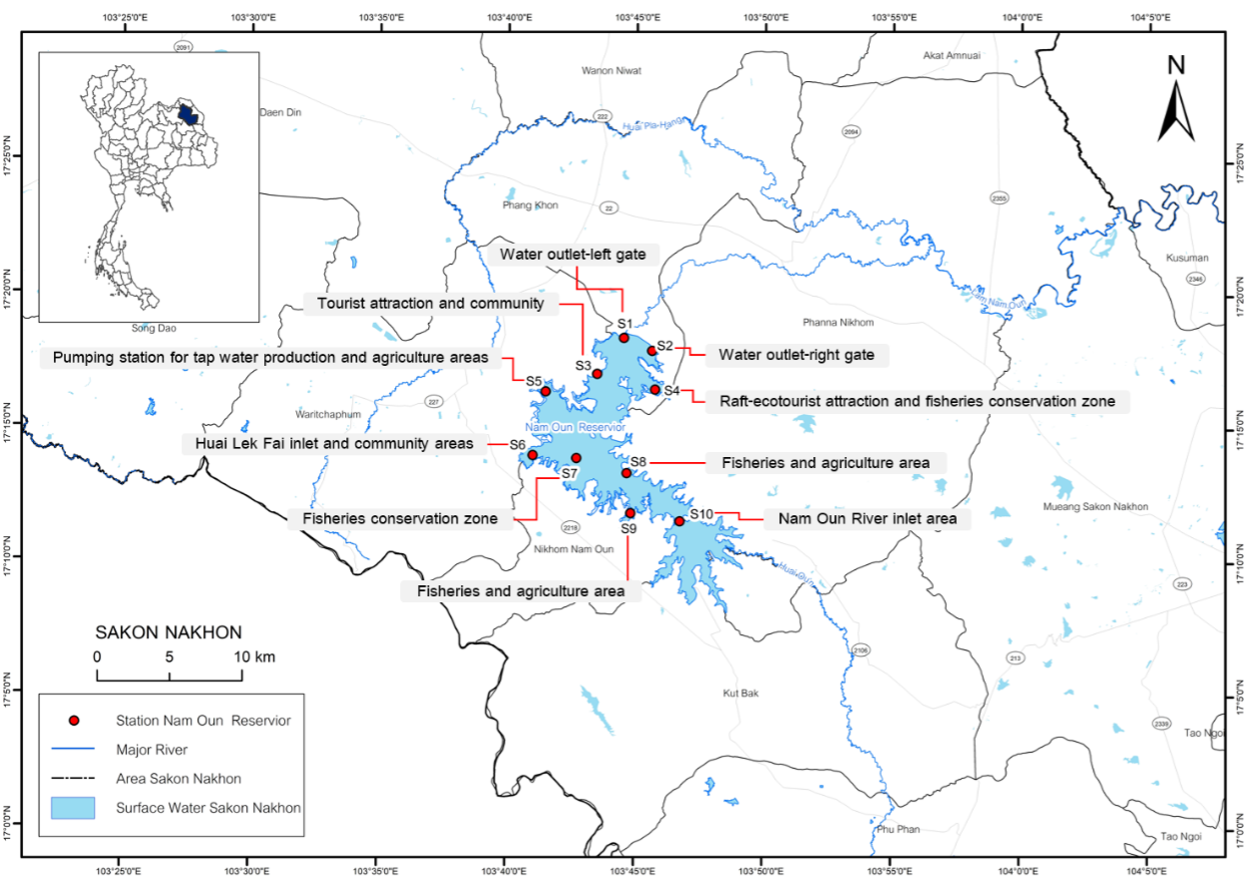
Methodology : Study sites in Nam Oun Dam Reservoir were 10 stations (S1-S10) such as S1 (water outlet-left gate), S2 (water outlet-right gate), S3 (tourist attraction and community), S4 (raft-ecotourist attraction and fisheries conservation zone), S5 (pumping station for tap water production and agriculture areas), S6 (Huai Lek Fai inlet and community areas), S7 (fisheries conservation zone), S8-S9 (fisheries and agriculture area) and S10 (Nam Oun River inlet area). Surface sediment samples were collected using an Ekman Grab sampler (15x15 cm) from 10 stations (S1-S10) located in areas with different land uses surrounding the reservoir. Sampling was conducted seasonally within a year, three sampling periods were summer (late March 2023), rainy (mid- August 2023) and winter (early January 2024). The sediment samples were analyzed to determine the contents of organic carbon (OC), organic matter (OM), ammonium-nitrogen (NH4+-N), nitrate-nitrogen (NO3--N), phosphate-phosphorous (PO43--P), sediment water content (WC) and percentage (%) of sediment particles (clay, silt and sand). The data were statically analyzed using One-Way Analysis of Variance (ANOVA), the averages were compared by Duncan’s Multiple Range Test, and the relationships between parameters were analyzed by Pearson’s Correlation.
Main Results :The contents of OC and OM ranged from 0.85-4.93% and 1.46-8.50%, with the averages of 2.22±0.97% and 3.83±1.66%, respectively. There were not significant seasonal differences (p>0.05), whereas significant spatial differences were found among the study sites (p<0.05). Site S7 was the highest OC and OM contents, while the lowest contents were found at S1, S2, S3, S6, S9 and S10. The averages of OM content in most areas of the reservoir indicated a low level of organic matter in the sediments. The averages of NH4+-N, NO3--N and PO43--P contents ranged from 3.68-58.69 mg/kg, 10.94-160.23 mg/kg and 0.07-0.72 mg/kg, with the averages of 17.55±12.99 mg/kg, 50.17±40.73 mg/kg and 0.36±0.20 mg/kg, respectively. There were not significant spatial differences for nutrients (p>0.05). However, significant seasonal differences were observed for NO3--N and PO43--P (p<0.05), with the highest averages recorded in winter and rainy seasons, respectively. In contrast, NH4+-N was not significant seasonal difference (p>0.05). The NH4+-N content was significantly correlated with OM content (p<0.05, r=0.41) and highly significantly correlated with NO3--N content (p<0.001, r=0.68). Furthermore, PO43--P content was also found to be very significantly correlated with OM content (p<0.01, r=0.49). These indicated that the organic matter content in the sediments had positive effect on the nutrient contents. WC ranged from 41.47-77.11%, with the averages of 58.45±9.03%. WC was not significant differences between seasons (p>0.05), but significant difference was found among study sites (p<0.05). The highest contents were found at S7 and S8, with the lowest content was found at S3. WC showed highly significant positive correlation with the contents of OM (p<0.001, r=0.83), very significant positive correlation with NH4+-N (p<0.01, r=0.48), and PO43--P (p<0.01, r=0.55) and significant positive correlation with NO3--N (p<0.05, r=0.39). Therefore, WC could be the important parameter for preliminary indicator of the organic matter and nutrient conditions in the sediments. The results of the sediment particle size were found that clay, silt and sand ranged from 19.96-54.27%, 14.72-44.57% and 22.63-62.09%, with the averages of 29.06±8.50%, 26.83±8.28% and 44.17±11.60%, respectively. Particle size was not statically significant seasonal difference (p>0.05), but it was statically significant spatial difference (p<0.05). The results of sediment texture analysis showed that sandy clay loam was mostly found in the study areas of the reservoir (S2, S4, S7 and S8), followed by loam (S1, S3 and S5), clay loam (S6 and S9) and clay (S10), respectively. This research did not detect a correlation in the particle size and the contents of organic matter and nutrients.
Conclusions : The land use areas surrounding the Nam Oun Dam Reservoir had a significant effect (p<0.05) on the variations in sediment organic matter contents (OC and OM), water content (WC) and Particle size (clay, silt and sand) within the reservoir, but had no significant effect (p>0.05) on the sediment nutrient contents. In contrast, the season had a significant effect (p<0.05) on the variations of OC, OM and particle size, but had no significant effect (p>0.05) on the variations of most sediment nutrients. Further study on water current velocity could provide more explanation of sediment transport direction. The data from this research can be used as baseline for sustainable management of Nam Oun Dam Reservoir.
References
APHA, AWWA , & WEF. (1998). Standard Methods for the Examination of Water & Wastewater (20thEdition). Washington, DC: American Public Health Association.
Boyd, C.E. (1995). Bottom soil, sediment and pond aquaculture. New York: Chapman & Hall Book.
Brooks, R.H. (1983). Soil Science and Agrochemistry. Amsterdam: Royal Tropical Institute.
Chuan, L.L. , & Sugahara, I. (1984). A manual on Chemical Analysis of Coastal Water and Bottom water, Primary Production. Singapore: Dept/ Marine Fisheries Research Dept., SEAFDE.
Department of Fisheries. (2019). Manual for Water Quality Analysis for Aquaculture and Farm Standard Certification. Chiang Mai: Wanida Printing L.P. (in Thai)
Fang, Q., Tang, Y., Zhu, J., Liao, H., Du, X., Bai, G., Yang, H., Wu, Z., & Zhang, Y. (2024). Nutrient status of overlying water and sediment of West Lake, Hangzhou, China. HydroResearch, 7, 55-70.
Hu, S., Wang, T., Xu, S., Ma, L. , & Sun, X. (2019). Seasonal release potential of sediments in reservoir and its impact on water quality assessment. International Journal of Environmental Research and Public Health., 16(18), 3303.
Li, W., Xu, S., Chen, X., Han, D., & Mu, B. (2023). Influencuing factors and nutrients release from sediments in the water level fluctuation zone of Biliuhe Reservoir, a drinking water reservoir. Water, 15, 3659.
Luvai, A., Obiero, J., & Omuto, C. (2022). Physiochemical properties of bottom sediment in Maruba Dam Reservoir, Machakos, Kenya. Applied and Environmental Soil Science, 2022(1), 2382277.
Meksumpun, C. (2005). Sediments. Bangkok: Department of Fishery Biology, Faculty of Fisheries, Kasetsart University. (in Thai)
Meksumpun, C. (2021). From Upstream to estuary Hydro-ecological Functions for Conservative Management. (2ndEdition). Bangkok: Department of Fishery Biology, Faculty of Fisheries, Kasetsart University. (in Thai)
Meteorological Development Division. (2022). Sakon Nakhon-Last 30 years (1981-2010). Thai Meteorological Department. https://www.tmd.go.th/en/weather/province/last30years-1981-2010/sakon-nakhon/26/356201
Obialor, C.A., Okeke, O.C., Onunkwo, A.A., Fagorite, V.I., & Ehujuo, N.N. (2019). Reservoir sedimentation: causes, effects and mitigation. International Journal of Advanced Academic Research, 5(10), 92-109.
Palma, P.M., Penha, A.M., Novais, M.H.m Fialho,S., Lima, A., Mourinha, C., Alvarenga, P., Rosado, A., Iakunin, M., Rodrigues, G., Potes, M., Costa, M.J., Morais, M., & Salgado, R. (2021). Water-sediment physicochemical dynamics in a large reservoir in the Mediterranean region under multiple stressors. Water, 13, 707.
Pudyastuti, P.S., Yakan, A.F., Abdurrosyid, J., & Budinetro, H.S. (2020). The impact of land-use on Cengklik Reservoir’s sedimentation rate. Journal of Physics: Conference Series, 1858, 012052.
Royal Irrigation Department. (n.d.). Summary table of water conditions in Nam Oun Dam: data from March 1, 2023 to February 29, 2024. https://app.rid.go.th/reservoir/rsvmiddle/dam_detail/100202/2023-03-01/2024-02-29. (in Thai)
Royal Irrigation Department. (2017). 50 Years of Nam Oun Dam, half a century of pride. Samut Sakhon: Pimdee Company Limited. (in Thai)
Shen, Y., Peng, C., Yuan, P., Wu, X., Jiang, L., Chen, Si., & Song, X. (2021). Seasonal and spatial distribution and pollution assessment of nitrogen and phosphorus in sediments from one of the world’s largest tidal reservoir. Water, 13, 395.
Simbo, R.T., Gueta, M.R.D., Oladejo, T.A., & Bello, T.O. (2022). Organic carbon speciation in settling particulate matter and sediments. Open Journal of Applied Science, 12, 1730-1739.
Simson, S., & Batley, G. (2016). Sediment quality assessment: a practical guide (2ndEdition), Clayton South: CSIRO Publishing.
Sakon Nakhon Provincial Statistical Office. (2025). Sakon Nakhon Provincial Statistical Report 2024. Sakon Nakhon Provincial Statistical Office. https://sakonnk.nso.go.th/reports-publications/provincial-statistics-report/sakon-nakhon-provincial-statistics-report-2024.html (in Thai)
Strickland, J.D.H, & Parsons, T.R. (1972). A Practical Handbook of Seawater Analysis. Ottawa: Fisheries Research Board of Canada.
Thai Meteorological Department, (2023a). The Commencement of Thailand’s Summer Season B.E. 2566. Thai Meteorological Department. https://www.tmd.go.th/warning-and-events/special-events/ (in Thai)
Thai Meteorological Department, (2023b). Announcement on the Beginning of Thailand’s Rainy Season B.E. 2566. Thai Meteorological Department. https://www.tmd.go.th/warning-and-events/special-events/ (in Thai)
Thai Meteorological Department, (2023c). Announcement on the Beginning of Thailand’s Winter Season B.E. 2566. Thai Meteorological Department. https://tmd.go.th/warning-and-events/special-events/ (in Thai)
Yang, L., Jiao, S., Wang, L., Li, Y., Yang, M., Feng, Y., Li, J., & Wei, Z. (2024). Characteristics and release risk of phosphorus from sediments in Karst Canyon Reservoir, China. Applied Science, 14, 2482.
Zhao, P., Wang, C., Wang, X., Yang, Z., & Liu, D. (2021). Effect of cascade reservoir on the transformation of nitrogen in pore water of sediments in the Lancang River. River Research and Application, 37, 1014-1054.
Downloads
Published
How to Cite
Issue
Section
License
Copyright (c) 2026 Faculty of Science, Burapha University

This work is licensed under a Creative Commons Attribution-NonCommercial-NoDerivatives 4.0 International License.
Burapha Science Journal is licensed under a Creative Commons Attribution-NonCommercial-NoDerivatives 4.0 International (CC BY-NC-ND 4.0) licence, unless otherwise stated. Please read our Policies page for more information