
Prediction of above Ground Carbon Sequestration from Landuse/Landcover Changes in the Upper Northern Thailand Using CASA-Biosphere Model
Keywords:
carbon sequestration , net primary productivity , CASA-Biosphere model , random forest classification , Markov-CA modelAbstract
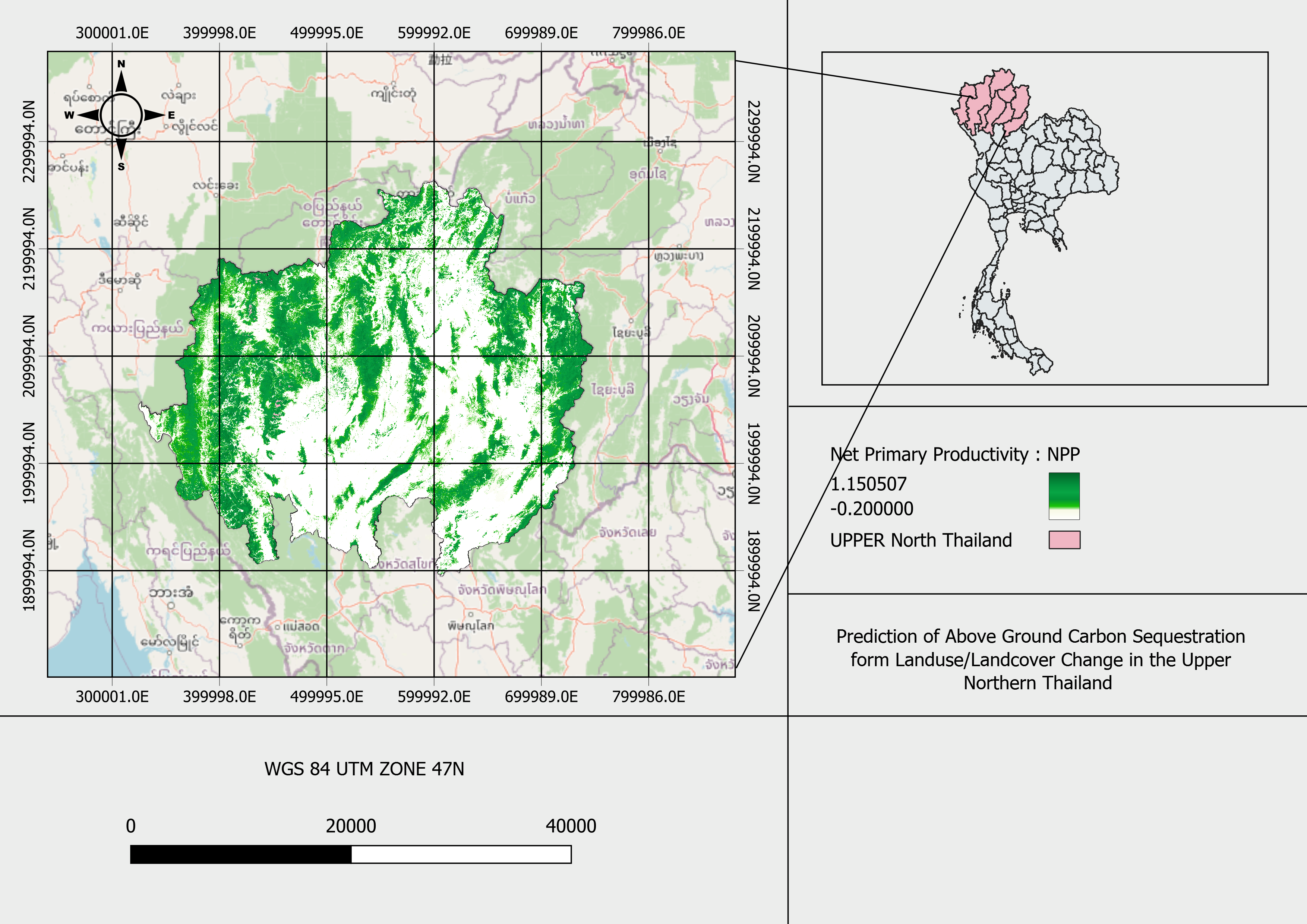
Background and Objectives : Aboveground carbon sequestration, or Net Primary Productivity (NPP), is an important ecological indicator that reflects the potential growth of vegetation in absorbing and storing carbon dioxide from the atmosphere through photosynthesis. This process plays a critical role in offsetting carbon emissions resulting from human activities. Therefore, assessing aboveground carbon sequestration in a specific region is essential for understanding carbon balance within ecosystems and promoting ecological restoration. This study selected the Upper Northern Region of Thailand as the study area due to several unique characteristics, including high ecological diversity, the presence of various forest and agricultural landscapes, topographical variation ranging from highlands to watershed areas, and seasonal climatic fluctuations. Land use/land cover (LULC) in this region directly affects the carbon sequestration potential of each land type. However, systematic studies on the relationship between LULC types and carbon sequestration in the Upper Northern Region of Thailand remain limited, especially those employing remote sensing technology for detailed spatial analysis. This study aims to (1) Analyze the relationship between carbon sequestration and changes in land use/land cover, and (2) Predict future carbon sequestration and land use/land cover changes.
Methodology : The study begins with an analysis of the relationship between land use/land cover and aboveground carbon sequestration by classifying land use types for three time periods 2016, 2019, and 2024 using the Random Forest model. The CASA-Biosphere Model is then applied to estimate carbon sequestration, and the estimated results are validated using field data through Pearson’s correlation coefficient. Subsequently, future aboveground carbon sequestration is predicted using the hybrid Markov-CA model to simulate future LULC changes. Regression equations are then developed to predict the Normalized Difference Vegetation Index (NDVI) and Land Surface Temperature (LST). These predicted datasets, together with projected LULC data, are incorporated into the CASA-Biosphere Model to estimate future NPP. Finally, the accuracy of NPP prediction is assessed using Pearson’s correlation coefficient, Correlation Coefficient, Root Mean Square Error (RMSE), and Mean Absolute Error (MAPE).
Main Results : The analysis using the CASA-Biosphere Model revealed distinct variations in aboveground carbon sequestration across different land use and land cover (LULC) types, with forest areas exhibiting the highest sequestration potential (0.249–1.256 gC/m²) due to dense vegetation, complex canopy structures, and robust root systems, followed by perennial crops (0.245–0.836 gC/m²), while rice paddies and field crops showed moderate values (up to 0.596 gC/m² and 0.637 gC/m², respectively), reflecting differences in species composition, management practices, and growing seasons. In contrast, urban and industrial areas showed very low or negative sequestration (0.057 to –0.287 gC/m²), indicating their role as net carbon sources as a result of limited vegetation cover and high anthropogenic emissions. Model validation using three sets of field data produced Pearson’s R² values of 0.663, 0.710, and 0.994, confirming strong agreement between modeled and observed NPP. Future projections for 2033 indicate increasing carbon sequestration across most LULC categories, with forests remaining the highest (up to 1.326 gC/m²), alongside rising values for rice paddies (0.569 gC/m²) and perennial crops (0.778 gC/m²), a trend potentially influenced by climatic conditions that enhance vegetation productivity. The accuracy of NPP predictions, validated using historical data, achieved a high correlation coefficient (R² = 0.924), demonstrating the model’s strong capability to capture spatial–temporal patterns and its suitability for long-term carbon sequestration forecasting and environmental planning
Conclusions : The assessment of aboveground carbon sequestration under land use/land cover changes using the CASA-Biosphere Model reveals that forest areas possess the highest carbon sequestration potential, followed by perennial crops. Agricultural areas show moderate potential, with field crops performing similarly to rice paddies. Urban and industrial areas exhibit very low or negative sequestration, acting instead as carbon sources. The CASA-Biosphere Model demonstrates high accuracy when validated with field data. Forecasts for the year 2033 indicate increasing carbon sequestration for all LULC categories, with forests remaining the strongest contributors, followed by perennial crops and agricultural areas. The high predictive accuracy confirms the suitability of this approach for assessing carbon sequestration trends within the study region. The findings support forest conservation and sustainable agricultural practices to enhance carbon sequestration and mitigate climate change impacts. The results can guide policy-making on forest resource conservation by identifying priority areas for preservation and restoration, as well as informing national greenhouse gas reduction targets under the Paris Agreement. Moreover, the projected carbon sequestration trends can serve as a foundation for sustainable land management, low-carbon agriculture, and the development of agricultural carbon credit mechanisms to enhance regional and national carbon sequestration efficiency.
References
Bulut, S., Alkan, G., & Onur, S. (2023). Estimating net primary productivity of semi-arid Crimean pine stands using biogeochemical modelling, remote sensing, and machine learning. Sciencedirect of Ecological Informatics, 76, 102137.
Das, B., Bordoloi, R., Tripathi, P., Sahoo, U. K., Nath, A. J., Deb, S., Gupta, A., Devi, N. B., & Charurvedi, S.(2023). Satellite based integrated approaches to modelling spatial carbon stock and carbon sequestration potential of different land uses of Northeast India. Environmental and Sustainability Indicator, 13(1).
Dejin, D., Ruhan, Z., Wei, G., Daohong. G., Ziliang, Z., Yufeng, Z., Yang, X., & Yuichiro, F. (2025).Assessing Spatiotemporal Dynamics of Net Primary Productivity in Shandong Province, China (2001–2020) Using the CASA Model and Google Earth Engine: Trends, Patterns, and Driving Factors. Journal of MDPI Remote Sens 2025, 17(3).
Potter, C. S., & Raich, J. (1995). Global patterns of Carbon dioxide emissions from soils. Global Biogeochemical Cycles, 9(1), 23-36
Gulinigaer, Y., Baozhong, He., Yaning, S., Xuefeng, L., Wen, Y., & Yuqian, C. (2025). Simulation of Vegetation NPP in Typical Arid Regions Based on the CASA Model and Quantification of Its Driving Factors. Journal of MDPI Land 2025, 14(2).
Huang, C., Sun, Z., Nguyen, M., Wu, Q., He, C., Yang, H., Tu, P., & Hong, Y. (2023). Spatio-temporal dynamics of terrestrial net ecosystem productivity in the ASEAN from 2001 to 2020 based on remote sensing and improved CASA model. Sciencedirect of Ecological Indicators, 154, 110920.
Jiang, X., & Bai, J. (2021). Predicting and assessing changes in NPP based on multi-scenario land use and cover simulations on the loess plateau. Journal of Geographical Sciences, 31(7).
Luana, B., Grazieli, R., Denise, C., Genei, A., Lucimara, W., Juliano, S., Jorge, A., & Gilberto, R. (2024).TVDI-based water stress coefficient to estimate net primary productivity in soybean areas. Sciencedirect of Ecological Modelling, 490, 110636.
Ma, B., Zeng, W., Chen, J., Liu, D., & Chen, P. (2022). Spatiotemporal patterns and drivers of net primary production in the terrestrial ecosystem of the Dajiuhu Basin, China, between 1990 and 2018. Sciencedirect of Ecological Informatics, 72, 101883.
Pal, M. K., & Pradhan, P. M. (2024). Development of Estimation Techniques for Solar Radiation, NDVI and Net Primary Productivity. SN Computer Science. 5. 10.1007/s42979-024-02720-9.
Potter, C. S., Randerson, T. J., Field, B. C., Matson, A. P., Vitousek, M. P., Mooney, H. A., & Klooster, S. A.(1993). Terrestrial ecosystem production: a process model based on global satellite and surface data. Glob Biogeochem. Cycles, 7(4), 811-841.
Sangngam, C., & Charoenpanyanet, A. (2016). Assessing Above-ground Carbon Sequestration of Para Rubber from Satellite Imageries. Chiangmai University Digital Collection, 143276.
Selmy, S. A. H., Kucher, D. E., Mozgeris, G., Moursy, A. R. A., Jimenez-Ballesta, R., Kucher, O. D., Fadl, M. E., & Mustafa, A. R. A. (2023). Detecting, Analyzing, and Predicting Land Use/Land Cover (LULC) Changes in Arid Regions Using Landsat Images,CA-Markov Hybrid Model, and GIS Techniques. Remote Sens, 15, 5522.
Tesfaye, B., Sileshi, D., Gemedo, D., & Gebeyehu, A. (2024). Spatiotemporal dynamics of vegetation net primary productivity and its response to climate variability. Environmental Systems Research, 13(47).
Wang, J., Wang, K., Zhang, M., & Zhang, C. (2015). Impact of climate change and human activities on vegetation cover in hilly southern China. Sciencedirect of Ecological Engineering, 81, 451-161.
Wang, X. L., Zhang, X. H., Liu, Z., Zhang, C. S., Kong, L. J., & Gao, Q. L. (2021). A coupled model for simulation and prediction of net primary productivity pattern. Geomatics and Information science of wuhan university, 46(11).
Zhang, H. L., Wu, F. Z., Chen, H. J., Liu, D. D., & Chen. P. P. (2022). Spatiotemporal patterns and drivers of net primary production in the terrestrial ecosystem of the Dajiuhu Basin, China, between 1990 and 2018. Sciencedirect of Ecological Informatics, 72, 101839.
Downloads
Published
How to Cite
Issue
Section
License
Copyright (c) 2026 Faculty of Science, Burapha University

This work is licensed under a Creative Commons Attribution-NonCommercial-NoDerivatives 4.0 International License.
Burapha Science Journal is licensed under a Creative Commons Attribution-NonCommercial-NoDerivatives 4.0 International (CC BY-NC-ND 4.0) licence, unless otherwise stated. Please read our Policies page for more information