
Partitions of Residue Classes Modulo 𝒎 with Identical Representation Functions
Keywords:
Sárközy’s problem, partition, representation function, Set of Residue Classes Modulo 𝓂Abstract
Background and Objectives: The problem of identical representation functions has long been an interesting question in additive number theory. This study is motivated by Sárközy’s problem, which asks whether there exist two distinct subsets of integers that have the same representation function. Early works by Nathanson (1978) introduced the fundamental concept of the representation function, while later studies by Erdős et al., (1986) formulated the well-known question on additive properties of integer sequences. Dombi (2002) provided partial solutions by proving that for certain sets of integers no such pair of subsets exists, but for some specific cases, such subsets can indeed be found. Subsequent research by Chen and Wang (2003), and later by Yang and Chen (2012), extended the problem to modular arithmetic within the residue class ring modulo (denoted as
. ).
This paper continues and deepens this line of research by focusing on the partition problem of the residue class ring . in which two subsets A and B satisfy
for all
, The goal is to determine necessary and sufficient conditions under which two subsets of
with
have identical representation functions. The main objective is to determine necessary and sufficient conditions ensuring the equality of representation functions between the two subsets, with special attention to the case where
is an odd integer. This investigation aims to clarify the structural and symmetric properties that govern additive equivalence in modular systems.
Methodology: The methodology integrates algebraic reasoning, modular arithmetic, and additive number theory. The representation function for a subset
. counts the number of unordered pairs
such that
. The analysis proceeds by defining this function explicitly, followed by constructing a characteristic function
to represent membership in
An illustrative example for
is first presented to demonstrate how representation values are computed and to visualize symmetry among residue classes under modular addition. Afterward, the study systematically distinguishes four fundamental cases according to the relative configurations of the subsets
and
within
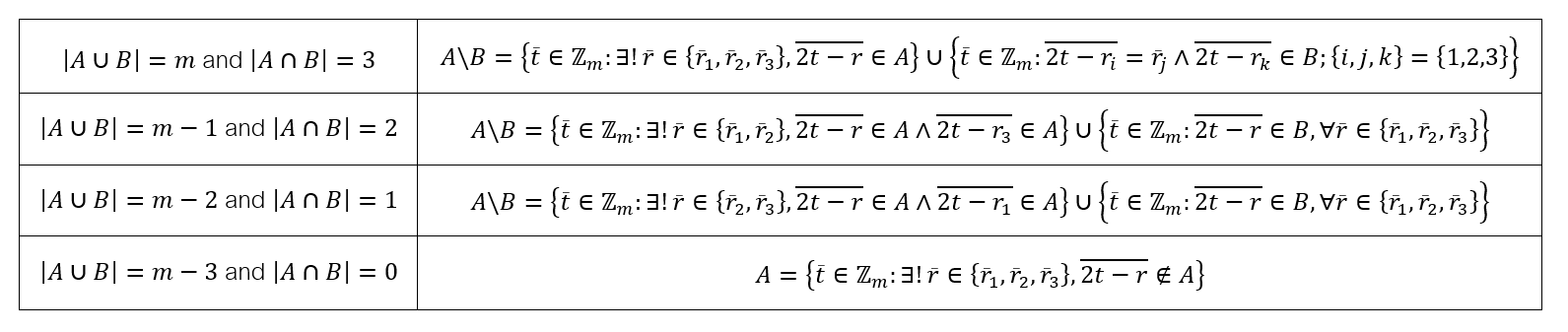
These four cases reflect different structural relationships between
and
, expressed as:
and
and
and
and
For each case, the study employs case analysis combined with modular congruence arguments to determine whether equality of representation functions is maintained. The methodology also introduces Lemma 2.1, asserting that if is odd, then
implies
This lemma ensures injectivity in modular doubling and serves as a key tool in verifying equivalence of representations. The overall analytic process combines theoretical proofs, parity-based reasoning, and direct algebraic verification under each of the four cases.By employing additive number theory and properties of modular arithmetic, the study analyzes the representation function
through the use of characteristic functions and modular congruences. A series of lemmas and theorems are developed to characterize relationships between the subsets
and
Logical deductions and case analyses are used to handle different configurations of subsets, distinguishing between cases where elements satisfy symmetric and congruence relations in
.
Main Results: The results demonstrate that if the representation functions of and
are identical for all
, then
must be odd. In this paper, we give a necessary and sufficient condition for two subsets
and
of
such that
for all
. Moreover, the equality of representation functions can be completely characterized through the following four fundamental cases, each describing a distinct modular relationship between
and
Case 1, Equality holds precisely when and
This configuration represents a pure modular shift, in which one subset can be obtained from the other through a fixed translation modulo .
Case 2, Equality is achieved when and
Here, the equality of representation functions results from reflection about a modular axis, meaning each element of corresponds to a symmetric counterpart in
under modular equivalence.
Case 3, Complementary partitions of preserve representation equality if the subset cardinalities satisfy
and
Here, the subsets and
together form a balanced bipartition of
, ensuring exact equality of additive representations across all residue classes.
Case 4, Equality also holds in a mixed configuration combining both shift and reflection properties, where
and .
This case demonstrates that the equality of representation functions can arise from a hybrid symmetry, where the subsets are simultaneously related by a modular shift and a reflection, depending on the specific overlap pattern among elements modulo .
Conclusions: This research enhances the understanding of additive partitions in modular systems by establishing precise algebraic criteria for identical representation functions. The results emphasize that modular symmetry, reflection, and parity are decisive factors for representation equality. For odd moduli, subsets and
that are structurally complementary under modular addition always yield identical representation functions. These findings not only extend classical additive number theory but also suggest future directions for study. Possible extensions include examining even moduli where symmetry conditions are broken, exploring multidimensional modular structures such as
and applying computational algorithms to test large-scale modular partitions.Ultimately, this study provides a rigorous theoretical foundation for understanding how additive identities and modular symmetries interact within residue class rings, contributing both to pure mathematics and to the broader combinatorial analysis of algebraic structures.
References
Chen, S. Q., & Yan, X. H. (2020). On certain properties of partitions of Z_m with the same representation function. Discrete Mathematics, 343(9), 111981.
Chen, S. Q., Wang, R. J., & Yu, W. X. (2023). On the structure of sets in a residue class ring with the same representation function. Advances in Applied Mathematics, 148, 102533.
Chen, Y. G., & Wang, B. (2003). On additive properties of two special sequences. Acta Arithmetica, 110, 299–303.
Dombi, G. (2002). Additive properties of certain sets. Acta Arithmetica, 103, 137–146.
Erdős, P., Sárközy, A., & Sós, V. T. (1986). Problems and results on additive properties of general sequences. V, Monatshefte für Mathematik, 102, 183–197.
Nathanson, M. B. (1978). Representation functions of sequences in additive number theory. Proceedings of the American Mathematical Society, 72(1), 16–20.
Yang, Q. H., & Chen F.J. (2012). Partitions of Z_m with the same representation functions. Australasian Journal of Combinatorics, 53, 257–262.
Yang, Q. H., & Tang M. (2017). Representation functions on finite sets with extreme symmetric differences. Journal of Number Theory, 180, 73–85.
Downloads
Published
How to Cite
Issue
Section
License
Copyright (c) 2026 Faculty of Science, Burapha University

This work is licensed under a Creative Commons Attribution-NonCommercial-NoDerivatives 4.0 International License.
Burapha Science Journal is licensed under a Creative Commons Attribution-NonCommercial-NoDerivatives 4.0 International (CC BY-NC-ND 4.0) licence, unless otherwise stated. Please read our Policies page for more information