
Enhancement of Phosphate Adsorption Efficiency in Synthetic Wastewater Using Water Treatment Plant Sludge Combined with Cocoa Husk
Keywords:
adsorption, phosphate, synthetic wastewater, cocao husk, chitosanAbstract
Background and Objectives: Cocoa husks are agricultural waste with potential for use as phosphate adsorbents in wastewater treatment. It can be applied as adsorbent material for pollutants and nutrients in wastewater, making it an alternative to the development of natural adsorbent materials that are low-cost and non-toxic to the environment. Currently, water pollution problems, especially phosphate nutrient contamination, have intensified progressively. Prior research has demonstrated that cocoa husks can adsorb phosphate from water, and surface modification with chitosan significantly improves adsorption efficacy. Additionally, sludge from water treatment plants contain mineral compositions suitable for phosphate binding. Therefore, this study aimed to investigate the enhancement of phosphate adsorption efficiency in synthetic wastewater using chitosan-coated adsorbent materials made from sludge from water treatment plants (S) combined with cocoa husks (C).
Methodology: The methodological procedures involved testing the molding of adsorbent materials between soil sediment from water treatment plant sludge (S) and cocoa husks (C), both without chitosan surface modification and with chitosan surface modification at ratios of 100:0, 70:30, 50:50, 30:70, and 0:100 by weight. The materials were then molded by firing at temperature of 500°C for 2 hours. The study examined equilibrium time of adsorption at various time intervals, including 1, 2, 4, 8, 12, 16, 20, 24, 28, 32, 36, 40, 44, and 48 hours respectively.To determine the optimal contact time and adsorption isotherms of phosphate in synthetic wastewater using Langmuir and Freundlich models. Residual phosphate concentration was analyzed using a spectrophotometer at a wavelength of 880 nanometers, followed by calculation of the phosphate removal percentage in wastewater.
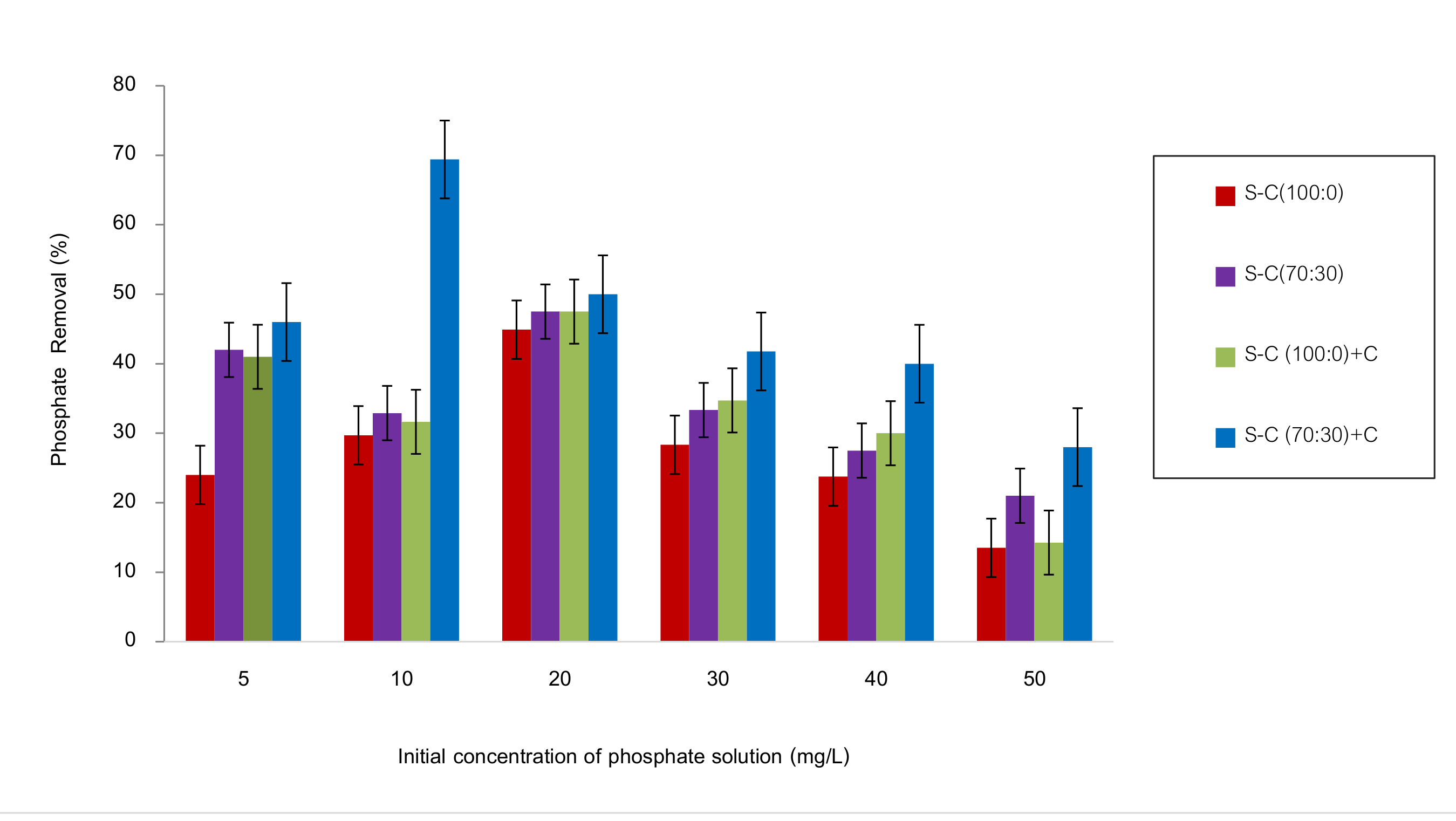
Main Results: The molding study of adsorbent materials showed that adsorbent materials at ratios S-C (100:0) and S-C (70:30) could be molded into pellets with stability and water insolubility, making them suitable for selection in subsequent procedures. Meanwhile, ratios S-C (50:50) and S-C (30:70) could not maintain form and dissolved in distilled water. This dissolution behavior was attributed to the higher organic content in these ratios, which compromised the structural integrity and thermal stability of the pellets during the firing process. All adsorption experiments were conducted at an initial pH of 5, which was selected based on preliminary optimization studies as the optimal condition for maximum phosphate solution removal efficiency. Under these conditions, the protonation of chitosan's amino groups was maximized, facilitating strong electrostatic interactions with phosphate anions. For the equilibrium time study of uncoated and chitosan-coated adsorbent materials revealed that coated adsorbent materials at ratio S-C(70:30)+C and S-C(100:0) reached equilibrium faster than uncoated adsorbent materials, achieving equilibrium within 16 hours and 24 hours respectively. This occurred because surface modification with chitosan resulted in faster equilibrium time, indicating adsorption kinetics. The adsorption performance study found that adsorbent materials with chitosan solution surface modification could adsorb phosphate concentration in synthetic wastewater higher than adsorbent materials without chitosan coating, with phosphate removal efficiencies of 60.45% and 47.68%, respectively. This demonstrated that surface modification with chitosan coating increased adsorption performance by 27.00% compared to the original. Additionally, analysis of the adsorption isotherm equations demonstrated the adsorption mechanisms of both chitosan-coated and uncoated adsorbent materials. Based on R² values closest to unity, the S-C (70:30)+C ratio showed the best fit, with the adsorption process conforming more closely to the Langmuir isotherm model (R² = 0.9950) than to the Freundlich isotherm (R² = 0.9628). The maximum adsorption capacity (qmax) value is 72.4638 mg/g, indicating that the adsorption on the surface of the adsorbent material is characterized by a single layer of adsorption.
Conclusions: Surface modification with chitosan coating enhanced phosphate adsorption performance due to the protonation of amino groups (NH2) under slightly acidic conditions, enabling strong electrostatic attraction with negatively charged phosphate ions. This material demonstrates high potential for application as a low-cost adsorbent in wastewater treatment, while simultaneously adding value to agricultural waste and reducing local environmental problems.
References
Aini, N., Mufandi, I., Jamilatun, S., & Rahayu, A. (2023). Exploring cacao husk waste–surface modification, characterization, and its potential for removing phosphate and nitrate ions. Journal of Ecological Engineering, 24(12). 282–292.
Elsheikh, M. A., Muchaonyerwa, P., Johan, E., Matsue, N., & Henmi, T. (2018). Mutual adsorption of lead and phosphorus onto selected soil clay minerals. Advances in Chemical Engineering and Science, 8(2), 67-81.
E-Tae, S., Tangkananuruk, K., Silberg, C.V., & Semawimol, N. (2022). Investigation of adsorption efficiency of orthophosphate and ammonium in solution and wastewater by tea residue and tea residue charcoal Engineering Journal of Research and Development. (2022), 33(3), 81-92. (in Thai)
Jaikaew, P., Kahapana, C., & Phowan, N. (2022). Efficacy of water hyacinth on phosphate absorption from Pla-ra production process. The Journal of Industrial Technology: Suan Sunandha Rajabhat University, 10(1), 52-61. (in Thai)
Karintaritip, S., Tangkananuruk, K., Rungrattanaubon, T., & Wararam, W. (2022). Adsorption and Desorption of Ammonium and Orthophosphate byRice Straw and Rice Husk for Soil Amendment. KKU Research Journal (Graduate Studies), 22(1), 133-144. (in Thai)
Meethai, S., Seekhamjeen, P., & Moonsri, P. (2024). The effective removal of the metal ion Pb2+ from an aqueous solution by activated carbon prepared from macadamia nut shell: isotherm and thermodynamic studies. Journal of Vocational Education in Agriculture, 8(2), 32-47. (in Thai)
Mekasamphan, J., Mekasamphan, C., & Achimanangkul, S. (2009). Aquatic ecosystem and water quality research: Project report on monitoring the carrying capacity for recreational use in national parks, Erawan National Park, Kanchanaburi Province and Kaeng Krachan National Park, Phetchaburi Province (1st ed.). Faculty of Fisheries, Kasetsart University. (in Thai)
Noinumsai, S., & Vinitnantharat, S. (2017). Humic Acid Adsorption by Adsorbent Granule Derived from Sludge of Water Supply Production. Burapha Science Journal, 22(2), 58-73. (in Thai).
Regional Environmental Office 13. (2019). Water pollution. Retrieved from https://epo13. pcd.go.th/th/news/ detail/49278. (in Thai)
Tandulwasem, M. (2000). Water Quality Analysis Handbook (4th ed.). Chulalongkorn University Press. (in Thai) Wongmukda, K., Supinya, Mullasir., Panjai.,& Saueprasearsit. (2020). Production of Lightweight Expended Clay Aggregate from Water Treatment Sludge and Cassava Sludge.Faculty of Environment and Resource Studies, Mahasarakham University, Kantarawichai District, MahaSarakham, Thailand. (in Thai)
Wongmukda, K., Morarasee, S., & Saueprasearsit, P. (2020). Production of Lightweight Expended Clay Aggregate from Water Treatment Sludge and Cassava Sludge. Journal of Science and Technology Journal of Science and Technology Mahasarakham University, 39(4), 472-479. (in Thai
Downloads
Published
How to Cite
Issue
Section
License
Copyright (c) 2026 Faculty of Science, Burapha University

This work is licensed under a Creative Commons Attribution-NonCommercial-NoDerivatives 4.0 International License.
Burapha Science Journal is licensed under a Creative Commons Attribution-NonCommercial-NoDerivatives 4.0 International (CC BY-NC-ND 4.0) licence, unless otherwise stated. Please read our Policies page for more information