
Structural Properties of Subsets and 𝑩-Antihomomorphisms in 𝑩 -Algebras
Keywords:
𝘉-algebra, ideal, 𝘉-antihomomorphismAbstract
Background and Objectives: Algebraic structures of non-empty sets equipped with binary operations represent a fundamental subject in abstract algebra that has been extensively studied. This research focuses on an intriguing algebraic structure known as B-algebras. Although various properties of B-algebras have been continuously investigated, in-depth details regarding the properties of certain specific subsets and the construction of algebraic structures on functional sets have not yet been comprehensively explored. The present research aims to address two primary objectives. First, it investigates and proves the structural properties of the subsets and
for any
, where
is a B-algebra, while identifying the necessary and sufficient conditions for the subset
to qualify as an ideal and a B-subalgebra. This investigation provides a deeper insight into internal structures that have remained unexplored in previous research. Second, the study examines B-antihomomorphisms to establish an algebraic structure on the set
, which consists of all B-antihomomorphisms from
to
, where
and
are B-algebras, under a newly defined binary operation. The findings reveal that, under suitable conditions,
constitutes a commutative B-algebra with associative properties. Consequently, this study extends the theoretical framework and establishes new algebraic properties, contributing to a more comprehensive understanding of B-algebra theory.
Methodology: This research relies on the definitions and theorems of B-algebras to investigate various algebraic properties. The methodology is divided into two main stages: the study of the structure and properties of B-algebra subsets, and the study of B-antihomomorphism functions. The first stage focused on exploring the properties of two specific sub-structures: and
, which are defined for an arbitrary element
of the B-algebra
. The sets
and
are defined as
and
, respectively. The study established the necessary conditions under which
constitutes both an ideal and a B-subalgebra of
The demonstration utilized the fundamental B-algebra axioms to verify the closure and structural properties required by the definitions of a B-subalgebra and an ideal. The second stage of the study focused on investigating the properties of B-antihomomorphisms and characterizing the resulting structure of the set
, defined as the collection of all such mappings from a B-algebra
to a B-algebra
. The core of the methodology here was to define a binary operation on
and use the established properties of B-algebras
and
(specifically the constraints that
is a commutative and associative B-algebra) to prove that
satisfies all the axioms of a B-algebra.
Main Results: This research established additional properties of B-algebras beyond those found in previous studies concerning B-algebras. It was found that in the case where is a commutative B-algebra, the subset
is both an ideal and a B-subalgebra of
. Furthermore, it was found that the subset
is an ideal of
and a B-subalgebra of
for all
. In addition, it was found that
if and only if
for all
. Also, we found that
if and only if
, and if
and
then
, where
. Let
be an arbitrary B-algebra, and let
be a B-algebra that satisfies the additional properties of commutativity and associativity with
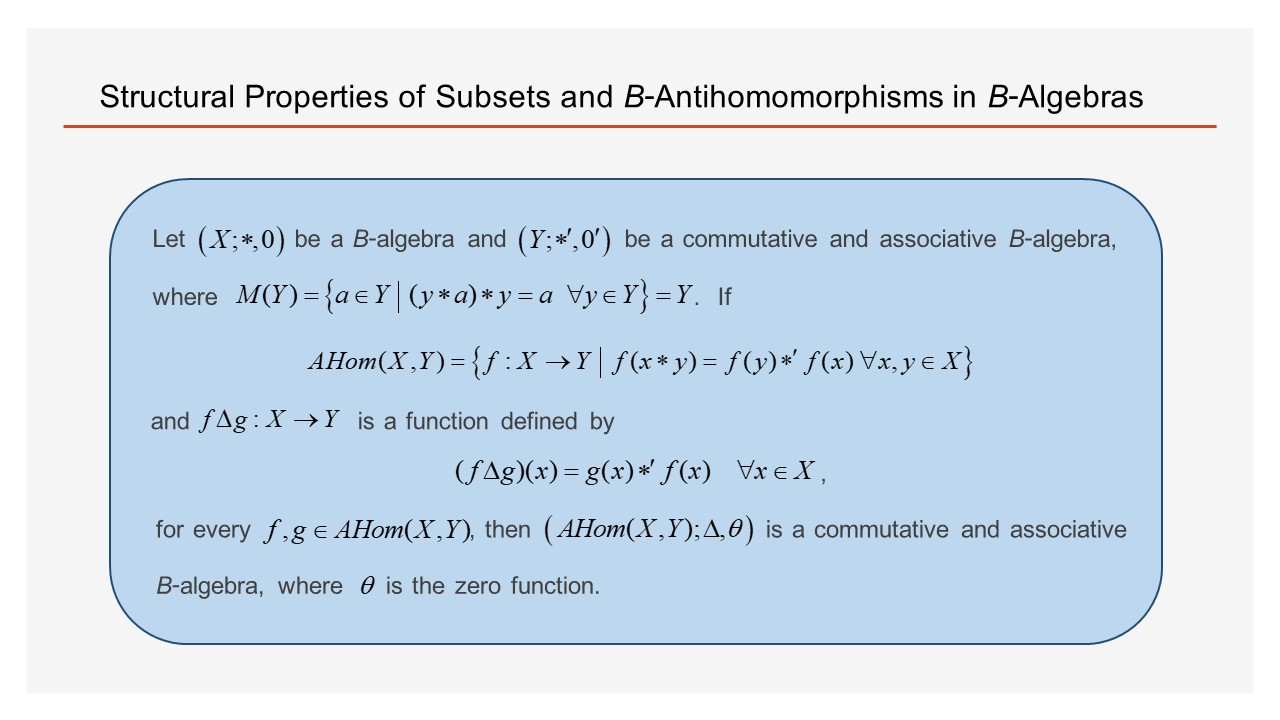
. We see that the zero function is a B-antihomomorphism, the set of all B-antihomomorphisms from
to
, denoted
, is non-empty. By defining a suitable binary operation on this set, it was successfully demonstrated that
, when equipped with this induced operation and the zero function, satisfies all the defining axioms of a B-algebra. Specifically
, is not merely a B-algebra but is also a commutative B-algebra and possesses the associative property.
Conclusions: The study found that B-algebras possess several interesting structures and properties. Consequently, numerous important properties related to B-algebras were successfully proven. It was definitively proven that the subset ( the set of all medial elements of
) in a commutative B-algebra assumes the dual role of both an ideal and a B-subalgebra. Furthermore, the properties of the subset
were provided. Crucially, the study successfully proved the existence of an algebraic structure on the set of B-antihomomorphismsm maps. It was concluded that the set of all B-antihomomorphisms,
, itself forms a commutative and associative B-algebra, provided the codomain
satisfies these same conditions with
. This establishes a new class of B-algebras derived from the structure of B-antihomomorphism functions. These research findings contribute to a deeper understanding of B-algebras and open up new avenues for future investigation, particularly in the study of ideals, quotient algebras, and derivations defined on the newly established B-algebra
.
References
Abdullah, H.K, & Atshan, A.A. (2017). Complete Ideal and n-Ideal of B-algebra. Applied Mathematical Sciences, 11(35), 1705-1713.
Allen, P.J., Neggers, J.,& Kim, H.S. (2003). B-algebras and Groups. Scientiae Mathematicae Japanicae Online, 9, 159-165.
Al-Shehri, N.O. (2010). Derivations of B-algebras. JKAU: Sci., 22(1), 71-83.
Al-Shehri, N.O. (2010). On Hom(-,-) as B-algebras. JP Journal of Algebra, Number Theory and Applications, 18(1),17-24.
Endam, Joemar C., & Vilela, P. (2014). The Second Isomorphism Theorem for B algebras. Applied Mathematical Sciences, 8(38), 1865-1872.
Endam, Joemar C. (2016). Centralizer and Normalizer of B-algebras. Scientiae Mathematicae Japanicae Online, 1-7.
Kondo, M., & Jun, Y.B. (2002) The class of B-algebras coincides with the class of groups. Sci. Math. Japo. Online, 7, 175-177.
Lingcong, Jacel, Angeline V., & Endam, Joemar C. (2016). Direct Product of B algebras. International Journal of Algebra, 10(1), 33-40.
Neggers, J. ,& Kim, H.S. (2002). A fundamental theorem of B-homomorphism for B-algebras. Intern. Math. J., 2, 207-214.
Neggers, J., & Kim, H.S. (2002). On B-algebras. Mate. Vesnik, 54, 21-29.
Walendziak, A. (2005). Anote on normal subalgebras in B-algebras. Scientiae Mathematicae Japonicae Online, 49-53.
Wicaksono, P. S., Triyanti, N. S., Sarti, L. , & Kusniyanti, E. (2023). B-Hom(Z_n,Z_n) as B-algebras. ITB Graduate School Conference, 3(1), 630-641.
Yattagi, E., Gemawati, S.,& Hasbiyati, I. (2021). On Left f_g-Derivations of B-algebras. Sintechcom: Science, Technology, and communication Journal, 2(1), 1-8.
Downloads
Published
How to Cite
Issue
Section
License
Copyright (c) 2026 Faculty of Science, Burapha University

This work is licensed under a Creative Commons Attribution-NonCommercial-NoDerivatives 4.0 International License.
Burapha Science Journal is licensed under a Creative Commons Attribution-NonCommercial-NoDerivatives 4.0 International (CC BY-NC-ND 4.0) licence, unless otherwise stated. Please read our Policies page for more information