
Power 3 Mean Labeling of Some Special Graphs
Keywords:
Power 3 mean graph, Ladder graph, Total graph, Chain of cycle graphAbstract
Background and Objectives: Graph labeling, the assignment of integers to the vertices, edges, or both of a graph under specific conditions, has been a central concept in graph theory since its introduction in 1960. Mean labeling, a specific type of graph labeling, was introduced by Somasundaram and Ponraj in 2003 and has since been extensively explored for various graph classes. The concept of Power 3 mean labeling was recently introduced in 2020 by Sreeji and Sandhya. A function f is called a Power 3 mean Labeling of a graph G = (V, E) with p vertices and q edges if it is possible to label the vertices u V with distinct labels f(u) from 1,2, … , q+1 in such a way that when f(u) = x and f(v) = y, each edge e = uv is assigned a label defined by
or
.
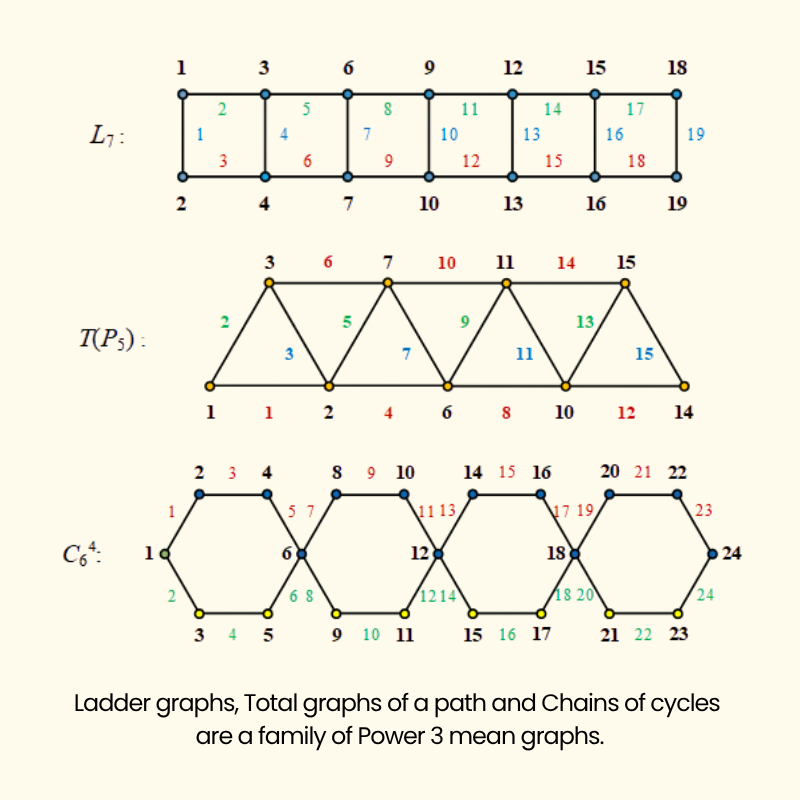
or . In this case, f is a Power 3 mean labeling of G and G is called a Power 3 mean graph. Sreeji and Sandhya demonstrated that some graphs possess this property while others do not. Their subsequent work explored this labeling for the line graphs of certain graphs. Moreover, they considered Power 3 mean labeling for various graphs resulting from the duplication of graph elements. This paper contributes to this area of study by proving that Ladder graphs, Total graphs of a path and Chains of cycles are a family of Power 3 mean graphs. n–ladder graph can be defined as the Cartesian product of two paths, , and it is equivalent to the 2xn graph. Total graph of G, denoted by T(G), is the graph whose vertex set consists of all vertices and edges of G. Two vertices in T(G) are adjacent if and only if their corresponding elements in G are either adjacent or incident in G. Chain of m cycle of length n is a graph obtained by taking m copies of the cycle graph
(n
3, m
1), arranging them in linear sequence, and identifying exactly one vertex of the i-th copy with one vertex of the (i+1)-th copy for i = 1, …, m-1. We denote this chain by
.
Methodology: To study Power 3 mean graphs, we begin by considering the relationships between the numbers assigned to an edge uv when the endpoints are f(u) = i and f(v) = i+m. For m=1,…,5, the lower and upper bounds of the possible 3 mean values can be determined, and a labeling pattern for the vertices and edges that satisfies the given conditions can be identified. Next, for n 1, we prove by induction on n to show that
and
are Power 3 mean graphs. Finally, for n
3 and m
1 the Power 3 mean labeling of
is considered in two cases: when n is even and when n is odd.
Main Results: We establish four lemmas describing the possible integer values assigned to an edge uv when f(u)=i and f(v) = i+m, the results are summarized as follows:
(1) m = 1 , f(uv) = i or i +1
(2) m = 2 or 3 , f(uv) = i +1 or i +2
(3) m = 4 , f(uv) = i +2 or i +3
(4) m = 5 , f(uv) = i +3 or i +4 when 3 i
9 and
, f(uv) = i +2 or i +3 when i 10.
We obtain three theorems presenting the Power 3 mean labeling functions of the ladder graph, the total graph of a path, and the chain of m cycles of length n.
Conclusions: The Ladder graph, Total graph of path and Chain of m cycle of length n are Power 3 mean graphs. To determine whether a class of graphs admits a Power 3 mean labeling, one common approach is to identify a suitable labeling pattern for the vertices and edges that satisfies the given conditions. This is typically achieved by analyzing the relationships among the integers assigned to the end vertices and the resulting values obtained for the corresponding edges. In the case of Power 3 mean labeling, when there is a large difference between the numbers of edges and vertices, the structure of the graph becomes more complex. As a result, it becomes difficult to determine an appropriate labeling pattern for the vertices. This difficulty also arises in graphs that form a closed loop, where finding a consistent labeling pattern under the given conditions is particularly challenging. The study of graph labeling remains a topic of significant interest among mathematicians, with research conducted under various conditions and on different types of graphs. For Power 3 mean graphs, there remain several classes of graphs that are of interest to investigate in order to determine whether they admit a Power 3 mean labeling.
References
Gallian, J. A. (2022). A Dynamic Survey of Graph Labeling. The Electronic Journal of Combinatorics, 25, 1-623.
Somasundaram, S, & Ponraj, R. (2003). Mean Labeling of graph. National Academy of Science Letters, 26, 210–213.
Sreeji, S , & Sandhya, S. S. (2020). Power 3 Mean Labeling of Graph. International Journal of Mathematical Analysis, 14(2), 51–59.
Sreeji, S , & Sandhya, S. S. (2020). Power 3 Mean Labeling of Line Graphs. Journal of Emerging Technologies and innovative Research, 7(4), 701–707.
Sreeji, S, & Sandhya, S. S. (2020). Power 3 Mean Labeling in the context of duplication of graph elements. Advance in Mathematics : Scientific Journal, 9(6), 4241–4249.
West, D. B. (2021). Introduction to graph theory (3rd ed.). Cambridge University Press.
Downloads
Published
How to Cite
Issue
Section
License
Copyright (c) 2026 Faculty of Science, Burapha University

This work is licensed under a Creative Commons Attribution-NonCommercial-NoDerivatives 4.0 International License.
Burapha Science Journal is licensed under a Creative Commons Attribution-NonCommercial-NoDerivatives 4.0 International (CC BY-NC-ND 4.0) licence, unless otherwise stated. Please read our Policies page for more information