
Diet Composition of the Smith's Barb, 𝙋𝙪𝙣𝙩𝙞𝙤𝙥𝙡𝙞𝙩𝙚𝙨 𝙥𝙧𝙤𝙘𝙩𝙤𝙯𝙮𝙨𝙩𝙧𝙤𝙣 (Bleeker, 1865) in the Riverine Floodplain of Ayutthaya Province
Keywords:
𝘗𝘶𝘯𝘵𝘪𝘰𝘱𝘭𝘪𝘵𝘦𝘴 𝘱𝘳𝘰𝘤𝘵𝘰𝘻𝘺𝘴𝘵𝘳𝘰𝘯, feeding ecology, diet composition, riverine floodplain, Ayutthaya ProvinceAbstract
Background and Objectives: Puntioplites proctozystron (Cyprinidae) is an ecologically and economically important species inhabiting the riverine floodplain ecosystems of Phra Nakhon Si Ayutthaya Province, Thailand. Its high abundance and broad spatial distribution underscore its central role in nutrient cycling and energy transfer within these dynamic, flood-pulse–driven systems. A detailed understanding of its dietary composition, foraging behaviour, and functional morphological adaptations is essential for informing conservation initiatives and developing sustainable fisheries management strategies. Given the pronounced variability in resource availability across seasons and life stages, this study was undertaken to examine the feeding ecology of P. proctozystron in a comprehensive manner. Specifically, the research investigates feeding patterns, characterises the morphology of the feeding and digestive organs, and documents shifts in dietary composition in response to two major ecological factors: ontogenetic stage (juvenile versus adult) and seasonal variation (dry versus rainy season). The findings aim to clarify the species’ trophic guild and elucidate its adaptive mechanisms within the Ayutthaya floodplain ecosystem.
Methodology: A total of 108 specimens of P. proctozystron were collected from eight sampling sites located in the Chao Phraya River, Noi River, Lopburi River, Pasak River, and the Bang Ban floodplain (Bang Ban District, Ayutthaya Province, Thailand). Sampling was conducted during the dry season (April 2023) and the rainy season (July 2023). The specimens were classified into juvenile (n = 75) and adult (n = 33) stages. All samples were examined to determine feeding patterns, feeding-related morphological structures, and digestive tract characteristics. Gut content composition was analysed using the frequency of occurrence method. Differences in the occurrence of food categories between life stages and seasons were statistically evaluated using the chi-square test at a significance level of 0.05. The resulting data were subsequently used to elucidate the species’ dietary diversity and infer its adaptive feeding strategies within the floodplain ecosystem.
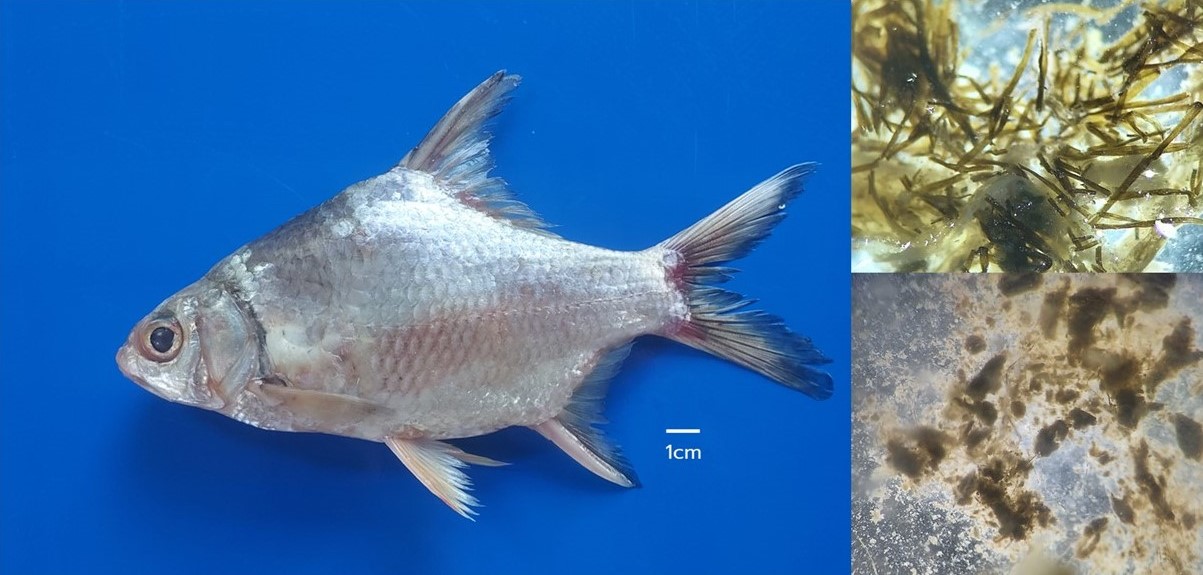
Main Results: Morphological examination confirmed that P. proctozystron exhibits clear adaptations for benthic feeding, as indicated by its subterminal to inferior mouth position. Pronounced morphological plasticity was observed in the digestive tract across ontogenetic stages. The intestinal length to standard length ratio (IL/SL) was considerably greater in adults (1.73–3.12 SL) compared with juveniles (1.68–2.53 SL). This progressive increase in relative gut length supports the classification of the species as an omnivore, reflecting an enhanced capacity to process plant material and detritus, which are fibrous and comparatively low in digestible nutrients. Analysis of stomach contents revealed three primary food categories consumed across life stages: macroalgae, detritus, and plant fragments. However, notable ontogenetic dietary differentiation was detected. Juveniles displayed a broad, generalist feeding strategy, exploiting both pelagic and benthic microhabitats. Their diet comprised high proportions of macroalgae, detritus, and plant fragments, with a distinct reliance on zooplankton, particularly copepods, which occurred frequently in juvenile digestive tracts but were largely absent from adult samples. This pattern indicates a size-dependent shift away from pelagic planktonic resources as individuals mature. In contrast, adults shifted predominantly to benthic foraging, reflected in the substantial increase in consumption of larger benthic invertebrates. While macroalgae, detritus, and plant fragments remained core dietary components, adults exhibited high frequencies of polychaetes and oligochaetes—dietary items nearly absent in juveniles—demonstrating an enhanced ability to capture and digest larger, nutrient-rich prey. Seasonal variation exerted a significant influence on adult feeding patterns. During the dry season, when receding water levels concentrate benthic resources, adults displayed markedly increased predation on benthic macrofauna, with ostracods (81.3%F), polychaetes (68.8%F), and oligochaetes (43.8%F) dominating the diet. None of these prey items were detected in adult samples during the rainy season, suggesting that high water volume disperses benthic organisms and expands available foraging habitats, thereby altering prey accessibility. In contrast, juveniles showed peak dependence on detritus (91.8%F) during the rainy season, likely reflecting the seasonal influx of allochthonous organic matter characteristic of flood-pulse systems.
Conclusions: P. proctozystron inhabiting the Ayutthaya floodplain can be conclusively characterised as an opportunistic omnivore–detritivore exhibiting substantial dietary plasticity. This flexibility enables the species to adjust its feeding spectrum in accordance with resource availability shaped by ontogenetic development and seasonal hydrological fluctuations. Morphological traits, particularly the inferior mouth orientation and the pronounced ontogenetic increase in the intestinal length to standard length (IL/SL) ratio, play a pivotal role in supporting efficient benthic foraging and the processing of its primary dietary components—macroalgae, detritus, and plant fragments. The species demonstrates a distinct ontogenetic trophic shift, transitioning from a juvenile diet reliant on pelagic zooplankton, especially copepods, to an adult diet dominated by larger, nutrient-dense benthic invertebrates such as polychaetes and oligochaetes. Seasonal dynamics further shape feeding strategies: juveniles and adults exploit abundant macroalgae and detritus during the rainy-season flood pulse, whereas adults capitalise on the increased concentration and accessibility of macrobenthic fauna during the dry season. This adaptive trophic flexibility underpins the species’ ecological success in the highly variable riverine floodplain ecosystem.
References
Banyen, S., Watthanadilokkul, K., Koetkomut, B., & Kaewcharoon, P. (1989). Reproductive Biology of Pla Kamang in the Ubolratana Dam Reservoir. Technical Paper No. 11. Bangkok: Department of Fisheries. (in Thai)
Blaber, S.J.M. (2000). Tropical Estuarine Fishes: Ecology, Exploitation and Conservation. Oxford: Blackwell.
Chittapalapong, T. (2014). Analysis of Fish Feeding. Bangkok: Department of Fisheries. (in Thai)
Dabrowski, K., & Portella, M.C. (2005). Feeding plasticity and nutritional physiology in tropical fishes. Fish Physiology, 21, 155-224.
Gerking, S.H. (1994). Feeding ecology of fish. California: Academic Press, Inc.
Heng, K., Chevalier, M., Lek, S., & Laffaille, P. (2018). Seasonal variations in diet composition, diet breadth and dietary overlap between three commercially important fish species within a flood-pulse system: The Tonle Sap Lake (Cambodia). PloS one, 13(6), p.e0198848.
Hydro Informatics Institute. (2023). Thailand Water Situation Summary 2023. National Hydroinformatics Data Center. https://www.thaiwater.net/uploads/contents/current/YearlyReport2023/summary.html
Junk, W. J., Bayley, P. B., & Sparks, R. E. (1989). The flood pulse concept in river-floodplain systems. Canadian special publication of fisheries and aquatic sciences, 106(1), 110-127.
Kottelat, M. (2013). The fishes of the inland waters of Southeast Asia: a catalogue and core bibliography of the fishes known to occur in freshwaters, mangroves and estuaries. Raffles Bulletin of Zoology, 27, 1-663.
Kramer, D.L., & Bryant, M.J. (1995). Intestine length in the fishes of a tropical stream: 2. Relationships to diet—the long and short of a convoluted issue. Environmental biology of fishes, 42(2), 129-141.
Kunlapapuk, S., Kulabtong, S., & Saipattana, P. (2016). Biology of Smith’s barb (Puntioplites proctozystron) in Phetchaburi Basin. Veridian E-Journal, Science and Technology Silpakorn University, 3(1), 48-56. (in Thai)
Mahasawat, N. (2010). Feeding ecology of drum fishes (Family Sciaenidae) in Pak Phanang Bay, Nakhon Si Thammarat Province. M.S. Thesis. Chulalongkorn University. (in Thai)
Petkar, A.S., & Shaikh, K.M. (2025). Morphometric analysis of fish intestines in relation to their dietary preferences. International Journal of Fisheries and Aquatic Studies, 13(5), 202-206.
Rainboth, W.J. (1996). Fishes of the Cambodian Mekong. FAO species identification field guide for fishery purposes. Rome: FAO.
Rainboth, W.J., Vidthayanon, C., & Yen, M.D. (2012). Fishes of the greater Mekong ecosystem with species list and photographic atlas. Ann Arbor: Museum of Zoology, University of Michigan.
Satapoomin, U., & Satapoomin, S. (2005). Food and feeding habits of fishes in the seagrass beds on the east coast of Phuket Island. Technical Paper No.16/2005. Phuket: Department of Marine and Coastal Resources. (in Thai)
Sricharoendham, B., Boothongchuay, J., & Poomikong, P. (2015). Spatio-temporal variation in fish community of the Chao Phraya River between 2008 and 2014. Thai Fisheries Gazette, 68(3), 201-223. (in Thai)
Taki, Y. (1974). Fishes of the Lao Mekong Basin. Vientiane: United States Agency for International Development Mission to Laos Agriculture Division.
Thongngok, V., & Jittapalapong, T. (2021). Reproductive biology of some fish species in the Pa Sak Cholasit Dam reservoir. Technical Bulletin, Inland Fisheries Research and Development Division No. 6/2021. Bangkok: Department of Fisheries. (in Thai)
To-orn, N. (2021). Fish Assemblage in watershed area, Ayutthaya Province. Ayutthaya: Rajamangala University of Technology Suvarnabhumi. (in Thai)
Yan, T., Liu, F., Chang, M., Yan, R., Luo, W., Wen, L., Ding, W., Fu, Q., Wang, X., Li, X. & Song, H. (2025). Morphological Differences in Feeding and Digestive Organs, the Diversity of Intestinal Microorganisms, and Variations in Digestive Enzyme Activity Promote the Differentiation of Nutritional Niches in Schizothoracinae Species. Animals, 15(22), p.3242.
Zar, J.H. (1999). Biostatistical analysis. 4th ed. Upper Saddle River: Prentice-Hall.
Downloads
Published
How to Cite
Issue
Section
License
Copyright (c) 2026 Faculty of Science, Burapha University

This work is licensed under a Creative Commons Attribution-NonCommercial-NoDerivatives 4.0 International License.
Burapha Science Journal is licensed under a Creative Commons Attribution-NonCommercial-NoDerivatives 4.0 International (CC BY-NC-ND 4.0) licence, unless otherwise stated. Please read our Policies page for more information