
Effect of Osmotic Dehydration on Characteristics and Physicochemical Properties of Plant-Based Crisps with Vacuum Fryer
Keywords:
plant-based crisp , pre-treatment frying , osmosis dehydration , dynamic mechanical analysis , physicochemical propertyAbstract
Background and Objectives : Almost fried products contain high amount of oil since there was an exchange between water in food and oil during frying. Dehydration is one of the methods can reduce moisture content in food products leading to a reduction of oil uptake in fried products. Moreover, vacuum frying can also reduce the amount of oil content in fried food compared to atmospheric frying. Due to the fact that water evaporation under the vacuum condition, there was low excessive retention of oil inside the product. In addition, temperature also affects to product characteristics. Around the glass transition, molecular mobility of food molecules increases resulting in softer product and enhancement of water molecular movement. Objective of the research was; therefore, to study the effect of a pre-treatment method on characteristics of plant-based crisps using osmosis dehydration (OD) prior to vacuum frying and to study thermal properties (glass transition temperature and α-relaxation) of plant-based crisps using a Differential Scanning Calorimeter (DSC) and a Dynamic Mechanical Analyzer (DMA), respectively. All data were used to evaluate the correlation of product characteristics, texture and physicochemical properties of plant-based crisps as well as to provide a guideline for application in other fried food industries.
Methodology : In the present study, there were 2 treatments consisting of the plant-based products without pre-treatment before frying (Control) and the products with pre-treatment with osmosis dehydration (OD) using 0.5% (w/w) salt solution (NaCl) prior to frying. The 200 g of pre-treatment products prior to frying were poured in the bowl containing 0.5% (w/w) NaCl solution in the ratio of samples to salt solution at 1:10 and soaked at 30°C for 1 hour. Then, the salt solution was drained and the excess water on the products was wiped off by tissue papers. The samples from both treatments were vacuum fried at 13.33 kPa for 3 hours. All vacuum fried products were analyzed as the physicochemical properties including shrinkage ratio, weight loss, hardness using texture analyzer, Tg using Differential Scanning Calorimetry (DSC), and storage modulus (E’) using Dynamic Mechanical Analyzer (DMA).
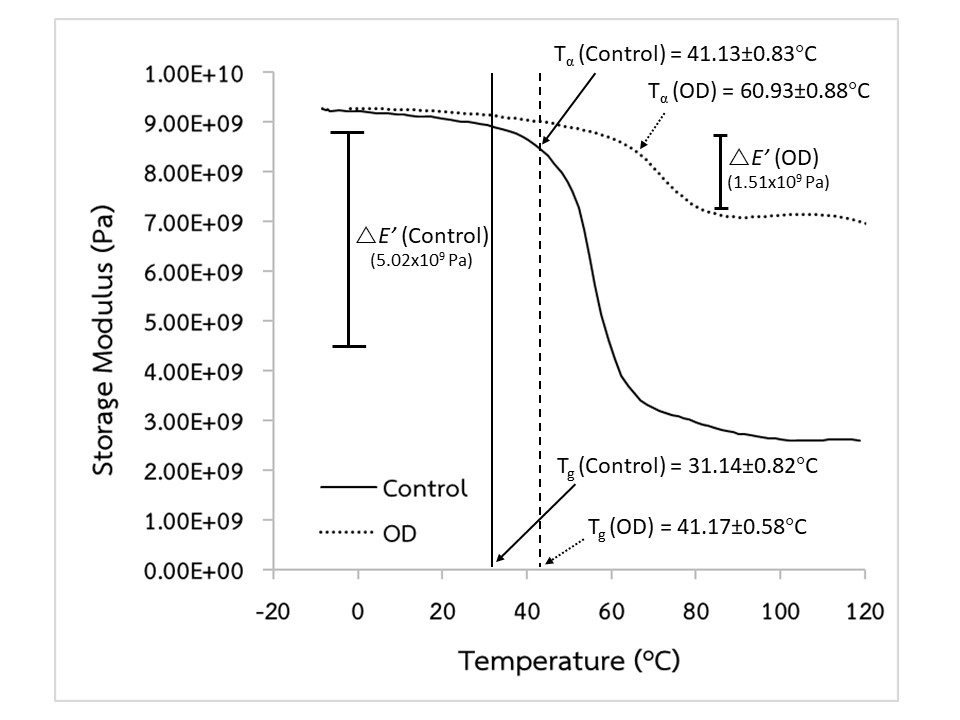
Main Results : Pre-treatment frying method significantly affected characteristics and physicochemical properties of fried products (p≤0.05). Shrinkage ratio, %moisture content, %fat content and texture of the fried product (control) were 2.53±0.15, 6.90±0.49, 4.36±0.18 and 214.96±1.17 N, respectively, which were higher than those of the fried product with OD method. The shrinkage ratio, %moisture content, %fat content and texture of the fried product with OD method were 1.29±0.08, 3.22±0.54, 3.42±0.26 and 115.20±1.20 N, respectively. On the other hand, %weight loss of the fried product (control) was 88.6±0.82, which was lower than that of the fried product with OD method having 93.4±0.51. Moreover, glass transition temperature (Tg) of the fried product with OD method were 41.17±0.58, which were significantly higher than those of the control fried product having 31.14±0.82 (p≤0.05) as a result of water plasticization behavior. Around the glass transition, storage modulus of the fried product (control) decreased dramatically, whereas a slight decrease in the storage modulus was found in the fried product with OD method. With consideration of a change in mechanical properties (storage modulus, ∆E’), we found that the ∆E’ of the fried product with OD method were lower than that of the control fried product. The ∆E’ of the fried product with OD method was 1.51x10⁹, while the ∆E’ of the control fried product was 5.02x10⁹. This was also consistent with a-relaxation as observed from a change in storage modulus around the glass transition. The a-relaxation temperature (Ta) of the fried product with OD method was 60.93±0.88 ºC, which was significantly higher than that of the control (p≤0.05). The Ta of the fried product (control) was 41.13±0.83 ºC. Texture of the fried products with and without OD method was measured as force value. The results indicated that the storage temperature affected a product texture. Force values of the fried products with OD method stored at 35 ºC were around 115 N, whereas force values of the control were approximately 215 N during storage. However, it seems that the force values of the fried products increased with increasing storage temperature. The force values of the fried products ranged from 215 to 250 N at storage temperature of 45 ºC. The results indicated that the ∆E’ had the correlation with changes in texture of the fried product, which were measured by the texture analyzer.
Conclusions : The pre-treatment process prior to frying could reduce shrinkage ratio, but increase weight loss of the fried products. Osmosis dehydration method could decrease moisture and fat content in the fried product, and also reduce changes in physicochemical properties during storage. In addition, DSC and DMA that were used to analyze thermal and mechanical properties of the products can be used to evaluate physical properties, such as fragility and crispness of the fried products during storage. The information could be a guideline to determine changes in fried products during process and storage including shelf-life extension.
References
Adedeji, A.A., & Ngadi, M. (2018). Impact of freezing method, frying and storage on fat absorption kinetics and structural changesof parfried potato. Journal of Food Engineering, 218, 24-32.
Andrés-Bello, A., García-Segovia, P., & Martínez- Monzó, J. (2010). Vacuum frying process of gilthead sea bream (Sparus aurata) fillets. Innovative Food Science and Emerging Technologies 11, 630-633.
Assawarachan, I., & Tantikul, S. (2020). Vacuum frying technology. Vocational Education Innovation and Research Journal, 5(2), 124-136.
Barati, E., & Esfahani, J. (2012). Mechanical simulation of convective drying: spatially distributed temperature and moisture in carrot slab. International Journal of Thermal Sciences, 56, 86-94.
Dagevos, H. (2021). Finding flexitarians: Current studies on meat eaters and meat reducers. Trends in Food Science & Technology, 114, 530-539.
Dehghannya, J., & Abedpour, L. (2018). Influence of a three stage hybrid ultrasound-osmotic-frying process on production of low-fat fried potato strips. Journal of the Science of Food and Agriculture, 98(4), 1485-1491.
Devi, S., Zhang, M., Ju, R., & Bhandari, B. (2021). Recent development of innovative methods for efficient frying technology. Critical Reviews in Food Science and Nutrition, 61(22), 3709-3724.
Dziki, D. (2020). Recent trends in pretreatment of food before freeze-drying. Processes, 8 (1661), 1-18.
Dueik, V., & Bouchon, P. (2011). Vacuum frying as a route to produce novel snacks with desired quality attributes according to new health trends. Journal of Food Science, 76(2), E188-95.
Granda, C., Moreira, R.G., & Tichy, E. (2004). Reduction of acrylamide formation in potato chips by low-temperature vacuum frying. Journal of Food Science 69, 405-411.
Krokida, M.K., & Maroulis, Z.B. (1997). Effect of drying method on shrinkage and porosity. Drying Technology, 10 (15), 1145-1155.
Kwaw, E., Osae, R., Apaliya, M.T., Sackey, A.S., Alolga, R.N., Kaburi, S.A., Hinson, M., Bediako, G., Botwe, A.K., & Pitcher, V.M. (2024). Effect of different pre-treatments on the physical properties, frying kinetics and organoleptic physiognomies of fried sweet potato (Ipomoea batatas) chips. Food and Humanity, 3, 1-8.
Liberty, J.T., Dehghannya, J., & Ngadi, M.O. (2019). Effective strategies for reduction of oil content in deep-fat fried foods: A review. Trends in Food Science & Technology, 92, 172-183.
Llavata, B., García-Pérez, JV., Simal, S., & Cárcel, J.A. (2020). Innovative pre-treatments to enhance food drying: a current review. Current Opinion in Food Science, 35, 20-26.
Nakraksa, W. (1993). Study on taro flour, mungbean protein isolate and white sesame used in meat analogue production. King Mongkut's Agricultural Journal, 13, 14-25. (in Thai)
Negoita, M., Mihai, A.L., & Hornet, G.A. (2022). Influence of water, NaCl and citric acid soaking pre-treatments on acrylamide content in french fries prepared in domestic conditions. Foods, 11(9),1204, 1-21.
Nunes, Y., & Moreira, R.G. (2009). Effect of osmotic dehydration and vacuum-frying parameters to produce high-quality mango chips. Journal of Food Science, 74(7), E355-362.
Oladejo, A.O., Ma, H., Qu, W., Zhou, C., Wu, B., Uzoejinwa, B.B., Onwude, D.I.,& Yang, X. (2017). Application of pretreatment methods on agricultural products prior to frying: a review. Journal of the Science of Food and Agriculture, 98(2), 456-466.
Osae, R., Essilfie, G., Alolga, R.N., Akaba, S., Song, X., Owusu-Ansah, P., & Zhou, C. (2020). Application of non-thermal pretreatment techniques on agricultural products prior to drying: A review. Journal of the Science of Food and Agriculture, 100 (6), 2585-2599.
Phungamngoen, C., Chanapanpan, C., Jaksingto, P., Sikanon, S., & Suwan, T. (2016). Drying process development of instant rice product: Effects of methods and drying temperature. Burapha Science Journal, 21(2), 47-60. (in Thai).
Piyalungka, P., Sadiq, M.B., Assavarachan, R., & Nguyen, L.T. (2019). Effects of osmotic pretreatment and frying conditions on quality and storage stability of vacuum-fried pumpkin chips. International Journal of Food Science and Technology, 54, 2963-2972.
Quan, X., Zhang, M., Fang, Z., Liu, H., Shen, Q., & Gao, Z. (2016). Low oil French fries produced by combined pre-frying and pulsed-spouted microwave vacuum drying method. Food and Bioproducts Processing, 99, 109-115.
Roos, Y.H. (1995). Phase Transitions in Foods. San Diego, CA.: Academic Press, Inc.
Roos, Y.H. (2012). Phase and state transitions and related phenomena in foods. In B. Bhandari, & Y.H. Roos (Eds.), Food Materials Science and Engineering (pp. 136-150). Oxford, United Kingdom; Blackwell Publishing Ltd.
Roudaut, G., Simatos, D., Champion, D., Contreras-Lopez, E., & Le Meste, M. (2004). Molecular mobility around the glass transition temperature. Innovative Food Science & Emerging Technologies, 5, 127–134.
Shyu, S.L. & Hwang, L.S. (2001). Effects of processing conditions on the quality of vacuum fried apple chips. Food Research International 34, 133-142.
Silalai, N., & Roos, Y.H. (2010a). Dielectric and mechanical properties around glass transition of milk powders. Drying Technology, 28, 1044-1054.
Silalai, N., & Roos, Y.H. (2010b). Roles of water and solids composition in the control of glass transition and stickiness of milk powders. Journal of Food Science, 75(5), 285-296.
Silalai, N., & Roos, Y.H. (2011). Mechanical α-relaxations and stickiness of milk solids/maltodextrin systems around glass transition. Journal of the Science of Food and Agriculture, 91(14), 2529-36.
Sinchaipanit, P., Peasura, N., Sangsuriyawong, A., & Disnil, S. (2022). Testing the shelf life of food products under accelerated temperature. Burapha Science Journal, 27(3), 1930-1949. (in Thai).
Su, Y., Zhang, M., Chitrakar, B., & Zhang, W. (2021). Reduction of oil uptake with osmotic dehydration and coating pre-treatment in microwave-assisted vacuum fried potato chips. Food Bioscience, 39(100825), 1-9.
Takeda, K., Miyazaki, S., Okamoto, T., Imanaka, H., Ishida, N., & Imamura, K. (2023). Water sorption and glass-to-rubber transition of amorphous sugar matrices, vacuum foam- and spray-dried from alcohols. Journal of Food Engineering, 349(4) . https://doi.org/10.1016/j.jfoodeng.2023.111483
van Koerten, K.N., Schutyser, M.A.L., Somsen, D., & Boom, R.M. (2015). Crust morphology and crispiness development during deep-fat frying of potato. Food Research International, 78, 336-342.
Wang, J., Yang, X.H., Mujumdar, A., Wang, D., Zhao, J.H., Fang, X.M., Zhang, Q., Xie, L., Gao, Z.J., & Xiao, H.W. (2017). Effects of various blanching methods on weight loss, enzymes inactivation, phytochemical contents, antioxidant capacity, ultrastructure and drying kinetics of red bell pepper (Capsicum annuum L.). LWT-Food Science and Technology, 77, 337-347.
Wu, D., Cao, Y., & Huang, Q. (2023). Trehalose and solium pyrophosphate inhibit ice-induced freezing quality deterioration of surimi: A comparative study on water migration, ice crystal growth, glass transition and state diagram. Journal of Food Engineering, 357. https://doi.org/10.1016/j.jfoodeng.2023.111657
Xu, X., Sharma, P. Shu, S., Lin, T., Ciais, P., Tubiello, F.N., Smith, P., Campbell, N., & Jain, A.K. (2021). Global greenhouse gas emissions from animal-based foods are twice those of plant-based foods. Nature Food, 2, 724–732.
Yamsaengsung, R., Rungsee, C., & Prasertsit. C. (2008). Simulation of the heat and mass transfer processes during the vacuum frying of potato chips. Songklanakarin Journal of Science and Technology 30, 109-115.
Zhang, Y., Zhang, T., Fan, D., Li, J., & Fan, L. (2018). The description of oil absorption behavior of potato chips during the frying. LWT-Food Science and Technology, 96, 119-126.
Downloads
Published
How to Cite
Issue
Section
License
Copyright (c) 2026 Faculty of Science, Burapha University

This work is licensed under a Creative Commons Attribution-NonCommercial-NoDerivatives 4.0 International License.
Burapha Science Journal is licensed under a Creative Commons Attribution-NonCommercial-NoDerivatives 4.0 International (CC BY-NC-ND 4.0) licence, unless otherwise stated. Please read our Policies page for more information