
Morphometric Comparison of Two Rare Catfishes, 𝑪𝒍𝒂𝒓𝒊𝒂𝒔 𝒏𝒊𝒆𝒖𝒉𝒐𝒇𝒊𝒊 and 𝑪𝒍𝒂𝒓𝒊𝒂𝒔 𝒎𝒆𝒍𝒂𝒅𝒆𝒓𝒎𝒂, from the Sirindhorn Swamp Forest, Narathiwat Province, Southern Thailand
Keywords:
morphometrics, 𝘊𝘭𝘢𝘳𝘪𝘢𝘴 𝘯𝘪𝘦𝘶𝘩𝘰𝘧𝘪𝘪 , 𝘊𝘭𝘢𝘳𝘪𝘢𝘴 𝘮𝘦𝘭𝘢𝘥𝘦𝘳𝘮𝘢, freshwater biodiversity, peat swamp forestAbstract
Background and Objectives: Princess Sirindhorn Wildlife Sanctuary (Pru To Daeng) contains the largest remaining primary peat swamp forest in Thailand and represents a distinctive freshwater ecosystem characterized by acidic, waterlogged conditions and high organic matter. This habitat supports diverse freshwater fishes that are highly specialized for survival in hypoxic blackwater environments. Among them, walking catfishes of the genus Clarias exhibit notable morphological and physiological adaptations, including elongated bodies, scaleless skin, dorsoventrally flattened heads, four pairs of barbels, and suprabranchial organs that enable aerial respiration. The genus Clarias comprises approximately 62 species distributed across Africa and Asia. In Thailand, five species are recognized. While C. batrachus and C. macrocephalus are economically important, C. meladerma, C. leiacanthus, and C. nieuhofii are relatively rare and strongly associated with swamp forest habitats. Although C. nieuhofii and C. meladerma are classified as Least Concern, both exhibit restricted distributions and high ecological specialization, making them particularly sensitive to habitat alteration. Morphometric analysis provides a robust quantitative approach to investigating body-shape variation in relation to taxonomy, ecology, and adaptive differentiation. However, morphometric data for Clarias remain limited, as previous studies have focused mainly on commercially important species, leaving habitat-specialist taxa poorly documented. This study aims to (1) quantify and compare the morphometric characteristics of C. nieuhofii and C. meladerma, (2) examine sexual dimorphism within each species, and (3) evaluate the effectiveness of principal component analysis (PCA) in discriminating interspecific morphological variation.
Methodology: Twenty-six slender walking catfish (Clarias nieuhofii) and thirty-four black catfish (Clarias meladerma) were collected from the Sirindhorn Swamp Forest, Narathiwat Province, Thailand. External morphological traits, including coloration, body form, and fin and barbel characteristics, were documented. Twenty-four morphometric characters were measured using Vernier calipers following the Department of Fisheries (2007). These measurements included major body lengths, head dimensions, fin lengths, barbel lengths, and body depths, and were expressed as %SL and %HL. Mean and standard deviation were calculated, and differences between sexes and between species were analyzed using independent t-tests. To remove size effects prior to multivariate analysis, morphometric variables were adjusted using Turan’s (1999) ratio-based log transformation. Principal component analysis (PCA) was then applied to evaluate morphological separation between the two species.
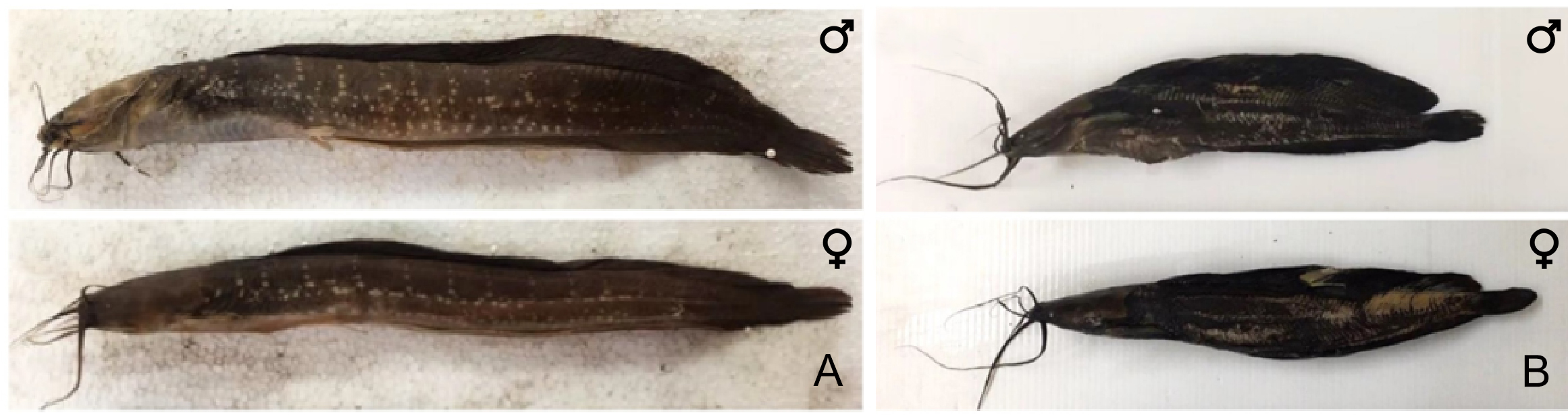
Main Results: Clear interspecific differences in external morphology were observed between Clarias nieuhofii and C. meladerma. Clarias nieuhofii exhibited an elongate, slender body with a laterally flattened profile and distinct white neuromast markings arranged in 13–20 rows along the lateral surfaces. The head was relatively small and blunt, bearing four pairs of long barbels. The dorsal, anal, and caudal fins were continuous, with a rounded caudal fin tip, and body coloration ranged from dark to reddish-brown. In contrast, C. meladerma displayed a shorter, more robust body form with uniform dark black coloration and no visible spots. This species possessed serrated pectoral fin spines and a comparatively taller dorsal fin, resulting in a stockier appearance typical of non-slender walking catfishes. Sexual dimorphism in C. nieuhofii was present but limited. Of the 24 morphometric variables analyzed, four differed significantly between sexes. Males exhibited significantly greater total length (TL), standard length (SL), and lower jaw length (LLJ), indicating larger overall body size, whereas females showed significantly larger eye diameter (ED). All remaining variables, including head dimensions, body depth, fin lengths, and caudal peduncle depth, did not differ significantly. Principal component analysis (PCA) revealed partial separation between males and females, suggesting modest sex-related morphological variation. In contrast, sexual dimorphism in C. meladerma was minimal. Among all variables examined, only standard length (SL) differed significantly between sexes, with males showing slightly greater values. All other measurements, including head proportions, fin dimensions, eye diameter, and barbel lengths, showed no significant differences. PCA supported these results, as male and female individuals exhibited substantial overlap in multivariate space. Interspecific comparisons revealed pronounced morphological divergence between the two species. Twenty-one of the 24 morphometric variables differed significantly, with measurements related to head size, body depth, fin lengths, pelvic and anal regions, and barbel lengths consistently higher in C. nieuhofii, reflecting its elongated morphology. Only TL, caudal peduncle depth (CPD), and mouth width (WM) showed no significant differences. PCA further confirmed interspecific differentiation, with the first two principal components explaining 59.44% of the total variance, and PC1 clearly separating the species, despite minor overlap.
Conclusions: Morphometric comparison of Clarias nieuhofii and C. meladerma from the Sirindhorn Swamp Forest was based on 24 variables expressed as %SL and %HL. Sexual dimorphism was evident in C. nieuhofii, with significant differences in TL, SL, ED, and LLJ, whereas C. meladerma showed minimal sexual differentiation, with significance detected only in SL. Interspecific comparisons revealed significant differences in 21 of the 24 morphometric variables. Principal component analysis (PCA) explained 59.44% of the total variance and clearly separated the two species in multivariate space. These results indicate pronounced morphological divergence likely associated with ecological specialization in peat-swamp habitats and provide baseline data for future conservation and monitoring efforts.
References
Abanikannda, O.T.F., Jimoh, A.A., Giwa, A.O., & Awosanya, L.A. (2019). Sexual dimorphism in body weight, morphometric measures and indices of African catfish (Clarias gariepinus). Aquaculture, 502, 148–52.
Behmene, I.E., Bouiadjra, B.B., Homrani, A., Daoudi, M., Sánchez-Vázquez, F.J., López-Lopez, A., Asensio-Pérez, A.I., & Galián, J. (2022). Morphometric and genetic diversity of an African catfish (Clarias gariepinus) population from Southeast Algeria. African Journal of Ecology, 60(4), 1287–92.
Bologan, G.R. (2009). The phylogeny of clariids and the ecomorphology of the African catfish. Cluj Veterinary Journal, 15(1), 73–6.
Chhuoy, S., Utsugi, K., Pin, K., Uy, S., Hogan, Z.S., Chandra, S., Chan, B., & Ngor, P.B. (2024). First specimen-based record of black skin catfish Clarias meladerma Bleeker, 1846 (Siluriformes: Clariidae) from the Mekong River basin. Cambodian Journal of Natural History, 2024(1), 17–22.
Department of Fisheries. (2007). Training Manual of Aquatic Animal Laboratory. Bangkok: Department of Fisheries.
Dwivedi, A.K., & De, K. (2024). Role of morphometrics in fish diversity assessment: status, challenges and future prospects. National Academy Science Letters, 47(2), 123–6.
Fagbuaro, O., Oso, J.A., Olurotimi, M.B., & Akinyemi, O. (2015). Morphometric and meristic characteristics of Clarias gariepinus from controlled and uncontrolled population from Southwestern Nigeria. Journal of Agriculture and Ecology Research International, 2(1), 39-45.
Fazazi, A., Abayomi, J., Olabode, G., & Adejumoke, A. (2019). Sexual dimorphism in body weight, morphometric measures and indices of African catfish (Clarias gariepinus). Aquaculture, 502, 148-152.
Forest Research Centre. (2000). Master Plan of Pru to Daeng Wildlife Sanctuary. Bangkok: Kasetsart University
Froese, R., & Pauly, D. (2025). FishBase. World Wide Web electronic publication. www.fishbase.org.
Iswanto, B., Imron, I., Suprapto, R., & Marnis, H. (2015). Morphological characterization of the African catfish (Clarias gariepinus Burchell, 1822) strains introduced to Indonesia. Indonesian Aquaculture Journal, 10(2), 91-99.
IUCN. (2025). The IUCN Red List of Threatened Species. Version 2025-1. www.iucnredlist.org.
Jawad, L.A., & Al-Janabi, M.I.G. (2016). Morphometric characteristics of catfish Silurus triostegus (Heckel, 1843) from the Tigris and Shatt al-Arab rivers, Iraq. Croatian Journal of Fisheries, 74, 179-185.
Kottelat, M. (2001). Fishes of Laos. Sri Lanka: WHT Publication (Pte).
Lim, K.K., & Ng, H.H. (1999). Clarias batu, a new species of catfish (Teleostei: Clariidae) from Pulau Tioman, Peninsular Malaysia. Raffles Bulletin of Zoology, 47, 157–68.
Mohamad, N.B. (2019). Morphometric and Meristic Analyses of Catfish (Hemibagrus spp. ) in Sarawak. Sarawak: Faculty of Resource Science and Technology, Universiti Malaysia Sarawak (UNIMAS).
Monteiro, L.R., & Nogueira, M.R. (2009). Adaptive radiations, ecological specialization, and the evolutionary integration of complex morphological structures. Evolution, 64(3), 724–43.
Ng, H.H., Hong, D.K., & Tu, N.V. (2011). Clarias gracilentus, a new walking catfish (Teleostei: Clariidae) from Vietnam and Cambodia. Zootaxa, 2823(1), 61–8.
Ng, H.H. (1999). Two new species of catfishes of the genus Clarias from Borneo (Teleostei: Clariidae). Raffles Bulletin of Zoology, 47(1),17–32.
Nguyen, L.T.N. (2015). Morphology and niche partitioning of fish assemblage in the Tonle Sap Biosphere Reserve a case study of the Prek Toal Core Area. Virginia: Hollins University.
Oguntade, O., Omidiji, O., & Ayinla, O. (2015). Morphometric differentiation of Clarias gariepinus strains in Nigerian water bodies using multivariate analysis. Journal of Aquatic Sciences, 30(2), 295–302.
Panitvong, N.A. (2020). Photographic Guide to Freshwater Fishes of Thailand. Bangkok: Siamensis Press. (in Thai)
Pouyaud, L., Sudarto, S., & Paradis, E. (2009). Phylogenetic structure of habitat shift and morphological convergence in Asian Clarias (Teleostei, Siluriformes: Clariidae). Journal of Zoological Systematics and Evolutionary Research, 47(4), 344–56.
Rainboth, W.J. (1996). Fishes of the Cambodian Mekong. Rome: Food and Agriculture Organization of the United Nations.
Roth, V.L., & Mercer, J.M. (2000). Morphometrics in development and evolution. American Zoologist, 2000, 40(5), 801–10.
Saenjundaeng, P. (2014). Encyclopedia of Freshwater Fish in Thailand. Khon Kaen: Klungnana Wittaya.
Sudarto, S., & Pouyaud, L. (2005). Identification key based on morphological characters of the Southeast Asian species of the genus Clarias (Pisces: Clariidae). Jurnal Iktiologi Indonesia, 5(2), 39–47.
Sudarto, S., Teugels, G.G., & Pouyaud, L. (2004). Description of a new clariid catfish, Clarias pseudonieuhofii from West Borneo (Siluriformes: Clariidae). Zoological Studies, 43(1), 8–19.
Teugels, G.G., Sudarto, S., & Pouyaud, L. (2001). Description of a new Clarias species from Southeast Asia based on morphological and genetical evidence (Siluriformes, Clariidae). Cybium, 25, 81–92.
Torgersen, K.T., Bouton, B.J., Hebert, A.R., Kleyla, N.J., Plasencia, X., Rolfe, G.L., Tagliacollo, V.A., & Albert, J.S. (2023). Phylogenetic structure of body shape in a diverse inland ichthyofauna. Scientific Reports, 13(1), 20758.
Turan, C., Yalçin, S., Turan, F., Okur, E., & Akyurt, I. (2005). Morphometric comparisons of African catfish, Clarias gariepinus, populations in Turkey. Folia Zoologica, 54(1–2), 165–72.
Turan, C. (1999). Note on the examination of the morphometric differentiation among fish populations: the truss system. Turkish Journal of Zoology, 23, 259–63.
Usman, B.I., Amin, S.M.N., Arshad, A., & Kamarudin, M.S. (2016). Morphometric relations in the grey eel catfish Plotosus canius in the coastal waters of Port Dickson, Peninsular Malaysia. Journal of Environmental Biology, 37(4), 573-578.
Wahl, K. (2012). Morphometrics. Croatia: Intech.
Więcaszek, B., Krzykawski, S., Antoszek, A., Kosik, J., & Serwotka, P. (2010). Morphometric characteristics of juvenile North African catfish Clarias gariepinus (Burchell, 1822) from heated-water aquaculture. Electronic Journal of Polish Agricultural Universities, 13(2), 1–14.
Downloads
Published
How to Cite
Issue
Section
License
Copyright (c) 2026 Faculty of Science, Burapha University

This work is licensed under a Creative Commons Attribution-NonCommercial-NoDerivatives 4.0 International License.
Burapha Science Journal is licensed under a Creative Commons Attribution-NonCommercial-NoDerivatives 4.0 International (CC BY-NC-ND 4.0) licence, unless otherwise stated. Please read our Policies page for more information