
Water Monitor Lizard (𝙑𝙖𝙧𝙖𝙣𝙪𝙨 𝙨𝙖𝙡𝙫𝙖𝙩𝙤𝙧 𝙢𝙖𝙘𝙧𝙤𝙢𝙖𝙘𝙪𝙡𝙖𝙩𝙪𝙨) distribution in Phitsanulok Province
Keywords:
𝘝𝘢𝘳𝘢𝘯𝘶𝘴 𝘴𝘢𝘭𝘷𝘢𝘵𝘰𝘳 , water monitor lizard, Maxent, species distribution, urban wildlifeAbstract
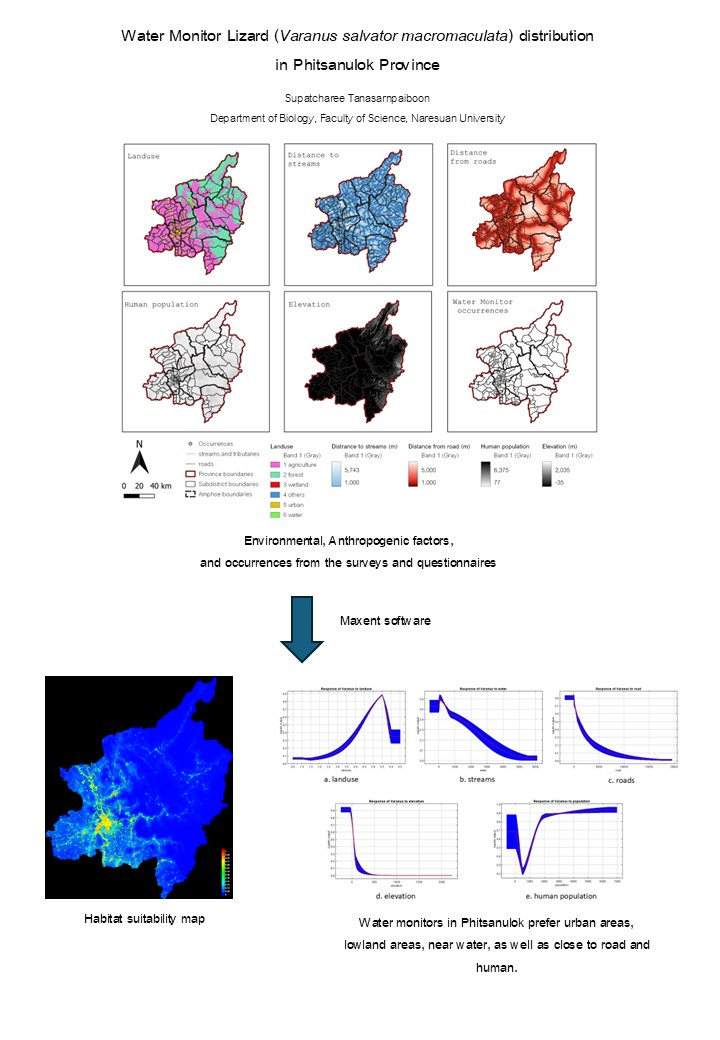
Background and Objectives : Urbanization may have positive or negative effects on presence and distribution of wildlife. The water monitor lizard (Varanus salvator macromaculatus) is a reptile that inhabits wide range of habitats, such as urban areas, swamp or wetland, but few occurrences in some area, such as forests. This study was aimed to examine the factors that influence the distribution of water monitor lizards in Phitsanulok province because of the area comprising of various habitat types.
Methodology : The surveys in districts in Phitsanulok province and secondary data from people and iNaturalist were collected. The species distribution model were analyzed in the software Maxent based on environmental variables, including elevation above sea level (m.), distance from road (m), distance to water resources (m), landuse types (i.e., agriculture , wetland, forest, water, urban, and miscellaneous), and sub-district population density in 2020 to explain the distribution of water monitor lizards in Phitsanulok. The model were evaluated using ROC and AUC. The contribution of each environmental variable to the lizard occurrence was explained using the Jacknife Test.
Main Results : There were 42 occurrences of the water monitor lizards during February 2020 to February 2021. The distribution model outputs using Maxent based on occurrences and environmental variables showed that the model have AUC = 0.933, which suggested that the data can excellently explain the distribution of the water monitor lizard. The landuse and the elevation made the most contribution to the occurrence of the lizard, which accounting for 60.5% and 26.6%, respectively.
Conclusions : Occurrence of the water monitor lizard in Phitsanulok province were not many as the survey were conducted in short time periods and not regularly. However, they were usually found in urban areas with human habitation and low land.
References
Andrews, K.M., Langen, T.A., & Struijk, R.P.J.H. (2015) Reptiles: Overlooked but Often at Risk from Roads. In van der Ree, R., Smith, D.J., Grilo, C. (eds). Handbook of Road Ecology. 1 ed. John Wiley & Sons, Ltd., pp. 271-280.
Bangkok prepares for Lumphini Park monitor lizard survey, population expected to be 160+. Springnews. https://www.springnews.co.th/news/341327. (in Thai)
Cook-Price, D. R., Makchai, S., Naithani, A., Pawangkhanant, P., & Suwanwaree, P. (2025). Lizard survey of Ko Pha-gnan in the Surat Thani Province, Thailand. Biodiversity Data Journal, 13, e154712.
Cota, M., Chan-ard, T., & Makchai, S. (2009). Geographical distribution and regional variation of Varanus salvator macromaculatus in Thailand. Biawak, 3(4), 134-143.
De Marco, P. J., & Nóbrega, C. C. (2018). Evaluating collinearity effects on species distribution models: An approach based on virtual species simulation. Plos One, 13(9), e0202403. https://doi.org/10.1371/journal.pone.0202403
Duengkae, P., & Chuaynkern, Y. (2009). A road-killed Water Monitor 𝘝𝘢𝘳𝘢𝘯𝘶𝘴 𝘴𝘢𝘭𝘷𝘢𝘵𝘰𝘳 𝘮𝘢𝘤𝘳𝘰𝘮𝘢𝘤𝘶𝘭𝘢𝘵𝘶𝘴: negative impact from the forest route in Khao Yai National Park, Thailand. Biawak, 3(1), 23Y25.
Evcin, O., Kucuk, O., & Akturk, E. (2019). Habitat suitability model with maximum entropy approach for European roe deer (Capreolus capreolus) in the Black Sea Region. Environmental Monitoring and Assessment, 191(11), 669.
Genevier, E. E. Z., Price, C., Evans, N., Streicher, J. P., & Downs, C. T. (2025). Population dynamics and morphometrics of Nile monitors along a gradient of urbanization in KwaZulu-Natal, South Africa. Journal of Zoology, 326(1), 23-36. https://doi.org/10.1111/jzo.13258
Hawkeswood, T., & Sommung, B. (2016). Observations on the reptile fauna of Lat Krabang Park, Bangkok, Thailand. Calodema, 440, 1-8.
IUCN. (2025). The IUCN Red List of Threatened Species. . https://www.iucnredlist.org
James, P. (2018). The Biology of Urban Environments. Oxford University Press.
Jong-achariyakul, S., & Phuangmalai, W. (2014). Survey and Assessment of Geological Sites in Phitsanulok Province. 1 ed. Lumpang: Mineral Resources Office (Region 1 Lumpang) Department of Mineral Resources. (in Thai)
Kematian, T., Ayob, N., Mustapha, M. A., SenawiI, J., & Ahamad, N. (2020). Herpetofauna roadkills on Langkawi Island, Peninsular Malaysia: The influence of landscape and season on mortality distribution. Sains Malaysiana, 49(10), 2373-2382.
Khadiejah, S., Razak, N., Ward-Fear, G., Shine, R., & Natusch, D. J. (2019). Asian water monitors (Varanus salvator) remain common in Peninsular Malaysia, despite intense harvesting. Wildlife Research, 46(3), 265-275.
Lauprasert, K., & Thirakhupt, K. (2001). Species diversity, distribution and proposed status of monitor lizards (Family Varanidae) in southern Thailand. Tropical Natural History, 1(1), 39-46.
Luna, Á., & Rausell-Moreno, A. (2024). Unveiling the urban colonization of the Asian water monitor (Varanus salvator) across its distribution range using citizen science. Peerj, 12, e17357.
Mahaprom, R. (2016). Population density and morphometry analysis for sex determination in Varanus salvator from Bangkachao [Unpublished master’s thesis]. Kasetsart University.
Mahaprom, R., & Kulabtong, S. (2018). Observation of feeding habit of the Asian water monitor, Varanus salvator (Laurenti, 1768) (Squamata Varanidae) on a Asian toad, Duttaphrynus melanostictus (Schneider, 1799) (Anura, Bufonidae) in Thailand. Biodiversity Journal, 9(3), 213-216.
Phillips, S. J., Anderson, R. P., & Schapire, R. E. (2006). Maximum entropy modeling of species geographic distributions [doi: 10.1016/j.ecolmodel.2005.03.026]. Ecological Modelling, 190(3-4), 231-259 http://www.sciencedirect.com/science/article/pii/S030438000500267X
QGIS Development Team. (2024). QGIS Geographic Information System. In Open Source Geospatial Foundation Project. http://qgis.osgeo.org
Twining, J. P., Bernard, H., & Ewers, R. M. (2017). Increasing land-use intensity reverses the relative occupancy of two quadrupedal scavengers. Plos One, 12(5), e0177143. https://doi.org/10.1371/journal.pone.0177143
Uyeda, L. (2009). Garbage appeal: Relative abundance of Water Monitor Lizards (Varanus salvator) correlates with presence of human food leftovers on Tinjil Island, Indonesia. Biawak, 3(1), 917.
Vasconcelos, R. N., Cantillo-Pérez, T., Franca Rocha, W. J. S., Aguiar, W. M., Mendes, D. T., de Jesus, T. B., de Santana, C. O., de Santana, M. M. M., & Oliveira, R. P. (2024). Advances and Challenges in Species Ecological Niche Modeling: A Mixed Review. Earth, 5(4), 963-989. https://www.mdpi.com/2673-4834/5/4/50
Downloads
Published
How to Cite
Issue
Section
License
Copyright (c) 2026 Faculty of Science, Burapha University

This work is licensed under a Creative Commons Attribution-NonCommercial-NoDerivatives 4.0 International License.
Burapha Science Journal is licensed under a Creative Commons Attribution-NonCommercial-NoDerivatives 4.0 International (CC BY-NC-ND 4.0) licence, unless otherwise stated. Please read our Policies page for more information