
Biology and Culture of the Fall Armyworm 𝙎𝙥𝙤𝙙𝙤𝙥𝙩𝙚𝙧𝙖 𝙛𝙧𝙪𝙜𝙞𝙥𝙚𝙧𝙙𝙖 with Mung Bean-Based Artificial Diet in Laboratory Conditions
Keywords:
fall armyworm, fecundity table, culture, artificial dietAbstract
Background and Objectives: The fall armyworm (FAW), Spodoptera frugiperda, is an important pest that poses a significant threat to maize and other economic crops, including rice, sugarcane, cotton, and peanuts, due to its polyphagous feeding habits and widespread global distribution, including Thailand. Currently, global research focuses on management of this pest through chemical and biological control methods, including the use of natural enemies such as nucleopolyhedrovirus (NPV) and Bt (Bacillus thuringiensis), as well as on studies of its nutritional requirements for growth and behavior under natural and laboratory conditions. Such studies require large numbers of test insects with controlled variability in age and health to ensure accurate experimental results. Thus, artificial diets play a critical role in laboratory rearing systems by providing standardized and consistent nutritional composition, eliminating the variability associated with natural host plants, and enabling mass production of insects throughout the year. At present, artificial diets for S. frugiperda commonly utilize protein sources derived from various legumes. However, some of these legumes are expensive and not readily available in Thailand, limiting their practical application. Therefore, this study aimed to evaluate the effectiveness of a mung bean (Vigna radiata (L.) R. Wilczek) -based artificial diet on the growth and reproduction of S. frugiperda under laboratory conditions in order to identify a cost-effective alternative protein source with high protein content, low cost, and wide availability in Thailand.
Methodology: The biological development and reproductive performance of S. frugiperda reared on a mung bean–based artificial diet were investigated under laboratory conditions at 25±2 °C and 80–90% relative humidity. One-day-old eggs (n = 100) were collected and observed under a stereomicroscope to determine the egg incubation period. After hatching, individual larvae were transferred to 59.14 ml transparent plastic cups, with one larva per cup to prevent cannibalism. Larvae were fed a mung bean–based artificial diet, which was replaced every three days until the larvae reached the pupal stage. Developmental duration and mortality were recorded daily. Upon pupation, pupal width and length were measured to compare the sizes of male and female pupae.. During the adult stage, newly emerged male and female moths were paired, and a total of 20 mating pairs were placed in transparent plastic boxes (13.5 × 20.5 × 7 cm), with one pair per box, to determine the number of eggs laid by each female. Daily observations were conducted until adult mortality. All Data collected included developmental duration and mortality rate of each life stage of S. frugiperda, pupal size, adult longevity, and daily fecundity. Eggs laid on wax paper and plastic containers were counted daily to determine reproductive output. Fertility table parameters, including the net reproductive rate (R0), intrinsic rate of increase (rc), finite rate of increase (), and mean generation time (Tc), were calculated using demographic methods. Differences in pupal size and adult longevity between males and females were analyzed using Student’s t-test.
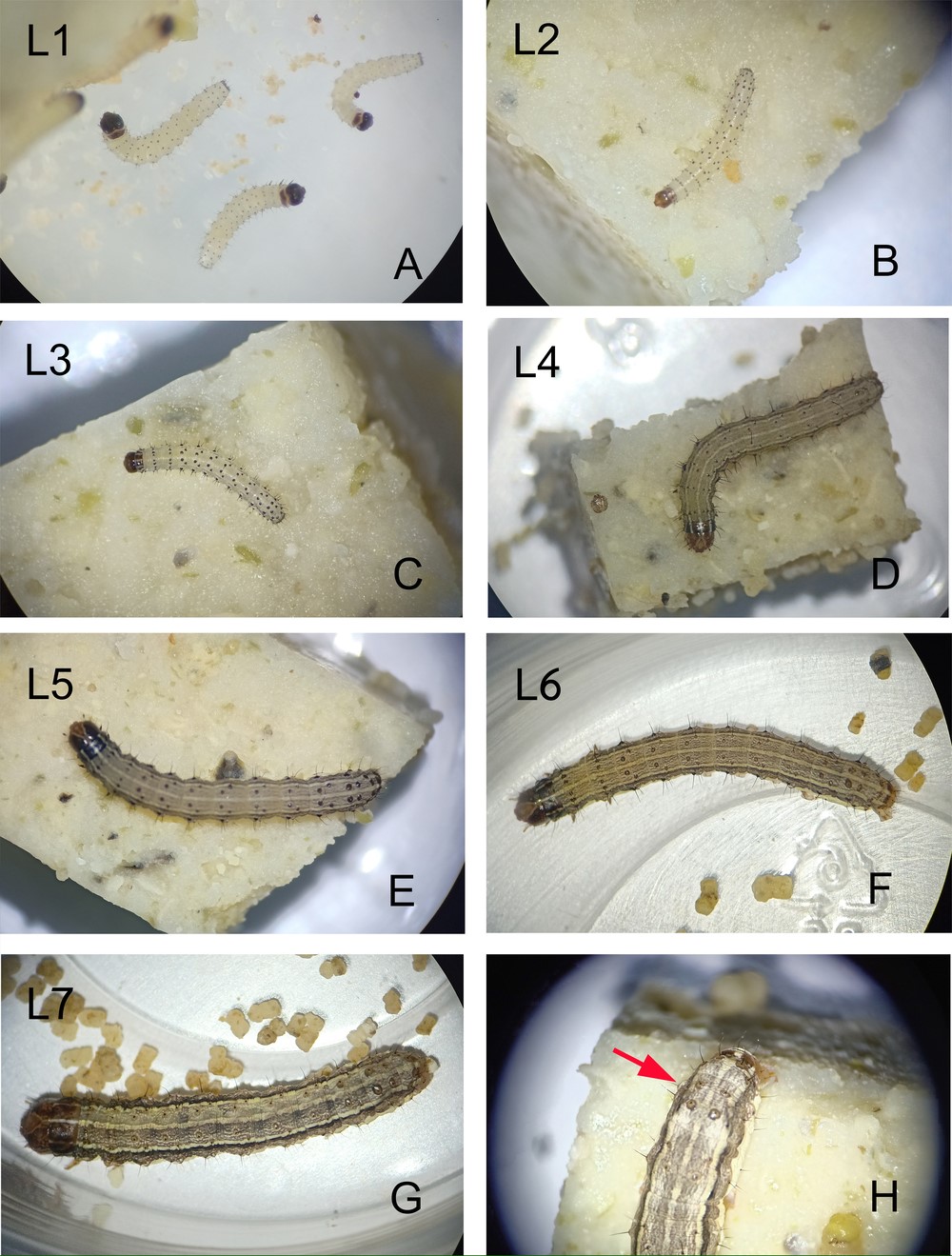
Main Results: The results indicated that S. frugiperda successfully completed its life cycle and exhibited rapid population growth when reared on the mung bean–based artificial diet under laboratory conditions. The life cycle consisted of four stages: egg, larva, pupa, and adult. The mean developmental duration from egg to adult emergence was 37.22±0.16 days. Fertility table analysis revealed a high reproductive potential of S. frugiperda reared on the mung bean diet. The net reproductive rate (R0) was 384.86 offspring per individual female. The intrinsic rate of increase (rc) was 0.13 day-1, while the finite rate of increase () was 1.14 day-1, indicating a rapid daily population growth rate under laboratory conditions. The generation time (Tc) was 45.77 days. Comparisons of pupal width and length between males and females revealed no statistically significant differences, whereas the adult lifespan of males was significantly shorter than that of females (p < 0.05).
Conclusions: Rearing S. frugiperda on a mung bean–based artificial diet effectively supported its growth, development, and reproduction under laboratory conditions. Although the developmental period of insects reared on the mung bean diet was longer than that reported for artificial diets based on white beans and pinto beans, the overall reproductive yield was higher. In addition, mung bean is inexpensive, widely available, and easily accessible in Thailand, making it a practical and economical protein source for artificial diet formulation. Therefore, the mung bean–based artificial diet represents a suitable and cost-effective alternative for the mass rearing of S. frugiperda in laboratory research and reduces reliance on expensive or imported protein sources.
References
Bowling, C.C. (1967). Rearing of Two Lepidopterous Pests of Rice on a Common Artificial Diet. Annals of the Entomological Society of America, 60(6), 1215–1216.
Burton, R.L. (1967). Mass rearing the fall armyworm in the laboratory. Agricultural Research Service, U.S. Dept. of Agriculture, 33-117.
Cunha, U.S., Martins, J.F.S., Porto, P.M., Garcia, S.M., Bernardi, O., Trecha, O.C., Bernadi, D., Jardim, O.E., & Bac,, U.C.E. (2008). Resistência de milho para cultivo em várzeas subtropicais à lagarta-do-cartucho Spodoptera frugiperda. Ciência. Rural, 38, 1125-1128.
Goergen, G., Kumar, P.L., Sankung, S.B., Togola, A., & Tamò, M. (2016). First report of outbreaks of the fall armyworm Spodoptera frugiperda (J E Smith) (Lepidoptera, Noctuidae), a new alien invasive pest in West and Central Africa. PLos ONE, 11(10), 1-9.
He, L., Wang, T., Chen, Y., Ge, S., Kris, A.G.W., & Wu, K. (2021). Larval diet affects development and reproduction of East Asian strain of the fall armyworm, Spodoptera frugiperda. Journal of Integrative Agriculture, 20(3), 736–744.
Horikoshi, R.J., Vertuan, H., de Castro, A.A., Morrell, K., Griffith, C., & Evans. A. (2021). A new generation of Bt maize for control of fall armyworm (Spodoptera frugiperda). Pest Management Science, 77(8), 3727–3736.
IPPC. (2018). First detection of Fall Army Worm on the border of Thailand. https://www.ippc,int/en/countries/thailand/pestreports/2018/12/first-detection-of-fall-army-worm-on-the-border-of-thailand/
Jaba, J., Sathish, K., & Mishra, S.P. (2020). Biology of fall armyworm Spodoptera frugiperda (J. E. Smith) on artificial diets. Indian Journal of Entomology, 82(3), 543-546.
Kranthi, P., Devi, R.S., Rajanikanth, P., & Ramya, V. (2021). Biology of an invasive fall armyworm, Spodoptera frugipera (J.E. Smith) (Lepidoptera: Noctuidae) on chickpea flour based artificial diet. The Pharma Innovation Journal 10(10), 1449-1452.
Lekha, Mahla, M.K., Swami, H., Vyas, A.K., & Ahir, K.C. (2020). Biology of fall armyworm, Spodoptera frugiperda (J.E. Smith) on different artificial diets. Journal of Entomology and Zoology Studies, 8(1), 584-586.
Lynch, R.E., Nwanze, K.F., Wiseman, B.R., & Perkin, W.D. (1989). Fall armyworm (Lepidoptera: Noctuidae) development and fecundity when reared as larvae on different meridic diets. Journal of Agricultural Entomology, 6(2), 101-111.
Montezano, D.G., Specht, A., & Sosa-Gómez, D.R. (2019). Developmental Parameters of Spodoptera frugiperda (Lepidoptera: Noctuidae) Immature Stages Under Controlled and Standardized Conditions. Journal of Agricultural Science, 11(8), 76-89.
Nawanich, S., Junta-ud, N., Promnaret, A., & Uraichuen, S. (2022). Natural parasitism of egg parasitoid and biology of Telenomus remus Nixon (Hymenoptera: Scelionidae) on fall armyworm, Spodoptera frugiperda (J.E. Smith) (Lepidoptera: Noctuidae). Agricultural Science Journal, 53(3), 242–255.
Neal, D. (2004). Introduction to Population Biology. United Kingdom: Cambridge University Press.
Panizzi, A.R., & Parra, J.R.P. (2009). Bioecologia e a nutrição de insetos – Base para ao manejo integrado de pragas. Brazil: Embrapa.
Paredes-Sánchez, F.A., Rivera, G., Bocanegra-García, V., Martínez-Padrón, H.Y., Berrones-Morales, M., & Niño-García, N. (2021). Advances in Control Strategies against Spodoptera frugiperda. Molecules, 26(18), 5587.
Pinto, J.R.L., Torres, A.F., Truzi, C.C., Vieira, N.F., Vacari, A.M., & De Bortoli, S.A. (2019). Artificial Corn-Based Diet for Rearing Spodoptera frugiperda (Lepidoptera: Noctuidae). Journal of Insect Science, 19(4), 1-8.
Raghunandan, B.L., Patel, N.M., Dave, H.J., & Mehta, D.M. (2019). Natural occurrence of nucleopolyhedrovirus infecting fall armyworm, Spodoptera frugiperda (J. E. Smith) (Lepidoptera: Noctuidae) in Gujarat, India. Journal of Entomology and Zoology Studies, 7(2), 1040-1043.
Sarate, P.J., Tamhane, V.A., Kotkar, H.M., Ratnakaran, N., Susan, N., Gupta, V.S., & Giri, A.P. (2012). Developmental and digestive flexibilities in the midgut of a polyphagous pest, the cotton bollworm, Helicoverpa armigera. Journal of Insect Science, 12(1), 42.
Sharanabasappa, Kalleshwaraswamy, C.M., Maruthi, M.S., & Pavithra, H.B. (2018). Biology of invasive fall army worm Spodoptera frugiperda (J.E. Smith) (Lepidoptera: Noctuidae) on maize. Indian Journal of Entomology, 80(3), 540-543.
Truzi, C.C., Vieira, N.F., de Souza, J.M., & De Bortoli, S.A. (2021). Artificial diets with different protein Levels for rearing Spodoptera frugiperda (Lepidoptera: Noctuidae). Journal of Insect Science, 21(4), 1-7.
USDA. (2019). FoodData central. https://fdc.nal.usda.gov/index.html
Downloads
Published
How to Cite
Issue
Section
License
Copyright (c) 2026 Faculty of Science, Burapha University

This work is licensed under a Creative Commons Attribution-NonCommercial-NoDerivatives 4.0 International License.
Burapha Science Journal is licensed under a Creative Commons Attribution-NonCommercial-NoDerivatives 4.0 International (CC BY-NC-ND 4.0) licence, unless otherwise stated. Please read our Policies page for more information