Effects of Vacuum Dehydration on the Physicochemical Properties of Itama Stingless Bee Honey
Keywords:
stingless bee honey (𝘏𝘦𝘵𝘦𝘳𝘰𝘵𝘳𝘪𝘨𝘰𝘯𝘢 𝘪𝘵𝘢𝘮𝘢), moisture reduction, vacuum dehydration, physical and chemical properties, antioxidant activityAbstract
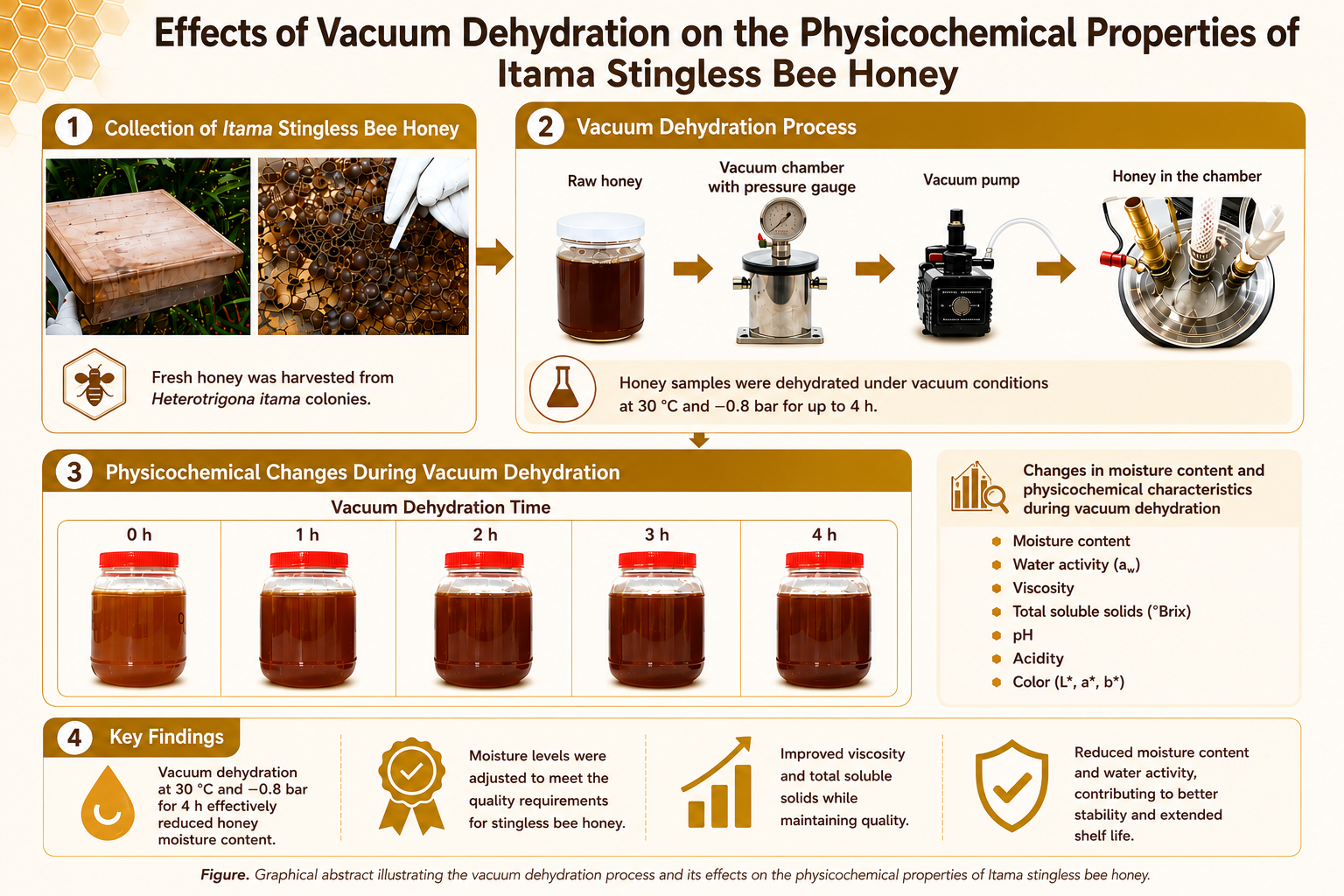
Background and Objective: At present, stingless bee honey has gained considerable attention as a product with high nutritional value and bioactive properties. However, its high moisture content remains a major limitation, affecting product quality and promoting fermentation. Therefore, moisture reduction is an essential process for extending shelf life and maintaining the quality of stingless bee honey. Conventional heat-based dehydration methods may adversely affect the physical and chemical properties as well as important bioactive compounds. In contrast, vacuum dehydration, which operates at low temperatures, has greater potential to preserve the quality and functional components of stingless bee honey. This study aimed to investigate the effects of vacuum dehydration at different processing times on the physical and chemical properties of stingless bee honey.
Methodology: This study used fresh stingless bee honey from the Itama species (Heterotrigona itama), collected from the Ban Phraiwan Stingless Bee Community Enterprise, Tak Bai District, Narathiwat Province, Thailand, in February 2025. The samples were stored at 4 °C prior to analysis. Before the experiment, the honey was filtered through sterilized muslin cloth and divided into five experimental groups. Moisture reduction was then performed using a vacuum system at a pressure of - 0.8 bar and a temperature of 30 ± 1 °C for 0, 1, 2, 3, and 4 h, respectively. The physical properties of the samples were evaluated, including viscosity using a Brookfield Viscometer and color values in the CIE Lab* system using a Chroma Meter. The chemical properties were determined by measuring moisture content using the AOAC (2000) method, total soluble solids using a refractometer, and pH using a digital pen-type pH meter. In addition, antioxidant properties were evaluated by determining total phenolic content using the Folin–Ciocalteu method, free radical scavenging activity using the DPPH assay, and total flavonoid content using the aluminum chloride colorimetric method. Sugar content was also analyzed by determining reducing sugars using the DNS method, total sugars using the anthrone method, and individual sugars, including fructose, glucose, and maltose, using HPLC. All data were expressed as mean ± standard deviation and statistically analyzed using one-way analysis of variance (One-way ANOVA) based on a Completely Randomized Design (CRD). Differences among means were determined using Duncan’s Multiple Range Test at a significance level of 0.05, in order to draw conclusions and identify the optimal conditions for the moisture reduction process of stingless bee honey.
Results: The study on the effects of vacuum moisture reduction time on fresh Itama stingless bee honey demonstrated that processing time significantly affected the physical, chemical, and bioactive properties of the honey (p < 0.05). In particular, viscosity increased from 372 ± 2.00 cP at 0 h to 529.46 ± 14.49 and 532.90 ± 45.81 cP at 3 and 4 h, respectively, indicating increased concentration and thickness of the honey as moisture content decreased. Regarding color properties, the L* value decreased from 69.05 ± 3.24 to 58.33 ± 1.93, while the b* value decreased from 34.29 ± 0.59 to 22.63 ± 0.99, indicating that the honey became darker and less yellow with increasing moisture reduction time. In addition, the a* value increased from -3.02 ± 0.23 to -0.56 ± 0.26, reflecting changes in pigment composition within the honey color system. For chemical properties, moisture content decreased from 12.38 ± 0.23% to 11.29 ± 0.23%, whereas total soluble solids increased from 68.73 ± 0.25 to 70.77 ± 1.40 °Brix. The pH value decreased from 3.13 ± 0.06 to 2.80 ± 0.02, indicating increased acidity during processing. In terms of antioxidant properties, total phenolic content increased from 484.60 ± 0.10 to 505.90 ± 0.14 mg GAE/100 g, total flavonoid content increased from 17.84 ± 0.04 to 18.05 ± 0.03 mg QE/100 g, and antioxidant activity increased from 90.15 ± 0.01% to 91.16 ± 0.14% with increasing processing time. The sugar composition showed that reducing sugars slightly decreased from 30.79 ± 0.01% to 30.51 ± 0.03%, whereas total sugars increased from 55.30 ± 0.03% to 56.58 ± 0.01%. Fructose increased from 9.73 ± 0.01% to 11.41 ± 0.04%, and glucose increased from 12.98 ± 0.01% to 14.30 ± 0.01%, while maltose decreased from 32.78 ± 0.01% to approximately 30.20–30.48%. These results reflect changes in carbohydrate composition associated with moisture reduction in stingless bee honey.
Conclusions: Vacuum-based moisture reduction effectively reduced the moisture content of stingless bee honey after 4 h at a pressure of - 0.8 bar. In addition, this method was able to preserve antioxidant compounds and phenolic substances, which are important factors contributing to product quality. Furthermore, it helped reduce fermentation and extend the shelf life of stingless bee honey products.
References
AOAC. (2000). Official methods of analysis of AOAC International (21st ed.). AOAC International.
Bertoncelj, J., Doberšek, U., Jamnik, M., & Golob, T. (2007). Evaluation of the phenolic content, antioxidant activity and colour of Slovenian honey. Food Chemistry, 105(2), 822-828. https://doi.org/10.1016/j.foodchem.2007.01.060
Biluca, F. C., Braghini, F., Gonzaga, L. V., Costa, A. C. O., & Fett, R. (2016). Physicochemical profiles, minerals and bioactive compounds of stingless bee honey (Meliponinae). Journal of Food Composition and Analysis, 50, 61-69. https://doi.org/10.1016/j.jfca.2016.05.007
Bogdanov, S., Ruoff, K., & Oddo, L. P. (2004). Physico-chemical methods for the characterisation of unifloral honeys: A review. Apidologie, 35(Suppl. 1), S4-S17. https://doi.org/10.1051/apido:2004047
Brand-Williams, W., Cuvelier, M. E., & Berset, C. (1995). Use of a free radical method to evaluate antioxidant activity. LWT-Food Science and Technology, 28(1), 25-30. https://doi.org/10.1016/S0023-6438(95)80008-5
Chua, L. S., Rahaman, N. L. A., Adnan, N. A., & Eddie Tan, T. T. (2012). Antioxidant activity of three honey samples in relation with their biochemical components. Journal of Analytical Methods in Chemistry, 2013, Article ID 313798. https://doi.org/10.1155/2013/313798
Ciappini, M. C., Gatti, M. B., & Di Vito, M. V. (2013). Color as an indicator of flavonoids content in honey. Revista de Ciencia y Tecnología, 19, 59–63.
Ciurzyńska, A., & Lenart, A. (2011). Freeze-drying - application in food processing and biotechnology - a review. Polish Journal of Food and Nutrition Sciences, 61(3), 165-171. https://doi.org/10.2478/v10222-011-0017-5
Codex Alimentarius. (2001). Codex standard for honey. Codex Stan 12-1981. FAO/WHO Food StandardsProgramme.
De-Melo, A. A. M., de Almeida-Muradian, L. B., Sancho, M. T., & Pascual-Maté, A. (2018). Composition and properties of Apis mellifera honey: A review. Journal of Apicultural Research, 57(1), 5–37.https://doi.org/10.1080/00218839.2017.1338444
Escriche, I., Kadar, M., Juan-Borrás, M., & Domenech, E. (2014). Suitability of antioxidant capacity, flavonoids and phenolic acids for floral authentication of honey. Impact of industrial thermal treatment. Food Chemistry, 142, 135-143. https://doi.org/10.1016/j.foodchem.2013.07.033
Halim, N. F., Basrawi, M. F., Azman, N. A. M., Sulaiman, S. A., & Razak, S. B. A. (2021). The effect of temperature on low temperature vacuum drying with induced nucleate boiling for stingless bees honey. IOP Conf. Series: Materials Science and Engineering, 1078(1), 012018. https://doi.org/10.1088/1757-899X/1078/1/012018
Hodge, J. E., & Hofreiter, B. T. (1962). In Methods in carbohydrate chemistry (pp. 420-421). Academic Press.
Gupta, B., Devi, K. P., Chanu, P. S., Jadav, S., C.S., V., & Gupta, S. (2024). Nutritional Composition of Honey: Implications for Human Health and Disease Prevention. Agriculture Archives, 3(3),1–5. https://doi.org/10.51470/agri.2024.3.3.01
Khalil, M. I., Sulaiman, S. A., & Gan, S. H. (2010). High 5-hydroxymethylfurfural concentrations are found in Malaysian honey samples stored for more than one year. Food and Chemical Toxicology, 48(8-9), 2388-2392. https://doi.org/10.1016/j.fct.2010.05.076
Lullah-Deh, J. A., Khan, M. E., & Eneji, I. S. (2018). Physicochemical characteristics of honey samples from Mambilla Plateau, Nigeria. 2(1), 7. https://doi.org/10.11648/J.JB.20180201.12
Miller, G. L. (1959). Use of dinitrosalicylic acid reagent for determination of reducing sugar. Analytical Chemistry, 31(3), 426-428. https://doi.org/10.1021/ac60147a030
Muhammad, M. A. A., Amir, A., & Abdul Razak, A. R. (2023). Heterotrigona itama kelulut honey dehydration process to prolong shelf life. In Proceedings of the 5th International Conference on Advances in Manufacturing and Materials Engineering (pp. 131–137). https://doi.org/10.1007/978-981-19-9509-5_18
National Bureau of Agricultural Commodity and Food Standards. (2024). Agricultural Commodity Standard: Stingless Bee Honey (TAS 8005-2024). Royal Thai Government Gazette, 141(Special Section 300 D), 3–16. (in Thai)
Piljac-Žegarac, J., Stipčević, T., & Belščak, A. (2009). Antioxidant properties and phenolic content of different floral origin honeys. Journal of ApiProduct and ApiMedical Science, 1(2), 43-50. https://doi.org/10.3896/IBRA.4.01.2.04
Quezada-Euán, J. J. G., Nates-Parra, G., Maués, M. M., Roubik, D. W., & Imperatriz-Fonseca, V. L. (2018). The economic and cultural values of stingless bees (Hymenoptera: Meliponini) among ethnic groups of tropical America. Sociobiology, 65(4), 534-557. https://doi.org/10.13102/sociobiology.v65i4.3447
Salgueiro, F. B., Lira, A. F., Rumjanek, V. M., & Castro, R. N. (2014). Phenolic composition and antioxidant properties of Brazilian honeys. Química Nova, 37(5), 821–826. https://doi.org/10.5935/0100-4042.20140132
Samoticha, J., Wojdyło, A., & Lech, K. (2017). The influence of different the drying methods on chemical composition and antioxidant activity in chokeberries. LWT-Food Science and Technology, 66, 484-489. https://doi.org/10.1016/j.lwt.2015.10.073
Shamsudin, S., Selamat, J., Sanny, M., Abd Razak, S. B., Jambari, N. N., Mian, Z., & Khatib, A. (2019). A comparative characterization of physicochemical and bioactive properties of processed Heterotrigona itama honey from different origins and classification by chemometric analysis. Molecules, 24(21), 3898. https://doi.org/10.3390/molecules24213898
Silva, T. M. S., dos Santos, F. P., Evangelista-Rodrigues, A., da Silva, E. M. S., da Silva, G. S., de Novais, J. S., Santos, F. de A. R., & Camara, C. A. (2013). Phenolic compounds, melissopalynological, physicochemical analysis and antioxidant activity of jandaíra (Melipona subnitida) honey. Journal of Food Composition and Analysis, 29(1), 10-18. https://doi.org/10.1016/j.jfca.2012.09.006
Singleton, V. L., & Rossi, J. A. (1965). Colorimetry of total phenolics with phosphomolybdic-phosphotungstic acid reagents. American Journal of Enology and Viticulture, 16(3), 144-158. https://doi.org/10.5344/ajev.1965.16.3.144
Sousa, J. M. B., de Souza, E. L., Marques, G., de Toledo Benassi, M., Gullón, B., Pintado, M. M., & Magnani, M. (2016). Sugar profile, physicochemical and sensory aspects of monofloral honeys produced by different stingless bee species in Brazilian semi-arid region. LWT-Food Science and Technology, 65, 645-651. https://doi.org/10.1016/j.lwt.2015.08.058
Turkmen, N., Sari, F., Poyrazoglu, E. S., & Velioglu, Y. S. (2006). Effects of prolonged heating on antioxidant activity and colour of honey. Food Chemistry, 95(4), 653-657. https://doi.org/10.1016/j.foodchem.2005.02.004
Vit, P., Pedro, S. R. M., & Roubik, D. (Eds.). (2013). Pot-honey: A legacy of stingless bees. Springer Science & Business Media. https://doi.org/10.1007/978-1-4614-4960-7
Yan, S., Wang, X., Wang, W., Peng, W., Wang, K., Huang, J., Wu, L., Tian, W. L., & Xue, X. (2022). Identification of Pigmented Substances in Black Honey from Leucosceptrum canum: Novel Quinonoids Contribute to Honey Color. Journal of Agricultural and Food Chemistry, 70(11), 3521–3528. https://doi.org/10.1021/acs.jafc.1c07885
Downloads
Published
How to Cite
Issue
Section
License
Copyright (c) 2026 Faculty of Science, Burapha University

This work is licensed under a Creative Commons Attribution-NonCommercial-NoDerivatives 4.0 International License.
Burapha Science Journal is licensed under a Creative Commons Attribution-NonCommercial-NoDerivatives 4.0 International (CC BY-NC-ND 4.0) licence, unless otherwise stated. Please read our Policies page for more information