
Influence of Water Quality on the Community Structure and Diversity of Phytoplankton in Shellfish Farming Areas, Chonburi Province, Thailand
Keywords:
water quality, phytoplankton, sellfish farming areas , ChonburiAbstract
Background and Objectives: Chonburi Province is a key coastal area along the upper Gulf of Thailand with high economic and social importance, particularly for marine shellfish farming, which represents a major coastal fisheries activity in eastern Thailand. This activity plays an essential role in supporting coastal livelihoods and contributing to national food security. Shellfish farming systems in this region rely heavily on natural environmental conditions, especially water quality and phytoplankton communities, which function both as the primary food source for shellfish and as primary producers in coastal ecosystems. Phytoplankton species composition, abundance, and diversity are highly sensitive to variations in physical and chemical water parameters, including temperature, salinity, and dissolved inorganic nutrients. Alterations in phytoplankton community structure, particularly blooms of potentially harmful species, may negatively affect water quality, lead to toxin accumulation in shellfish, and pose risks to food safety. Therefore, understanding the interactions between water quality and phytoplankton dynamics is crucial for sustainable management of shellfish farming areas. This study aimed to assess the relationships between water quality parameters and the structure and diversity of phytoplankton communities in shellfish farming areas along the coast of Chonburi Province. Temporal variations in phytoplankton species composition were also examined to support monitoring of potentially harmful phytoplankton and to provide scientific information for effective and sustainable shellfish aquaculture management.
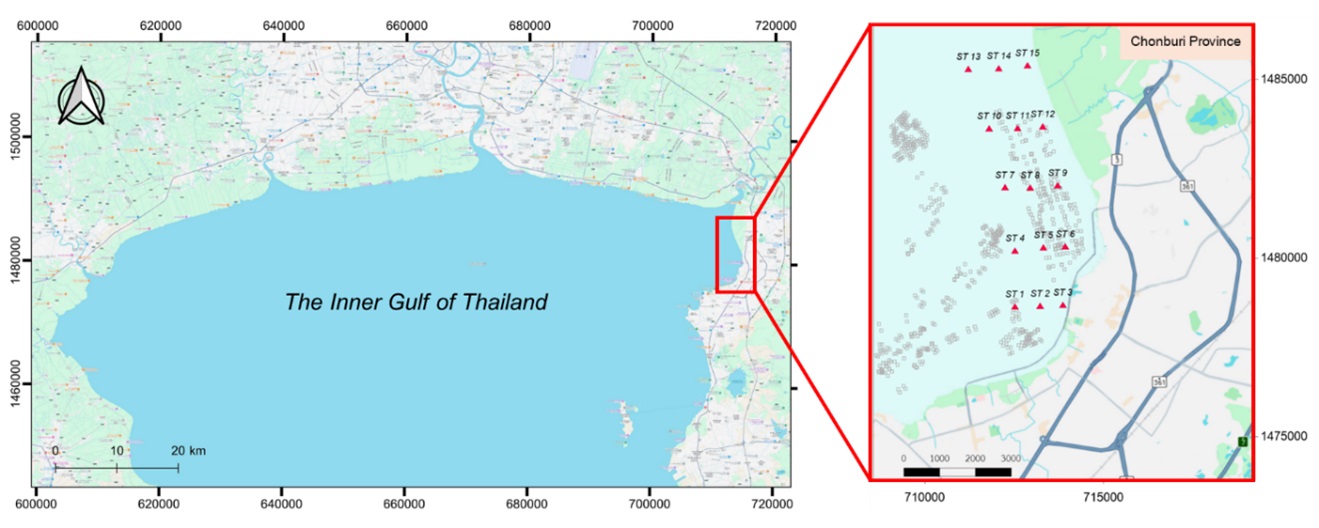
Methodology: Field surveys were conducted in coastal waters of Chonburi Province, Thailand, adjacent to shellfish farming areas. A total of 15 sampling stations were established in Mueang District, with sampling undertaken during five periods between December 2023 and August 2024 to capture seasonal variability. In situ measurements of temperature, salinity, dissolved oxygen (DO), and pH were performed using a multiparameter probe. Surface water samples were collected at approximately 30 cm depth in triplicate at each station, stored in acid-cleaned HDPE bottles, and maintained at 4°C prior to laboratory analysis within 24 hr. Samples for dissolved inorganic nutrients were filtered through pre-combusted glass fiber filters (GF/F) and stored at 4°C, whereas chlorophyll-a samples were stored at -20°C until analysis. Phytoplankton samples were obtained by filtering 20 L of seawater through a 20-µm mesh plankton net and preserved with 4% formalin. Taxonomic identification was performed to the lowest possible level using light microscopy, and abundance was quantified with a Sedgewick–Rafter counting chamber.Community structure was assessed using the Shannon–Wiener diversity index (H’) and Pielou’s evenness (J’). Spatial and temporal variations were evaluated using one-way analysis of variance (ANOVA) followed by Tukey’s HSD test. Relationships between environmental variables and phytoplankton assemblages were examined using Pearson’s correlation and multiple linear regression, with model performance assessed by the coefficient of determination (R²). All statistical analyses were performed using Minitab Statistical Software.
Main Results: Water quality in shellfish farming areas along the coastal zone of Chonburi Province exhibited pronounced seasonal variability. Seawater temperature ranged from 29.2 to 31.3 °C and showed no significant spatial differences among stations, whereas salinity, dissolved oxygen (DO), chlorophyll-a, and dissolved inorganic nutrients varied significantly over time (p < 0.05). Salinity decreased during the rainy season due to freshwater input, while higher and more stable salinity in the dry season favored phytoplankton growth. Chlorophyll-a concentrations ranged from 4.4 to 14.4 µg L-1, with peak values observed during the dry season, indicating elevated phytoplankton biomass. Phytoplankton assemblages comprised three divisions—Cyanophyta, Chlorophyta, and Chromophyta with a total of 68 genera. Chromophyta dominated throughout the study and exhibited pronounced blooms during the dry season, resulting in the highest phytoplankton density in February (mean: 527,504 cells L-1; maximum: 1,337,125 cells L-1), whereas densities declined markedly during the rainy season. Phytoplankton diversity (H’) and evenness (J’) decreased during diatom (Bacillariophyceae) bloom events and increased toward the late rainy season, reflecting a more heterogeneous community structure. Potentially harmful dinoflagellates were detected, particularly during the dry season, including Prorocentrum spp. (6,500 cells L-1) and Gymnodinium sp. (800 cells L-1). Correlation and multiple linear regression analyses identified salinity, temperature, and dissolved inorganic nutrients as key drivers regulating phytoplankton density. These findings highlight the seasonal risk of phytoplankton blooms and harmful species, with potential implications for water quality and shellfish safety in the study area.
Conclusions: Overall, the results demonstrated that temperature, salinity, and dissolved inorganic nutrients were key drivers influencing phytoplankton density, diversity, and community composition in the study area. During the dry season, phytoplankton blooms dominated by Bacillariophyceae (diatoms) were observed, resulting in reduced diversity, whereas the rainy season promoted shifts in community structure with an increased occurrence of taxa tolerant to low salinity conditions. Harmful and bloom-forming phytoplankton, including Thalassiosira sp. and Bellerochea sp., as well as potentially toxic dinoflagellates such as Prorocentrum spp. and Gymnodinium sp., were detected, particularly during the dry season. The proliferation of these taxa may contribute to oxygen depletion and increase the risk of toxin accumulation in shellfish. Therefore, continuous monitoring of water quality and phytoplankton communities, particularly during the dry season, combined with effective management of nutrient inputs and environmental conditions, is essential to reduce ecological risks, ensure food safety, and support the long-term sustainability of shellfish aquaculture.
References
Anderson, D. M., Cembella, A. D., & Hallegraeff, G. M. (2012). Progress in understanding harmful algal blooms: Paradigm shifts and new technologies for research, monitoring, and management. Annual Review of Marine Science, 4, 143–176.
Buranapratheprat, A., Yanagi, T., & Matsumura, S. (2008). Seasonal variation in water column conditions in the upper Gulf of Thailand. Continental Shelf Research, 28(18), 2509–2522.
Borcard, D., Gillet, F.,& Legendre, P., 2018. Numerical ecology with R, 2nd ed. Springer.
Cloern, J. E. (2001). Our evolving conceptual model of the coastal eutrophication problem. Marine Ecology Progress Series, 210, 223–253.
Cohen, J., 1988. Statistical power analysis for the behavioral sciences, 2nd ed. Lawrence Erlbaum Associates.
Department of Fisheries-DOF. (2023). Statistics of marine shellfish farms 2022 (Report No. 10/2566). Fisheries Statistics Group, Policy and Planning Division, Ministry of Agriculture and Cooperatives.(in Thai)
Department of Marine and Coastal Resources - DMCR. (2022). State of marine and coastal resources and coastal erosion: Thailand national report 2021. Ministry of Natural Resources and Environment, Bangkok. (in Thai)
Diaz, R. J., & Rosenberg, R. (2008). Spreading dead zones and consequences for marine ecosystems. Science, 321(5891), 926–929.
Egge, J. K., & Aksnes, D. L. (1992). Silicate as regulating nutrient in phytoplankton competition. Marine Ecology Progress Series, 83, 281–289.
Food and Agriculture Organization of the United Nations - FAO. (2004). Marine biotoxins (FAO Food and Nutrition Paper No. 80). FAO.
Grasshoff, K., Kremling, K., & Ehrhardt, M. (1999). Methods of seawater analysis (3rd ed.). Wiley-VCH.
Hallegraeff, G. M. (1993). A review of harmful algal blooms and their apparent global increase. Phycologia, 32(2), 79–99
He, Y., Zhang, P., Xu, F., Zhao, L., & Zhang, J. (2023). Seasonal nutrients variation, eutrophication pattern, And Chlorophyll a response adjacent to Guangdong coastal water, China. Frontiers in Marine Science,10, 1236609. https://doi.org/10.3389/fmars.2023.1236609
Hilaluddin, F., Yusoff, F. M., & Toda, T. (2020). Shifts in diatom dominance associated with seasonal changes in an estuarine mangrove phytoplankton community. Journal of Marine Science and Engineering, 8(7), 528.
Horner, R. A., Garrison, D. L., & Plumley, F. G. (1997). Harmful algal blooms and red tide problems on the U.S. west coast. Limnology and Oceanography, 42(5_part_2), 1076–1088.
Howarth, R. W., Billen, G., Swaney, D., Townsend, A., Jaworski, N., Lajtha, K., Downing, J. A., Elmgren, R., Caraco, N., Jordan, T., Berendse, F., Freney, J., Kudeyarov, V., Murdoch, P., & Zhu, Z. L. (1996). Regional nitrogen budgets and riverine N and P fluxes for the drainages to the North Atlantic Ocean: Natural and human influences. Biogeochemistry, 35(1), 75–139.
Hurlbert, S. H. (1971). The nonconcept of species diversity: A critique and alternative parameters. Ecology, 52(4), 577–586.
Jahan, S., & Singh, A. (2023). The role of phytoplankton in the environment and in human life: A review. Basic and Applied Science Journal, 41(2), 379–398. https://doi.org/10.29072/basjs.20230212
Jin, J., Liu, S. M., Ren, J. L., Liu, C. G., Zhang, J., Zhang, G. L., & Huang, D. J. (2013). Nutrient dynamics and coupling with phytoplankton species composition during the spring blooms in the Yellow Sea. Deep-Sea Research Part II: Topical Studies in Oceanography, 97, 16–32.
Kholssi, R., Lougraimzi, L., & Moreno-Garrido, I. (2023). Influence of salinity and temperature on the growth, productivity, photosynthetic activity and intracellular ROS of two marine microalgae and cyanobacteria. Marine Environmental Research, 186, 105932. https://doi.org/10.1016/j.marenvres.2023.105932
Leong, S., Lim, C. Y., Chew, L. P., Kok, J. W., & Teo, S. L. M. (2015). Three new records of dinoflagellates in Singapore’s coastal waters, with observations on environmental conditions associated with microalgal growth in the Johor Straits. Raffles Bulletin of Zoology, Supplement 31, 24–36.
Niyomsilpchai, T., Kornkanitnan, N., Saisahat, R., Somboon, S., & Chalermwut, J. (2023). Variation and relationship between water qualities and phytoplankton along the coast of the upper Gulf of Thailand. Thai Science and Technology Journal, 31(2), 82-104 (in Thai)
Paerl, H. W., Hall, N. S., & Calandrino, E. S. (2011). Controlling harmful cyanobacterial blooms in a world experiencing anthropogenic and climatic change. Science of the Total Environment, 409(10), 1739-1745.
Peierls, B. L., Caraco, N. F., Pace, M. L., & Cole, J. J. (1991). Human influence on river nitrogen. Nature, 350(6317), 386–387.
Pollution Control Department-PCD. (2006). Surface Water Quality Standards & Criteria in Thailand. Ministry of Science, Technology and Environment. (in Thai)
Reguera, B., Velo-Suárez, L., Raine, R., & Park, M. G. (2014). Dinophysis toxins: Causative organisms, distribution and fate in shellfish. Marine Drugs, 12(1), 394–461.
Smith V.H., Tilma G.D., & Nekola J.C. (1999). Eutrophication: impacts of excess nutrient inputs on freshwater, marine, and terrestrial ecosystems. Environmental Pollution, 100 (1999),179-196.
Strickland, J.D.H., & Parsons, T.R. (1972). A Practical Handbook of Seawater Analysis. Fishery Research Board of Canada, Ottawa.
Valenzuela-Sanchez, C. G., Pasten-Miranda, N. M. A., Enriquez-Ocana, L. F., Barraza-Guardado, R. H., Valdez- Holguin, J. E., & Martinez-Cordova, L. R. (2021). Phytoplankton composition and abundance as indicators of aquaculture effluents impact in coastal environments of mid Gulf of California. Heliyon, 7(2), e06203. https://doi.org/10.1016/j.heliyon.2021.e06203
Wongrat, L. (1999). Phytoplankton, Department of Fishery Biology, Faculty of Fisheries, Kasetsart University, Bangkok, Thailand. (in Thai)
Wongrat, L, & Boonyapiwat, S. (2003). Manual of Sampling and Analytical Methods of Plankton,Kasetsart University, Bangkok, Thailand. (in Thai)
Wu, R. S. S., Wo, K. T., & Chiu, J. M. Y. (2012). Effects of hypoxia on growth of the diatom Skeletonema costatum. Journal of Experimental Marine Biology and Ecology, 420–421, 65–68.
Downloads
Published
How to Cite
Issue
Section
License
Copyright (c) 2026 Faculty of Science, Burapha University

This work is licensed under a Creative Commons Attribution-NonCommercial-NoDerivatives 4.0 International License.
Burapha Science Journal is licensed under a Creative Commons Attribution-NonCommercial-NoDerivatives 4.0 International (CC BY-NC-ND 4.0) licence, unless otherwise stated. Please read our Policies page for more information