
Mango Leaf Extract–Mediated Silver Nanoparticles for Photocatalytic Degradation of Methylene Blue
Keywords:
silver nanoparticles, green synthesis, photocatalyst, methylene blue, degradationAbstract
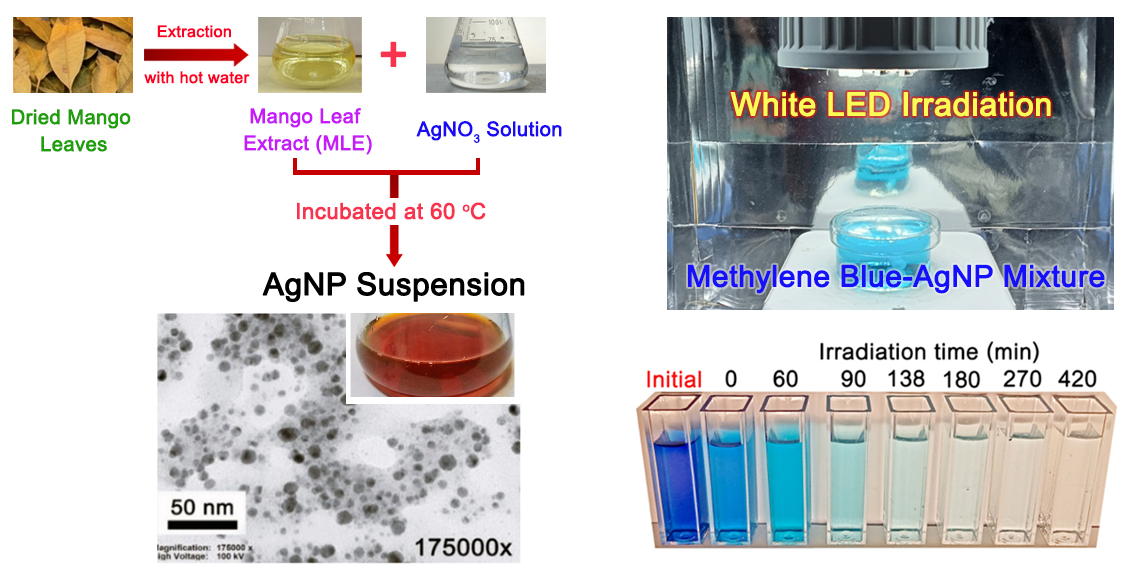
Background and Objectives : Silver nanoparticles (AgNPs) have been widely studied owing to their distinctive optical and catalytic properties, which enable applications in antimicrobial treatment, sensing, and environmental remediation. In particular, AgNPs have attracted growing interest as photocatalysts for the degradation of organic dyes in wastewater under light irradiation, due to their strong surface plasmon resonance (SPR) and their ability to promote the formation of reactive oxygen species. Nevertheless, conventional AgNP synthesis methods frequently employ hazardous chemical reducing agents and stabilizers, raising concerns regarding environmental impact, safety, and sustainability. Consequently, green synthesis strategies based on plant-derived extracts have emerged as promising alternatives, utilizing naturally occurring phytochemicals as reducing and stabilizing agents. Mango (Mangifera indica) leaves are an abundant agricultural byproduct in Thailand and contain high levels of polyphenolic compounds, particularly mangiferin, which exhibit strong reducing and antioxidant activities. Despite this potential, systematic studies on the formation kinetics of mango leaf extract (MLE)–mediated AgNPs and their photocatalytic performance under practical, low-energy light sources remain limited. Therefore, this study aimed to develop an environmentally friendly synthesis route for AgNPs using MLE, to investigate the effects of key synthesis parameters on AgNP formation kinetics, and to evaluate the applicability of the synthesized AgNPs for photocatalytic degradation of methylene blue (MB) in aqueous solutions under white LED and solar irradiation.
Methodology : MLE was prepared using deionized water as the sole extraction solvent to ensure a simple, non-toxic, and environmentally benign process compatible with aqueous silver precursor solutions. AgNPs were synthesized via the reduction of Ag+ ions from AgNO3 using MLE under systematically varied experimental conditions, including incubation temperature (20–60 °C), AgNO3 concentration (1–7 mM), MLE volume fraction (1–30% v/v), and pH (3–11), in order to elucidate their effects on reduction kinetics, nanoparticle formation, and photocatalyst preparation. The formation of AgNPs was monitored by UV–Vis spectrophotometry through the time-dependent evolution of the SPR absorption band. Kinetic data were analyzed using a pseudo-first-order model, and observed rate constants were obtained by nonlinear curve fitting. Temperature-dependent rate constants were further examined using Arrhenius and Eyring analyses to determine activation energies and thermodynamic activation parameters. The synthesized AgNPs were characterized by Fourier-transform infrared spectroscopy (FTIR), transmission electron microscopy (TEM), scanning electron microscopy (SEM), X-ray diffraction (XRD), and X-ray fluorescence spectroscopy (XRF) to evaluate functional group involvement, morphology, crystalline structure, and elemental composition. Photocatalytic performance was evaluated by monitoring methylene blue (MB) degradation under white LED irradiation (30 W and 60 W) and natural solar irradiation. The effects of AgNP dosage and initial MB concentration on removal efficiency were systematically investigated, and degradation kinetics were analyzed using a pseudo-first-order model. All photocatalytic experiments were carried out under identical geometric configurations to ensure consistent light exposure. Prior to irradiation, reaction mixtures were magnetically stirred in the dark to establish adsorption–desorption equilibrium between MB molecules and AgNP surfaces. Control experiments conducted in the absence of AgNPs confirmed negligible photolysis of MB under the applied irradiation conditions throughout all experiments.
Main Results : UV–Vis spectrophotometric analysis confirmed successful AgNP formation by the appearance and progressive increase of a characteristic SPR band at approximately 425 nm, accompanied by a visible color change of the reaction mixture from yellow to reddish-brown. The formation kinetics followed a pseudo-first-order model with high coefficients of determination (R² > 0.99). Increasing incubation temperature resulted in higher observed rate constants, indicating a thermally activated reduction process. Arrhenius and Eyring analyses yielded similar activation energies of approximately 27 kJ mol-1, suggesting efficient reduction of Ag+ ions by MLE-derived phytochemicals. FTIR spectra revealed a decrease in O–H stretching intensity along with both an increase in intensity and a shift of the C=O stretching band, indicating oxidation of phenolic groups during Ag+ reduction and possible interaction of carbonyl groups with the AgNP surface. TEM analysis showed predominantly quasi-spherical, well-dispersed AgNPs with a narrow size distribution and an average diameter of 8.56 ± 1.61 nm. XRD analysis confirmed a single-phase crystalline face-centered cubic silver structure, while XRF analysis indicated a high silver content of approximately 94.6 wt%. In photocatalytic experiments, MB removal efficiency increased with increasing AgNP dosage and decreased with increasing initial MB concentration due to competitive adsorption and light screening effects. Under optimal conditions (1.5 mg L-1 MB, 3% v/v AgNP dosage, and 60 W white LED irradiation), near-complete MB removal (99.9%) was achieved within 420 min. Effective MB degradation was also observed under solar irradiation, demonstrating photocatalytic activity under low-energy light sources.
Conclusions : This study demonstrates that mango leaf extract can serve as an efficient and environmentally friendly bioreducing and stabilizing agent for silver nanoparticle synthesis. The MLE-mediated AgNPs exhibited favorable formation kinetics, well-defined nanoscale characteristics, and high photocatalytic efficiency toward methylene blue degradation under both white LED and solar irradiation, highlighting their potential for sustainable wastewater treatment applications.
References
Almatroudi, A. (2020). Silver nanoparticles: synthesis, characterization and biomedical applications. Open Life Sciences, 15(1), 819-839.
Al-Zaban, M.I, Mahmoud, M.A., & AlHarbi, M.A. (2021). Catalytic degradation of methylene blue using silver nanoparticles synthesized by honey. Saudi Journal of Biological Sciences, 28, 2007-2013.
Arulnangai, R., Ganesamoorthy, R., Mohamed, V. B. H., Vivekanand, P. A., Kavitha, P., Kavitha, P., & Thirugnanasambandham, K. (2025). Green synthesis of silver nanoparticles from Centella asiatica and its application in photodegradation of methylene blue dye in paper industry effluent. Cleaner Water, 4, 100179(1-8).
Chewchinda, S., Suriyaphan, O., Kanchanadumkerng, P., Sato, H., & Hirunpanich Sato, V. (2021). Comparison of Antioxidant and -glucosidase inhibitory activities in different cultivars of five mango (Mangifera Indica L.) leaf extracts. Chiang Mai University Journal of Natural Sciences, 20(1), e2021014(1-16).
Ewais, H. A. (2014). Kinetics and mechanism of the formation of silver nanoparticles by reduction of silver (I) with maltose in the presence of some active surfactants in aqueous medium. Transition Metal Chemistry, 39, 487–493.
Foud, A., Awad, M. A., AL-Faifi, Z. E., Gad, M. E., Al-Khalaf, A. A., Yahya, R., & Hamza, M. F. (2022) Aspergillus flavus-mediated green synthesis of silver nanoparticles and evaluation of their antibacterial, anti- candida, acaricides, and photocatalytic activities. Catalysts, 12, 462(1-19).
Gebre, S. H. (2023). Bio-inspired synthesis of metal and metal oxide nanoparticles: the key role of phytochemicals. Journal of Cluster Science, 34, 665-704.
Ghasemi, Z., Younesi, H., & Zinatizadeh, A. A. (2016). Kinetics and thermodynamics of photocatalytic degradation of organic pollutants in petroleum refinery wastewater over nano-TiO2 supported on Fe-ZSM-5. Journal of the Taiwan Institute of Chemical Engineers, 65, 357-366.
Kumar, I., Gangwar, C., Yaseen, B., Pandey, P. K., Mishra, S. K. , & Naik, R. M. (2022). Kinetic and mechanistic studies of the formation of silver nanoparticles by nicotinamide as a reducing agent. ACS Omega, 7(16), 13778–13788.
Lia, J. F., Liu, Y.-C., Chokkalingam, M., Rupa, E. J., Mathiyalagan, R., Hurh, J., Ahn, J. C., Park, J. K., Pu, J. Y., & Yang, D. C. (2020). Phytosynthesis of silver nanoparticles using rhizome extract of Alpinia officinarum and their photocatalytic removal of dye under UV and visible light irradiation. Optik, 208, 164521(1-7).
Liu, Q., Gao, M.-R., Liu, Y., Okasinski, J. S., Ren, Y., & Sun, Y. (2016). Quantifying the nucleation and growth kinetics of microwave nanochemistry enabled by in situ high-energy x-ray scattering. Nano Letters, 16(1), 715–720.
Marimuthu, S., Antonisamy, A. J., Malayandi, S., Rajendran, K., Tsai, P.-C., Pugazhendhi, A., & Ponnusamy, V. K. (2020). Silver nanoparticles in dye effluent treatment: A review on synthesis, treatment methods, mechanisms, photocatalytic degradation, toxic effects and mitigation of toxicity. Journal of Photochemistry and Photobiology B: Biology, 205, 111823(1–13).
Martínez, A., Hernández-Marin, E., & Galano, A. (2012). Xanthones as antioxidants: A theoretical study on the thermodynamics and kinetics of the single electron transfer mechanism. Food & Function, 3, 442–450.
Mushran, S. P., Agrawal, M. C., Mehrotra, R. M., & Sanehi, R. (1974). Kinetics and mechanism of reduction of silver (I) by ascorbic acid. Journal of the Chemical Society, Dalton Transactions, 14, 1460–1462.
Oladoye, P. O., Ajiboye, T. O., Omotola, E. O., & Oyewola, O. J. (2022). Methylene blue dye: Toxicity and potential elimination technology from wastewater. Results in Engineering, 16, 100678(1-17).
Pardo-Andreu, G. L., Cavalheiro, R. A., Dorta, D. J., Naal, Z., Delgado, R., Vercesi, A. E., & Curti, C. (2007). Fe(III) shifts the mitochondria permeability transition-eliciting capacity of mangiferin to protection of organelle. Journal of Pharmacology and Experimental Therapeutics, 320(2), 646–653.
Tooba, Assad, N., Laila, M.B., Iqbal, R.M.F., Manahil, L., Iqbal, J., Naeem-ul-Hassan, M., Khuram, A., Assad, Y., Khan, M.N., Hussain, S., Kaplan, A., Al-Mohaimeed, A.M. ,& Abid, I. (2026). Green synthesis of silver nanoparticles using Solanum lycopersicum leaves extract for highly selective detection of mercury ions and photocatalytic degradation of methylene blue. Discover Nano, 21(14), 1-31.
Trieu, Q.-A., Le, C. T. B., Pham, C. M., & Bui, T. H. (2023). Photocatalytic degradation of methylene blue and antibacterial activity of silver nanoparticles synthesized from Camellia sinensis leaf extract. Journal of Experimental Nanoscience, 18(1), 2225759(1-18).
Vo, T. H. T., Nguyen, T. D., Nguyen, Q.H., & Ushakova, N. A. (2017). Extraction of mangiferin from the leaves of the mango tree Mangifera indica and evaluation of its biological activity in terms of blockade of alpha-glucosidase. Pharmaceutical Chemistry Journal, 51(9), 806–810.
Yuwono, A. H., Septiningrum, F., Dhaneswara, D., Sofyan, N., Suwartha, N., Lalasari, L. H., Maulana, F. A., Nurhidayah, E., & Barep, A. L. (2024). Investigation of methylene blue dye degradation using green synthesized mesoporous silver-titanium. South African Journal of Chemical Engineering, 50, 415–426.
Downloads
Published
How to Cite
Issue
Section
License
Copyright (c) 2026 Faculty of Science, Burapha University

This work is licensed under a Creative Commons Attribution-NonCommercial-NoDerivatives 4.0 International License.
Burapha Science Journal is licensed under a Creative Commons Attribution-NonCommercial-NoDerivatives 4.0 International (CC BY-NC-ND 4.0) licence, unless otherwise stated. Please read our Policies page for more information