
A Hybrid Safeguarded Quasi-Newton Method for Nonlinear Systems with Engineering Applications
Keywords:
Hybrid quasi-Newton method, Broyden-type algorithm, Nonlinear equation systemsAbstract
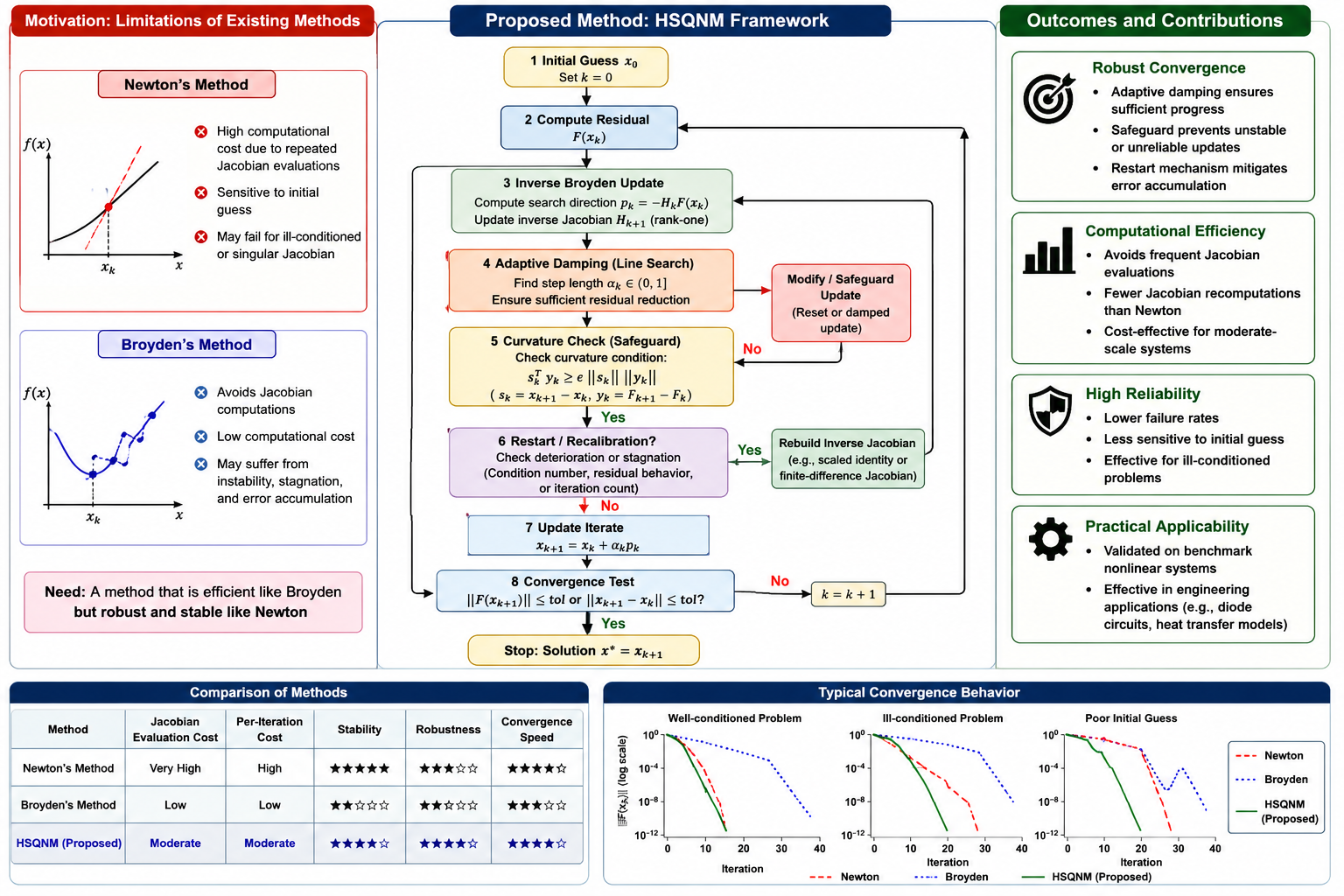
Background and Objectives: Nonlinear systems of equations arise extensively in engineering, applied physics, computational science, economics, and industrial process modeling. Accurate and efficient numerical techniques for solving such systems are therefore essential in many scientific and engineering applications. Classical Newton’s method remains one of the most widely used approaches because of its rapid local quadratic convergence. However, its implementation requires repeated evaluations and factorizations of the Jacobian matrix at every iteration, which can become computationally expensive for large-scale or moderately complex nonlinear systems. In addition, Newton’s method is highly sensitive to the choice of initial approximations and may fail to converge when the Jacobian matrix is singular, ill-conditioned, or poorly approximated near the solution. To reduce computational cost, quasi-Newton methods such as Broyden’s method replace exact Jacobian evaluations with low-rank matrix updates. These methods significantly improve efficiency by avoiding repeated Jacobian computations, making them attractive for practical applications involving expensive function evaluations. Nevertheless, classical Broyden-type methods may experience instability, stagnation, inaccurate search directions, and error accumulation due to progressive deterioration of the inverse Jacobian approximation during the iterative process. Such difficulties often reduce convergence reliability, particularly for strongly nonlinear or ill-conditioned problems. Motivated by these limitations, this study proposes a Hybrid Safeguarded Quasi-Newton Method (HSQNM) that combines the efficiency of quasi-Newton updates with additional stabilization and safeguarding mechanisms to improve robustness, reliability, and overall convergence performance.
Methodology: The proposed HSQNM integrates an inverse Broyden rank-one update with three complementary stabilization components: adaptive damping, curvature-based safeguarding, and restart-based recalibration. The adaptive damping mechanism dynamically adjusts the step length according to the behavior of the nonlinear residual, ensuring sufficient residual reduction and preventing excessively large iterative steps that may lead to divergence. A curvature-monitoring criterion is incorporated to detect unstable or unreliable updates when the secant condition becomes nearly degenerate or when the approximate inverse Jacobian loses numerical quality. Under such conditions, a safeguarding strategy modifies the update process to maintain stability and improve descent behavior. Furthermore, a restart mechanism is introduced to periodically reconstruct the inverse Jacobian approximation whenever deterioration or stagnation is detected. This recalibration process reduces accumulated numerical errors and restores the quality of the iterative search direction. Theoretical analysis of the proposed method is developed under standard assumptions of Lipschitz continuity and nonsingularity of the Jacobian matrix in a neighborhood of the exact solution. Local convergence properties are established to demonstrate that the proposed hybrid strategy preserves the desirable convergence characteristics of quasi-Newton methods while improving robustness in challenging nonlinear regimes.
Main Results: To evaluate the effectiveness of the proposed algorithm, numerical experiments were conducted on a collection of benchmark nonlinear systems together with several engineering applications involving nonlinear mathematical models. The benchmark problems include systems with varying dimensions, nonlinearities, and conditioning characteristics to examine both efficiency and stability. Performance comparisons were carried out against the classical Broyden method and Newton’s method using metrics such as iteration count, residual norm reduction, Jacobian evaluations, computational cost, and convergence success rate. The numerical results demonstrate that HSQNM consistently achieves lower failure rates and improved convergence stability compared with the classical Broyden method. In many test problems, the proposed approach required fewer Jacobian recalculations while maintaining accurate convergence behavior. The adaptive damping strategy was particularly effective in preventing divergence for poor initial guesses, whereas the restart mechanism successfully mitigated stagnation caused by inaccurate inverse Jacobian approximations. Additional experiments on engineering nonlinear systems, including diode circuit analysis and radiative heat transfer models, further confirmed the practical applicability of the proposed method. In these applications, HSQNM achieved convergence accuracy comparable to Newton’s method but with reduced computational expense and improved robustness. The results also indicate that the safeguarding framework enhances reliability for ill-conditioned systems where traditional quasi-Newton methods may fail or exhibit unstable iterative behavior.
Conclusions: The proposed Hybrid Safeguarded Quasi-Newton Method provides a reliable and computationally efficient framework for solving moderate-scale nonlinear systems arising in engineering and scientific applications. By integrating adaptive damping, curvature-based safeguarding, and restart-based recalibration into the inverse Broyden update process, the method improves convergence robustness without sacrificing the computational advantages of quasi-Newton techniques. Numerical experiments demonstrate that the proposed approach offers better stability, lower failure rates, and competitive computational performance compared with classical Broyden-type methods. Moreover, the method retains convergence accuracy comparable to Newton’s method while reducing the frequency of expensive Jacobian evaluations. The flexibility of the hybrid safeguarding framework also suggests potential extensions to large-scale sparse nonlinear systems, optimization-based nonlinear solvers, and parallel scientific computing applications. Consequently, HSQNM represents a promising alternative for practical nonlinear system solving in modern computational engineering and applied mathematics.
References
Bollhöfer, M., Saad, Y., & Schenk, O. (2019). ILUPACK—Preconditioners for large-scale nonlinear systems. SIAM Journal on Scientific Computing, 41(2), A1141–A1168. https://doi.org/10.1137/18M1184604
Broyden, C. G. (1965). A class of methods for solving nonlinear simultaneous equations. Mathematics of Computation, 19(92), 577–593. https://doi.org/10.1090/S0025-5718-1965-0198670-6
Dennis, J. E., Jr., & Moré, J. J. (1977). Quasi-Newton methods, motivation and theory. SIAM Review, 19(1), 46–89. https://doi.org/10.1137/1019005
Dennis, J. E., Jr., & Schnabel, R. B. (1996). Numerical methods for unconstrained optimization and nonlinear equations. SIAM. https://doi.org/10.1137/1.9781611971200
Fang, H., & Saad, Y. (2009). Two classes of multisecant methods for nonlinear acceleration. Numerical Linear Algebra with Applications, 16(3), 197–221. https://doi.org/10.1002/nla.617
Gao, W., & Goldfarb, D. (2019). Superlinear convergence of a modified BFGS-type method for nonlinear equations. Computational Optimization and Applications, 72(1), 1–23. https://doi.org/10.1007/s10589-018-0053-4
Gratton, S., Toint, P. L., & Vicente, L. N. (2015). On the complexity of the global optimization of nonlinear systems. SIAM Journal on Optimization, 25(2), 1179–1195. https://doi.org/10.1137/140984758
Kelley, C. T. (2003). Solving nonlinear equations with Newton’s method. SIAM. https://doi.org/10.1137/1.9780898718898
Knoll, D. A., & Keyes, D. E. (2004). Jacobian-free Newton–Krylov methods: A survey of approaches and applications. Journal of Computational Physics, 193(2), 357–397. https://doi.org/10.1016/j.jcp.2003.08.010
Liu, D., & Yuan, Y. (2017). A modified damped quasi-Newton method for nonlinear systems. Applied Mathematics and Computation, 298, 195–207. https://doi.org/10.1016/j.amc.2016.11.040
Nocedal, J., & Wright, S. J. (2006). Numerical optimization (2nd ed.). Springer. https://doi.org/10.1007/978-0-387-40065-5
Ortega, J. M., & Rheinboldt, W. C. (1970). Iterative solution of nonlinear equations in several variables. Academic Press.
Ulbrich, M. (2011). Semismooth Newton methods for variational inequalities and constrained optimization problems. SIAM. https://doi.org/10.1137/1.9781611970692
Downloads
Published
How to Cite
Issue
Section
License
Copyright (c) 2026 Faculty of Science, Burapha University

This work is licensed under a Creative Commons Attribution-NonCommercial-NoDerivatives 4.0 International License.
Burapha Science Journal is licensed under a Creative Commons Attribution-NonCommercial-NoDerivatives 4.0 International (CC BY-NC-ND 4.0) licence, unless otherwise stated. Please read our Policies page for more information