
Development of Dual-Layer Paving Blocks Using Waste Plastic as Aggregate Replacement with the Potential to Mitigate Microplastic Emissions
Keywords:
paving blocks, microplastic, dual-layer molding, aggregate replacement material, sustainable developmentAbstract
Background and Objectives: The escalating global crisis of post-consumer plastic waste has driven the development of innovative solutions and strategic approaches across various sectors. In the field of construction materials, although the incorporation of plastic fragments as a partial aggregate replacement has gained a degree of acceptance, the environmental risks associated with the dispersal of secondary In the field of construction materials, although incorporating plastic fragments as a partial aggregate replacement has gained a degree of acceptance, the problem of the release of secondary microplastics induced by physical degradation and ultraviolet radiation has attracted increasing attention, posing long-term environmental risks during practical implementation. Consequently, this research studies the materials science and engineering feasibility and environmental safety of producing dual-layer paving blocks that utilize recycled plastic waste as a partial aggregate substitute. The primary objective is to develop a paving block with the potential to mitigate these environmental hazards through a specialized structural design: an inner core containing plastic waste is encapsulated within a high performance, plastic-free outer concrete shell. This design specifically aims to prevent the release of plastic fragments or microplastics into the ecosystem while ensuring that the physical and mechanical properties comply with the specified Thai industrial standards.
Methodology: The experimental program was divided into two sections. The first section consisted of three phases aimed at determining the optimal mix proportions to produce paving blocks, ensuring that the specimens achieved mechanical and physical properties in compliance with the Thai Industrial Standard for concrete paving blocks (TIS 827-2531). Phase 1 was a foundational study conducted to evaluate the influence of aggregate grading (fine sand and coarse sand) on the compressive strength of hydraulic cement mortar. In Phase 2, a polycarboxylate-type superplasticizer was introduced to refine the structure, optimizing the physical characteristics and workability required for the manual compaction molding process. In Phase 3, aggregates were partially replaced with three types of plastic waste, including low-density polyethylene (LDPE), high-density polyethylene (HDPE), and polyethylene terephthalate (PET), at replacement ratios of 1.67% and 3.33% by weight of the total aggregate, investigating two particle size ranges: small (less than 5 mm) and large (5 – 15 mm). The second section of the research focused on the production process using the manual hand press technique, involving a comparative analysis of two distinct dual-layer molding approaches: (1) Sequential Casting, where the inner core was molded and cured to harden before being encased in the outer layer, and (2) Simultaneous Casting, a technique where both the inner and outer layers were consolidated and compressed concurrently. Test specimens were cured for 7 and 28 days and were analyzed using compressive strength testing according to ASTM C109/C109M, water absorption testing with TIS 109-2517, and microstructural analysis using Scanning Electron Microscopy (SEM) to investigate the interfacial bonding between the plastic fragments and the cement matrix.
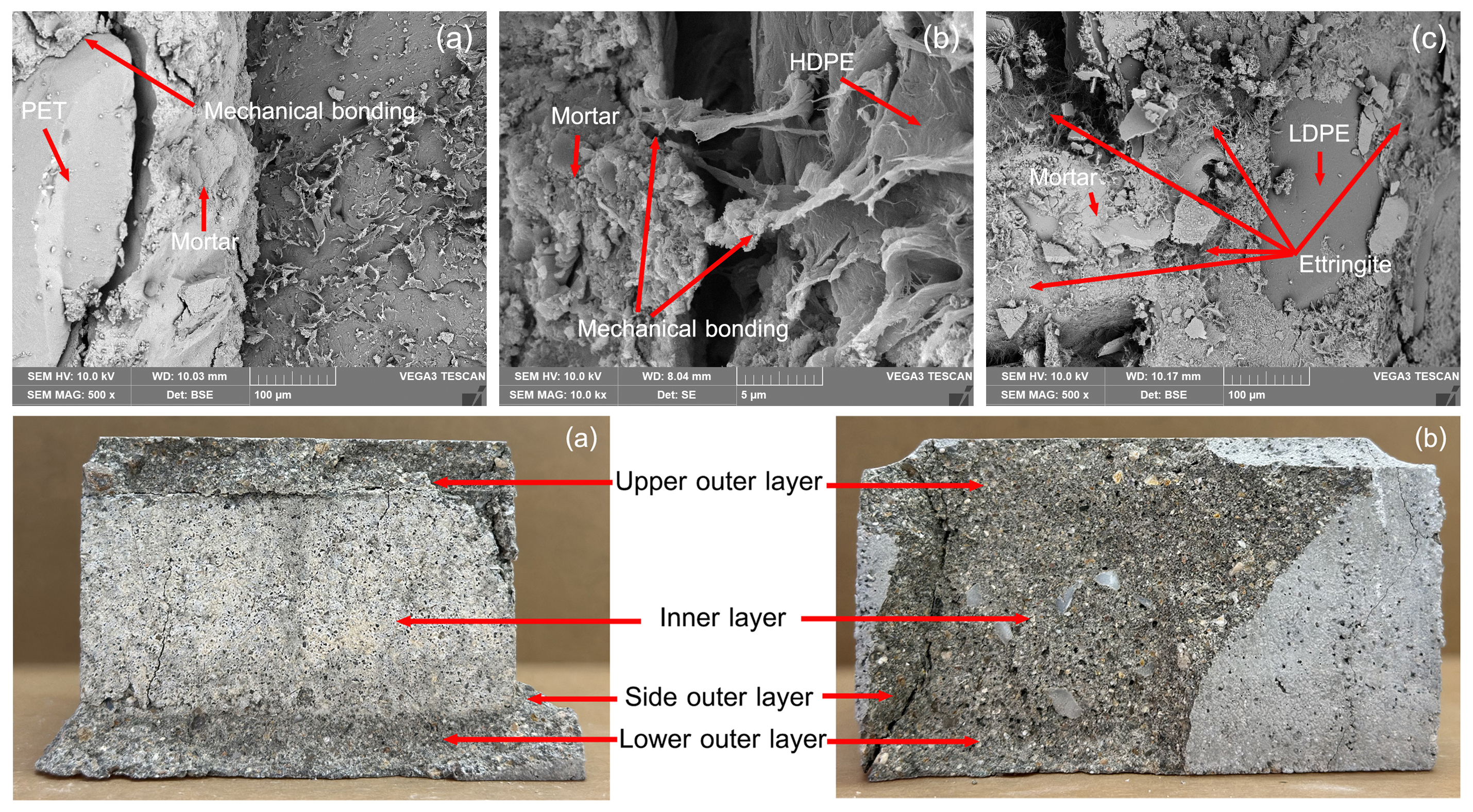
Main Results: The results of the mix proportion evaluation phase indicated that the optimal weight ratio for the outer layer (plastic free) was hydraulic cement : water : coarse sand : superplasticizer at 1:0.35:3.00:0.007, which yielded the maximum compressive strength of 508.6 ksc at 28 days of curing. Regarding the influence of aggregate replacement with waste plastic, mechanical properties exhibited a continuous decreasing trend as the replacement content increased from 1.67% to 3.33% by weight of aggregate. The morphology and size of the plastic types played a crucial role in mechanical performance; specifically, specimens containing HDPE and PET shredded plastics with particle sizes smaller than 5 mm achieved higher compressive strength than those with larger sizes (5 – 15 mm) due to uniform dispersion within the matrix. Conversely, specimens incorporating LDPE plastic exhibited average compressive strengths below the minimum standard requirements across all mix proportions, with microstructural analysis revealing large voids and a high accumulation of needle-like shape of Ettringite. In the comparison of fabrication techniques for the dual-layer concrete paving blocks, where the inner layer utilized HDPE and PET plastics as aggregate replacement at 3.33% by weight of the outer layer mix, it was found that blocks manufactured via sequential casting encountered cold joint issues, leading to defects and interfacial delamination. Conversely, specimens fabricated through simultaneous casting effectively developed a monolithic bond. Consequently, the simultaneously cast dual-layer concrete paving blocks developed high compressive strengths of 481.6 ksc and 499.2 ksc, respectively, along with water absorption rates of 4.4% and 3.7%, respectively, both of which are below 5% and fully comply with the specified industrial standards.
Conclusions: This research demonstrates that the development of dual-layer paving blocks is an effective and viable approach for incorporating plastic waste into construction materials. Both the quantity and size of plastic fragments significantly influence the mechanical properties of the specimens, with HDPE and PET identified as the most suitable materials for aggregate replacement. The simultaneous casting technique is the optimal method for fabricating dual-layer paving blocks, as it eliminates the weak interfacial planes in the structure. Furthermore, the outer layer of the dual-layer structure serves as a protective barrier, shielding the plastic fragments from main degradation factors, such as abrasion and ultraviolet radiation, during practical applications. Adhering to Circular Economy principles, this research transforms plastic waste into high value, standardized construction products, fostering sustainable development that not only reduces plastic waste volume but also effectively possesses the potential to prevent microplastic pollution within the ecosystem
References
American Society for Testing and Materials. (2008). ASTM C33-08: Standard Specifications for Concrete Aggregates. Annual book of ASTM standards 2008, West Conshohocken, PA, USA.
American Society for Testing and Materials. (2014). ASTM C136/136M: Standard Test Method for Sieve Analysis of Fine and Coarse Aggregates. Annual book of ASTM standards 2014, West Conshohocken, PA, USA.
American Society for Testing and Materials. (2021). ASTM C109/C109M: Standard test method for compressive strength of hydraulic cement mortars. (using 2-in. or [50 mm] cube specimens). Annual book of ASTM standards 2021. West Conshohocken, PA, USA.
Beushausen, H., & Alexander, M. G. (2008). Bond strength development between concretes of different ages. Magazine of Concrete Research, 60(1), 65-74. https://doi.org/10.1680/macr.2007.00108
CPAC Concrete Academy (2000). Concrete Technology. https://www.cpacacademy.com/index.php?tpid=0063 (in Thai)
Crawford, C. B., & Quinn, B. (2017). Microplastics, standardisation and spatial distribution. Microplastic Pollutants. 101-130. https://doi.org/10.1016/B978-0-12-809406-8.00005-0
Ghuge, J., Surale, S., Patil, B. M., & Bhutekar, S. B. (2019). Utilization of waste plastic in manufacturing of paver blocks. System, 6(04), 1967-1970.
Janpetch, N., & Kokkamhaeng, W. (2016). The test ofthe compressive strength of aninterlockingblockofThailand. RMUTSB Academic Journal, 4(2), 196–206. (in Thai)
Khamput, P., Haruehansapong, S., Sittigool, W., Prasertsri, T., Yoddumrong, P., & Sanit-in, P. (2024). Development of Paving Interlocking Block from Plastic Bottle Wastes with Dust Stone. The Journal of KMUTNB, 34(3), 1–13. (in Thai)
Ministry of Industry. (2022). Ministry of Industry Announcement No. 6819 (B.E. 2565) on hydraulic cement as an industrial material for concrete and cement product group. https://www.tisi.go.th/data/news/139_282_1110166.pdf. (in Thai)
Office of Natural Resources and Environmental Policy and Planning. (2023). Thailand state of environment report 2023 (pp. 264–265). Ministry of Natural Resources and Environment. https://www.onep.go.th/book/soe2566/ (in Thai)
Panyayong., P. (2025). Plastic waste. Office of Natural Resources and Environmental Policy and Planning. Retrieved February 8, 2025, https://www.onep.go.th/ขยะพลาสติก (in Thai)
Phatthara, K., Surasak, N., Thanagrit, N., Arnuwat, P. (2022). Interlocking Brick with Plastic Scrap. Industrial Technology Journal, 7(2), 137-148. https://doi.org/10.14456/journalindus.2022.19. (in Thai)
Pollution Control Department. (2021). Policy on waste reduction and segregation in government agencies (Workshop on implementation guidelines for waste reduction and segregation measures in government agencies, fiscal year 2022). https://www.pcd.go.th/wp-content/uploads/2021/11/pcdnew-2021-11-23_08-29-17_914529.pdf. (in Thai)
Prasittisopin, L., Ferdous, W., & Kamchoom, V. (2023). Microplastics in construction and built environment. Developments in the Built Environment, 15, 100188. https://doi.org/10.1016/j.dibe.2023.100188
Rummel, C. D., Jahnke, A., Gorokhova, E., Kühnel, D., & Schmitt-Jansen, M. (2017). Impacts of Biofilm Formation on the Fate and Potential Effects of Microplastic in the Aquatic Environment. Environmental Science & Technology Letters, 4(7), 258-267.https://doi.org/10.1021/acs.estlett.7b00164
Saikia, N., & de Brito, J. (2012). Use of plastic waste as aggregate in cement mortar and concrete preparation: A review. Construction and Building Materials, 34, 385–401. https://doi.org/10.1016/j.conbuildmat.2012.02.066
Saikia, N., & de Brito, J. (2014). Mechanical properties and abrasion behaviour of concrete containing shredded PET bottle waste as a partial substitution of natural aggregate. Construction and Building Materials, 52, 236-244. https://doi.org/10.1016/j.conbuildmat.2013.11.049
Sarang, G. (2019). Replacement of stabilizers by recycling plastic in asphalt concrete. In F. Pacheco-Torgal, J. Khatib, F. Colangelo, & R. Tuladhar (Eds.), Use of recycled plastics in eco-efficient concrete (pp. 307–325). Woodhead Publishing. https://doi.org/10.1016/B978-0-08-102676-2.00014-1
Sripumun, A., Cheerarot, R., & Chaimoon, K. (2016). The Effect of Superplasticizer on the Physical Properties of Cellular Concrete Containing Bottom Ash. Journal of Industry Technology Lampang Rajabhat University, 9(1), 116–127. (in Thai)
Suweero, K., & Khamput, P. (2020). Development of Interlocking Concrete Paving Block Product Mixed with Colored Polyethylene Terephthalate Plastic Bottle from Post-Consumer Waste. Journal of Engineering, RMUTT, 18(1), 81-90.
Thai Industrial Standards Institute (TISI). (1974). Standard methods for sampling and testing of masonry materials made of concrete (TIS 109-1974). Bangkok. (in Thai)
Thai Industrial Standards Institute (TISI). (1982). Methods of test for compressive strength of concrete specimens (TIS 409-1982). Bangkok. (in Thai)
Thai Industrial Standards Institute (TISI). (1988). Concrete paving blocks (TIS 827-1988). Bangkok. (in Thai)
Thai Industrial Standards Institute (TISI). (2000). Interlocking concrete paving blocks for heavy-duty use (TIS 2035-2000). Bangkok. (in Thai)
Thai Industrial Standards Institute (TISI). (2016). Standard Practice for Mechanical Mixing of Hydraulic Cement Pastes and Mortars of Plastic Consistency (TIS 2752 Part 17). Bangkok. (in Thai)
Waroonkun, T., Puangpinyo, T., & Tongtuam, Y. (2017). The Development of a Concrete Block Containing PET Plastic Bottle Flakes. Journal of Sustainable Development, 10, 186.
Zhang, K., Hamidian, A. H., Tubić, A., Zhang, Y., Fang, J. K. H., Wu, C., & Lam, P. K. S. (2021). Understanding plastic degradation and microplastic formation in the environment: A review. Environmental Pollution, 274, 1-14. https://doi.org/10.1016/j.envpol.2021.116554.
Downloads
Published
How to Cite
Issue
Section
License
Copyright (c) 2026 Faculty of Science, Burapha University

This work is licensed under a Creative Commons Attribution-NonCommercial-NoDerivatives 4.0 International License.
Burapha Science Journal is licensed under a Creative Commons Attribution-NonCommercial-NoDerivatives 4.0 International (CC BY-NC-ND 4.0) licence, unless otherwise stated. Please read our Policies page for more information