
การพัฒนาเทคนิคการขยายพันธุ์เอื้องเข็มแดง กล้วยไม้หายากในสภาพปลอดเชื้อ
คำสำคัญ:
เอื้องเข็มแดง, ออกซิน, ไซโทไคนิน, ไคโทซาน, การเพาะเลี้ยงเนื้อเยื่อพืชบทคัดย่อ
วัตถุประสงค์และที่มา : ประเทศไทยเป็นแหล่งทรัพยากรทางชีวภาพที่สำคัญของโลก เนื่องจากตั้งอยู่บนรอยต่อเขตการกระจายพันธุ์ของพืชจาก 3 ภูมิภาค ได้แก่ อินโดจีน อินโด-มลายัน และอินโด-เบอร์มีส ส่งผลให้เกิดความหลากหลายของทรัพยากรธรรมชาติ โดยเฉพาะอย่างยิ่งพืชในวงศ์กล้วยไม้ นับเป็นหนึ่งในกลุ่มพืชที่มีความสำคัญทั้งในเชิงนิเวศวิทยาและเศรษฐกิจมากที่สุดกลุ่มหนึ่ง เอื้องเข็มแดงเป็นกล้วยไม้อิงอาศัยที่มีลักษณะดอกโดดเด่นสะดุดตาและกำลังเผชิญกับสถานการณ์ที่เปราะบางต่อการสูญพันธุ์ ซึ่งปัจจุบันถูกจัดเป็นพืชหายากในประเทศไทย และมีรายงานการลดลงของประชากรในธรรมชาติอย่างรวดเร็ว สาเหตุหลักเกิดจากการเปลี่ยนแปลงของสภาพภูมิอากาศ การรุกรานถิ่นที่อยู่อาศัย และการลักลอบค้าอย่างต่อเนื่อง ด้วยเหตุนี้การขยายพันธุ์ให้ได้ปริมาณมากในระยะเวลาอันสั้น จึงมีความจำเป็นอย่างยิ่ง การศึกษานี้ จึงมีวัตถุประสงค์เพื่อทดสอบปัจจัยต่าง ๆ ที่มีผลต่อการขยายพันธุ์ต้นกล้าเอื้องเข็มแดงในสภาพปลอดเชื้อ ได้แก่ 1) ประสิทธิภาพของสูตรอาหารพื้นฐานชนิดต่าง ๆ 2) ผลของสารควบคุมการเจริญเติบโตในกลุ่มออกซินและไซโทไคนิน และ 3) ผลของไคโทซาน เพื่อเพิ่มจำนวนต้นอ่อนให้ได้ปริมาณมาก ประกอบกับยังไม่มีรายงานการศึกษาถึงปัจจัยดังกล่าวมาก่อน จึงเป็นที่มาของการวิจัยในครั้งนี้ ซึ่งจะเป็นการส่งเสริมการอนุรักษ์พันธุกรรมของเอื้องเข็มแดงให้คงอยู่ต่อไป
วิธีดำเนินการวิจัย : ใช้ต้นกล้าเอื้องเข็มแดงที่ได้จากการเพาะเมล็ดในสภาพปลอดเชื้อมาขยายพันธุ์ การทดลองที่ 1: ศึกษาผลของอาหารพื้นฐาน 4 สูตร ได้แก่ VW, ½VW, MS และ ½MS เพื่อหาสูตรอาหารที่เหมาะสมต่อการเจริญเติบโตที่สุด การทดลองที่ 2: นำสูตรอาหารพื้นฐานที่ดีที่สุดจากการทดลองแรก เสริมด้วยสารกลุ่มออกซิน ได้แก่ NAA, IAA และ IBA ที่ความเข้มข้น 0, 0.1, 0.5, 1.0 และ 2.0 มิลลิกรัมต่อลิตร เพื่อเปรียบเทียบการเจริญของแต่ละสูตรอาหาร การทดลองที่ 3: ใช้ช่วงความเข้มข้นเดียวกันกับการทดลองที่ 2 แต่เปลี่ยนเป็นกลุ่มไซโทไคนิน ได้แก่ BA, Kinetin และ TDZ และการทดลองที่ 4: ศึกษาผลของไคโทซานในการกระตุ้นการเจริญเติบโต ใช้สูตรอาหารที่ดีที่สุดจากการทดลองที่ 1 จากนั้นเติมไคโทซานลงในอาหารพื้นฐานสูตรที่เหมาะสม ที่ระดับความเข้มข้นตั้งแต่ 0 ถึง 100 มิลลิกรัมต่อลิตร (เพิ่มทีละ 10 มิลลิกรัมต่อลิตร) เพื่อระบุความเข้มข้นที่มีประสิทธิภาพสูงสุดในการส่งเสริมคุณภาพและปริมาณของต้นกล้า การทดลองทั้งหมดดำเนินการภายใต้สภาวะแวดล้อมที่ควบคุมได้ พร้อมทั้งมีการติดตามตรวจสอบพารามิเตอร์การเจริญเติบโตอย่างสม่ำเสมอ
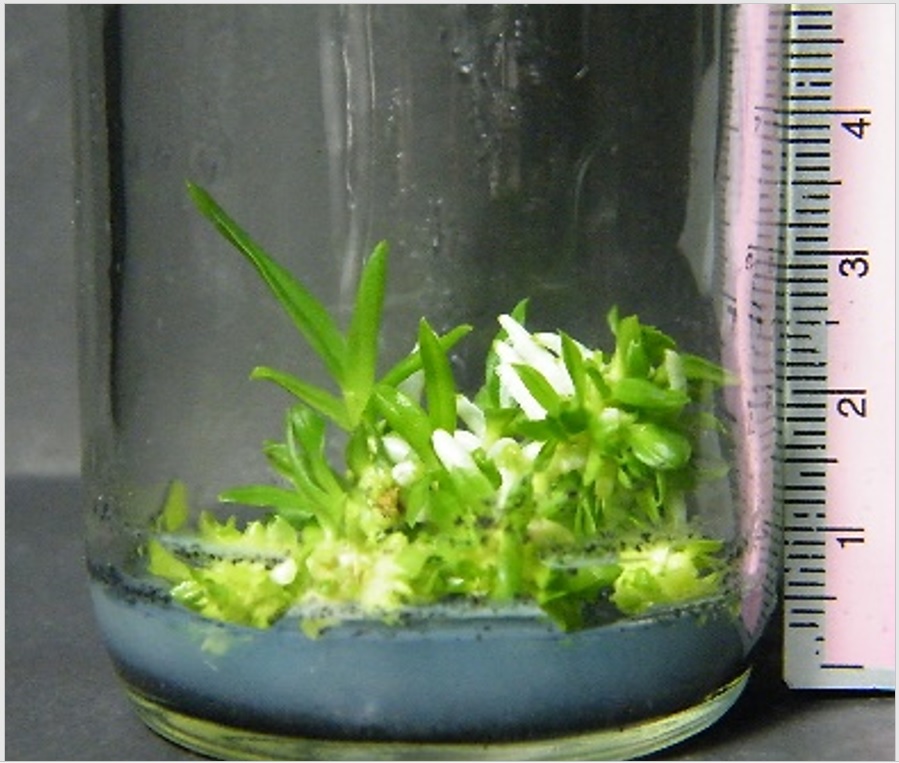
ผลการวิจัย : หลังการเพาะเลี้ยงเป็นเวลา 12 สัปดาห์ พบว่า สูตร VW มีประสิทธิภาพสูงสุด โดยชักนำให้เกิดยอดสูงสุดร้อยละ 13.33 และมีจำนวนยอดเฉลี่ย 1.23 ยอดต่อต้น ซึ่งแตกต่างอย่างมีนัยสำคัญทางสถิติ (p≤0.05) เมื่อเทียบกับสูตรอื่น ๆ มีจำนวนใบเฉลี่ยสูงที่สุด 4.46 ใบต่อต้น รวมถึงมีความสูงต้นอ่อนเฉลี่ยสูงที่สุด 0.94 เซนติเมตรต่อต้น ขณะที่การเลี้ยงต้นอ่อนเอื้องเข็มแดงบนสูตรอาหาร VW ที่เติมสารกลุ่มออกซิน พบว่า IAA ความเข้มข้น 0.5 มิลลิกรัมต่อลิตร ชักนำให้เกิดยอดสูงสุดร้อยละ 40 มีจำนวนยอดเฉลี่ยสูงสุด 1.70 ยอดต่อต้น และเกิดแคลลัสสูงสุดร้อยละ 20 ซึ่งแตกต่างอย่างมีนัยสำคัญทางสถิติเมื่อเทียบกับสูตรอื่น ๆ รวมถึงชักนำให้เกิดโปรโทคอร์มสูงสุดร้อยละ 25 มีจำนวนโปรโทคอร์มเฉลี่ย 2.45 โปรโทคอร์มต่อต้น ขณะที่การเลี้ยงต้นอ่อนเอื้องเข็มแดง บนสูตรอาหาร VW ที่เติมสารกลุ่มไซโทไคนิน พบว่า อาหารที่เติม BA 0.5 มิลลิกรัมต่อลิตร ชักนำให้เกิดยอดสูงสุดร้อยละ 35 มีจำนวนยอดเฉลี่ยสูงสุด 1.55 ยอดต่อต้น และมีจำนวนใบเฉลี่ยสูงสุด 5.35 ใบต่อต้น รวมถึงการเลี้ยงต้นอ่อนเอื้องเข็มแดงบนสูตรอาหาร VW ที่เติมไคโทซาน 100 มิลลิกรัมต่อลิตร พบว่า มีร้อยละการเกิดยอด ได้สูงร้อยละ 35 มีจำนวนยอดเฉลี่ยสูงสุด 3.50 ยอดต่อต้น มีจำนวนรากเฉลี่ยสูงสุด 4.95 รากต่อต้น และมีจำนวนโปรโทคอร์มเฉลี่ยสูงสุด 2.10 โปรโทคอร์มต่อต้น ผลการวิจัยนี้เป็นพื้นฐานทางวิทยาศาสตร์สำคัญสำหรับการพัฒนาวิธีการขยายพันธุ์เอื้องเข็มแดงในสภาพปลอดเชื้อ เพื่อการอนุรักษ์และการขยายพันธุ์ปริมาณมากของพืชหายากชนิดนี้
สรุปผลการวิจัย : การวิจัยนี้ประสบความสำเร็จในการขยายพันธุ์ที่มีประสิทธิภาพสูงสำหรับเอื้องเข็มแดง โดยการใช้อาหารสูตร VW ร่วมกับไคโทซาน 100 มิลลิกรัมต่อลิตร ซึ่งจะช่วยให้สามารถผลิตต้นกล้าคุณภาพดีในปริมาณมากได้อย่างรวดเร็ว วิธีการนี้เป็นเครื่องมือสำคัญสำหรับการอนุรักษ์นอกถิ่นกำเนิด ช่วยในการผลิตพืชเพื่อนำกลับคืนสู่ป่าหรือเพื่อการค้าในเชิงพาณิชย์อย่างยั่งยืน ซึ่งสามารถช่วยลดอัตราการลักลอบเก็บกล้วยไม้เอื้องเข็มแดงจากธรรมชาติได้ และส่งเสริมการอนุรักษ์ความหลากหลายทางชีวภาพของกล้วยไม้ได้อย่างยั่งยืน
เอกสารอ้างอิง
Aktar, S., Nasiruddin, K. M., & Huq, H. (2007). In vitro root formation in Dendrobium orchid plantlets with IBA. Journal of Agriculture & Rural Development, 5, 48-51.
Arditti, J. ,& Harison, C.R. (1977). Vitamin requirements and metabolism in orchid. In Orchid Biology: Reviews and Perspectives I, (pp. 159-175). Edited by Joseph Arditti. Ithaca: Cornell University Press, 1977.
Arditti, J., & Ernst, R. (2008). Micropropagation of orchids. (2nd ep). Singapore: COS Printers Pte Ltd.
Bhadra, S. K., & Hossain, M. M. (2003). In vitro germination and micropropagation of Geodorum densiflorum (Lam.) Schltr., an endangered orchid species. Plant Tissue Culture, 13, 165-171.
Borasee, B. , & Theanhom, A. A. (2014). In vitro seed germination and seedling development of Rhynchostylis coelestis. Khon Kaen Agriculture Journal, 42(3), 524-528. (in Thai)
Boonkerd, N., Chandrkrachang, S., & Stevens, W. F. (1996). Effect of chitin on nodulation and N2 fixation rhizobia-soybean symbiosis, chitin and chitosan. Proceedings of the Asia Pacific Symposium, Bangkok. (pp.183- 187.)
Chamchumroon, V., Suphuntee, N., Tetsana, N., Poopath. , & Tanikkool, S. (2017). Threatened Plants in Thailand. Bangkok: Omega Printing Co., Ltd.
Chuengpanya, R., Muangkroot, A., Jenjittikul, T., Thammasiri, K., Umpunjun, P., Viboonjun, U. , & Chuenboonngarm, N. (2022). In vitro propagation and genetic fidelity assessment of Hedychium longicornutum Griff. ex Baker, a vulnerable zingiberaceous plant of Thailand. Current Applied Science and Technology, 22(6), 1-21.
Chunraspan, S. (2003). Plant Tissue Culture. Department of Biology, Faculty of Science, Udon Thani Rajabhat University. (in Thai)
Coello, C. Y., Miceli, C. L., Dendooven, L., & Gutierrez, F. A. (2010). Plant growth regulators optimization for in vitro cultivation of the orchid Guarianthe skinneri (Bateman) Dressier & W.E. Higgins. Gayana botanica, 67(1),19-26.
Das, M. C., Kumaria, S., & Tandon, P. (2008). In vitro propagation and conservation of Dendrobium lituiflorum Lindl. through protocorm-like bodies. Journal of Plant Biochemistry and Biotechnology, 17, 177-180.
Dasri, K., Munglue, P., Rattana, K., & Sangchanjiradet, S. (2006). The effect of IAA produced by Bacillus pumilus on growth of orchid under micropropagation. Khon Kaen Agricultural Journal, 44(1), 832-837.
Duncan, D. B. (1955). Multiple range and multiple F test. Biometrics, 11, 1-42.
Dzung, N. A. (2005). Application of chitin, chitosan and their derivatives for agriculture in Vietnam. Journal of Chitin Chitosan, 10(3), 109–113.
Faengmuang, W., & Kongbangkerd, A. (2012). Effect of plant growth regulators on growth and development of Dendrobium lamellatum Lindl. in vitro. In Proceedings of the 1st Phayao Research Confarence. (pp.96-102.). Thailand: Phayao. (in Thai).
Fay, M.F., Andriamahefarivo, L., Bachman, S.P., Brown, M.J.M., Calevo, J., Campbell, T., Charitonidou, M., Dixon, K.W., Droissart, V., Forest, F., Hinsley, A.E., Kumar, P., Le Breton, T., Rajaovelona, L.R., Ramandimbisoa, B. Rankou, H., Schuiteman, A., Sharma, J., Simo-Droissart, M., Smidt, E.C., Stévart, T., Svahnström, V.J., Verlynde, S., & Zimmer, H.C. (2025). How threatened are orchids? A review of the state of play and identification of gaps and priorities. Biodiversity and Conservation, 34, 5075–5115.
Gupta, A. (2016). Asymbiotic seed germination in orchids: role of organic additives. International Advanced Research Journal in Science, 3(5), 143-147.
Heikrujam, J., Kishor, R., & Mazumder, P. B. (2017). In vitro propagation of the endemic orchid Ascocentrum ampullaceum (Roxb.) var. auranticum pradhan. International Journal for Science and Advance Research in Technology, 3, 462-467.
Hirano, S. (1999). Chitin and chitosan as novel biotechnological materials. Polym International ,48, 732-734.
Hossain, M. M., Sharma, M, Teixeira da Silva, J. A., & Pathak, P. (2010). Seed germination and tissue culture of Cymbidium giganteum Wall. ex Lindl. Scientia Horticulturae, 23, 479–487.
Hutchinson, J. F., Beardsel, D. V. l., & Comb, J. A. M. (1985). Propagation by tissue culture introduction. In Horticulture of Australian Plants. (pp. 38-52). Western Australian. Dept. Agriculture: South Perth, W.A.
Ieamkheng, S., & Noosawat, S. (2012). Effect of chitosan on in vitro growth and development of Dendrobium moschatum. In The 9th National Kasetsart University Kamphaeng Saen Conference. (pp. 2206-2212).(in Thai)
Indhamusika, S. , & Watthana, S. (2013). Plant of Thailand Orchid 3. Chiang Mai: The Botanical Garden Organization. Ministry of Natural Resources and Environment. (in Thai).
Islam, S. S., & Bhattacharjee, B. (2015). Plant regeneration through somatic embryogenesis from leaf and root explants of Rhynchostylis retusa (L.) Blume. Applied Biological Research, 17, 158-165.
Jandee, A., Bundithya, W., & Potapohn, N. (2021). In vitro seed culture of Dendrobium peguanum Lindl. Journal of Agriculture, 37(2), 149-157.
Janarthanam, B., & Seshadri, S. (2008). Plantlet regeneration from leaf derived callus of Vanilla planifolia Andr. In Vitro Cellular and Developmental Biology – Plant, 44, 84–89.
Kalawong, S., Yimyong, P., Rittirat, S., Suwanno, S., & Siangsuepchart, A. (2020). Effects of culture media, sucrose and chitosan concentrations on Dendrobium palpebrae Lindl. Micropropagation.Khon Kaen Agriculture Journal, 48(2), 395-404. (in Thai)
Khatun, M. M., Khatun, H., & Khanam, D. (2010). In vitro root formation and plantlet development in Dendrobium Orchid. Bangladesh Journal of Agricultural Research, 35(2), 257-265.
Krotsan, J., Soonthornkalump, S.,& Kaewubon, P. (2019). Asymbiotic seed germination and protocorm Development enhancing by chitosan treatment in Coelogyne brunnea Lindl. (Orchidaceae). Khon Kaen Agriculture Journal, 47(1), 141-150. (in Thai)
Malerba, M., & Cerana, R. (2016). Chitosan effects on plant systems. International Journal of Molecular Sciences, 17, 1-15.
Maneerattanarungroj, C., Laywisadkul, S., & Kongbangkerd, A. (2011). Tissue culture of Bulbophyllum affine Lindl. NU Science Journal, 7(2), 45-59. (in Thai)
Mongkolsawat, W. , & Punjansing, T. (2016). In vitro propagation of Liparis regnieri. Journal of Research and Development Buriram Rajabhat University, 11, 118-123. (in Thai)
Murashige, T. , & Skoog, F. (1962). A revised medium for rapid growth and bioassays with tobacco tissue cultures.Physiologia Plantarum, 15(3), 473-497.
Nakamura, T., Nakayama, N., Yamamoto, R., Shimamura, S., Kim, Y., Hiraga, S., Ohyama, T., Komatsu, S., & Shimada, S. (2010). Nitrogen utilization in the supernodulating soybean variety “Sakukei 4” and its parental varieties, “Enrei” and “Tamahomare”. Plant Production Science, 13(2), 123-131.
Nanakorn, W., & Watthana, S. (2008). Queen Sirikit Botanic Garden (Thai Native Orchids 1). Chiang Mai: Wanida Press. (in Thai).
Nasib, A., Ali, K., & Khan, S. (2008). An optimized and improved method for the in vitro propagation of kiwifruit (Actinidia deliciosa) using coconut water. Pakistan Journal of Botany, 4(1), 2355-2360.
Neumann, K.H., Kumar, A.. & Imani, J. (2009). Plant Cell and Tissue Culture - A Tool in Biotechnology Basics and Application. Springer-Verlag. Berlin Heidelberg, 16(2), 1377-1378.
Novak, S. D., Luna, L. J., & Gamage, R. N. (2014). Role of auxin in orchid development. Plant Signaling & Behavior, 9(10), e972277-1 - e972277-8.
Obsuwan, K., & Sawangsri, K. (2010). The effect of chitosan on growth of Dendrobium Queen Pink in tissue culture. Agricultural Sciences Journal, 41(3), 477-480. (in Thai)
Pornpienpakdee, P., Pichyangkura, R., Chadchawan, S., & Limanavech, P. (2005). Chitosan effects on Dendrobium “Eiskul” protocorm-like body production. Congress on Science and Technology of Thailand at Suranaree University of Technology, 31, 18-20. (in Thai)
POWO (2025) Plants of the World Online. Facilitated by the Royal Botanic Gardens, Kew.Retrieved from https://powo.science.kew.org/
Prasertsongskun, S. (2009). Plant tissue culture and plant breeding. (2nd ed.). Bangkok: Forepace publishing house. (in Thai).
Prasertsongskun, S., & Chaipakdee, W. (2011). Effect of chitosan on growth and development of Phalaenopsis cornucervi (Breda) Blume & Rchb.f. Khon Kaen University Science Journal, 39(1), 113-119.
Putalun, W. (2014). Tissue culture technology for medicinal plants: from basics to pharmaceutical applications. Khon Kaen: Khon Kaen pimpattana CO., LTD. (in Thai).
Razdan, M.K. (2002). Introduction to plant tissue culture. (2nd ed.) USA: Science Publishers.
Rahman, M.S., Hasan, M.F., Das, R., Hossain, M.S., & Rahman, M. (2009). In vitro micropropagation of orchid (Vanda tessellata L.) from shoot tip explant. Journal of Biological Sciences, 17, 139-144.
Ritti, W., Chourykaew, B., Phrombangyuan, P., & Thaksin, S. (2016). Effect of chitosan on growth and Development of in vitro seedling of Panisea uniflora(Lindl.) Lindl. Songklanakarin Journal of Plant Science, 3(4), 8-13. (in Thai)
Ritti, W., Chourykaew, B., & Sreenamkhum, O. (2018). Effect of chitosan on growth of in vitro seedling culture of Dendrobium lindleyi Steud. Burapha Science Journal, 23(2), 669-681. (in Thai)
Roy, A. R., Sajeev, S., Pattanayak, A., & Deka, B. C. (2012). TDZ induced micropropagation in Cymbidium giganteum Wall. Ex Lindl. and assessment of genetic variation in the regenerated plants. Plant Growth Regulation, 68, 435-445.
Santarunai. N. (2016). Effect of medium on growth of orchid (Dendrobium friedericksianum Rchb.f.) in vitro. Master of Science Thesis. Burapha University. (in Thai)
Sawhney,R. K., Tiburcio, A. F., Altabella, T., & Galston, A. W. (2003). Polyamines in plants: An overview. Journal of Cell and Molecular Biology, 2, 1-12.
Senavongse, R., Saensouk, P., & Saensouk, S. (2014). In vitro tissue culture of Dendrobium kontumense Gagnep. Khon Kaen University Research Journal, 19(3), 399-413. (in Thai)
Shreetiet, R., Kong, F., & Khanam, D. (2013). In vitro propagation of orchid, Dendrobium densiflorum Lindl. through mature seed culture. South African Journal of Botany, 112, 521-526.
Silayoi, B. (2015). Banana (4th ed.). Bangkok: Kasetsart University Press. (in Thai)
Sitthisatchatham, S. (2007). Wild Orchid of Thailand (4th ed). Bangkok: Bann Lae Suan.
Sitthisatchatham, S. (2015). Orchid (1st ed). Bangkok: Sarakadee Press.
Sitthisatchatham, S. , & Triphet, P. (2009). Wild Orchid of Thailand 2. Bangkok: Bann Lae Suan.
Stewart, S. L., & Kane, M. E. (2006). Asymbiotic seed germination and in vitro seedling development of Habenaria macroceratitis (Orchidaceae), a rare Florida terrestrial orchid. Plant Cell, Tissue and Organ Culture, 86, 147–158.
Street, H. E. (1977). Plant tissue and cell culture (2nd ed). California: University of California Press.
Subthira, T., Suntaranond, S., & Bunnag, S. (2013). Effects of Plant Growth Regulator on in vitro culture of Dendrobium aphyllum (Roxb.) Fischer. Khon Kaen University Research Journal (Graduate Student), 13(1), 1-13. (in Thai)
Sunpapao, A. ,& Pornsuriya, C. (2014). Effects of chitosan treatments on para rubber leaf fall disease caused by Phytophthora palmivora Butler - a laboratory study. Songklanakarin Journal of Science and Technology, 36(5), 507-521. (in Thai)
Supinrach, S., & Supinrach, I. (2014a). Effects of IBA and NAA on Rooting for the Orchid Plantlet Rhynchostylis gigantea (Lindl.) Ridl. ‘Cartoon’. Thai Science and Technology Journal, 22(4), 507-514. (in Thai)
Supinrach, S., & Supinrach, I. (2014b). Effects of BA and NAA on In Vitro Growth of Dendrobium lindleyi Steud.Seedlings. Burapha Science Journal, 19(2), 84-92. (in Thai)
Taji, A. M., & Williams, R. R. (1996). Tissue culture of Australian plants. Australia: University of New England Press.
Tantasawat, P., & Waranyuwut, A. (2008). Plant tissue culture laboratory manual. Bangkok: Agentech CO., LTD. (in Thai)
Tao, J., Yu, L., Kong, F., & Zhao, D. (2011). Effects of plant growth regulators on in vitro propagation of Cymbidium faberi Rolfe. African Journal of Biotechnology, 10(69), 15639-15646.
Techapinyawat, S. (2011). Plant physiology. Bangkok: Chamchuree products Co., Ltd. (in Thai)
Thaitong, O. (2003). Orchid of Thailand (4th ed.). Bangkok: Amarin Printing & Publishing Public Company Limited. (in Thai)
Tikendra, L., Singh, A.R., Vendrame, W.A., & Nongdam, P. (2025). In vitro propagation of endangered Vanda coerulea Griff. ex Lindl.: asymbiotic seed germination, genetic homogeneity assessment, and micro-morpho-anatomical analysis for effective conservation. Agronom, 15, 1-28.
Thammasiri, K. (2016). Thai Orchid Genetic Resources and Their Improvement. Horticulturae, 2(9), 1-13.
Trigiano, R. N. ,& Gray, D. J. (2004). Plant development and biotechnology. USA: CRC Press LLC.
Utami, E. S. W., Hariyanto, S., & Manuhara Y. S. W. (2017). In vitro propagation of the endangered medicinal orchid, Dendrobium lasianthera J.J.Sm through mature seed culture. Asian Pacific Journal of Tropical Biomedicine, 7(5), 406 - 410.
Vacin, E., & Went, F. (1949). Some pH changes in nutrient solutions. In: C.L. Withner (ed.). The Orchids Survey. New York: Ronald Press. 589-599.
ดาวน์โหลด
เผยแพร่แล้ว
รูปแบบการอ้างอิง
ฉบับ
ประเภทบทความ
สัญญาอนุญาต
ลิขสิทธิ์ (c) 2026 คณะวิทยาศาสตร์ มหาวิทยาลัยบูรพา

อนุญาตภายใต้เงื่อนไข Creative Commons Attribution-NonCommercial-NoDerivatives 4.0 International License.
Burapha Science Journal is licensed under a Creative Commons Attribution-NonCommercial-NoDerivatives 4.0 International (CC BY-NC-ND 4.0) licence, unless otherwise stated. Please read our Policies page for more information